
Long-term capital has more than one clock. Returns arrive over years. Benefit payments, capital calls, collateral requirements and statutory measurement dates fall due on particular days. An institution's horizon is not the date on its mandate — it is the earliest date on which it must be able to act.
Two funds published evidence of that distinction this week, and they bought opposite instruments.
A Dutch retail-sector pension fund has protected the great majority of its developed-market equity book with long put options, ahead of two dates: the one that decides whether its members get a full inflation increase in January, and the conversion of its scheme a few weeks later. The UK's nuclear decommissioning fund — which has already paid about £3 billion of a bill running into the next century — handed Brookfield an initial $1 billion designed to compound rather than distribute. Britain's largest workplace scheme used the same week to press other Mansion House signatories to move faster into private markets. And four managers closed €12 billion, $4.0 billion, $1.3 billion and €1.2 billion of vehicles built so a long-horizon owner can take the exposure without buying anything.
Four answers to one question: what do you do about a liability you cannot trade out of?
A pension fund at 143.7 per cent funded bought insurance — and the nearer date is not the famous one
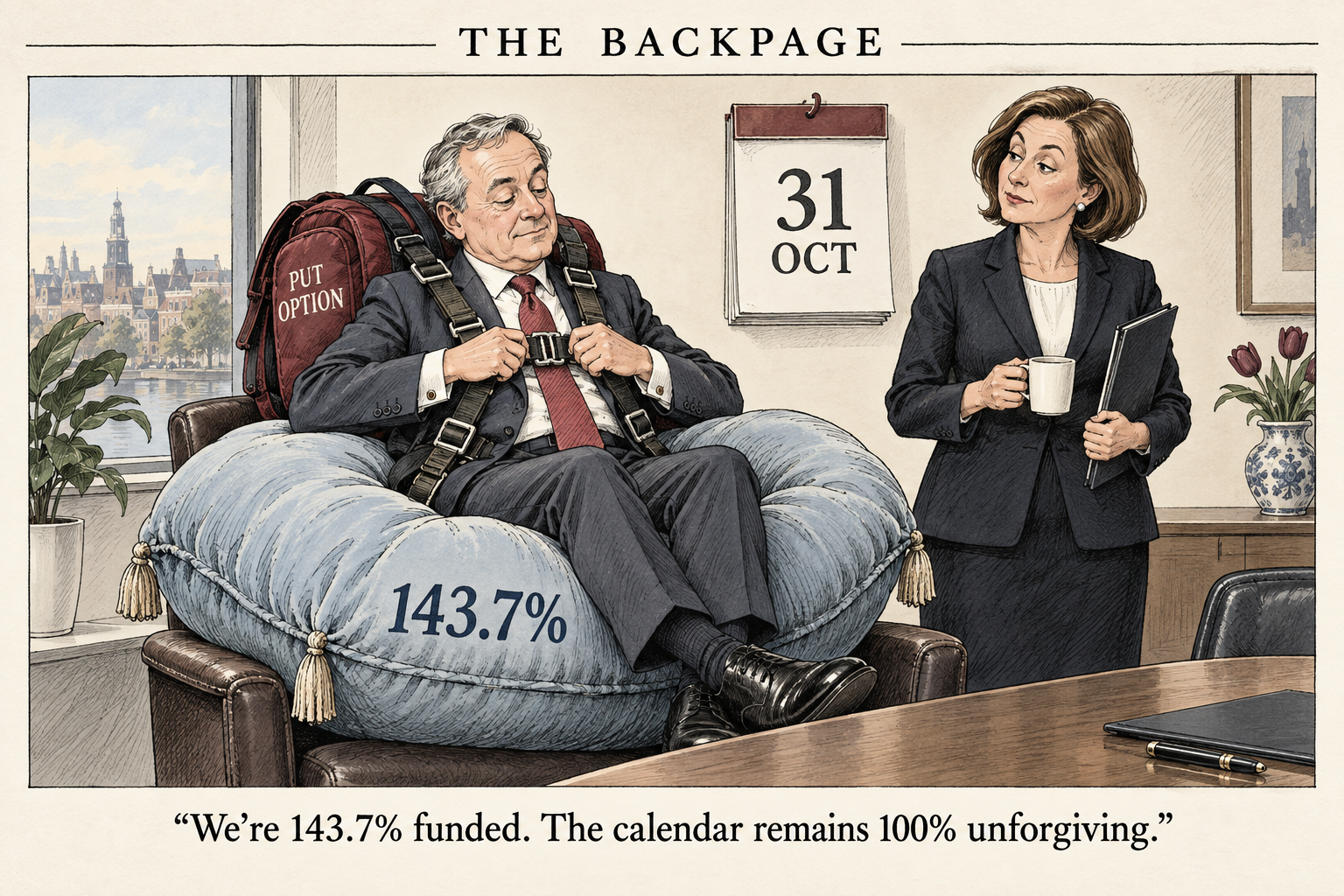
Pensioenfonds Detailhandel, the industry-wide scheme for Dutch retail workers, has protected approximately 80 per cent of its developed-market equity portfolio with long put options ahead of its transition to the new Dutch pension arrangement. Its coverage ratio was 143.7 per cent at end-July; its policy coverage ratio — the twelve-month average that governs decisions — was 136.3 per cent. Equities were 32.2 per cent of the portfolio, of which 84 per cent developed markets. The rest of the investment policy is unchanged.
In the fund's own words, the measures "work as a safety net: in sharp price falls they offer extra protection, while the fund can simultaneously continue to profit if markets develop favourably."
Two qualifications belong beside those figures.
First, what the notional does and does not tell you. Hedging 80 per cent of a developed sleeve that is 84 per cent of a 32.2 per cent equity allocation covers about two-thirds of total equity risk and a little over a fifth of the fund. That is the size of the position. It is not a measure of protection: the disclosure specifies no strikes, maturities or premiums, and an 80 per cent notional struck far out of the money and one struck near the money are the same sentence describing different portfolios.
Second, personal pension capital is not the end of collective arrangements. The fund's participant material states that under the new arrangement investments remain collective, risks continue to be shared, and a solidarity reserve helps moderate pension fluctuations. What changes at conversion is that capital is allocated to individual accounts. Risk-sharing does not simply cease, and any version of this story that says it does is wrong in the direction that makes the story sound better.
So what is the fund protecting? Start with the nearer date.
Under the fund's own indexation policy, the policy coverage ratio measured on 31 October determines whether pensions are increased the following January. Above roughly 110 per cent, partial indexation is permitted. Above approximately 139 per cent, the fund may increase pensions fully in line with prices. The policy ratio is 136.3 per cent — inside the partial band, roughly two and a half points short of full inflation protection for members, with the measurement date seven weeks away.
That is where twelve-month averaging stops being a technicality. A sharp equity fall in September or October does not merely dent a spot number that recovers by December. It enters the average struck on 31 October, and that average decides January's increase.
The supervisory floor sits far below: De Nederlandsche Bank requires the policy ratio to be at least 105 per cent, and the fund has had no recovery plan since 2022. Protection is being bought from a position of strength, in advance, which is the only time it is affordable.
Then the conversion. At transition, capital is allocated to individual accounts. A drawdown in the weeks around that allocation is not absorbed by a future collective surplus in the way it would have been before; the mark date is the allocation, and cohorts are affected differently depending on when it falls.
Why it matters to a universal owner. Neither is a view that equities are expensive. Both are recognition that a scheme's capacity to absorb a loss changes on calendar days it does not control. Every fund approaching a conversion, a wind-up, a buy-in quotation, a benefit vote, an indexation test or a fiscal-transfer date faces a version of the same problem, and most have never priced it.
The other side, stated fairly. At 143.7 per cent a scheme can argue the buffer is the insurance and the premium is a transfer from members to a dealer. Reserves and the risk-sharing that survives the transition may already absorb an acceptable range of outcomes. A hedge can protect the wrong exposure if it is built around a market index rather than the rules governing the indexation test and the conversion. And most of this fund's peers disagree: analysts at ING note that although equity options are theoretically effective steering tools, most Dutch funds are expected to rely on interest-rate swaps instead, on cost and complexity grounds. Detailhandel is the outlier, not the template.
And rates need their own calculation. Holding promised cash flows constant, a lower yield raises the present value of liabilities. Whether the ratio deteriorates depends on how assets and hedges respond too — a bond rally lifts both sides, and the relative sensitivities decide it. An equity put is silent on that path.
A fund with a bill running into the next century bought the opposite instrument
The UK Nuclear Liabilities Fund — which exists to meet the cost of decommissioning eight of Britain's nuclear power stations — selected Brookfield's Investment Solutions Group for a multi-decade multi-asset mandate with an initial $1 billion, roughly £750 million, against total fund assets of about £20.7 billion, following a competitive process. Announced 8 September. Capital is to be deployed across infrastructure, energy, private equity, real estate and private credit, through funds, direct investments and co-investments, with proceeds expected to be reinvested rather than routinely distributed.
The detail that reframes it: the fund has already paid approximately £3 billion toward decommissioning, and the work is expected to extend into the next century.
Detailhandel and the Nuclear Liabilities Fund have the same underlying problem and bought opposite instruments, and both are defensible, because the liabilities are different shapes. Detailhandel's exposure concentrates on dates it can name. The nuclear fund's obligation runs for generations — but it also requires payments today, which is the fact an outside reader is most likely to miss about a fund with "nuclear liabilities" in its name. The relevant horizon belongs to each part of the cash-flow schedule, not to the final date on the mandate.
For a public-purpose fund with both distant obligations and current spending, a reinvestment portfolio can support compounding if other assets cover the intervening payments. That is a portfolio design choice and should be described as one. The announcement does not establish a contractual prohibition on withdrawals, protection against future government decisions, or a guaranteed reduction in taxpayer exposure. No mandate document is public.
Three notes on the manager. The Investment Solutions Group was established last year to serve institutional, private-wealth and family-office clients; it is chaired by Howard Marks and led by Alper Daglioglu; and it is part of Brookfield building a business that assembles and sells multi-asset portfolios. The Nuclear Liabilities Fund has not bought five strategies. It has bought one relationship containing five.
The other side. An initial billion is a fraction of the liability and the mandate names no target size. Locking capital into private markets across decades is precisely the posture that creates a liquidity problem if costs inflate, work is brought forward or the spending schedule is revised — and a structure oriented against distribution also resists it when distribution is correct. Concentrating five strategies with one manager simplifies oversight and concentrates it at the same time.
For trustees overseeing anything similar, the board paper should connect three schedules — expected liability payments, liquid assets available to meet them, and the dates on which private investments can reasonably return cash — and show what changes if costs rise while realisations slow.
Britain's largest workplace scheme told the market to catch up — and the local pools wrote the cheque
Nest's chief investment officer, Liz Fernando, said on 9 September that the scheme has delivered on its Mansion House commitments and pressed other signatories to follow. Nest runs about a fifth of its assets in private markets against an Accord floor of 10 per cent by 2030, with a stated ambition of 30 per cent by 2030. Its annual report shows £13 billion invested in the UK economy, about a fifth of £62.9 billion of net assets.
This is not a new cheque. It is an already-hit target converted into pressure on the rest of the defined-contribution market. Read it as a governance event.
The harder fact. Clean Growth Fund II held a second close at £81.5 million against a £150 million target, anchored by £22.5 million from Border to Coast Pensions Partnership's UK Opportunities Fund, with Strathclyde Pension Fund adding £10 million to take its Fund II total to £30 million; Islington and East Riding pension funds are also investors. Those amounts are included in the announced close, not additional to it. Seed-to-Series A UK climate technology; roughly 25 companies planned, four backed — Sheffield, Bristol, Cardiff and London, across battery technology, food, heavy industry and buildings. The manager's 20 per cent net IRR is a target, not a forecast or an achieved result. The fund remains below its fundraising target, so the close is not a completed investment programme.
Why the two belong together. This is a two-speed productive-finance market. The state-backed DC scheme is at a fifth of assets and pressing its peers; a handful of local-government pools are writing small, named, early-stage cheques; and the programme's measured progress, on the ABI's own tracking, is default-fund unlisted equity rising from £793 million to £1.6 billion — from 0.36 per cent to 0.6 per cent of roughly £268 billion of defaults. Border to Coast pools for eighteen partner funds, expanded from eleven in April 2026.
The observation that carries the section. The same pension system consulting on thinner statutory reporting for listed companies is placing new transition exposure into a limited-partnership agreement. Those are two different control technologies. A proxy vote is cheap, standardised and weak. A fund agreement is expensive, bespoke and negotiated. They are not ranked — an LP's information and consent rights depend entirely on terms nobody outside has read. What is observable is that owners are increasingly choosing the second where the first has thinned.
The other side. £22.5 million and £10 million are small tickets, deliberately so. Venture carries technology failure, weak unit economics, dilution and dependence on policy or later investors. And one successful close does not establish that origination capacity, rather than available capital, is the binding constraint across the UK market — an appealing generalisation the evidence does not support.
Four closes, and not one of them was a purchase
Four vehicles aimed at pensions, insurers and sovereign investors printed final or platform closes.
ICG Europe Fund IX — €12 billion final close, 50 per cent larger than its predecessor, oversubscribed with the hard cap held, and 22 per cent deployed across six investments. The release's stated investor components do not reconcile to the accepted total, differing by several hundred million euros; this edition prints the accepted close and omits the components rather than inventing an explanation. ICG's "largest globally" characterisation, citing Preqin, is the manager's and is left with the manager.
EIG Senior Infrastructure Debt Fund VI — $1.9 billion, nearly double its predecessor, with $2.1 billion in single-investor vehicles taking the platform to $4.0 billion against a $3 billion target. About $1 billion committed across 16 investments since July 2024. EIG attributes the raise to demand for customised and evergreen exposure — the separate accounts are larger than the fund.
EnTrust Global Blue Ocean Income Fund IV — $1.3 billion, the fourth vintage of a rated-notes fund for insurance investors, principally in the United States, explicitly offering a more capital-efficient way to access the underlying maritime strategy. Strategy capital reaches $5.0 billion since 2023 and $7.6 billion since 2017.
BNP Paribas AM Alts European Junior Infrastructure Debt Fund II — approximately €1.2 billion, above target, European and Asian investors including re-ups; close to ten investments since August 2024, predominantly energy transition, green mobility and digital infrastructure. Announced 7 September.
These are four fund closes in two currencies across debt and structured equity — a deal tape, not a trend number, and deliberately not added up.
Why it matters. Not one is a sovereign or a pension buying an operating company. All four are duration products, engineered so a long-horizon owner can take the exposure without signing a share-purchase agreement — and, in EnTrust's case, so an insurer's allocation reports as a note rather than a ship.
The mechanism, working as intended. EnTrust's own language is the clearest evidence: a rated note exists because insurance capital rules make certain direct holdings uneconomic. The wrapper is not obfuscation; it is what makes the allocation permissible at all. The same is true of evergreen separate accounts, which let an investor size to its own pacing rather than a fund's.
The concern, at the width the evidence supports. Not that packaging conceals, and not that any of these managers is doing anything other than solving a real constraint. It is that one owner can hold the same underlying economic exposure through several instruments that will not reprice at the same time or in the same place — structured equity, infrastructure debt, a rated note and an insurance-capital allocation, in different buckets, under different governance regimes, marking on different schedules. That is a look-through and valuation-lag question. It is answerable, which is why it belongs on an agenda rather than in an accusation.
The other side. Four unrelated managers in three jurisdictions raised into genuine demand. Senior infrastructure debt does sit higher in the structure than the equity beneath it. A manager that declines to raise a hard cap is exercising restraint. And a re-up figure is a commitment measure — it does not establish investor satisfaction, terms or bargaining power, and should not be read as though it did.
What decision it could affect. Not whether any one of these is a good fund. It is: if this packaging is mispriced, on what date do we find out?
Ownership and fiduciary affairs
Britain's reporting consultation: what closes on 30 November
The consultation — published 7 September, open until 30 November, and a proposal, not law — would remove the annual advisory vote on the directors' remuneration report while retaining the binding vote on remuneration policy. It would not eliminate every shareholder vote on pay, and any account saying so is wrong. It would also remove specified strategic-report disclosures, including the separate section 172 statement, while retaining a materiality-based baseline. Removing a reporting statement is not abolishing the underlying directors' duty. Climate-related financial disclosure is being considered separately.
On the government's own estimates, up to 44,000 medium-sized private companies and around 7,000 subsidiaries would no longer produce a strategic report, and approximately 440,000 companies no longer a directors' report.
For institutional investors the practical question is which information and accountability mechanisms become harder to obtain or use. A stewardship team can test it directly: take a sample of holdings, identify the disclosures actually used in investment or voting decisions, map the proposals against them, and establish whether an equivalent source remains. That makes a more persuasive response than defending every existing paragraph.
The government's case deserves weight: more focused reporting can reduce duplication and improve usefulness, and the companies bearing the cost are also assets in the portfolio. The countervailing risk is that discretion produces inconsistent information, and that data currently available to all shareholders must be requested company by company — shifting burden to investors and data providers. That is a transmission mechanism, not a costed estimate.
Nike: a pay package that ISS, Glass Lewis and Norway all opposed still passed
At Nike's annual meeting on 8 September, shareholders rejected a Green Century proposal asking the company to report how it intends to meet its existing science-based emissions targets. Norges Bank Investment Management — Nike's eleventh-largest holder on LSEG data — backed the proposal. Nike has said supply-chain emissions are 11 per cent below a 2015 baseline. Green Century's argument was not that the targets are wrong, but that investors lack the detail needed to judge whether progress is real, repeatable and comparable year to year. Its shareholder advocate, Giovanna Eichner: "It's more that we want to know what's really going on."
The more consequential vote was on pay. Chief executive Elliott Hill received more than $36 million for fiscal 2026. ISS and Glass Lewis both recommended rejection. Norges Bank voted against, arguing the board "should ensure that all benefits have a clear business rationale." The package passed.
That is the datapoint. A remuneration arrangement opposed by both major proxy advisers and by the world's largest single-owner fund still carried — which establishes something measurable about how much of the standard advisory infrastructure translates into outcomes at this company, in this year. An institution relying on that infrastructure to transmit its views should know the size of the gap before deciding whether the next step is a director vote, escalation or acceptance.
The margins are not yet public. Vote percentages appear in Form 8-K, Item 5.07, due within four business days of the meeting — 14 September. Absence of a tally at the time of reporting is a filing sequence, not evidence of conduct.
The other side. A single-year supply-chain figure is a weak basis for conclusions either way. Boards are entitled to argue that incremental disclosure imposes cost without improving decisions, and that a compensation committee closer to the business is better placed than a proxy adviser applying a general framework. A rejected shareholder proposal and an approved pay package at a widely held company are ordinary outcomes.
Jordan installs the other half of the 2026 map
The Jordan Securities Commission launched an ESG Code for ASE20 companies on 9 September. From financial year 2027, issuers apply-and-explain: standalone sustainability reports aligned to IFRS S1 and S2; boards carrying female representation, at least one-third independent directors and sustainability and climate-risk expertise; and five committees covering governance, sustainability, audit, risk, and nominations and remuneration.
Jordan is not a benchmark weight. It is a clean observation: while one major market proposes to rescind a federal climate rule and another proposes to delete statutory environmental and social narrative, a frontier exchange is installing the ISSB standards as listing-adjacent soft law. Apply-and-explain is not comply-or-else, and the test in 2028 is whether the explanations are specific or formulaic. The value is a comparability option, not an enforcement one.
The long horizon: demographics, longevity and liabilities
Detailhandel's hedge answers a dated question. This section is the undated one behind it: the liability side of a long-horizon portfolio moves for reasons that have nothing to do with markets, and it moves on a different clock from the assets.
One — the baseline may already be wrong, in the direction that flatters. Work circulated in August by Jesús Fernández-Villaverde and Patrick Norrick (Terra Incognita: The Economics of a Shrinking World, prepared for the Annual Review of Economics) argues global fertility is already below replacement as of 2026 — they put it at 2.19 or lower against a replacement rate nearer 2.20 than the conventional 2.1 — and that world population peaks around 2056 at roughly 9 billion, against the UN's 10.3 billion in 2084. The decline is not confined to rich countries: their figures put Thailand at 0.87 and Colombia at 1.01. These are the authors' estimates, not a UN revision.
Two — longevity risk may be about variance, not trend. Recent mortality work finds the apparent slowdown in life-expectancy gains is a change in the variance of annual gains rather than the mean. That matters because a scheme that has quietly banked a mortality-improvement slowdown as a liability reduction may have banked noise.
Three — the finding that unsettles the consensus in both directions. NBER work by Acemoglu, Autor, Beirne and Scott finds lower birth rates associated with higher GDP per working-age adult and higher local wage growth, through endogenous labour-saving technical change.
Put them together and the standard demographic haircut is the wrong instrument. Taking 50 to 100 basis points off long-run growth for "demographics" may be too pessimistic about output per worker and far too optimistic about the number of workers paying in. Per-worker output and system solvency can diverge, and a single number cannot represent that.
Two distinctions before any of this enters a model. First, fertility affects future entrants with a long lag; longevity affects how long benefits are paid to people already accruing. One finding cannot be inserted into both calculations. Second, the institutional design decides the exposure: a pay-as-you-go system depends directly on contributions against benefits; a funded pension also has accumulated assets and returns, and its exposure depends on plan design, contribution rules, sponsor strength and the membership population.
The countercase: migration, participation, retirement age and productivity can change the outcome — but they enter as explicit assumptions with realistic timing. Higher productivity does not automatically become higher contributions or tax receipts; the route through wages, profits and public policy matters.
What this means for the portfolio
The cross-owner pattern. Four unrelated institutions made the same category of decision inside one window and bought four different instruments. Detailhandel bought an option across dated tests. The Nuclear Liabilities Fund bought a design oriented against distribution. Border to Coast and Strathclyde bought a negotiated fund agreement. Around ninety new investors in one European fund bought a wrapper. None is primarily a market view. Each is an answer to which risks the institution can afford to keep.
Second-order effects, testable rather than rhetorical. Valuation transparency falls as a larger share of exposure marks quarterly at best. Manager relationships concentrate as single mandates absorb five strategies. And an owner's real exposure becomes harder to read from a holdings file, because one economic exposure can appear under four instrument names in four governance regimes.
The strongest contrary case. Every one of these structures exists because a real constraint made the direct alternative unworkable — a capital charge, a rating requirement, a pacing limit, an origination gap. Packaging that resolves a genuine constraint is a market functioning, not a warning. The reasonable concern is narrower: that the instruments are chosen one at a time, by different teams, against different constraints, with nobody asking what they sum to.
On transferability. These are institution-specific decisions under specific mandates, currencies and regulatory regimes. What generalises is the question, not the trade. No fund should conclude from Detailhandel that it needs equity puts — most of that fund's own peers have concluded otherwise.
The question for the investment committee. On which dates in the next thirty-six months does this institution lose the ability to wait out a mistake — a conversion, an indexation or solvency measurement, a buy-in quotation, a benefit vote, a covenant test, a statutory transfer — and what would it cost today to preserve flexibility through each?
Two refinements make it harder to answer glibly, and both come from this week's evidence.
Identify the measurement date, not the event date. Detailhandel's conversion is 1 January 2027, but the date deciding its members' January increase is 31 October, struck on a twelve-month average. The binding date is often earlier, and quieter, than the one in the board calendar.
Name which of your ratios is the permission. A fund with a spot ratio of 143.7 per cent and a policy ratio of 136.3 per cent has one number that describes it and another that governs it. Committees are rarely wrong about the level. They are frequently wrong about which measure the rulebook reads.
And the answer must identify authority as well as exposure. A portfolio manager can sell a liquid asset; changing a spending rule requires a board or a government. A manager can control investment pace without controlling a portfolio company's next financing round. A trustee can choose a hedge without being able to change the rules that determine what the hedge is protecting.
Geopolitics and chokepoints
What is confirmed. The Panama-flagged New Andros, carrying approximately two million barrels of fuel oil and chartered by the Iraqi Oil Tankers Company as a storage vessel, was struck in Iraqi waters at about 03:00 GMT on 9 September. A fire broke out. Iraq's oil ministry said the vessel was struck by an unknown source, causing minor hull damage, with no injuries among the 22 crew and no leakage of cargo. Maritime security sources suggested initial assessments point to a drone. Attribution has not been established and this edition does not assign it. UKMTO separately reported several merchant vessels hit by disabling fire in the northern Gulf and Gulf of Oman, and a vessel listing at anchor 24 nautical miles from Port Rashid; UKMTO could not confirm casualties or environmental damage, and the incidents should not be conflated.
Why a universal owner reads a shipping incident. Because of who was chartering. This was not an independent owner's hull; it was a storage vessel under charter to an Iraqi state entity. As commercial insurance and charter markets reprice, exposure migrates toward sovereign and state-linked energy balance sheets that cannot decline it. An owner's oil-equity book can be unchanged while its liability book is not: diesel, jet fuel, freight, fertiliser and food price off product cracks and insurance lines, not off the crude benchmark alone.
Declared, not filed. An IRGC spokesman said on 9 September that a restricted zone extends from Chabahar into the Gulf of Oman and the Arabian Sea, with coordinates to be announced later. No coordinates have been published, and Lloyd's List reports the IMO has received no formal proposal. It matters because ship-to-ship transfers and Oman-coordinated lanes east of the strait are what has kept impaired barrels moving. The envelope is drawn over the workaround, not over the strait.
On costs, attributed carefully. At the APPEC conference on 9 September, Emirates National Oil Company director Paul Bradshaw described cargo insurance reaching 5 to 6 per cent of cargo value, additional war-risk charges reaching 10 per cent, and total transit costs in the $10 million to $20 million range, with some participants foregoing insurance and some national oil companies taking shipping in-house. These are one executive's observations of a dislocated market, not a published tariff, and must not be applied to every voyage or vessel class.
The reconciliation this edition owes its reader. The US Energy Information Administration's September outlook, published 9 September, estimates global oil inventories down roughly 400 million barrels so far this year, puts Middle East shut-ins at 6.7 million barrels a day in August and projects 5.7 million a day on average in the fourth quarter, with pre-conflict flows not restored before the second quarter of 2027. That forecast was finalised on 3 September — before the escalation of 8 and 9 September. Pairing any EIA number with this week's prices lifts a number out of its conditional. The October outlook is the trigger; this one is not.
Standing correction. The Strait of Hormuz is impaired, not closed. It has not been closed at any point in this conflict.
Balance sheet and portfolio health
A lower yield raises the present value of liabilities. A funding ratio can fall in a bond rally.
Funding. Pensioenfonds Detailhandel: coverage ratio 143.7 per cent; policy coverage ratio 136.3 per cent at end-July. The gap is where the decision lives, and it generalises. The spot ratio describes the portfolio. The policy ratio — the twelve-month average — governs what the fund is permitted to do, and it sits 7.4 points lower. A trustee reading only the headline would conclude the fund is past its full-indexation threshold of roughly 139 per cent. On the measure that decides January's increase, it is below it. Any institution whose permissions are set by a smoothed or trailing measure has the same asymmetry and should know which number binds before a market move forces the question.
Liquidity and pacing. NEXTDC launched A$1.1 billion of convertible notes due September 2031 with a holder put in September 2029 — its third raise in just over four months — against FY2027 capital-expenditure guidance of A$5.25–5.75 billion, well above FY2026's actual spend. An asset class can be demand-rich and still financing-constrained: capital structure, not customer interest, sets the build rate — and a holder put in 2029 is a refinancing date, not a maturity.
Sovereign and central-bank liquidity. Market participants report the Reserve Bank of India began near-maturity dollar-rupee sell-buy swaps after weak demand for its 30-day reverse-repo operation; September and October forward premiums rose about 2.5 and 4 paise. The RBI has not commented; the transactions are inferred from market activity and are printed as inference. Context that is not inferred: core surplus liquidity peaked at ₹14–15 trillion; banks raised roughly $128 billion of special non-resident deposits; net forward dollar liabilities stood near $137 billion at end-July, with $47.6 billion maturing inside one year. The swaps reverse at short-dated maturity — they do not permanently drain liquidity. The exposure lasts years; the instrument lasts weeks.
The liability curve. Fitch assesses that higher Japanese government-bond yields — the ten-year near 3 per cent, highest since 1996 — may keep more domestic institutional capital at home, with megabanks rebuilding JGB positions and life insurers reinvesting at higher yields. Fitch finds no evidence of a GPIF allocation change. A flow reversal can happen entirely through new-money allocation and reinvestment, without a single forced sale. The marginal buyer moves long before the stock does.
Insurer capital. EnTrust's Blue Ocean IV is an insurer-capital instrument before it is a maritime one — the rated-note wrapper exists to make the allocation work against capital rules. Read alongside the chokepoints section, that is insurance capital taking corridor exposure in a form that reports as credit.
The UAO signal ledger
S-1 · The workaround east of Hormuz becomes commercially uninsurable — DEVELOPING. Verified: New Andros hull damage confirmed by Iraq's oil ministry; UKMTO reports; a named ENOC executive on transit costs. Unknown: attribution for both incidents; whether quoted rates are representative. Evidence against: Iran has repeatedly described an Oman corridor "in final stages"; Lloyd's List reports the IMO has received no proposal. Evidence strength: moderate — one confirmed hull, one named executive, no filed coordinates. Conviction: high on the mechanism. Confirms: a named commercial-flag total loss, or a Joint War Committee listed-area extension east of Hormuz. Kills: transit counts and quotes normalising. Catalyst: the October EIA outlook.
S-2 · Hyperscaler bond supply sets the marginal cost of capital for the build — EARLY OBSERVABLE. Verified: Amazon priced £4.25 billion across four sterling tranches, maturities three to 19 years, final orders above £10.65 billion, its first sterling issue. Unknown: use of proceeds; whether supply widens spreads for utilities or sovereigns. Evidence against: issuers are cash-generative and investment-grade; roughly 2.5-times cover signals capacity, not stress; a book from a different issuer or date does not establish demand strength either way. Strength: strong on the transaction; weak on any sector aggregate. Conviction: medium.
S-3 · Japanese institutional home bias lifts global term premia at the margin — EARLY OBSERVABLE. Verified: 10-year JGB near 3 per cent, highest since 1996; Fitch's assessment; GPIF has not changed its allocation. Evidence against: hedging costs and relative yields remain decisive; Fitch expects no disorderly selling. Strength: moderate. Conviction: medium. Catalyst: monthly MOF flow data.
S-4 · GPIF reopens the 25/25/25/25 allocation — DEVELOPING. Verified: the health minister said on 8 September the fund is "still considering" whether a review is needed, after the fund decided in March it was not; the management committee met on 21 August. Assets about ¥318 trillion; alternatives sit well inside a 5 per cent cap. Unknown: everything that matters — nothing has been decided. Evidence against: the March decision stands; a newspaper column is opinion, not a board minute. An exposure calculation on a stock is not a flow. Conviction: low.
S-5 · Sovereign hidden-debt cases become creditor-coordinated earlier — DEVELOPING. Verified: at least eight fund managers holding Senegalese bonds formed a creditor group and retained White & Case, per four Reuters sources; members unnamed. An IMF staff-level agreement of about $2.2 billion follows identification of previously undisclosed debt — estimates of the amount vary between sources and this edition does not print a single figure. Evidence against: a group and an adviser guarantee neither confrontation nor restructuring. Conviction: medium.
S-6 · Resilience capital expenditure versus distributions at part-pension-owned infrastructure — EARLY OBSERVABLE. Verified: Britain ordered NATS to report within one week on the flight-data failure that halted air-traffic processing on 8 September, with a separate CAA review due within six months; roughly 2,000 flights affected across 8–9 September; Ryanair reported £3 million of losses from 260 cancellations affecting 48,000 passengers.
Ownership, stated precisely, because it is routinely described loosely: the UK government holds about 48.9 per cent with a golden share; The Airline Group 41.9 per cent; LHR Airports 4.2 per cent; an employee trust 5 per cent. Pension money reaches NATS indirectly — USS holds a stake in The Airline Group, whose consortium also includes the Pension Protection Fund. This is a state-controlled asset with pension money inside a minority holding, not a pension-owned utility.
The company has already stated the relevant policy: distributions are set by reference to NERL's free cash flows after investment in airspace infrastructure and operational resilience. Dividends were resumed at £171 million in the year to March 2025, against nil the prior year, having been suspended since November 2019. So the question the report will test is not a rhetorical capex-versus-dividends trade-off. It is whether a stated policy held in practice in the first year distributions resumed.
Evidence against: the transport minister said she does not believe it was a cyberattack; NATS says the cause differed from the August 2023 failure — Ryanair's chief executive alleges repetition, and that dispute is unresolved. Strength: strong on the outage; weak on the governance consequence. Conviction: medium.
Next triggers
Next 24 hours. Today — European Parliament ECON committee scheduled to vote on SFDR II; scheduled is not held. Today — enlarged US long-end Treasury buyback, up to $6 billion in the 10-to-20-year sector. Today, 14:15 CET — ECB decision. 11 September — NBIM New York real-estate investment-manager applications close.
Next 7 days. 12 September — CalPERS legal seats close. 12–13 September — 18th BRICS Summit, Bharat Mandapam, New Delhi; the Philippines' president attends as an outreach invitee in his capacity as ASEAN chair, and the Philippines is not a BRICS member. The commercial item to watch is conversion of the $5.8 billion of pledges made by Indian firms during the August 2025 state visit. Within one week of 9 September — NATS report to the UK government. 14 September — Nike's Item 5.07 filing due. 14–15 September, Toronto — Canada Investment Summit, hosted by the Prime Minister with CPP Investments and PSP Investments. 15 September, 15:00 Gulf Standard Time — AD Ports tender window closes; settlement by 9 October. 17 September — NBIM New York associate portfolio-manager applications close.
Next 30 days and beyond. 24 September — China's president scheduled at the White House. 30 September — PACE plenary takes the committee text on Russian state assets; a committee draft is not law, not an EU regulation, and not a transfer order on Euroclear. 6 October — the EIA's next Short-Term Energy Outlook, and the first to incorporate the escalation. 31 October — Pensioenfonds Detailhandel's policy coverage ratio is measured for January indexation. Later this month — Blackstone's energy-transition fund targets its $8.5 billion hard-cap close. 10 November — California SB 253 first Scope 1 and 2 filings. November — ASEAN's Digital Economy Framework Agreement targeted for signature at the 49th ASEAN Summit; the regional digital economy is on a path to roughly $1 trillion by 2030, with the $2 trillion figure applying only if the agreement is fully implemented. 30 November — UK Modernising Corporate Reporting consultation closes. 1 January 2027 — Detailhandel's intended conversion, subject to supervisory review.
Careers, opportunities and must-attend events
Open searches and live tenders. Manitoba Civil Service Superannuation Board — chief investment officer, Winnipeg, via Boyden; approximately C$13 billion, team of about 16, retirement-driven. Government Employees Pension Service, Korea — ₩100 billion emerging-market bond mandate, two managers sought, opened 10 September.
Capability signal. LAPP Corporation is hiring two managers of investment oversight and research in Edmonton. This is the asset owner staffing independent oversight of its manager — not an origination hire. The Canadian governance tell.
Must-attend. Canada Investment Summit — 14–15 September, Toronto, hosted by the Prime Minister with CPP Investments and PSP Investments.
Moves are omitted this edition: no institutional release was opened for any named appointment, and a posting or profile change supports "the seat is open," never "the person was hired."
The Backpage
— The Universal Asset Owners editorial team
This edition covers institutional developments verified to named sources. It is not investment advice.