
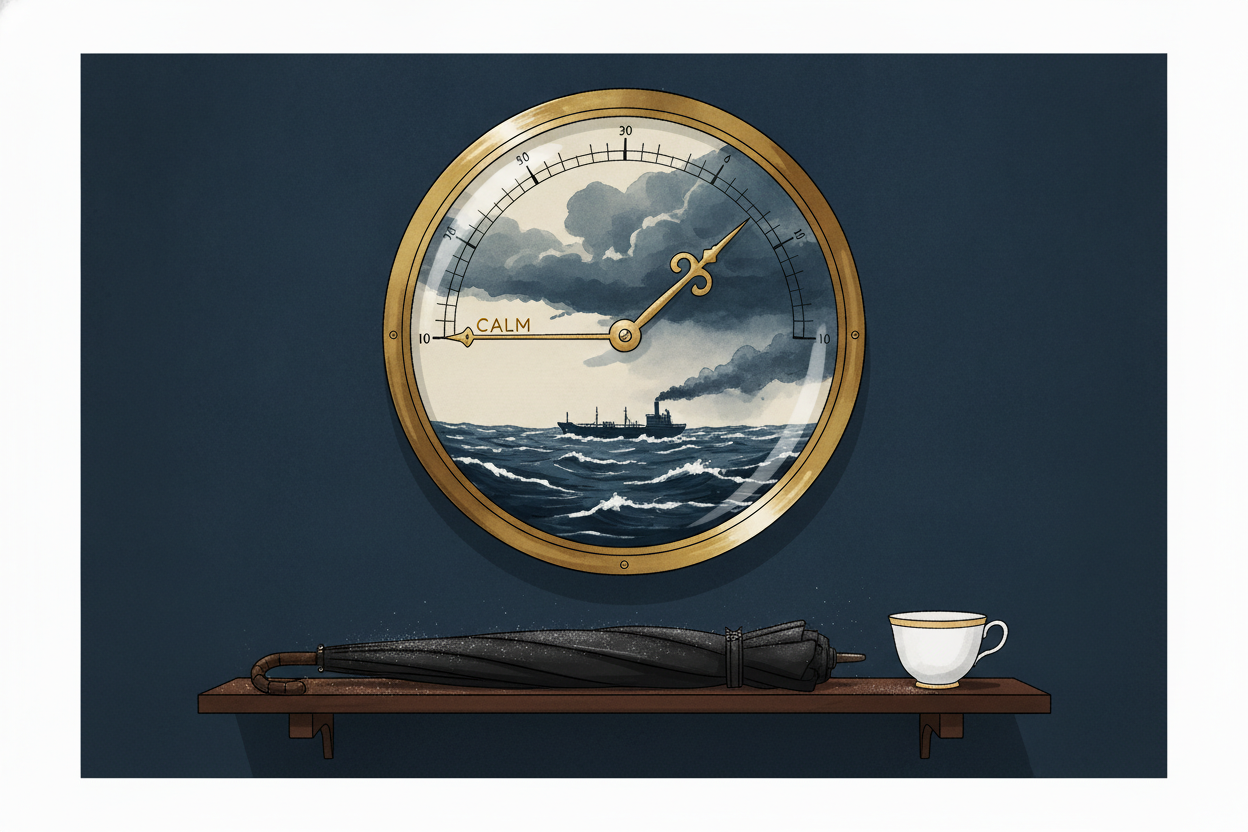
The instruments read calm; the reflection shows the storm.
UAO Deep Dive · Friday, July 17, 2026 · Vol 1, Issue 63 companion
A shooting war is running at the world's most important energy chokepoint, and nearly every instrument that exists to price that fact has gone quiet. This deep dive maps where the risk premium went — and what a universal owner should do when the market stops selling insurance honestly.
I. The facts, laid side by side
Put the physical tape and the financial tape on the same page and the dissonance is the story.
The physical tape, as of Thursday morning: the U.S. military counted its sixth consecutive night of airstrikes on Iran, the latest wave reaching targets near Tehran for the first time, per Iranian state media (CNN; Euronews). CENTCOM's stated target set — command centres, air defence, missile and drone capabilities, coastal surveillance — is explicitly about Iran's capacity to disrupt the Strait of Hormuz. U.S. forces struck a tanker near Kharg Island attempting to skirt the blockade (NPR). Iran retaliated against facilities used by U.S. forces in Kuwait, Bahrain and Jordan (Al Jazeera). Hormuz shipping traffic — the corridor for roughly a fifth of global oil and LNG trade — continued to dwindle (Bloomberg).
The financial tape, same day: Brent settled near $84.63, down 0.37% (TradingEconomics) — elevated versus spring, but falling into an escalation. The VIX at 15.67 and U.S. high-yield spreads at 2.71% (both FRED, Jul 15) are numbers from a calm year. The St. Louis Fed's Financial Stress Index reads −0.882 — below-average stress. And the July BofA Global Fund Manager Survey records the most bullish positioning since February, with cash at 3.6% of portfolios — beneath the bank's own 4.0% contrarian sell threshold (Reuters/US News).
One of these tapes is wrong, or — the more interesting possibility — both are right and the risk has moved somewhere the instruments don't reach.
II. Three mechanical reasons premiums compress
It is tempting to read flat pricing as complacency and stop there. The institutional reality is more mechanical, and each mechanism is checkable.
First, positioning is pinned. With cash at 3.6%, the marginal private buyer of protection has already spent the ammunition. Hedging demand shows up in options and credit protection when investors hold risk they are nervous about and have budget to insure it; fully-invested portfolios in a performance-chasing year systematically under-hedge. BofA's survey history makes the pattern quantifiable: only 16 readings at or below 3.6% cash since 2002, followed on average by a 1% fall in global equities over two weeks. The sample is small — that is the honest caveat — but the direction is consistent: premiums compress hardest exactly when buffers are thinnest.
Second, the supply of insurance has industrialised. Systematic volatility-selling programmes, option-overwriting ETFs and dealer gamma positioning supply short-dated protection almost regardless of the news cycle. When realised volatility stays low — and a war that has not yet closed the strait outright produces surprisingly little S&P-level realised volatility — these flows compress implied volatility mechanically. The VIX at 15.67 is not a considered judgement about Tehran; it is the residue of a supply-demand imbalance in listed insurance.
Third — and this is the universal-owner point — the marginal buyer of the underlying assets no longer responds to price. The IE University / ICEX Sovereign Wealth Funds Report 2026 documents $15.1 trillion across 109 sovereign funds, up 14% on the prior edition, with allocations tilting decisively toward national priorities: AI capacity, infrastructure, energy security (Reuters, Jul 9; report PDF). Gulf funds deployed a record $53.9bn in 1H 2026 — through the war, not despite it (Global SWF via EnterpriseAM). A policy-driven buyer that must build AI and energy capacity on a national timetable does not demand a bigger discount because the neighbourhood got more dangerous this week. Structural, price-insensitive demand compresses risk premiums as effectively as any derivative flow — and for longer.
III. The TSMC test case: what a full market does to good news
Wednesday delivered a controlled experiment. TSMC reported net income up 77.4% year on year, revenue of $40.2bn (+33.7% y/y in USD), a 67.7% gross margin, and raised guidance (TSMC, Jul 16). The stock fell more than 4%, taking the Nasdaq down 1.47% (TheStreet).
In an unpinned market, that print rallies. In a market where the same BofA survey finds "AI bubble" the most-cited tail risk for the first time and a net 24% overweight in U.S. equities, there is no incremental buyer left to reward the beat — so the price discovers the seller instead. This is what premium exhaustion looks like from the equity side: the risk premium on good news has also gone to zero. The information in the selloff is not about semiconductor demand. It is about how little slack exists anywhere in the ownership structure.
IV. Where the risk actually lives now
If the premium is not in the price, it has not disappeared — it has migrated to places that do not mark to market daily.
The physical layer. Insurance that is not priced in Brent futures is being paid in kind: longer routes, slower transits, dark-fleet workarounds, tanker crews earning war wages, a strait where commercial traffic is dwindling week by week. These costs are real, compounding, and largely invisible to a portfolio dashboard until they arrive later as inflation, insurer loss ratios and earnings misses in trade-exposed sectors.
The fiscal layer. Every week of a Gulf war costs governments — in munitions, base defence, and eventually reconstruction — and the capital that funds it is the same sovereign pool that has been supporting asset prices. The IE/ICEX finding that sovereign funds are becoming policy instruments cuts both ways: the bid is steady until the state needs the money for something else.
The correlation layer. The disinflation that markets are celebrating is energy-led (June CPI's decline was driven by a 5.7% energy fall — see yesterday's edition). The war that markets are ignoring is an energy war. The crowded AI trade runs on power whose global price is set, at the margin, by the same strait. These are not three exposures. They are one exposure wearing three costumes — and the instruments that would normally warn about it (vol, spreads, oil) have all been quieted by the mechanics in section II.
V. What a universal owner does with a mispriced quiet
Not a forecast — a checklist against the day the premium reprices.
Buy insurance while it's cheap, not because escalation is certain. The asymmetry argument does not require a view on Tehran. When implied volatility, credit protection and oil calls all price a calm that the physical evidence contradicts, the expected cost of being wrong about hedging has rarely been lower. Structural hedges — energy-shock overlays, long-vol allocations sized to survive carry — earn their keep in exactly one regime: this one.
Re-run the Hormuz-closure stress test with current positioning, not last year's. A closure scenario against a market holding 3.6% cash and record U.S. equity overweights produces a very different liquidity cascade than the same scenario against a hedged market. The scenario has not changed; the market's capacity to absorb it has.
Interrogate the "diversification" between your AI book and your energy book. If both ultimately price off Gulf stability and grid power, the portfolio holds a concentrated position that the asset-class labels conceal.
Watch the sovereign bid for the first sign of hesitation. Gulf deployment running at a record $53.9bn per half-year is the shock absorber under private markets. The confirm-or-kill signal is a quarter of visibly slowed sovereign commitments — that is when compressed premiums start finding their real level.
The market is not wrong that the war has not yet closed the strait. It is wrong that this fact is free.
Sources are linked inline. Figures as of their stated dates; market data are settles/closes, not intraday. Not investment advice.