The Probability Desk · Monday, 14 September 2026 · Universal Asset Owners
Editorial scenario analysis only. Not investment, actuarial, or geopolitical advice.
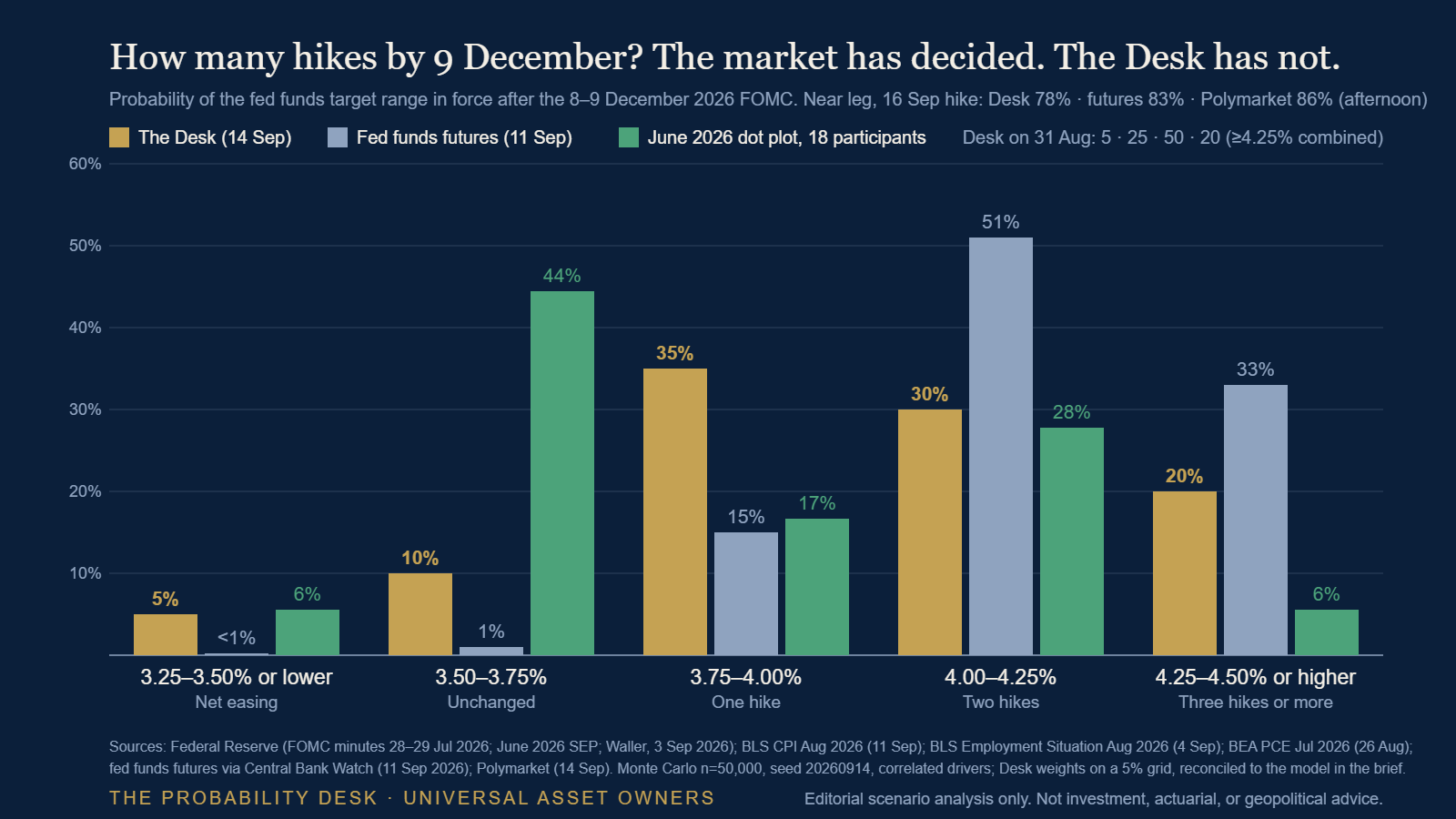
Standfirst. On 31 August this Desk put 70% on at least one Federal Reserve rate increase by the 9 December meeting and 20% on two or more. Two weeks later the fed funds strip has moved past us: it now prices a September increase at 83%, a fresh move in December at 85.5%, and 54 basis points of tightening in total — a distribution with 84% of its mass on two hikes or more. Governor Waller has set out the conditions for a hike; the August inflation report delivered a mixed answer; oil is back above $105 with the Salalah talks postponed; and the October meeting falls six days before the midterm elections. The Desk updates: 85% on at least one hike, 50% on two or more. The gap between us and the market is no longer about September. It is about whether December is already decided.
The Trigger
The Federal Open Market Committee meets on Tuesday and Wednesday, 15–16 September, its first meeting since Chair Kevin Warsh's Jackson Hole address of 28 August and the first with a Summary of Economic Projections since June. The target range for the federal funds rate has stood at 3.50–3.75% since the cut that took effect on 11 December 2025; it has been held at every meeting of 2026, most recently on 29 July by a vote of 9–3, with Beth Hammack, Neel Kashkari and Lorie Logan — the presidents of the Cleveland, Minneapolis and Dallas Reserve Banks — dissenting in favour of a quarter-point increase. The minutes of that meeting, released 19 August, record that "many participants assessed that policy tightening would likely be necessary if inflation did not decline," that several favoured an increase then and there, and that the Committee judged the risks to inflation "skewed to the upside."
Three things have happened since the Desk last priced this question on 31 August.
First, the Committee's swing voter spoke. On 3 September Governor Christopher Waller told a Reuters audience that the governor would support holding if the August data showed continued progress, and would "consider a rate hike" if inflation came in hot, adding that policy was "only slightly restricting aggregate demand" and that "it may not take much acceleration in inflation" to tip the governor toward tightening. He put three-month annualised core PCE inflation at 3.05% through July, down from 4.76% in February, and flagged a pending Commerce Department revision to imputed financial-services prices that "could lower 12-month PCE inflation by a few tenths of a percentage point."
Second, the data the governor asked for arrived, and they were mixed. The August employment report (4 September) showed payrolls up 162,000 against a prior twelve-month average of 31,000, the unemployment rate unchanged at 4.1%, and average hourly earnings up 3.1% on the year. The August consumer price index (11 September) rose 0.4% on the month and 3.4% on the year; gasoline, up 3.9% in the month, accounted for more than a third of the increase, and the energy index is up 16.3% on the year. The index excluding food and energy rose 0.3%, after 0.2% in July, but stands at 2.4% on the year — a tenth lower than in July. Over June, July and August, core CPI has risen 0.5% in total, an annualised pace of roughly 2%.
Third, the market moved from leaning to certainty. Fed funds futures, which implied roughly 60% odds of a September increase when the Desk wrote on 31 August, implied 83% on 11 September. Polymarket's September contract stood at 79% for a 25-basis-point increase on the morning of 14 September and at 86% by mid-afternoon, with $159 million traded — a seven-point move on a day with no scheduled data and no Committee speakers. And the strip did not stop at September: it prices the December meeting as an 85.5% fresh move, puts 51% on a 4.00–4.25% range and 33% on 4.25–4.50% or higher by 9 December, and implies an expected year-end rate of 4.16%.
Oil has not helped the doves. Brent ended last week near $104.6 a barrel; on Monday morning the GCC–Iran talks at Salalah were postponed — Gulf News reports Oman as postponing, Trading Economics reports Tehran as the party that pulled them, and the two accounts have not been reconciled — Saudi Arabia temporarily shut its East-West pipeline after drone attacks, and a merchant vessel was struck in the Strait of Hormuz. Iran's blockade of GCC oil exports remains in force, and the U.S. military says 101 commercial vessels have been redirected because of it. Brent for November delivery traded up 2.8% at $107.54; by 9 a.m. Eastern the benchmark was $110.42, a four-month high. It did not hold. By mid-afternoon Brent was back near $105–106 after President Trump said Russia and Ukraine had agreed to suspend strikes on each other's energy infrastructure and that he was "open" to engaging with Iran to end the war. The Treasury market had already moved: the 2-year yield rose from 4.39% on 8 September to 4.63% on 11 September — 24 basis points in three sessions — with the 10-year at 4.96% and the 30-year at 5.35%.
The Forecast Question
Which federal funds target range will be in force after the FOMC meeting of 8–9 December 2026?
The arbiter is the FOMC statement of 9 December 2026 as published on federalreserve.gov, read with the accompanying implementation note. Buckets are mutually exclusive and exhaustive, stated by the target range in force, and — for continuity with the 31 August edition — by net 25-basis-point moves from today's 3.50–3.75%:
| Bucket | Target range after 9 December | Net moves | Desk 14 Sep | Desk 31 Aug | Futures 11 Sep | June dots |
|---|---|---|---|---|---|---|
| A | 3.25–3.50% or lower | net easing | 5% | 5% | under 1% | 6% |
| B | 3.50–3.75% | unchanged | 10% | 25% | 1% | 44% |
| C | 3.75–4.00% | one hike | 35% | 50% | 15% | 17% |
| D | 4.00–4.25% | two hikes | 30% | 20% (D combined) | 51% | 28% |
| D+ | 4.25–4.50% or higher | three or more | 20% | — | 33% | 6% |
For grading against the 31 August edition, whose D bucket was "4.25% or higher on the upper bound" (two or more hikes), today's D and D+ combine to 50%. P(at least one hike by December) = 85%. P(two or more) = 50%.
Near leg, resolves Wednesday: P(a 25-basis-point increase at the 15–16 September meeting) = 78%; no change 22%; a 50-basis-point move is carried at under 1% inside the model and is not given a grid weight. Arbiter: the FOMC statement of 16 September.
Prior / Base Rate
Two priors compete, and the Desk publishes both rather than choosing one silently.
The Committee's own distribution. The June Summary of Economic Projections is the last written statement of what the Committee thought appropriate. Eighteen participants submitted end-2026 projections; the Chair did not. Eight placed the year-end midpoint at 3.625% (today's range), one at 3.375% (a cut), three at 3.875% (one hike), five at 4.125% (two hikes) and one at 4.375% (three). Read as a distribution: no net hike 50%, one hike 17%, two 28%, three 6%; median 3.75%, printed as 3.8%. The June dots were submitted before Jackson Hole, before the August data and before oil returned to $100, so they are stale — but they are the Committee's, and the wholesale shift the market now prices (84% on two or more) would require nine participants who saw no hike in June to see two by December.
The historical record of first hikes. Since 1990 the Committee has begun tightening from a standing start six times: February 1994, March 1997, June 1999, June 2004, December 2015 and March 2022. In four of the six (1994, 1999, 2004, 2022) a second increase followed within the next two scheduled meetings; in three (1994, 2004, 2022) the Committee moved at each of the first three meetings of the cycle. In the other two — March 1997 and December 2015 — the first increase stood alone until the following December or later: 1997's until June 1999, and 2015's until the FOMC of 13–14 December 2016, 363 days after the lift-off decision. That is a base rate of roughly two-in-three for a second hike within two meetings, from a sample of six, which is to say a wide interval around a weak lean. The reference class also flatters the hawkish case: the three uninterrupted sequences — 1994, 2004 and 2022 — all began from policy rates the Committee itself judged well below neutral, whereas Governor Waller today describes policy as "only slightly restricting aggregate demand." The one-and-done of March 1997 was a pre-emptive single step from a rate already near neutral; the one-and-wait of December 2015 was a lift-off the Committee had promised in advance would be gradual. Neither of the two sequences the market now prices began from where this Committee stands.
The Desk's prior, before the evidence table below, is therefore a September increase as more likely than not, and a genuine split on whether it is the first of a sequence or a credibility-reinforcing single step.
The Evidence-Update Table
| Evidence (dated) | Direction | Weight | Source |
|---|---|---|---|
| July minutes (19 Aug): 9–3 hold; three dissents for a hike; "many participants" see tightening as likely necessary if inflation does not decline; inflation risks skewed up, employment risks skewed down | Hawkish on September; two-sided on the sequence | High | FOMC minutes 28–29 Jul |
| Jackson Hole (28 Aug): Warsh calls 2% PCE "a firm, fixed target"; the summer's readings "do not tell me that underlying trends have meaningfully improved"; 54% of the 199 PCE components rose more than 3% over twelve months (49% over six; 32% in the two pre-pandemic decades, and well below the post-pandemic high of about 77%); "hard pressed to describe broad financial conditions as restrictive" | Hawkish on breadth; the speaker's own comparison is two-sided | High | Federal Reserve, 28 Aug (speech text); AP via PBS, 29 Aug |
| Dallas Fed trimmed-mean PCE, July: 2.3% on twelve months, against headline 3.7% and core 3.3%; next update 30 Sep | Dovish on the underlying trend — the same 199 components, read by trimming the tails rather than counting them | Medium | Federal Reserve Bank of Dallas, 26 Aug |
| Treasury par yields: 2-year 4.39% (8 Sep) → 4.63% (11 Sep); 10-year 4.96%; 30-year 5.35% | The front end has priced the sequence; the long end has not rallied on it | Reference | U.S. Treasury, 11 Sep |
| Waller (3 Sep): hold if August shows progress; hike if hot; three-month core PCE 3.05% from 4.76%; pending PCE measurement revision of "a few tenths" | Conditional; dovish on the sequence | High | Federal Reserve, 3 Sep |
| August payrolls +162k; unemployment 4.1%; prior 12-month average +31k; earnings +3.1% y/y | Removes the labour objection to hiking; no overheating | Medium | BLS, 4 Sep |
| August CPI: headline +0.4% m/m, 3.4% y/y; core +0.3% m/m, 2.4% y/y; gasoline over a third of the monthly increase; energy +16.3% y/y | Hawkish on headline; benign on core; core three-month pace near 2% annualised | High | BLS, 11 Sep |
| July PCE: headline 3.7% y/y, core 3.3% y/y, both +0.2% m/m; next release 30 Sep with the annual update | In line with the Committee's June path (core 3.3% for 2026) | Medium | BEA, 26 Aug |
| June SEP: median end-2026 rate 3.8%; 9 of 18 at or below today's range; 6 at two hikes or more | Dovish relative to market on the sequence | Medium | Federal Reserve, 17 Jun |
| Fed funds futures (11 Sep): September 83%; December fresh move 85.5%; 54bp priced; December mode 4.00–4.25% at 51% | The market's view; carries a front-end risk premium | Reference | Central Bank Watch |
| Polymarket (14 Sep, afternoon read): September +25bp 86% ($158.8m traded; 79% in the morning); October "no change" 62%, +25bp 37% ($2.2m); December +25bp 57%, no change 40% ($0.74m — thin); end-2026 upper bound ≤3.50% 4%, 3.75% 7%, 4.00% 36%, 4.25% 36%, ≥4.50% 18% ($6.8m) | A cash-settled crowd that has converged on the strip for September, prices December as a coin flip in a thin contract, and — in its most liquid year-end contract — carries a distribution close to the Desk's | Reference | Polymarket, four contracts, read 14 Sep |
| Oil: Brent near $104.6 on 11 Sep; $107.54 on the Monday-morning postponement of the Salalah talks and the East-West pipeline shutdown; $110.42 at 9 a.m. ET, a four-month high; back near $105–106 by mid-afternoon on the Russia–Ukraine energy-strike pause and Trump's "open to" Iran talks | Hawkish on headline inflation and expectations; Waller says no pass-through to core "so far"; the intraday reversal shows how much of the price is a headline premium | Medium | Gulf News live blog, Fortune, Trading Economics, all 14 Sep |
| Calendar: FOMC 27–28 Oct is six days before the 3 Nov midterms; no SEP at that meeting | Dampens October | Medium | Fed calendar; Britannica |
| BEA annual update, 30 Sep: revision to imputed financial-services prices expected to lower measured PCE inflation | Dovish for October and December | Medium | Waller, 3 Sep |
| J.P. Morgan Wealth Management (5 Aug): September hike "standalone", not the start of a cycle; 30-year yield at its highest since 2007 after the July hold | Supports the one-and-done case; flags the credibility channel | Low | J.P. Morgan WM |
Net of the table: the September leg has strengthened since 31 August (the Desk moves from a 60% market anchor and a 70% union to 78% on the near leg); the case for a second hike has strengthened less than the strip implies, because the two most informative new facts — Waller's conditional and the core CPI print — point at "one, then assess," while the two facts the market seems to be pricing — headline CPI and oil — are the ones the Committee's centre has said it will look through unless they bleed into core and expectations.
The Scenarios
A. Net easing — 3.25–3.50% or lower — 5%. The labour market cracks before December: unemployment rises more than a third of a point in twelve weeks, the Sahm-style momentum that the July payroll decline hinted at before revision returns, and the Committee that hiked in September reverses course by December. The engine carries this at 1.4%; the Desk keeps a 5% floor because the twelve-month payroll average is 31,000 and one negative print already happened this summer.
B. Unchanged — 3.50–3.75% — 10%. Wednesday's hold, then a hold, then a hold: the Committee reads the 0.3% core CPI as noise around a 2% trend, waits for the 30 September revision, and Waller's conditional never triggers. The dissent count rises to four or more, but the centre holds. This was the Desk's 25% bucket on 31 August; the Jackson Hole follow-through and the market's full pricing have taken most of it.
C. One and done — 3.75–4.00% — 35%. The base case in the Desk's single most likely path (27% of simulated paths are hike-hold-hold). A quarter-point on Wednesday "to reinforce the Committee's commitment," a September dot plot whose median for 2026 sits at 3.875% with a hawkish minority at 4.125%, no move six days before the election, and a December meeting that holds because core inflation kept falling and the PCE revision did the Committee's work for it. Long yields fall on the credibility signal; the front end gives back part of the 54 basis points.
D. The sequence — 4.00–4.25% — 30%. September, then December (25% of paths), or September and October (3%). The September SEP median moves to 4.125% for 2026, headline inflation stays near 3.4% into the autumn with Brent above $100, and the Committee delivers the second step at the December SEP meeting where it can explain it. This is the market's mode, at 51%.
D+. The credibility cycle — 4.25–4.50% or higher — 20%. All three meetings, including the one six days before the midterms (23% of paths), or a 50-basis-point move. It requires oil to feed into core, survey expectations to lift, and a Committee willing to tighten through an election it will be accused of influencing either way. It also requires the Committee's own June centre — nine of eighteen at no hike — to have been overturned entirely within six months. The market has 33% here; the June dots had 6%.
The Monte Carlo
Design. Fifty thousand paths, seed 20260914, across the three remaining meetings. Three macro drivers are drawn per intermeeting window from a Gaussian copula: three-month annualised core PCE inflation (anchor 3.05%, per-window innovation 0.45 points), log Brent (anchor $104.6, per-window volatility 0.14, roughly 40% annualised) and the unemployment rate (anchor 4.1%, per-window 0.15 points with a 0.07-point drift toward the SEP's 4.3%). The correlations are economic, not decorative: inflation with oil +0.45, inflation with unemployment −0.25, oil with unemployment +0.20 — an oil shock that lifts headline inflation and softens activity at once. On top of the macro state sits a persistent committee disposition, an AR(1) with coefficient 0.6 and standard deviation 0.8 in score units, so that a Committee that surprises hawkish in September is more likely to do so again. A meeting hikes 25 basis points when its score exceeds zero; a 50-basis-point move requires the shock component alone to exceed 2.8 (it fires on 0.9% of paths); a cut requires a deeply dovish shock and a rise in unemployment of more than 0.35 points.
Calibration to the market, and what it revealed. Run in market mode, the three meeting intercepts are solved so that the engine reproduces the strip of 11 September: 83.2% for September, 38% for two hikes by October, and the December buckets by least squares. The engine gets there — 0.3 / 14.3 / 47.4 / 38.0 against the strip's 1 / 15 / 51 / 33 — but only by making the December increase all but certain: 99.9% on the calibrated intercept, against 40.6% for October. That is the strip's own message translated: with September at 83% and October under half, the only way to put 84% on two hikes or more is to treat December as done. The market has decided December.
Desk mode. The Desk does not accept that intercept. Its priors for the three meetings, stated as marginal hike probabilities before each window's data arrive and published so they can be argued with, are September 78%, October 28%, December 58%. The engine is re-solved to those marginals and the correlation structure does the rest:
| Net easing | Unchanged | One hike | Two hikes | Three or more | |
|---|---|---|---|---|---|
| Engine, Desk mode | 1.4% | 12.8% | 32.9% | 30.0% | 22.9% |
| 95% sampling interval (four-bucket grid; ±0.3 is the combined no-net-hike bucket) | — | ±0.3 | ±0.4 | ±0.4 | ±0.4 |
| Desk stated (5% grid) | 5% | 10% | 35% | 30% | 20% |
| Futures, 11 Sep | <1% | 1% | 15% | 51% | 33% |
| Polymarket end-2026 upper bound, 14 Sep | 4% | 7% | 36% | 36% | 18% |
| June dots | 6% | 44% | 17% | 28% | 6% |
Expected year-end midpoint: engine 4.03%, Desk stated 4.00%, futures 4.16%, June dots median 3.75%.
Reconciliation line. Desk stated minus engine: +3.6 / −2.8 / +2.1 / 0.0 / −2.9. Desk stated minus futures: +5 / +9 / +20 / −21 / −13. Engine minus futures: +1.3 / +11.8 / +17.9 / −21.0 / −10.1. The Desk names every departure from the engine larger than 2.5 points. There are three. The easing bucket is held at a 5% floor rather than the engine's 1.4% because the cut branch is narrow by construction; the unchanged bucket takes the offsetting 2.8 points, so that the combined no-net-hike bucket moves only from 14.2% to 15% and the re-split is a judgment about where inside it the mass sits; and the three-or-more bucket is shaded from 22.9% to 20% because the engine's persistence parameter carries a September hawkish surprise into the pre-election meeting more mechanically than the Desk believes a Warsh Committee would.
Threshold sensitivity. Shifting the action threshold by ±0.10 score units (an eighth of a standard deviation of committee noise) moves the buckets to 12.1 / 30.5 / 31.2 / 26.2 and 16.7 / 34.9 / 28.6 / 19.9 on the four-bucket grid (no-net-hike combined). The ordering of the two middle buckets flips within that band: the coin flip is real.
Structural envelope. Twenty-three specifications were run. The parameters that matter are the priors on the two later meetings and the persistence of the committee's disposition; the macro betas and driver correlations barely move the answer once the marginals are pinned. Setting the December prior to the market's 85.5% moves two hikes to 45.0% and one hike to 21.9%; setting it to 45% moves them to 25.0% and 37.8%. Removing the election dampener (October at the market's 45.8%) lifts three-or-more to 33.5%. Turning persistence off entirely gives 10.5 / 34.1 / 38.9 / 16.5; raising it to 0.85 gives 16.9 / 29.7 / 27.8 / 25.5. Across all runs the envelope is: no net hike 6.5–16.9%, one hike 16.9–37.8%, two hikes 25.0–45.0%, three or more 15.8–41.5%. The envelope is thirty to sixty times the sampling error. The Desk's published numbers sit inside it on every bucket. The market's do not: the strip's 1% on no net hike is below the envelope's 6.5% floor, its 15% on a single hike is below the 16.9% floor, and its 51% on two hikes is above the 45.0% ceiling. Only the three-or-more bucket, at 33%, falls inside. No specification the Desk ran reproduces the strip's shape.
One more finding. Setting all three priors to the market's own fresh-move probabilities (83.2 / 45.8 / 85.5) inside the Desk's correlation structure returns 6.5 / 16.9 / 35.1 / 41.5 with an expected rate of 4.15% — the market's mean, but with a fatter tail and a thinner mode than the strip prints. The strip's shape is consistent with the same meeting-by-meeting probabilities and less clustering than the Desk assumes. Either the Desk's persistence is too high, or the futures distribution — which is a term-structure of hedging demand as much as a probability — smooths the tail. The red team takes this up below.
One caveat belongs on this paragraph rather than in a footnote. The aggregator that supplies these three numbers says of them: "Markets price 54 bp of tightening in total… This is the one figure that is safe to quote on its own. The per-meeting percentages below describe the same single expected path seen from different dates — they are not separate bets, and adding them across meetings double-counts the same move." The Desk uses them as three separable marginals anyway, because that is the only form a meeting-by-meeting engine can consume. The finding that survives without them is the one drawn from the December bucket distribution alone: 1 / 15 / 51 / 33 puts 84% on two hikes or more, and no specification in the Desk's envelope reproduces that shape.
Market vs. Desk View
Three markets, three answers. The futures strip prices 54 basis points of tightening by December — about 2.1 hikes on the aggregator's own arithmetic — with 84% of its December mass on two hikes or more. Polymarket, a cash-settled crowd with no hedging term premium, priced September at 79% on Monday morning and 86% by mid-afternoon, an October increase at 37%, and a December increase at 57% — though the December contract has traded only $0.74 million against $159 million on September, and a thin crowd is a crowd of a few. Its most liquid year-end contract is the more telling one: $6.8 million traded on where the upper bound of the target range will be at the end of 2026, and the distribution is 4% at or below 3.50%, 7% at 3.75%, 36% at 4.00%, 36% at 4.25% and 18% at 4.50% or above. The Desk is closer to the crowd than to the strip, and closest of all on the meeting that matters: 78 / 28 / 58 by meeting against the crowd's 86 / 37 / 57 and the strip's 83 / 46 / 86, with 30% on exactly two. On the year-end grid the crowd's 4 / 7 / 36 / 36 / 18 and the Desk's 5 / 10 / 35 / 30 / 20 differ by no more than six points in any bucket; the strip's 1 / 15 / 51 / 33 differs from both by twenty on one hike and by fifteen or more on two.
On the near leg the Desk is now the least hawkish of the three, and it stays there until Wednesday. The crowd's seven-point move on Monday came with no new data and no Committee speakers; the Desk does not update a prior on a price move alone. It is also the cheap leg to be wrong on: a hike on Wednesday costs the Desk a Brier penalty of about 0.05 on that leg (0.22 squared); a hold would cost the strip 0.69 and the Desk 0.61. The December leg is where the disagreement is expensive, and that is where the Desk has put its weight.
Why the Desk is less hawkish than the strip:
- The Committee's own June centre was "no hike," and its hawkish wing wanted two. To reach the strip, the centre has to move further in six months than it moved between March and June, when the median rose from 3.4% to 3.8% on a genuine inflation upgrade.
- The variables the Committee says it targets are improving. Three-month core PCE has fallen from 4.76% to 3.05%; core CPI is 2.4% on the year and about 2% annualised over three months; the Dallas Fed's trimmed-mean PCE, which discards the extremes on both sides of the same 199 components the Chair counts, is 2.3% on twelve months; and the 30 September annual update is expected — per Waller, who put it no higher than "could" — to take a few tenths off measured PCE before the October meeting.
- The variables that are not improving — headline CPI at 3.4%, energy at 16% — are the ones Waller says have not bled into core "so far," and that the Committee's centre has said it will look through unless expectations move. Longer-run inflation compensation, per the July minutes, remained consistent with 2%.
- The October meeting is six days before the midterms and has no projections attached. The Committee has hiked into a midterm before — in November 2022, six days before that year's vote — but mid-cycle, from a rate everyone agreed was too low, not as a second step from near-neutral under a chair appointed by the president whose party is on the ballot.
- Fed funds futures are not a probability distribution. A futures price embeds a risk premium as well as an expectation, and the two cannot be separated from the strip alone; the 33% on three or more hikes is as consistent with hedging demand as with belief. The cash-settled crowd, which carries no such premium, is 28 points lower on December than the strip in its thin December contract and fifteen points lower on "two hikes" in its liquid year-end one.
Why the market may be right and the Desk wrong:
- Three Reserve Bank presidents have already voted to hike and lost, and said so in the record. A chair who has staked his credibility on "work to do," and a market that has pre-paid the hike, make the September step costless; the same logic makes a December step costless if headline inflation is still 3.4%.
- Warsh's breadth measure — 54% of PCE components rising more than 3% over twelve months, against 32% in the two decades before the pandemic — is an argument about generality, and breadth does not decay when gasoline does. The Chair's own sentence cuts both ways: 54% is also well below the post-pandemic high of about 77%.
- The Committee's June distribution is stale in the direction that matters: the August data, Jackson Hole and $107 oil all arrived after it.
- The strip has been right and the Desk wrong on the direction of travel for two weeks: our 31 August 60% September anchor became 83%.
The Universal-Owner Portfolio Read
For an institution that owns a slice of everything, the number that matters is not the funds rate but what the funds rate does to the long end, and the two scenarios the Desk rates as a coin flip pull the long end in opposite directions.
A single, credibility-reinforcing increase (Bucket C) is the scenario in which long yields fall. The July hold, per J.P. Morgan Wealth Management's account, sent the 30-year Treasury to its highest since 2007 because investors read tolerance; the Jackson Hole speech barely moved longer-term yields because investors read resolve. A hike that is believed to be the last lowers the term premium. For a defined-benefit plan that is a liability event before it is an asset event: a lower long yield raises the present value of liabilities, and a plan that has been enjoying the highest discount rates since 2007 gives some of that funded-status gain back even as its bond portfolio marks up.
A sequence (D and D+) is the scenario in which the front end does the work and the curve bear-flattens or inverts. Floating-rate private credit — the asset class most of the audience has been adding — re-prices every quarter; each 25 basis points is a direct transfer from sponsor-backed borrowers to lenders until it becomes a default-rate question. Reserve managers and insurers holding short paper are paid more to wait. The dollar, already appreciating per the July minutes, strengthens further into an oil shock, which is a stress on energy-importing emerging economies and a windfall for the Gulf sovereigns whose revenues and whose dollar-pegged balance sheets both benefit.
The tail the Desk rates lowest — net easing — is the one that combines a labour crack with an oil shock, the stagflationary corner in which neither duration nor credit protects a portfolio, and in which the Committee's employment mandate and inflation mandate pull apart. It is 5% because it needs a lot to go wrong in twelve weeks; it is not zero because the July payroll print was negative before revision and the twelve-month average is 31,000.
Universal-Owner Portfolio Heatmap
Direction and size of the reprice by asset class under the two scenarios that carry 85% of the weight between them. Bands are Desk judgment about the order of magnitude of the move attributable to the Fed path alone, holding the oil path constant; they are not forecasts of levels.
| Asset class | C — one and done (35%) | D / D+ — the sequence (50%) | Band |
|---|---|---|---|
| Public equities | ▲ small: term premium falls, credibility read | ▼ moderate for long-duration growth; banks and short-duration value relatively better | Small–moderate |
| Investment-grade credit | ▲ small: spreads tighten with the long end | ▬ flat to ▼ small: carry rises, spreads widen modestly | Small |
| High-yield and leveraged loans | ▲ small | ▼ moderate: a third hike is when floating-rate coverage ratios bite | Moderate |
| Rates — front end (2-year, 4.63%) | ▼ 20–30bp of the 54bp priced comes out | ▲ toward and through the strip's 4.16% year-end mean | Moderate |
| Rates — long end (30-year, 5.35%) | ▼ falls on the credibility signal; the July-hold move reverses | ▬ bear-flattens: the front end does the work, the long end is range-bound | Moderate |
| FX (dollar) | ▼ small | ▲ moderate into an oil shock; energy-importing EM currencies weakest | Small–moderate |
| Commodities | ▬ oil is priced off Hormuz, not the Fed; gold ▲ small on lower real yields | ▬ oil unchanged; gold ▼ on higher real yields | Small |
| Private credit (floating) | ▬ coupons flat | ▲ for lenders, each 25bp a transfer from sponsor-backed borrowers until it becomes a default question | Moderate |
| Real assets and infrastructure | ▲ small: cap-rate relief | ▼ small–moderate: cap-rate pressure, refinancing walls | Small–moderate |
| Defined-benefit liabilities | ▲ present value rises as the long yield falls; funded status gives back part of the 2007-high discount-rate gain | ▼ present value falls if the long end holds; funded status improves at the margin | Moderate |
| Gulf sovereign balance sheets | ▬ | ▲ dollar-pegged assets and oil revenues both benefit | Small |
▲ higher / ▼ lower / ▬ little change. "Small" is a move inside a normal month's range; "Moderate" is a move that would show in a quarter's attribution.
Second- and Third-Order Effects
The election. If the Committee hikes on Wednesday and holds in October, it will be read as having front-loaded to avoid the election; if it hikes in October, it will be read as having proven its independence; if it holds on Wednesday, it will be read as having flinched. There is no path on which the September decision is not also a statement about Fed independence, at a moment when the Supreme Court has just spoken on what it takes to remove a Fed governor: in Trump v. Cook, decided 29 June 2026 by five votes to four, the Court upheld the injunction keeping Governor Cook in post while her challenge to the removal proceeds, the Chief Justice writing that the administration's reading "would in effect transform the Federal Reserve's for-cause protection into at-will employment."
The revision. The 30 September annual update to the national accounts will revise personal income and outlays back to January and, per Waller, could lower measured PCE inflation by a few tenths. A Committee that hikes on 16 September on a 3.7% headline PCE may discover on 30 September that the number it hiked on has been revised lower. That is not a policy problem — the direction of the revision is known — but it is a communication problem for a chair who has promised to explain each move on its own data.
The transmission. A Fed hiking into an oil shock exports tightening: the July minutes already note headline inflation above target abroad on retail energy prices, and a stronger dollar raises the local-currency price of oil for every importer. The Japanese ten-year at 3% and a 30-year Treasury at its highest since 2007 are part of the same global term-premium story; a sequence in Washington extends it.
The cadence. The July minutes record that the Chair raised the possibility of moving from eight scheduled meetings a year to six, with no decision taken and no change for 2026. If adopted for 2027, every question this Desk asks about the Fed acquires a longer interval between resolution points and a higher premium on each one.
Watch Dashboard
| Date | Event | What moves the weights |
|---|---|---|
| Wed 16 Sep, 14:00 ET | FOMC statement, SEP, press conference | Hike with a 2026 median dot at 3.875% and "assess" language: move 10 points from D/D+ to C. Hike with a median at 4.125%: move 15 points from C to D. Hold: B to 30, C to 35, D to 25, D+ to 5. Four or more dissents either way: widen the tails. |
| Wed 30 Sep | August PCE and the BEA annual update | Core PCE m/m at or below 0.2% and a downward revision of three tenths or more: 5 points from D to C. |
| Fri 2 Oct | September employment | Payrolls below zero or unemployment at 4.3% or higher: A to 10, D+ to 15. |
| Wed 14 Oct | September CPI | Core m/m 0.4% or higher, or headline 3.6% or higher: 5 points from C to D. |
| Tue–Wed 27–28 Oct | FOMC (no SEP) | A hike here resolves D versus D+ almost entirely; a hold with "further adjustments" language keeps D at 30. |
| Tue 3 Nov | Midterm elections | No direct update; the October decision will already have been read through it. |
| Late Oct / mid-Nov | September PCE; October CPI and employment | Same rules as above, applied to the December leg. |
| Tue–Wed 8–9 Dec | FOMC, SEP | Resolution. |
| Continuous | Brent above $110 sustained, or the Salalah talks reconvened; the two-year Treasury yield; five-year, five-year inflation compensation; the Dallas Fed trimmed mean | Oil above $110 for two weeks: 5 points from C to D. Talks reconvened with a transit mechanism: reverse. Five-year, five-year compensation above its July range: 5 points to D+. |
Red Team — How This Could Be Wrong
1. The December prior is the whole disagreement, and it is a judgment. The Desk's 58% for December against the strip's 85.5% rests on the June dot plot, the core disinflation and the measurement revision. If the September SEP prints a 2026 median of 4.125%, the Desk's prior is wrong on Wednesday afternoon and the update rule above moves 15 points immediately.
2. The engine's persistence may be the artefact, not the strip's smoothness. With the market's own meeting probabilities, the Desk's structure produces a fatter tail than the strip. That could mean the strip smooths; it could equally mean the AR(1) coefficient of 0.6 is too high for a Committee that has said it has no preset path. At zero persistence the two-hike bucket rises to 38.9% and three-or-more falls to 16.5% — closer to the strip on the mode, further from it on the tail.
3. The June dots are stale in the hawkish direction. Every piece of information since 17 June — the July dissents, Jackson Hole, August CPI, $107 oil — has arrived on the hawkish side. Using the June distribution as a prior imports a Committee that no longer exists.
4. The core CPI–core PCE wedge cuts the other way. Core CPI at 2.4% looks benign; core PCE at 3.3% does not, and PCE is the Committee's target. Waller's argument that the wedge is imputed financial-services prices is one governor's argument; the Chair's Jackson Hole count says 54% of the PCE basket is rising more than 3%. The Dallas Fed's trimmed mean of the same 199 components says 2.3%. The two measures disagree about the tails, and the Chair chairs.
5. Oil is the channel the engine handles worst. Log-normal Brent with 40% annualised volatility has no jump for a closure of the Strait or a settlement; the 9 September Desk edition on Brent carried a 30% toll-regime scenario and a 5% break scenario that this engine does not import. If the Strait's toll regime settles above $110, the headline inflation path the Committee is asked to look through becomes a path it cannot.
6. The election argument may invert. A Committee anxious about independence might hike in October precisely to demonstrate it. The Desk's dampener is a judgment about incentives, sized at −18 points on the October marginal relative to the strip; the sensitivity table shows what happens without it (three-or-more rises to 33.5%).
7. The market anchor is a derived series. The 11 September December distribution comes from a third-party aggregator's expanding-tree reconstruction of fed funds futures rather than from the exchange's own tool, which the Desk could not open. The September figure (83.2%) is corroborated by Polymarket (86%) and by the minutes' description of pricing in July; the December bucket shape is corroborated only in aggregate (Polymarket's 36% on an end-2026 upper bound of exactly 4.25% against the strip's 51%). The Desk treats the December shape as directional. The same page also warns that its per-meeting percentages are not independent bets and should not be compared across meetings. The Desk's "the market has decided December" reading is therefore an inference about the shape of the December distribution, which the source does stand behind, and not a claim about three separable meeting probabilities, which it does not.
8. The base rate is six observations. Two-in-three for a second hike within two meetings is a lean with a 95% interval that runs from roughly a third to nine-in-ten. It is published because a reader should see it, not because it decides anything.
Methodology Box
- Question and arbiter. Target range in force after the 8–9 December 2026 FOMC, read from the FOMC statement and implementation note on federalreserve.gov. Near leg: the 16 September statement.
- Weights. Desk judgment on a 5% grid summing to 100, reconciled line-by-line to the engine's output; every departure from the engine larger than 2.5 percentage points is named with its reason.
- Independent review. A cold reviewer with no memory of the build re-verified every trigger fact, base rate, expert view and quotation against fresh dated sources on the afternoon of 14 September and re-read the engine and its results file line by line: FLAG, 19 items, none a fabricated source, prior or quote; all applied before publication. The review is filed with this edition as
scenario-review.md. - Engine. mc.js, 50,000 paths, seed 20260914, no dependencies. Three macro drivers per intermeeting window from a Gaussian copula (Cholesky), a persistent committee disposition (AR(1), 0.6), a score-threshold reaction function, a 50-basis-point branch keyed on the shock component, a cut branch keyed on a labour crack. Market mode calibrates the three meeting intercepts to the 11 September strip by bisection and least squares; Desk mode calibrates them to the Desk's stated marginal priors (78 / 28 / 58). Twenty-three sensitivity specifications; Wilson 95% sampling intervals; a ±0.10 threshold band.
- What is judgment and what is fitted. Fitted: the three intercepts (in each mode). Judgment: the priors, the correlation matrix, the betas, the persistence, the innovation scales. All are printed in the code and in the results file that accompanies this edition.
- What the engine does not do. No jump process for oil; no explicit dot-plot update on 16 September (the update rule in the dashboard handles it by hand); no term-premium adjustment to the futures anchor beyond the Desk's stated priors.
- Scoring. Brier score on the five-bucket grid at resolution on 9 December, and on the two-outcome near leg on 16 September; graded against the 31 August edition on its four-bucket grid (today's D and D+ combined). Interim checkpoints: 16 September, 30 September, 28 October.
- Disclosure. Editorial scenario analysis only. Not investment, actuarial, or geopolitical advice.
Source Ledger
1. Federal Reserve — Minutes of the Federal Open Market Committee, July 28–29, 2026 (released 19 August 2026): https://www.federalreserve.gov/monetarypolicy/fomcminutes20260729.htm
2. Federal Reserve — FOMC meeting calendars, statements and minutes (2026 schedule: 15–16 Sep, 27–28 Oct, 8–9 Dec): https://www.federalreserve.gov/monetarypolicy/fomccalendars.htm
3. Federal Reserve — Summary of Economic Projections, June 17, 2026 (Table 1 and Figure 2): https://www.federalreserve.gov/monetarypolicy/fomcprojtabl20260617.htm
4. Federal Reserve — Governor Christopher J. Waller, "The Economic Outlook and Some Comments on My Policy Communication," Reuters NEXT Newsmaker Interview, 3 September 2026: https://www.federalreserve.gov/newsevents/speech/waller20260903a.htm
5. Federal Reserve — Open Market Operations, target federal funds rate changes 2003–2025: https://www.federalreserve.gov/monetarypolicy/openmarket.htm and historical archive 1990–2002: https://www.federalreserve.gov/monetarypolicy/openmarket_archive.htm
6. U.S. Bureau of Labor Statistics — Consumer Price Index Summary, August 2026 (released 11 September 2026): https://www.bls.gov/news.release/cpi.nr0.htm
7. U.S. Bureau of Labor Statistics — Employment Situation Summary, August 2026 (released 4 September 2026): https://www.bls.gov/news.release/empsit.nr0.htm
8. U.S. Bureau of Economic Analysis — Personal Income and Outlays, July 2026 (released 26 August 2026): https://www.bea.gov/news/2026/personal-income-and-outlays-july-2026
9. Central Bank Watch — Federal Reserve market-implied probabilities from fed funds futures, dated 11 September 2026: https://centralbank.watch/federal-reserve/
10. Polymarket — "Fed Decision in September?", read 14 September 2026 morning (25 bps increase 79%): https://polymarket.com/event/fed-decision-in-september-762
10a. Polymarket — "Fed Decision in October?", read 14 September 2026 afternoon (no change 62%, 25 bps increase 37%, 25 bps decrease 2%; $2.21 million volume): https://polymarket.com/event/fed-decision-in-october-20260617190323537
10b. Polymarket — "Fed Decision in December?", read 14 September 2026 afternoon (25 bps increase 57%, no change 40%, 25 bps decrease 3%, 50+ bps increase 2%; $742,678 volume): https://polymarket.com/event/fed-decision-in-december-20260729232808632
10c. Polymarket — "What will the Fed rate be at the end of 2026?" (upper bound of the target range), read 14 September 2026 afternoon (3.50% 4%, 3.75% 7%, 4.00% 36%, 4.25% 36%, ≥4.50% 18%; $6.85 million volume): https://polymarket.com/event/what-will-the-fed-rate-be-at-the-end-of-2026
11. PBS News / Associated Press — "Warsh raises stakes for Fed's next meeting, and other takeaways from Jackson Hole conference," 29 August 2026: https://www.pbs.org/newshour/economy/warsh-raises-stakes-for-feds-next-meeting-and-other-takeaways-from-jackson-hole-conference
12. Gulf News — live blog, "Oman postpones GCC-Iran meeting on Strait of Hormuz as oil prices rise on supply fears," updated 14 September 2026: https://gulfnews.com/world/mena/oman-postpones-gcc-iran-meeting-on-strait-of-hormuz-as-oil-prices-rise-on-supply-fears-1.500673518
13. J.P. Morgan Wealth Management — "Will the Fed hike rates in September? A 25-basis-point move is now expected," 5 August 2026: https://www.chase.com/personal/investments/learning-and-insights/article/september-2026-rate-hike-now-expected-amid-energy-shocks
14. FRED Blog, Federal Reserve Bank of St. Louis — "FOMC Summary of Economic Projections, June 2026," 22 June 2026: https://fredblog.stlouisfed.org/2026/06/fomc-summary-of-economic-projections-june-2026/
15. Encyclopaedia Britannica — "When are the 2026 midterm elections?" (3 November 2026), updated 8 September 2026: https://www.britannica.com/question/When-are-the-2026-midterm-elections
16. Universal Asset Owners — The Probability Desk, 31 August 2026, "The Fed's December call moved 25 points in three sessions. Ours moved with it.": https://www.universalassetowners.com/probability-desk/the-probability-desk-2026-08-31/
17. Universal Asset Owners — The Probability Desk, 9 September 2026, "Five forecasts $22 apart — and a 30% chance of the toll regime": https://www.universalassetowners.com/probability-desk/the-probability-desk-2026-09-09/
18. Universal Asset Owners — The Probability Desk, 1 September 2026, "Japan's 10-year hits 3%. The Desk's base case is that it stays there.": https://www.universalassetowners.com/probability-desk/the-probability-desk-2026-09-01/
19. Federal Reserve — Chair Kevin Warsh, "In Our Time," keynote at the Jackson Hole Economic Policy Symposium, 28 August 2026 (2% PCE "a firm, fixed target"; 54% of 199 PCE components above 3% over twelve months, 49% over six, 32% pre-pandemic; "hard pressed to describe broad financial conditions as restrictive"): https://www.federalreserve.gov/newsevents/speech/warsh20260828a.htm
20. Federal Reserve — FOMC statement, 29 July 2026 (9–3 vote; target range 3-1/2 to 3-3/4 percent maintained; "The Committee will deliver price stability"): https://www.federalreserve.gov/newsevents/pressreleases/monetary20260729a.htm
21. U.S. Department of the Treasury — Daily Treasury Par Yield Curve Rates, September 2026 (8 Sep: 2-year 4.39%, 30-year 5.25%; 11 Sep: 2-year 4.63%, 5-year 4.78%, 10-year 4.96%, 30-year 5.35%): https://home.treasury.gov/resource-center/data-chart-center/interest-rates/TextView?type=daily_treasury_yield_curve&field_tdr_date_value_month=202609
22. Federal Reserve Bank of Dallas — Trimmed Mean PCE Inflation Rate, July 2026 (2.3% on twelve months; overall PCE 3.7%, core 3.3%; latest update 26 August, next 30 September): https://www.dallasfed.org/research/pce
23. U.S. Bureau of Economic Analysis — Release schedule: Personal Income and Outlays, August 2026, Wednesday 30 September 2026, 8:30 a.m. ET: https://www.bea.gov/news/schedule
24. Polymarket — "Fed Decision in September?", re-read 14 September 2026 at approximately 3 p.m. ET (25 bps increase 86%, no change 14%, 50+ bps 1%, volume $158.8 million): https://polymarket.com/event/fed-decision-in-september-762
25. Fortune — "Current price of oil as of September 14, 2026" (Brent $110.42 at 9 a.m. ET; $109.63 the previous morning; $89.25 one month earlier): https://fortune.com/article/price-of-oil-09-14-2026/
26. Trading Economics — Brent crude, read 14 September 2026 mid-afternoon ET (about $105–106, from a four-month high of $110 earlier in the session; the Russia–Ukraine energy-infrastructure strike suspension; the East-West pipeline closure; GCC–Iran talks postponed): https://tradingeconomics.com/commodity/brent-crude-oil
27. Gulf News — live blog, "Trump says 'open' to engaging with Iran to end Middle East war," last updated 14 September 2026 22:59 GST (Trump "open" to talks at 19:56 GST; Vance on "direct conversations" with the Houthis at 19:32 GST; the U.S. military's 101 redirected vessels): https://gulfnews.com/world/mena/oman-postpones-gcc-iran-meeting-on-strait-of-hormuz-as-oil-prices-rise-on-supply-fears-1.500673518
28. SCOTUSblog — Amy Howe, "Court prevents Trump from firing Fed governor," opinion analysis of Trump v. Cook, 29 June 2026 (5–4; Roberts, C.J., joined by Sotomayor, Kagan, Kavanaugh and Jackson; Thomas and Alito dissenting; the injunction upheld while the challenge proceeds): https://www.scotusblog.com/2026/06/court-prevents-trump-from-firing-fed-governor/
Rows 1–18 were opened during the overnight build (all returned 200); rows 10a–10c and 19–28 were opened during the afternoon hardening pass and the independent review on 14 September 2026, and rows 10 and 12 were re-read then. Every figure in the text traces to one of these rows or to the recorded engine output in mc-results.json.
The Probability Desk is the afternoon intelligence property of Universal Asset Owners. We publish the evidence that moved every probability, we keep a public calibration log, and we grade ourselves. The engine (mc.js, seed 20260914), its results file and the independent scenario review are filed with this edition.
Editorial scenario analysis only. Not investment, actuarial, or geopolitical advice.
Continue the briefing. Read the daily brief · watch the daily video briefing · listen to The Universal Owner · view the chart of the day.
Produced and edited by the UAO editorial desk. Not investment advice.