
98% of the world’s sovereign wealth funds |
18 of 20 of the world’s largest pension funds |
10 of 10 of the largest charitable foundations |
85% of the world’s largest family offices |
100+ billionaires, every morning |
When a trade route becomes a negotiating instrument
Iran’s progress toward an arrangement with Oman over shipping lanes in the Strait of Hormuz is being read as the beginning of normalisation. It is not. A route mechanism can be nearly settled while the political conditions required to use it commercially remain entirely unsettled — and the exposure that matters to a long-horizon owner is not the price of a barrel but the reliability of delivery.
For a trader, the distinction between “the strait is reopening” and “the strait may be usable on terms yet to be agreed” is close to semantic. For a sovereign fund, a pension plan, an insurer or a family office holding a slice of the entire global economy, it is the whole question.
The Strait of Hormuz has been closed since late February. On Friday, transits fell 33% day on day, with most vessels routing Iranian-side.S1 Iran’s Supreme National Security Council has restated six conditions for reopening — a package of demands including an end to threats against Iran, a permanent end to hostilities against Iran and its allies, the lifting of the naval blockade and withdrawal of US forces from the region, and full compensation for war damage.S5 Tehran says the Oman mechanism is in its final stages and that it will not by itself reopen the waterway. There are no direct US–Iran talks.S1
Monday morning confirmed the frame. Foreign minister Abbas Araghchi said Iran is not in direct talks with the United States and repeated the demand for compensation as a condition of reopening. Brent traded up 1.4% at $84.70 by mid-morning, WTI at $79.31 — the market pricing exactly the gap this edition describes: a route that is nearly agreed, and permission that is not.S34 S35
That is not a supply interruption. It is a change in the category of the asset. A sea lane exposed to geopolitical risk can be modelled as a shock with a distribution. A sea lane whose commercial availability is an instrument of negotiation cannot, because the variable driving it is not weather, or capacity, or even conflict intensity — it is what another government decides to accept in exchange.
The misread: a shipping arrangement is not a reopening
The optimistic reading is coherent. Iran and Oman appear close to a mechanism; traffic could resume; the risk premium in energy, shipping and regional assets could compress. It may prove right. It is also incomplete, and the incompleteness is specific. A diplomatic framework can establish lanes, protocols and communication channels. It cannot, by itself, restore any of the six things commerce actually requires:
- Vessel owners need confidence that ships and crews can transit.
- Marine insurers need enough clarity to price war-risk cover.
- Charterers need the voyage to be commercially feasible.
- Banks and trade financiers need to stay comfortable with collateral, covenants and delivery risk.
- Energy customers need to plan refinery runs, inventories and substitute supply.
- Governments need to judge whether reserves, escorts or demand management are warranted.
A route is not open because an official says it is open. It is open when ships transit regularly, cargoes arrive on schedule, cover is available at a workable price, and counterparties accept the residual risk. Four of those six decisions are private and commercial. None of them are settled by a communiqué.
The evidence that they are not settled arrived on 8 August, while the talks were being reported as near-final. The UAE said Iran struck a tanker linked to ADNOC with a missile — an official accusation Tehran has not answered — in the early hours of the morning as it transited the strait, calling it a flagrant violation of a UN Security Council resolution on freedom of navigation and an act of piracy by the Islamic Revolutionary Guard Corps.S2 S3 Qatar condemned it as well.
Then the number that reframes it. ADNOC says 15 of its vessels have been targeted by missiles and drones since the conflict began. Three were hit in that week alone; across those three, one crew member was killed and 20 were injured.S4 (No casualties were reported on the 8 August vessel specifically.S3)
Fifteen is not a scattering of incidents; it is a sustained pattern of attacks on the shipping of a single state energy company, running in parallel with the negotiation that is supposed to be resolving the waterway. No single actor has been independently established for all fifteen — ADNOC’s count attributes the fire, not the finger — and the commercial point does not require one: underwriters price the pattern, not the culprit.
The real exposure is reliability, not price
A price shock can be absorbed, hedged, or partly passed through. A reliability shock cannot, because it lands on physical planning, working capital, inventory policy, contracts, insurance and credit simultaneously. A refinery can often buy alternative crude. It cannot instantly redesign its logistics, replace a specialised feedstock, guarantee freight, or promise a customer that the disruption will not recur next month.
| Channel | Immediate effect | Long-duration implication |
| Energy | Higher transport, insurance and supply cost | Secure supply, storage and route diversity gain value |
| Shipping | Disrupted sailings, diversions, higher war-risk premia | Route dependence repriced; vessel availability becomes an asset |
| Inflation | Higher delivered energy cost | Pressure on real-return assumptions and indexed liabilities |
| Sovereign | Stress on energy importers’ external balances | Wider differentiation in sovereign resilience |
| Credit | Working-capital strain, covenant pressure | Leveraged transport, trading and industrial borrowers at risk |
| Infrastructure | Operational uncertainty at ports, pipelines, logistics | A premium for redundancy, storage and route optionality |
| Insurance | Claims uncertainty, war-risk repricing | Less available cover; larger public-sector backstops |
So the value of a pipeline, a storage terminal, an LNG regasification plant, a port or a refinery is not a function of throughput. It is a function of the probability of continued throughput under stress — and that probability has just been marked down by an amount nobody has quoted.
The bypass is now the target
At dawn on Sunday a fire broke out at Saudi Aramco’s Jazan refinery on the Red Sea coast, 44 miles from the Yemeni border. Saudi Arabia’s energy ministry confirmed the fire and said Aramco’s own teams extinguished it with no injuries; it did not confirm the cause. The Houthis claimed a drone strike.S7 S8
Do not read this as 400,000 barrels a day coming offline. It was already off. Jazan’s nameplate is 400,000 b/d, but the plant has been shut since 27 July, after a 25 July Houthi missile-and-drone attack — the first direct strike on Saudi energy infrastructure in four years — damaged its integrated gasification combined-cycle complex and tank farm. Repairs were not due to finish until mid-August. That July attack hit Yanbu as well, the Red Sea terminal at the end of the East-West pipeline. Aramco’s chief executive Amin Nasser has said the attacks had no material operational or financial impact.S9
Which makes Sunday more interesting, not less. A facility already down for repairs caught fire again — after what the Houthis claim was a second strike — while being repaired. No barrels were lost because there were none to lose. What was demonstrated is that the repair window itself is contested — the redundancy leg cannot be restored while it remains under fire.
And Jazan is the redundancy leg. It is part of the western, Red Sea system built precisely to move Saudi barrels without transiting Hormuz. So the sequence reads: the main artery is closed by Iran; cargo reroutes to the western alternative; the alternative is struck in July, taken offline, and burning again in August — after a claimed second strike — before it can return.
Geographic redundancy is not risk-factor redundancy. A bypass diversifies a portfolio only while its political, military and insurance risks stay independent of the route it replaces. These no longer are. A defence pact signed weeks earlier between Saudi Arabia, Turkey and Pakistan did not prevent the incident the Houthis claim.
Why insurance is the instrument to watch, not the communiqué
Insurance is the bridge between a geopolitical incident and a market-wide financial consequence. It decides whether a voyage is financeable, whether a cargo can be delivered, whether a lender stays inside covenants, and who bears delay or replacement cost. It is a source of resilience while it is available and a transmission mechanism the moment it withdraws or reprices. If ships connected to a major state energy company are being hit during a negotiation, political language about passage will not by itself restore normal behaviour by underwriters, operators and crews.
Four questions, and the order matters:
- Are vessels resuming passage at a sustained rate — not isolated or escorted transits?
- Are war-risk terms returning toward workable commercial levels?
- Are cargo delays and diversions declining?
- Are shipping, energy and trade-finance counterparties behaving as if risk has normalised?
A yes to only the first is not normalisation. It is a photo opportunity.
The second-order problem: correlation
The principal risk to a universal owner is correlation between assets that look unrelated in normal conditions. A pension plan holds global equities, index-linked bonds, private credit, infrastructure and real assets. An insurer holds corporate bonds, commercial property and equities while underwriting marine, trade and business-interruption risk. A sovereign fund owns listed energy, logistics, real estate, foreign sovereign debt and strategic domestic assets.
A prolonged or repeated disruption reaches all of them, by different routes: energy producers gain on realised price while carrying higher shipping and security cost; airlines, chemicals and manufacturing lose margin; import-dependent sovereigns face trade, inflation and fiscal pressure; infrastructure earns scarcity rents only if operations stay dependable; insurers take claims while their investment portfolios reprice; private-credit borrowers need liquidity exactly as lending tightens; and central banks must choose between accommodating an energy shock and defending inflation credibility.
Geographic diversification does not solve this. A portfolio can be diversified across securities and still be concentrated in a single set of physical assumptions: dependable shipping, available insurance, low-friction trade, stable delivered-energy cost. The deeper issue is not that the portfolio lacks diversification. It is that the diversification model was built on a common infrastructure of reliability that is less secure than assumed.
The counterargument, which is not weak
Markets routinely price geopolitical threats that never become durable changes in physical supply. A negotiated arrangement could hold. Producers and consumers adapt quickly. Inventories, alternative routes, changed shipping practice and state intervention limit the damage. And no one should extrapolate a permanent restructuring of energy trade from one allegation and a few weeks of disruption. Nasser’s own position — no material operational or financial impact — is a serious rebuttal from the party with the best information.S9
That caution is warranted, and this analysis does not require a forecast of prolonged closure or escalation. It rests on something narrower: normal commercial use of the strait cannot be inferred from progress in diplomatic talks. An opening that stays politically conditional leaves a reliability premium in the system even after some traffic resumes. The thesis weakens materially if an agreement is followed by sustained commercially normal passage, broadly available insurance, no further credible security incidents, and a visible de-linking of maritime access from wider political demands. Those are the falsification conditions. They are checkable, and we will check them.
Second: the 187 tonnes that changed owner in a footnote
The other restatement of the week runs on the same fault line — a number that is right, describing an actor that turned out to be wrong.
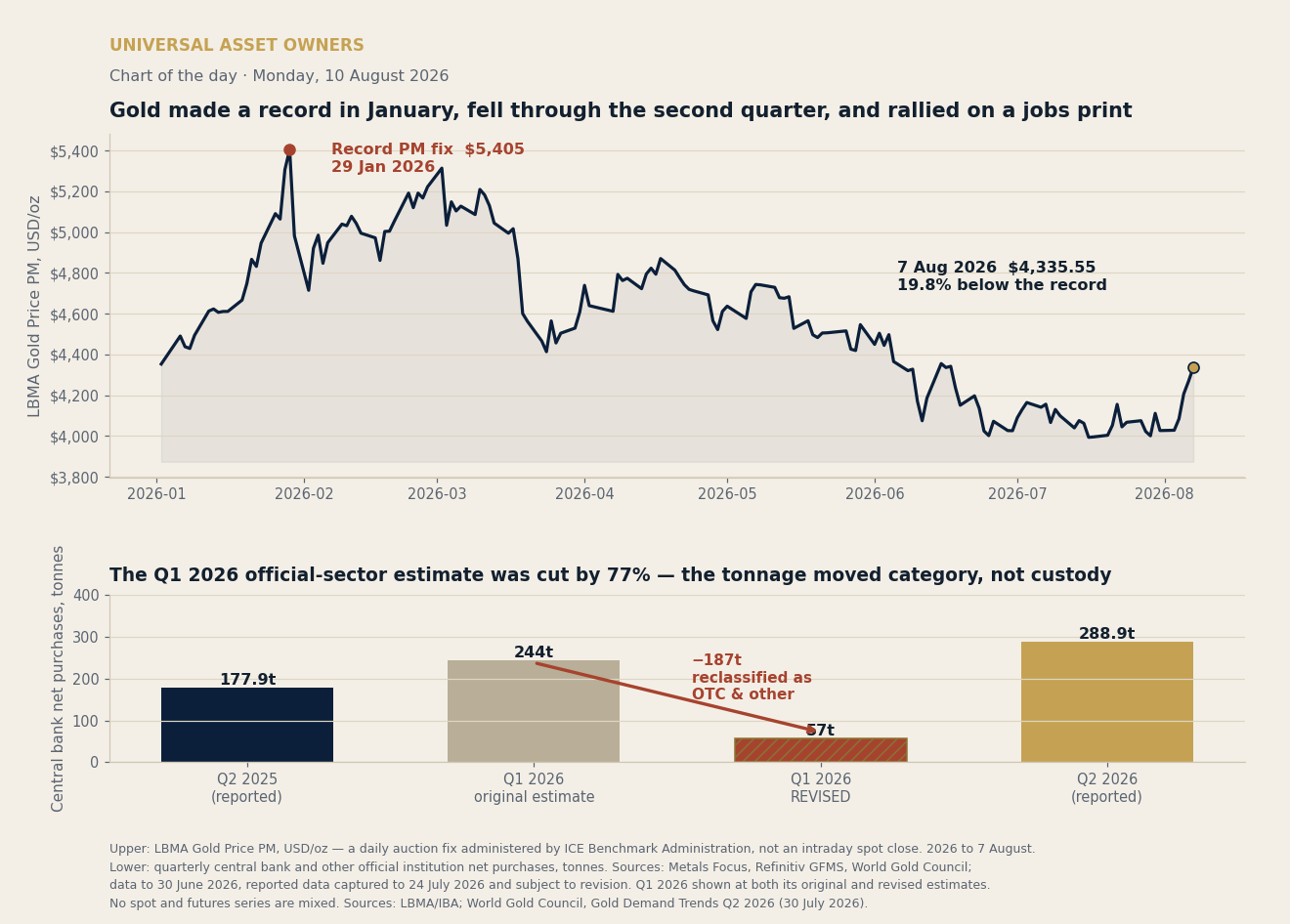
On 30 July the World Gold Council published Gold Demand Trends: Q2 2026. Central banks and other official institutions added a net 288.9 tonnes in the quarter, 62% more than Q2 2025’s 177.9t, and a record for a second quarter.S10
The story is in footnote 3. Metals Focus revised its Q1 2026 estimate of central bank gold demand from 244 tonnes to 57 tonnes, and reclassified the 187-tonne difference as over-the-counter and other demand.S11
That is 77% of the original estimate, moved from the most transparent category of buyer to the least. Reserve managers report to the IMF on a schedule; their holdings are public and their behaviour is slow and rules-bound, which is exactly why a memo naming them as the marginal buyer feels safe. OTC buyers report to nobody, and the WGC states plainly that OTC demand is not directly observable and is estimated partly as a statistical residual. For one quarter, the most-cited pillar of the de-dollarisation thesis was, in large part, a residual.
The counterclaim. Metals Focus moved tonnage between categories; it did not delete it. The gold was bought. And the WGC notes unreported official-sector buying was again elevated in Q2, which cuts the other way — some OTC tonnage may migrate back as reporting catches up. The honest reading is narrow: the market balance is an estimate, and what moved was its attribution — OTC demand is not directly observable and includes a statistical residual — so the official-sector series carries an error bar of at least 187 tonnes a quarter that almost nobody sizes.
What survives is what is reported, because reported means named: Poland +51t to 632t against a stated 700t target; the People’s Bank of China +33t, its largest quarterly addition since Q4 2023, to 2,346t; Uzbekistan +16t, Kazakhstan +15t, Jordan +6t, Czechia +6t. On the other side, Russia sold 22t and Turkey 4t. And H1 official demand of 345t was the lowest first half since 2022, when it was 241t — a fact the record-quarter headline entirely obscures.S10
Intent has not moved: 89% of WGC survey respondents expect global reserves to rise, and a record 45% expect to add to their own.S12 OMFIF’s Global Public Investor 2026, across 90 central banks, public pension funds and sovereign funds with more than $10trn between them, finds 82% of central banks now hold physical gold, up from 71%; a net 30% intend to add; and 51% cite protection against geopolitical risk, up 11 points from 2024. 61% of surveyed reserve managers expect $5,000–$6,000 an ounce by June 2027 — an expectation held by the buyers, not a forecast by OMFIF. For the first time since the study began, more central banks expect to reduce than increase dollar allocations over the coming decade.S13
And here the two stories become one. Fifty-one per cent of reserve managers name geopolitical protection as their motive for holding gold. This week they watched a chokepoint stay shut, a state oil company’s fifteenth vessel take fire, and a bypass refinery burn while under repair. Gold rose 7.7% from its 31 July fix to $4,335.55 at Friday’s PM fix ($4,026.60 → $4,335.55), still 19.8% below its 29 January record of $5,405.00.S14 Part of that is Friday’s payroll miss and the rate repricing — the immediate catalysts by any honest reading. But the survey tells you what else sits in the backdrop: the hedge is doing what its holders said it was bought to do, at the exact moment the data stopped being able to say who is buying it.
The tape — latest available closes; as-of dates shown
| Close | Change | |
| S&P 500 — record close | 7,757.64 | +0.62% · +3.6% wk |
| Nasdaq Composite — record close | 26,690.62 | +1.3% · +5.2% wk |
| Dow Jones Industrial Average | 54,036.93 | +151.83 (+0.28%) |
| US 2-year Treasury | 4.19% | −6bp |
| US 10-year Treasury | 4.65% | −4bp |
| US 30-year Treasury | 5.19% | −3bp |
| 2s10s spread | +46bp | — |
| Cboe VIX | 14.90 | from 15.15 (6 Aug) |
| LBMA Gold Price PM | $4,335.55 | +1.6% · +7.7% vs 31 Jul |
| Brent crude (settle, 6 Aug — see note) | $82.49 | +3.8% · WTI $77.29 |
| ICE BofA US High Yield OAS (6 Aug) | 2.71% | from 2.75% |
S17 S18 S14 S19 S20 S6 — On the oil line, and a correction to our own reasoning. An earlier version of this edition carried no oil price. The EIA/FRED Brent Europe spot series returned violent moves — 86.99, 105.32, 85.51, 96.95, 88.90 across eight sessions — and we read that as a corrupted feed. It was not. It is a war. With Hormuz closed since February, that is roughly what a crude benchmark should look like. The lesson runs opposite to the one we drew: data contradicting your model may be telling you the model is wrong. The figure above is the 6 August front-month settle, after Iranian state media published a restrictive draft plan for Hormuz shipping that would bar US and Israeli vessels outright and fine violators a fifth of cargo value.S6
These items are a deal tape, not a daily total. Unlike quantities are not summed.
Capital flow watch
Indonesia’s sovereign fund buys a platform, not a fund stake. On 7 August JBS agreed a joint venture with PT Danantara Investment Management. DIM contributes $2.5bn for 25% of a vehicle holding JBS’s Australian and New Zealand businesses — $800m at closing, the balance over up to three years — while JBS retains control. With up to $2.5bn of debt alongside, the venture can deploy $5bn. For the first two years DIM’s capital may be deployed only into Indonesian protein production.S23 S24 Note the shape: an operating platform stake with governance rights and a ring-fenced domestic mandate, not an LP cheque. That is industrial policy executed through a balance sheet. Subject to regulatory approval.
The secondaries bid keeps clearing. Adams Street Partners secured more than $5bn for its latest Secondaries Investment Program on 3 August, including Global Secondary Fund 8 at $2.7bn — roughly 50% larger than its predecessor.S27 A programme sized 50% above its predecessor is a statement about expected deal flow, about how many LPs are expected to need out, before it is a statement about returns.
Family offices: Delfin’s €10bn unblocking stalls. The governance deadlock inside Delfin — the roughly €55bn Luxembourg holding of Leonardo Del Vecchio’s eight equal heirs — has resurfaced: Leonardo Maria Del Vecchio’s proposed €10bn purchase of two siblings’ 12.5% stakes, which would lift him to 37.5% and break the stalemate, has stalled, with financing complicated by a fall in EssilorLuxottica shares. No transaction has completed. Why a universal owner cares: the paralysis constrains one of Europe’s largest family balance sheets and its influence across EssilorLuxottica, Generali, UniCredit and Monte dei Paschi — a reminder that succession mechanics are a market factor in European financials, per FT and Reuters reporting of 10 August.
Gulf capital circles Japanese compute — in talks, not signed. MGX — the Abu Dhabi AI investment vehicle founded by Mubadala and G42 — is reported to be weighing an investment of up to ¥1 trillion (~$6.3bn) in a proposed 500MW data centre in Akita Prefecture, which would be Japan’s largest. Total project cost is reported at up to ¥2 trillion, operational in the early 2030s.S25 S26 Nothing is signed; no figure enters any total. The shape is what matters: sovereign capital seeking power and land in a jurisdiction it reads as stable, on a multi-decade horizon.
Watchlist — reported, not yet independently confirmed. A purpose-built data-centre platform (“Theseus Infrastructure”) is reported to pair GIC and Macquarie Asset Management-managed funds as majority equity behind long-term leases to an anchor AI tenant, with an initial US focus. We could not verify the platform against a primary announcement by publication time, so no figure and no counterparty detail is carried; what is first-party is the tenant-side pattern — AI operators committing to absorb data-centre electricity-price increases rather than pass them to consumers, alongside multi-gigawatt long-term leases signed this summer. If confirmed, it is the same shape as the Akita talks below: patient capital buying power and land behind compute. Confirmation trigger: a primary announcement, a first site, or a disclosed capital call.
Context: 109 sovereign wealth funds managed an estimated $15.1 trillion as of April 2026.S28
Reported journalism from our correspondents — two pieces from this week’s newsroom, chosen for today’s themes.


Triple exposure. A universal owner meets this three times, not once.
- As an asset holder — through energy, shipping, commodity and reserve-diversification sleeves.
- As a liability carrier — through the discount rate. The 30-year at 5.19% is doing more for funded status this morning than the equity record is, and it moves against equities in the tail that matters. Lower long yields raise the present value of liabilities.
- As an owner of the intermediaries — banks, exchanges, custodians, index providers and insurers, whose revenues sit on OTC volume and war-risk cover that have both just been shown to be larger, and less legible, than reported.
Practical tilt. Map route dependence — direct and indirect — across energy, LNG, petrochemicals, shipping, ports, aviation, industrial inputs and trade finance. Stress delivery, not only price: freight, inventory drawdown, insurance repricing, contract delay. Separate infrastructure with optionality — alternative routes, storage, contractual pass-through, regulated returns — from assets dependent on uninterrupted throughput. Demand insurance visibility: exclusions, renewal dates, retentions, counterparty concentration, pass-through. Re-underwrite any sleeve whose sizing memo names central banks as the marginal buyer — restate it in terms of the bid, not the bidder. And where a mandate references listed infrastructure or a climate-transition index, check the embedded gas exposure before treating it as a physical-risk hedge. The opportunity side is real — storage, multi-route terminals, grid flexibility, strategic inventories — but distinguish durable contractual economics from a momentary crisis premium.
The Risk Radar
Every row is a dated, reproducible observation with its issuing authority. Unnamed rumours are not carried.
| Strait of Hormuz remains closed — six restated conditions; transits −33% d/d, most on the Iranian route (Kpler) | 8 Aug · CNN |
| UAE accuses Iran of missile strike on ADNOC-linked tanker; ADNOC reports 15 vessels hit since the conflict began, 3 this week, 1 dead, 20 injured | 8 Aug · Gulf News |
| Fire at Aramco’s Jazan refinery; Houthis claim a second strike — cause unconfirmed by Saudi authorities; plant already shut since 27 July; no fresh capacity lost | 9 Aug · Al Jazeera |
| Tropical Cyclone DOLPHIN-26, Marshall Islands, Japan, China — Orange alert period ended 9 Aug; damage assessments pending | to 9 Aug · GDACS |
| Geomagnetic K-index 6 warning — grid, satellite and GPS relevance; warning window 8–9 Aug, now lapsed | 8 Aug 20:35Z · NOAA SWPC |
| CVE-2026-8037, Progress LoadMaster command injection — exploited in the wild | 7 Aug · CISA KEV |
| Chokepoint sea-state benign at all seven monitored straits — weather only. This says nothing about the closure above: Hormuz is shut by policy and force, not by weather | 10 Aug 06:05Z · Open-Meteo |
Watch — the next 72 hours
- The four normalisation tests above, in order. Sustained transits, workable war-risk terms, declining diversions, counterparty behaviour.
- July CPI, Wednesday 12 August, 08:30 ET.S16 Futures did not add rate cuts on Friday — they removed a rate hike. Odds of a September hike fell to roughly 44% from 57% on Friday.S21 An allocator reading Friday as the start of a cutting cycle has made the same category error as one reading “record Q2 buying” as a persistent official bid.
- 28 August: BLS publishes a preliminary estimate of its annual benchmark revision, measuring the payroll count against near-universal unemployment-insurance tax records. It is an estimate of the coming restatement, not the restatement itself — official figures are not updated until February 2027. July payrolls fell 23,000 against a +83,000 consensus, with May and June revised down 103,000 combined and temporary layoffs up 153,000 to 921,000.S15 A month that revised May and June down 103,000 and then previews a benchmark restatement is a month reminding you the payroll series is an estimate.
Early signals
These are pre-consensus signals, below our confirmation bar. Each carries its source and the test that would confirm or kill it. Nothing here is established fact, and none of it is carried elsewhere in this edition as such.
China may be the oil market’s hidden shock absorber. Reuters analysis of customs and Kpler data has June–July crude imports at 7.78m b/d — about 4.21m below the pre-war average, roughly matching Asia’s entire lost intake — with strategic inventories estimated above 1.2bn barrels. The stockpile figure is not an official disclosure. Confirming test: September imports and refinery runs rising together — restocking before Hormuz normalises would expose tightness China’s restraint currently hides.
The Rhine may split in two at Kaub this week. Germany’s inland-shipping association warns the Kaub gauge could fall into single-digit centimetres, making the Middle Rhine commercially impassable; four states have already relaxed Sunday trucking bans. A forecast, not an event. Confirming test: carrier suspension notices and completed-transit counts, not the gauge alone.
Washington’s urgency on Hormuz may be fading. Remarks by Treasury Secretary Scott Bessent, reported by Reuters, suggesting Gulf oil could increasingly reroute via pipeline have been read as reduced US incentive to pay for a reopening. A single-source interpretation of one comment — not policy. Confirming test: any sequenced US concession on sanctions or the blockade, or its continued absence.
Japan’s external engine ran backward for a month. Japan’s Ministry of Finance June balance of payments, released this morning Tokyo time, is reported to show a ¥92.3bn current-account deficit — the first in 17 months, against a ¥1.51tn consensus surplus — as the primary-income surplus fell ~74% on dividends paid to foreign investors and the crude-import bill rose 59% by value on 14% lower volume. The counterweight is a record ¥17.4tn first-half surplus. Whether this is dividend timing or a pattern is unresolved. Confirming test: the July release on 8 September.
Odesa returns the food corridor to the war premium. Ukraine says Russian strikes damaged Odesa port infrastructure on Sunday — framed by Kyiv as an attack on food security — while Turkey says commercial passage through the straits remains smooth. Damage is Ukrainian-government-sourced; throughput impact is not yet measurable. Confirming test: grain-export tonnage and Black Sea war-risk quotes this week.
Mocha’s damage may be the larger Red Sea event. Yemen’s recognised military reports seven killed, 30 injured and severe port-infrastructure damage in the strike accompanying Jazan — government-sourced figures, no independent engineering survey yet. If Mocha’s capacity is materially impaired, the Red Sea leg weakens at both ends. Confirming test: port notices and satellite assessment.
Today’s scenario
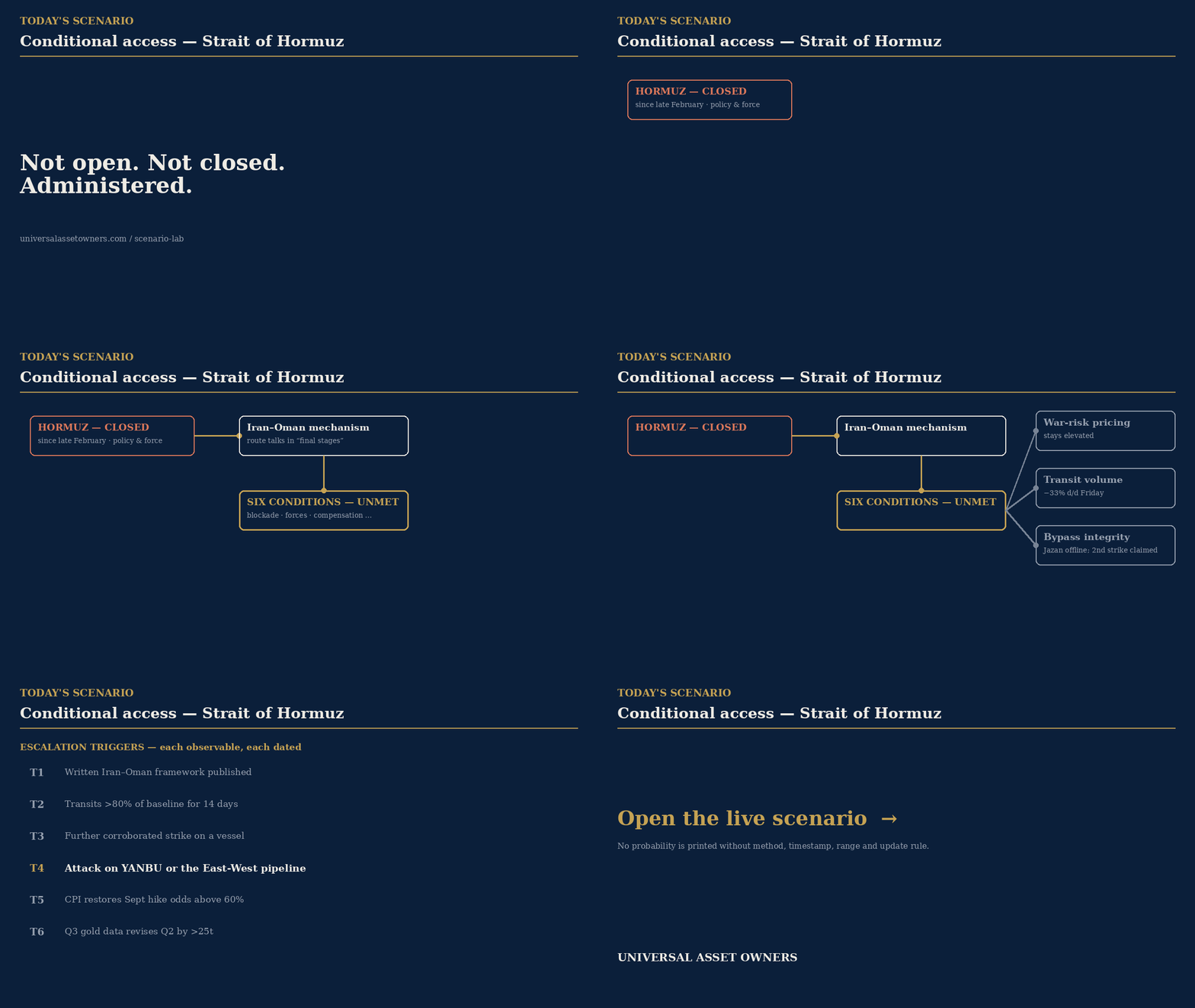
Base case. Hormuz access becomes administratively conditional rather than either open or closed: a route mechanism exists on paper, partial and escorted traffic resumes, and war-risk pricing stays materially above pre-February levels because the political conditions governing access remain unresolved.
Escalation triggers — each observable, each dated.
- T1 — A written Iran–Oman framework is published with legal status and implementation timetable.
- T2 — Sustained transit counts return above 80% of the pre-February baseline for 14 consecutive days.
- T3 — A further credible, independently corroborated strike on a commercial or state-linked vessel.
- T4 — Any attack on Yanbu or the East-West pipeline itself, as opposed to Jazan.
- T5 — July CPI on 12 August prints hot enough to restore September hike odds above 60%.
- T6 — Q3 Gold Demand Trends (late October) revises Q2 by more than 25t in either direction.
Open today’s interactive scenario → — explore the map and question the desk’s three agents.
The scenario carries a desk estimate of 0.60 (range 0.45–0.75, set 06:00 ET, updated when T1 or T2 fires). No probability is printed here. A probability appears in this publication only with its method, timestamp, range and update rule attached.
Podcast · The Universal Owner
Podbean · Apple Podcasts — 9:37. Opens on the week’s core contradiction.
The Back Page — with The Allocator
The Allocator has sat on investment committees for thirty years. He is not a strategist and he does not forecast. He turns up once a day to ask the one question the paper in front of the committee was written to avoid.
Forty-five seconds. “We assume the ships will sail.”

The allocator’s desk — careers
Roles at the institutions this publication covers. Openings we find interesting this week, linked directly to the institutions’ own postings:
- Abu Dhabi Investment Authority — investment and research openings across asset classes
- GIC — roles across public and private markets, Singapore and global offices
- Ontario Teachers’ Pension Plan — investment, risk and infrastructure roles, Toronto and London
- CalPERS — investment office and stewardship positions, Sacramento
Our careers desk → — hiring across the asset-owner world.
Sources
Every citation in this edition resolves here — publisher, article title and date, so you can judge the source before you click it.
- S1 — CNN, “Iran demands concessions from US as it nears Strait of Hormuz deal with Oman”, 8 August 2026
- S2 — CNBC, “Iran sets conditions for opening Strait of Hormuz after UAE says one of its ships was targeted”, 8 August 2026
- S3 — Al Jazeera, “UAE says Iran targeted ADNOC tanker in Strait of Hormuz, no casualties”, 8 August 2026
- S4 — Gulf News, “ADNOC says 15 vessels hit by missiles and drones in Strait of Hormuz, one dead and 20 injured”, 8 August 2026
- S5 — Tehran Times, “Iran sets six conditions for reopening the Strait of Hormuz”, August 2026
- S6 — CNBC, “Oil prices jump after Iran publishes restrictive draft plan for Strait of Hormuz”, 6 August 2026
- S7 — Al Jazeera, “Saudi Arabia says fire extinguished at Aramco facility in Jizan”, 9 August 2026
- S8 — NPR, “Yemen’s Houthis claim attack on Aramco oil facility in Saudi Arabia”, 9 August 2026
- S9 — Oil & Gas Middle East, “Aramco shuts Jazan refinery after Red Sea facility attack”, July 2026
- S10 — World Gold Council, Gold Demand Trends: Q2 2026, Central Banks, 30 July 2026
- S11 — World Gold Council, “Gold market shows resilience as price momentum cools in Q2”, press release, 30 July 2026
- S12 — World Gold Council, Central Bank Gold Reserves Survey 2026
- S13 — OMFIF, “The golden shift: how reserve managers are rethinking risk” (Global Public Investor 2026), July 2026
- S14 — LBMA / ICE Benchmark Administration, LBMA Gold Price PM daily auction fixes
- S15 — US Bureau of Labor Statistics, The Employment Situation, July 2026 (USDL-26-1291), 7 August 2026
- S16 — US Bureau of Labor Statistics, Consumer Price Index release schedule
- S17 — US Department of the Treasury, Daily Treasury Par Yield Curve Rates
- S18 — Cboe Global Markets, VIX historical data
- S19 — FRED, ICE BofA US High Yield Index Option-Adjusted Spread
- S20 — CNBC, “S&P 500 rises to record close Friday and posts strongest week since April”, 7 August 2026
- S21 — CNBC, “Odds the Fed hikes in September tumble following big July jobs miss”, 7 August 2026
- S22 — Reuters, via The Korea Times, “US rate futures cut chances of September rate hike after jobs data”, 8 August 2026
- S23 — JBS N.V., Form 6-K, US Securities and Exchange Commission, 7 August 2026
- S24 — Nikkei Asia, “Indonesia fund Danantara to invest $2.5bn in tie-up with Brazil meat supplier JBS”, 7 August 2026
- S25 — The Japan Times, “UAE fund weighs $6.3 billion AI data center investment in Japan”, 6 August 2026
- S26 — Taipei Times, “UAE fund weighs a US$6.3 billion AI data center investment in Japan”, 7 August 2026
- S27 — Adams Street Partners, via Business Wire, “Adams Street raises over $5 billion for secondaries investment program”, 3 August 2026
- S28 — IE University Center for the Governance of Change / ICEX, Sovereign Wealth Funds Report 2026, July 2026
- S34 — CNBC, “Oil prices rise amid uncertainty over U.S.-Iran Strait of Hormuz deal”, 10 August 2026
- S35 — Al Jazeera, “Oil prices climb as Iranian demands cloud outlook for Strait of Hormuz”, 10 August 2026
- S29–S33 — GDACS · NOAA SWPC · USGS · CISA KEV · Open-Meteo — risk radar observations
Sources checked through 10 August 2026. Material claims are linked to named sources; primary or first-party sources are used where available.
An earlier version of this edition led with the gold revision and carried neither the Hormuz closure nor an oil price; both omissions and the reasoning behind them are corrected in the text above.
This publication is not investment advice.