
98% of the world’s sovereign wealth funds |
18 of 20 of the world’s largest pension funds |
10 of 10 of the largest charitable foundations |
85% of the world’s largest family offices |
100+ billionaires, every morning |
A Dutch insurer said on the record why a coal revenue test can miss a large coal producer, and what it now tests instead. In Philadelphia, the SEC asked a court to see how a proxy adviser voted each client’s shares. In Buenos Aires, a decree turned a resource-title dispute into a sworn declaration. Three rules, three institutions, one question: is the rule real, or is it a document?
Dispatches
Filed this morning by our correspondents, in their own time zones. Bullets, not analysis — what they are seeing on the ground before New York opens.
 | BOGOTÁ · NICOLÁS BOHÓRQUEZ UAO Correspondent · Contributing Journalist, The Americas · filed 11:07 local |
- Argentina — Milei moves on the South Atlantic. In a Thursday national broadcast the president announced a naval base at Ushuaia and sanctions against companies exploiting Malvinas resources; Navitas and Rockhopper, both with South Atlantic exploration interests, fell. Ámbito
- Colombia — a 12.5% US tariff may go to zero. ANALDEX president Javier Díaz says the 12.5% US tariff on Colombian exports could fall to zero within days; removal requires Colombia to block forced-labour goods, and a decree was published for public comment this week, mirroring terms recently extended to Ecuador. Portafolio
The thesis — What you can’t see, you can’t exclude
Every institution in this edition operates a rule that decides what it will not own, will not vote for, will not permit, or will not let across a border. A rule like that is not a statement of values. It is a claim about what the institution can see — because a threshold you cannot measure is not a threshold, it is a sentence in a policy document.
Today one owner said so on the record, one regulator went to court over the same principle, and one government wrote it into a form every permit-holder has to sign. Each rule is executed on a file the owner does not hold — a vendor’s production estimate, a proxy platform’s vote record, a chain of beneficial ownership. In each case the question that decides whether the rule is real is not what the rule says but whether the file underneath it can be produced, inspected and reproduced.
The Lead — NN Group added an output test to its coal revenue screen, and told us why
On 3 September, at 09:00 Amsterdam time, NN Group announced an extension of its Thermal Coal Policy: “additional restrictions covering large thermal coal producers, large coal-fired power generators, and companies developing new coal mines or coal-fired power plants,” and a formalised exemption process.
Asked by Universal Asset Owners what a revenue threshold had failed to capture, NN Group answered in writing on 8 September:
“Percentage-based thresholds remain useful, but they do not always give a full picture of a company’s thermal coal exposure or future direction. For example, a diversified mining company may fall below a revenue-share threshold, while still being a large thermal coal producer, or involved in new coal expansion.”
That is the gap, named as a class rather than a case: a miner large enough to matter to the atmosphere and diversified enough to be invisible to a revenue screen. The added criteria, NN Group said, “look beyond relative exposure and better capture absolute production, generation capacity and expansion plans.”
The numbers, from the policy itself
The announcement does not carry thresholds. Appendix V of NN Group’s Responsible Investment Framework policy does. For new investments in proprietary assets, in addition to the group-wide exclusion of companies deriving more than 20% of revenues from thermal coal mining:
| Activity | Restriction criteria (policy wording) |
| Thermal coal mining | Companies deriving >5% revenues from thermal coal mining |
| Companies with annual thermal coal production ≥10 million tons | |
| Companies developing new thermal coal mines or extending the lifetime of existing mines | |
| Coal-fired power generation | Companies with >5% installed coal-fired power generation capacity |
| Companies with installed coal-fired power generation capacity of ≥5 GW | |
| Companies building new coal-fired power plants |
The revenue tests remain. The absolute tests sit beside them, each a separate criterion, so a company that clears the revenue line can still be caught by tonnage, capacity or expansion. That is the whole point.
When the criteria actually arrived. The document containing them is labelled “Current version: March 2026,” and archived copies of the same document from May and June 2026 already contain Appendix V; the April 2025 version has no absolute thresholds at all. Read together: 3 September was the public announcement of criteria that had been in NN’s published policy for months. What is new is that NN announced them — and answered questions about them.
On the portfolio impact. The release says the update “is expected to have only a limited impact on our current portfolio.” NN’s written answer went further: the impact is limited “where remaining thermal coal-related investments are significantly lower than at the start of the policy period.” The published numbers support that: thermal coal-related investments fell from around EUR 1.8 billion in 2019 to approximately EUR 300 million at the end of 2025, which NN attributes to investments reaching maturity, companies reducing coal activity, and selective divestment. The 2030 phase-out commitment is unchanged; “close to zero” is defined in the policy as 0–5%. The restrictions do not apply to investments via mutual funds or ETFs; restricted fixed-income positions may be held to maturity on a run-off basis.
The question that actually matters, and the answer
An absolute-output or capex-direction test is only as good as the data feeding it. Revenue share comes off a financial statement; annual tonnage, installed gigawatts and pipeline do not, not uniformly, not across every diversified miner and utility in an investment universe. Asked whether today’s disclosure can feed such a test at scale, NN Group said it is “dependent on available data sources when determining restrictions to our investment universe,” and described the exemption process as a different, more manual thing:
“When assessing potential exemptions on a case-by-case basis, we use a mix of external data, company disclosure, national or regional policies, and other information available to us to form our view on coal exit plans. If there are information gaps, we may also ask our external asset managers to verify relevant points with the company.”
Read that as an architecture, not a hedge. The universe screen runs on vendor data and is therefore only as absolute as the vendor’s coverage. The exemption runs on a hand-built file, including asking the external manager to go back to the company. NN also said it reads that analysis alongside its assessment of a company’s Paris-alignment strategy “to gain a broader perspective on the credibility of their transition plans,” and that the exemption process has been extended to just-transition considerations — social, regional and employment impacts — which, in its written answer, “may require a more nuanced assessment.”
Why a universal owner should care
Three consequences follow, and none is about NN’s EUR 300 million.
First, a revenue-share exclusion policy is not a coal policy; it is a coal-revenue policy. It can be passed by a diversified miner whose coal tonnage is large and whose coal revenue line is diluted by iron ore, copper or energy trading. An owner that has never run its own exclusion list against an absolute-tonnage screen does not know whether its policy is binding or decorative. That test costs one afternoon and a production dataset.
Second, an absolute test moves the binding constraint from the policy to the data vendor. Once a criterion is “≥10 million tons” rather than “>20% of revenue,” who is excluded is settled by whoever supplies production and capacity figures, and by their coverage of unlisted subsidiaries, joint ventures and minority-held assets. That is a procurement decision doing the work of a fiduciary one. It should be documented as such, and the exclusion list should be reproducible from the underlying data.
Third, a formalised exemption with a just-transition limb is a discretion that has to be governed. NN has put it inside its responsible-investment governance and said it is case-by-case. Any owner adopting the same architecture is creating a standing route around its own threshold. The governance question — who decides, against what evidence, with what record, reviewed by whom — is the difference between a policy with a calibrated release valve and a policy with a door.
What NN would not say. Asked whether it expects peers, and insurers in particular, to follow, and on what timeline: “We cannot speak for peers or predict their timelines.”
The case against the read. The change is small in NN’s own book, and a multi-criterion test on vendor data may exclude more companies erroneously than a revenue test excludes wrongly, because production estimates for unlisted subsidiaries are noisier than audited revenue. NN’s answer concedes the data dependence. The falsifier for the mechanism is an owner publishing an exclusion list reproducible from source data; none has. NN does not quantify how many companies move because of the criteria, and the EUR 300 million and EUR 1.8 billion figures are published without a stated basis.
Sources: NN Group, “NN strengthens thermal coal policy with stricter restrictions”, 3 Sep · NN Group Responsible Investment Framework policy, Appendix V · NN Group, Restrictions · NN Group written answers to Universal Asset Owners, 8 Sep
Deep dive — The vote file, not the slogan
The SEC has gone to court to see how ISS voted each client’s shares
On 4 September 2026 the Securities and Exchange Commission filed, in the Eastern District of Pennsylvania, an application for an order to show cause and an order compelling Institutional Shareholder Services, Inc. to comply with an administrative subpoena. The docket is 2:26-mc-00078; the memorandum of law runs to 29 pages. Every quotation below is from that filing.
The chronology, as the memorandum gives it: the SEC’s Division of Examinations opened an examination of ISS in March 2026; ISS produced sample reports for three clients on 27 April; on 6 July the SEC told ISS’s counsel that the Division of Enforcement had opened an inquiry into what the SEC describes as ISS’s failure to produce what the examination team had requested; a formal order of investigation issued on 20 July and an investigative subpoena was served on 21 July; production was due 4 August, extended to 11 August; ISS set out objections on 24 August; the SEC proposed a compromise on 1 September; ISS rejected it on 3 September; the SEC filed the next day.
What is asked for. The subpoena, in the SEC’s words, “directed ISS to produce three categories of documents”: “(1) documents sufficient to identify ISS’s clients during a four-year period; (2) vote authorization registration agreements and any modifications, renewals, or terminations of those agreements; and (3) an electronic export of ProxyExchange recommendation and voting data for a four-year period, including the data fields included in the three sample reports previously produced.” ProxyExchange is the platform through which ISS delivers recommendations and executes votes. Under an “Implied Consent” election, the memorandum says, ISS “agrees to execute votes in accordance with ISS’s recommendations to the client—without further action by the client—with the client retaining the ability to override the recommendation.”
“The Commission cannot assess whether ISS is acting in a particular client’s best interests because ISS refuses to identify how it voted for each client. This information goes to the core of the services—the advice—ISS provides to its clients and to whether it has met its fiduciary duties to those clients.”
Status. An application to compel production of documents is a procedural step in an investigation; it does not find misconduct. The formal order, as the memorandum describes it, directs an investigation into whether ISS has “engaged in, or are about to engage in, acts or practices that may possibly violate” Sections 204 and 206 of the Advisers Act and two rules under it. No complaint alleging a violation has been filed, and nothing has been adjudicated.
ISS’s position, as the filing records it. The memorandum characterises ISS’s 24 August objections as: a “high level of sensitivity associated with the requested information,” including clients’ custom voting policies and “data on how ISS’[s] clients have voted their shares”; an objection “based on the First Amendment rights of ISS and its clients,” citing Executive Order 14366 of 11 December 2025 and expressing “concern[s] that the Subpoena … poses an unlawful effort to subject ISS to retaliatory actions for having engaged in protected speech”; and a freedom-of-association argument that clients could “choose not to associate with ISS” if their voting data were disclosed. ISS proposed producing anonymised data. These are the SEC’s characterisations of ISS’s letters. ISS was asked for comment on 8 September; any response will be carried in a future edition.
Why it reaches every large owner. Nearly every large asset owner sits on one side of a proxy adviser and the ballot sits on the other. The question being litigated is narrow and structural: does a registered adviser’s fiduciary file include a client-identified record of how each client’s shares were voted, producible to the regulator? If the court says yes, three things change regardless of which political frame is applied to proxy advice. Pass-through voting becomes auditable at the client level. Custom voting policies become discoverable. And an owner’s own manager-alignment audit — did our managers vote our shares the way our policy says — acquires a document trail that today sits inside a vendor’s platform.
The case against the read. The court may deny, narrow, or accept anonymised production, leaving the client-level trail inside the vendor and the structural point deferred rather than decided. ISS’s confidentiality argument has real weight: client voting strategies are competitively sensitive, and compelled production sets a precedent for every adviser holding similar data.
What this means for the portfolio
The cross-owner pattern. An exclusion policy, a voting policy and a sanctions screen are all rules an owner writes and someone else executes. NN Group runs its coal screen on vendor production data. Every owner that delegates voting runs its policy on a proxy platform’s export. Argentina’s new sworn declaration turns on a shareholder register. Three unrelated institutions, one dependency.
Second-order effects. If absolute-output coal tests spread, the binding constraint moves to the data vendors, and diversified miners that pass revenue screens today could appear on restricted lists across owners at once — a correlated, non-fundamental seller in a narrow set of names. If client-level vote files become discoverable, pass-through voting and custom policies acquire a paper trail that changes the bargaining position between owners and their proxy advisers.
Contrary evidence. NN’s change is small in its own book; a court may narrow the SEC’s request; and Argentina’s decree has produced no sanction yet. Each of the three could resolve without moving any portfolio.
Investment-Committee Question. For each exclusion, restriction or voting instruction we operate, is the determining record audited, vendor-estimated, or held by someone else — and if we had to reproduce our own exclusion list and our own vote record from source tomorrow, could we?
A liability dated into the next century just hired a compounding engine
Brookfield announced on 8 September that it had been selected by the UK Nuclear Liabilities Fund to manage “a long-term, multi-asset investment mandate, with an initial $1bn commitment” — about £750 million by the release’s own conversion. Status: selected; initial commitment. Not deployed.
The mandate sits inside Brookfield’s Investment Solutions Group, which the release says is chaired by Howard Marks and led by Alper Daglioglu, and will “invest globally across Brookfield’s infrastructure, energy, private equity, real estate and private credit strategies” through “a combination of fund commitments, direct investments and co-investments.” The portfolio is structured so that “investment proceeds [are] expected to be reinvested into new opportunities over time rather than routinely distributed.”
NLF’s chief executive, Melissa Hope, said in the release: “Following a competitive selection process, Brookfield stood out for its depth of global investment capability, long-term perspective and disciplined approach to portfolio construction and governance.” The release also says the partnership “aims to help the Nuclear Liabilities Fund achieve the required returns”; no selection criteria beyond that sentence are published.
What NLF is. An independent, ring-fenced fund established in 1996 to meet the cost of decommissioning eight UK nuclear power stations. Brookfield’s release says “circa £3bn of decommissioning costs have been paid” and that the programme “is expected to continue into the next century.” NLF’s own site puts the fund at approximately £20.7 billion at March 2025, in two sections: a National Loans Fund account, “used to meet the current and shorter-term liabilities of the fund,” and the Mixed Assets Portfolio, which that arrangement “allows the Trustees greater freedom in investing.” NLF says “the majority of the funds assets are held in the National Loans Fund” (sic), that this “allows the investments in the Mixed Assets Portfolio (MAP) to grow with no withdrawals,” and expects that “by the early 2050’s the National Loans Fund will be fully utilised and the MAP will meet the remaining liabilities.” Under a 2020 Funding Agreement, if the annual funding review predicts an insufficiency greater than £300 million, the government has the option to make an additional contribution; if that option is not taken, NLF may transfer funds from its National Loans Fund account to the MAP. The government “continues to meet the costs of discharging relevant nuclear liabilities to the extent that there are insufficient assets in the fund.”
The denominator. The £750 million is an addition to the growth sleeve, not a statement about the £20.7 billion. Measured against the whole fund it is small; measured against the sleeve that is expected to carry the liabilities from the 2050s onward, it is the mandate that governs.
Why a universal owner should care. This is asset–liability matching for an environmental liability that outlives the generation that incurred it, with three features worth copying or arguing with. The manager was chosen by competition, and NLF’s stated grounds include “portfolio construction and governance.” The vehicle is built to compound rather than distribute, which is the correct structure for a liability whose peak cash calls are decades out. And the sovereign remains the residual backstop — which is exactly why the governance of the private-markets sleeve is the whole question: a compounding engine that fails converts a taxpayer guarantee into a payout schedule.
The case against the read. An initial $1 billion is a first slice; whether it is followed, and whether it is funded from the MAP or by transfer from the National Loans Fund account, is not published. The appointment had not appeared on nlf.uk.net’s news page at publication. “Reinvest rather than distribute” is easy to state at inception and hard to hold through a drawdown.
Sources: Brookfield Asset Management, “Brookfield Selected by Nuclear Liabilities Fund for Multi-Decade Investment Mandate”, 8 Sep · Nuclear Liabilities Fund, “How we are funded” · NLF, “Our investments” · NLF, “Investment principles”
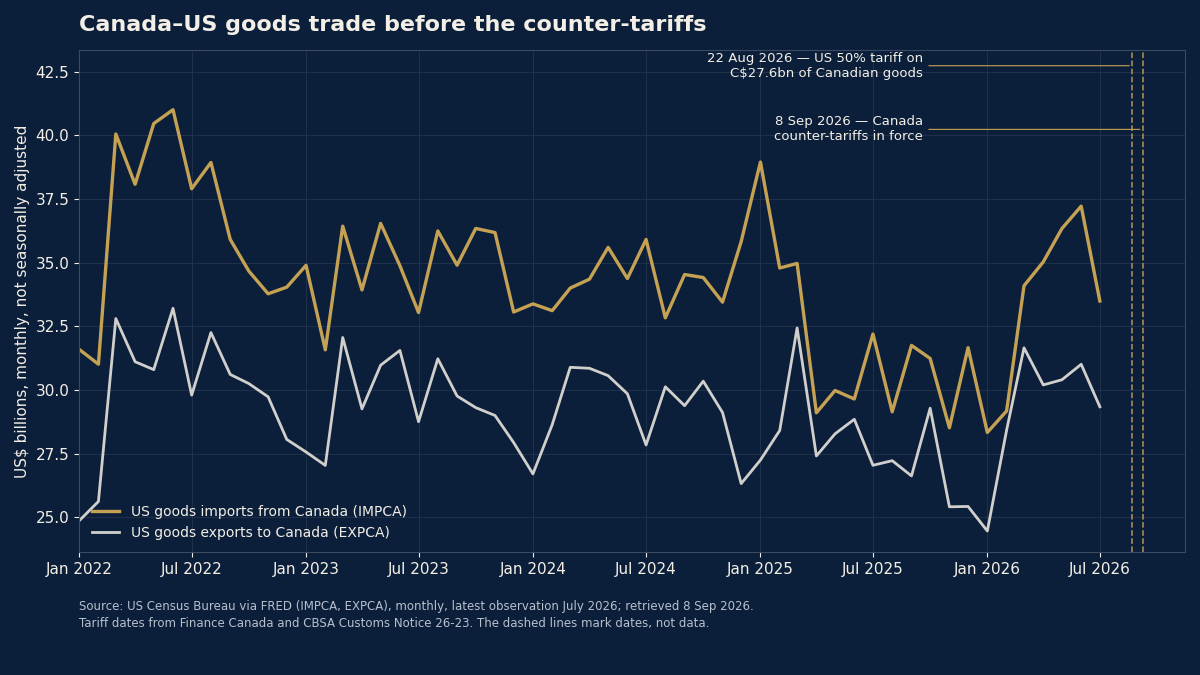
Canada’s counter-tariffs are in force. The number is C$27.6 billion
“Effective September 8, 2026, certain goods imported into Canada and originating in the U.S. are subject to a surtax of either 15%, 25% or 50% of the value for duty” under the United States Surtax Order (2026), administered by the Canada Border Services Agency. The goods are “drawn from those targeted by U.S. Section 338 and Section 232 tariffs, with the surtax applicable to each product generally corresponding to the U.S. tariff rate.”
Finance Canada’s backgrounder gives the effective time — “as of 12:01 a.m., September 8, 2026” — and the transit rule: the countermeasures “do not apply to U.S. goods that are in transit to Canada on the day on which they come into force.” It sizes the measure as a response to the United States’ “decision to impose a 50 per cent tariff on $27.6 billion of Canadian goods effective August 22,” matched “dollar for dollar,” applying “to products covering $27.6 billion in imports from the U.S.,” focused on steel, dairy, appliances, agricultural equipment, pulp and paper, and electronics.
The currency. Finance Canada’s page gives the figure as “$27.6 billion” without a label. On a Government of Canada page sizing Canadian exports and matching them dollar for dollar, the currency is Canadian: C$27.6 billion, roughly US$20 billion at early-September rates. Rendering it in US dollars overstates the measure by about a third.
Why a universal owner should care. The measure is now a customs-collection fact rather than a negotiating position — a working-capital and sourcing input for every North American industrial holding, before any treaty text changes. The mechanism is the state change, not the size. The schedule sizes an import base; it does not measure duty collected or pass-through.
The case against the read. Exemptions, remissions and the duty-relief and drawback programmes the customs notice itself references can shrink the effective base substantially, and a negotiated rollback would make this a short working-capital shock rather than a structural one. No collection data exists yet.
Sources: CBSA, Customs Notice 26-23: United States Surtax Order (2026), 7 Sep · Department of Finance Canada, list of U.S. products subject to counter-tariffs effective 8 Sep 2026
Argentina’s Malvinas decree is law, and it works through a sworn declaration
In a national broadcast on the evening of Thursday 3 September, President Javier Milei said Argentina would move to bar from operating in its territory companies “involved directly or indirectly in projects in the Malvinas Islands without Argentine authorisation” (translated from the Spanish), singling out the Sea Lion project operated by Navitas Petroleum (65%) with Rockhopper Exploration (35%). On Friday 4 September, Infobae reported, Rockhopper fell about 6% in London and Navitas 2.3% in Tel Aviv.
The instrument. Decree 868/2026, dated 3 September and published in the Boletín Oficial No. 35,985 on 4 September, in force the day after publication. It designates the Ministry of Foreign Affairs as enforcement authority for Law 26.659; obliges every national public body to report suspected breaches within five working days; gives an accused party ten working days to respond and the authority ten to decide; and — the part that reaches portfolios — requires every applicant for a hydrocarbon permit or concession under Law 17.319, and every applicant to the RIGI investment-incentive regime, to sign a sworn declaration that neither it nor any person with direct or indirect participation in it engages in the conduct Law 26.659 prohibits. The sanction under that law is disqualification for five to twenty years and reversion of concessions. Status: in force. No sanction under it has yet been imposed.
Why a universal owner should care. This is a resource-title dispute converted into a counterparty screen. Any company that wants an Argentine hydrocarbon permit or RIGI incentives must now attest, on oath, to the absence of direct or indirect participation in Falklands/Malvinas projects — through its shareholders. For an owner, that is a new compliance question on every Vaca Muerta exposure, and the cleanest current example of sovereign action landing on named listed equity in a jurisdiction with no connection to the sovereign making the claim.
Sources: Decreto 868/2026, full text as published in the Boletín Oficial No. 35,985, 4 Sep (via Comercio y Justicia) · Infobae, “Tras el anuncio de Milei cayeron las acciones de Rockhopper y Navitas”, 4 Sep
Capital in Motion
- UK Nuclear Liabilities Fund → Brookfield — stage: selected; initial commitment. $1bn (c.£750m) multi-asset mandate inside Brookfield’s Investment Solutions Group; reinvest-not-distribute structure. Not deployed. Brookfield release
- Aware Super → Macquarie Global Infrastructure Fund — stage: agreed; conditional. MGIF to acquire a 50% interest in Secure Electronic Registries Victoria, operator of Victoria’s land register under a 40-year concession granted in 2018, processing more than nine million transactions a year; Aware “will retain and manage the remaining 50% ownership.” Completion expected Q4 2026 “subject to customary conditions and regulatory approvals.” No price is stated in the releases. A superannuation fund recycling a core public-infrastructure asset while remaining the long-term operator-owner: pacing and governance, not an exit. Macquarie Asset Management release, 7 Sep
- Indonesia — stage: intention. President Prabowo Subianto, guest of honour at the 11th Eastern Economic Forum in Vladivostok on 3 September, invited Russian energy companies to bid on 138 oil and gas exploration blocks; the energy ministry’s secretary general, Ahmad Erani Yustika, confirmed the ministry “is offering more than a hundred oil and gas blocks to Russian investors.” At the same forum Prabowo said “Danantara and Russia’s sovereign wealth fund, the Russian Direct Investment Fund, can move from identifying possibilities toward financing bankable projects.” The Russian Direct Investment Fund, its management company and Kirill Dmitriev were added to the US Treasury’s Specially Designated Nationals list on 28 February 2022 under Executive Order 14024. No bid lodged, no financing signed. For anyone holding Indonesian state-enterprise paper or co-investing with Danantara, a counterparty-screening item. ANTARA, 4 Sep · ANTARA, 3 Sep · OFAC, 28 Feb 2022
Risk Radar
- Client-level vote files become discoverable from proxy advisers. Trigger: the court grants the SEC’s application without anonymisation. SEC memorandum, 4 Sep
- Absolute-output coal tests spread to other owners. Trigger: a major ESG data vendor announces absolute thermal-coal production and installed capacity as standard fields with stated coverage of unlisted subsidiaries and joint ventures. NN Group policy, Appendix V
- Argentina’s sworn-declaration regime produces a first disqualification. Trigger: a sanction resolution published in the Boletín Oficial. Decreto 868/2026
- Indonesia’s Danantara–RDIF proposal becomes a transaction. Trigger: a signed financing, not a communiqué. ANTARA, 3 Sep
- Canada–US tariff escalation. Trigger: new product schedules from either side. CBSA Customs Notice 26-23
- Strait of Hormuz. Iran’s announced restricted zone remains an intention: no coordinates, no effective date, no instrument. The strait is not closed. Live Risk Map
The UAO Signal Ledger
Meaningful but not fully confirmed. Every signal carries one status — EARLY OBSERVABLE, DEVELOPING, CONFIRMED, WEAKENED, DISPROVED, EXPIRED — and no signal leaves the ledger quietly.
- EARLY OBSERVABLE Absolute-output coal tests spread beyond NN Group
Verified: NN Group’s Appendix V thresholds (≥10 million tons; ≥5 GW) and its on-record data dependence · Unknown: whether any vendor plans absolute production and capacity fields with subsidiary coverage · Evidence for: NN Group policy and written answers · Evidence against: NN says it cannot speak for peers; no peer statement found after a search · Evidence strength: strong · Analytical conviction: medium · Last checked 8 Sep 2026, 10:30 UTC · Confirms/disproves: a vendor product announcement, or a second owner policy in tons or gigawatts · Next catalyst: next owner policy updates in Q4 2026 - DEVELOPING Client-level proxy vote files become producible to the SEC
Verified: the 4 September application to compel; ISS’s objections as the SEC records them · Unknown: the court’s ruling and any anonymisation compromise · Evidence for: SEC memorandum of law · Evidence against: ISS’s confidentiality and First Amendment objections in the same filing · Evidence strength: strong · Analytical conviction: medium · Last checked 8 Sep 2026, 10:30 UTC · Confirms/disproves: an order granting or denying production; terms of any anonymised set · Next catalyst: E.D. Pa. docket 2:26-mc-00078; no hearing date published - EARLY OBSERVABLE Danantara–RDIF co-financing becomes a transaction
Verified: Prabowo’s stated proposal; RDIF’s SDN listing · Unknown: any signed vehicle, project or amount · Evidence for: ANTARA reports; OFAC listing · Evidence against: nothing beyond the speech; no bid or agreement found · Evidence strength: moderate · Analytical conviction: low · Last checked 8 Sep 2026, 10:30 UTC · Confirms/disproves: a signed financing agreement or a named project · Next catalyst: none dated - EARLY OBSERVABLE Argentina issues a first disqualification under Decree 868/2026
Verified: the decree is in force with a sworn-declaration mechanism · Unknown: whether any company is reported, and which · Evidence for: Decree text in the Boletín Oficial · Evidence against: no resolution published · Evidence strength: strong · Analytical conviction: low · Last checked 8 Sep 2026, 10:30 UTC · Confirms/disproves: a sanction resolution in the Boletín Oficial · Next catalyst: ten-working-day response windows once a report is filed - DEVELOPING EU–Greenland partnership package (carried from 7 September)
Verified: a package was announced during the Commission president’s visit · Unknown: project list, grant/loan mix, legal basis · Evidence for: Commission statements as reported · Evidence against: no project-level commitments disclosed · Evidence strength: moderate · Analytical conviction: low · Last checked 8 Sep 2026, 10:30 UTC · Confirms/disproves: a programme legal basis or a project list · Next catalyst: 2028–34 envelope proposal - DEVELOPING Reported US–South Korea Texas gas plant (carried)
Verified: a report citing unidentified officials · Unknown: sponsor, interconnection filing, permit, offtaker · Evidence for: Edaily report · Evidence against: Seoul’s Industry Ministry could not confirm · Evidence strength: weak · Analytical conviction: low · Last checked 8 Sep 2026, 10:30 UTC · Confirms/disproves: a named sponsor or an ERCOT interconnection filing · Next catalyst: none dated - DEVELOPING China storage-battery approval pause (carried)
Verified: industry-source reporting of a pause on unstarted factories · Unknown: a ministry notice or affected-project list · Evidence for: Cailianshe and Reuters reports · Evidence against: no published directive · Evidence strength: weak · Analytical conviction: medium · Last checked 8 Sep 2026, 10:30 UTC · Confirms/disproves: a published national directive · Next catalyst: none dated - DEVELOPING Germany’s anti-sabotage and counter-drone package (carried)
Verified: interior-ministry planning confirmed · Unknown: enactment · Evidence for: ministry statements · Evidence against: not enacted law · Evidence strength: moderate · Analytical conviction: low · Last checked 8 Sep 2026, 10:30 UTC · Confirms/disproves: a bill introduced or passed · Next catalyst: none dated - EARLY OBSERVABLE iBRICS Delhi, 12–13 September (carried)
Verified: the meeting is scheduled · Unknown: who attends; the organiser’s AUM claim · Evidence for: organiser materials · Evidence against: the “$1tn in the room” figure is an organiser claim · Evidence strength: moderate · Analytical conviction: low · Last checked 8 Sep 2026, 10:30 UTC · Confirms/disproves: an attendee list from the organiser · Next catalyst: 12–13 September 2026 - DEVELOPING Waterland bid for Gamma Communications (carried)
Verified: a bid was being prepared · Unknown: whether it was submitted · Evidence for: press reports · Evidence against: no announcement by either party · Evidence strength: weak · Analytical conviction: low · Last checked 8 Sep 2026, 10:30 UTC · Confirms/disproves: a Rule 2.4 or 2.7 announcement · Next catalyst: none dated
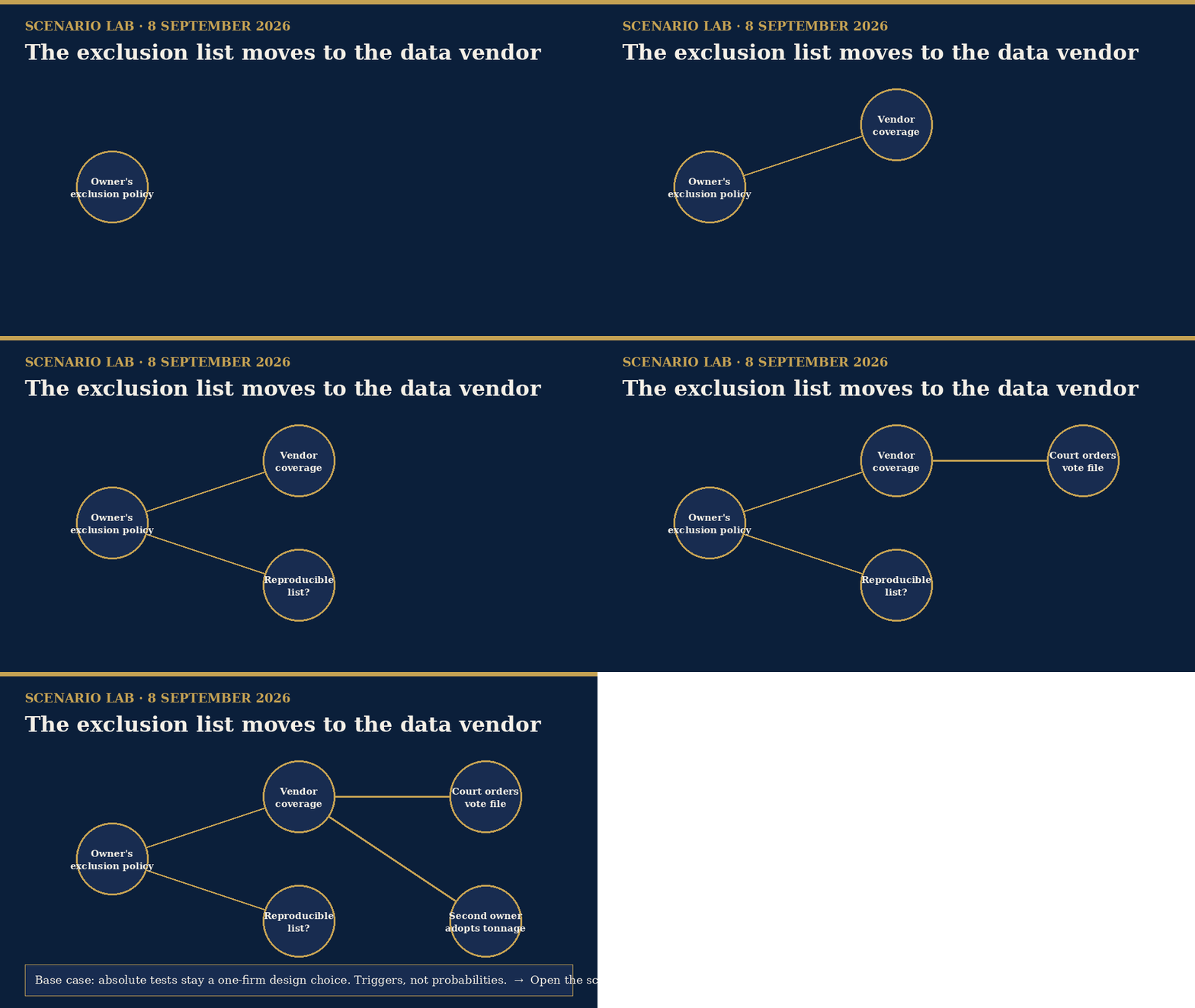
Base case. Absolute-output coal tests remain a one-firm design choice. No major ESG data vendor adds absolute thermal-coal production and installed capacity as standard fields with stated coverage of unlisted subsidiaries and joint ventures; each owner’s exclusion list stays only as reproducible as its own hand-built file.
It escalates if — each observable, each dated
- A major ESG data vendor announces absolute production and capacity fields as standard, with a coverage statement for unlisted subsidiaries and joint ventures.
- A second European insurer, or a large Dutch or Nordic pension, publishes a threshold denominated in tons or gigawatts within two quarters.
- The court in SEC v. ISS orders client-identified production — a second file, in a second market, becoming producible on demand.
It de-escalates if
The next three owner policies published lean on revenue share; the court accepts anonymised production; no vendor adds the fields.
Falsifier: an owner publishes an exclusion list reproducible from source data. Update rule: re-scored on vendor product announcements and owner policy publications, not on market moves. No probability is published for this scenario. Open the scenario →
The reproducibility test — three questions per rule
- For each exclusion, restriction or voting instruction: is the determining input audited, vendor-estimated, or self-reported?
- Where it is a vendor’s or a platform’s: what is their coverage of unlisted subsidiaries, joint ventures, minority holdings and custom policies?
- If the process has a discretionary limb: who decides, on what evidence, and is the decision written down where a trustee can inspect it?
Editorial watchlist — named, unsized, not promoted
- Taiwan’s Bureau of Labor Funds — reported to have introduced a 2030 restriction on new investment in fossil-fuel companies “not actively transitioning” in its directly managed equities; the 2024–2025 sustainability report itself was not available on BLF’s site at publication.
- GPIF — the health minister is reported to have said the fund is still considering whether an allocation review is required after deciding in March that one was not needed; no decision.
- Colombia’s 12.5% US tariff — an exporters’ association president’s expectation that it falls to zero within days; no decree read, no US statutory basis stated.
- Gildi–Festa — merger agreement signed 4 September; member votes 4–5 November. Not closed.
Future Signals — next triggers
- 24 hours — Wednesday 9 September, 10:00 KST. Korea Zinc’s EGM: four directors elected by cumulative voting, one day before the amended Commercial Code takes effect.
- 7 days — Thursday 10 September. Korea’s cumulative-voting and audit-committee provisions commence for large listed companies; the European Parliament’s ECON committee votes on SFDR the same day. Rolling: the SEC v. ISS docket in the Eastern District of Pennsylvania.
- 30 days. Aware Super–Macquarie SERV completion expected in Q4 2026; NLF’s next annual funding review; OPEC+ meets 4 October.
The Job Board
Live openings at asset owners, each with its closing date, taken from the institution’s own careers portal on 7 September. All current roles →
- AIMCo — Director, Quantitative Investment Research · Calgary · closes 26 September 2026 · Apply →
- Ontario Teachers’ Pension Plan — Intern — Investments, Capital Markets, Hedge Funds & Insurance-Linked Securities (May 2027) · Toronto · closes 22 September 2026 · Apply →
- Ontario Teachers’ Pension Plan — Intern — Risk, Models and Asset Liability (May 2027, 12 months) · Toronto · closes 22 September 2026 · Apply →
- OMERS — Student, Portfolio Construction (Winter 2027) · Toronto · closes 21 September 2026 · Apply →
- PSP Investments — Intern, Real Estate Investments — London (off-cycle, January–June 2027) · London · closes 21 September 2026 · Apply →
- AIMCo — Student, Private Equity (May 2027) · Calgary · closes 1 October 2026 · Apply →
Meet The Allocator

Source ledger. NN Group release, 3 Sep 2026 · NN Group Responsible Investment Framework policy, Appendix V · NN Group restrictions page · NN Group written answers to Universal Asset Owners, 8 Sep 2026 · SEC memorandum of law, 2:26-mc-00078, filed 4 Sep 2026 · Brookfield Asset Management release, 8 Sep 2026 · Nuclear Liabilities Fund, “How we are funded”, “Our investments”, “Investment principles” · CBSA Customs Notice 26-23, 7 Sep 2026 · Department of Finance Canada backgrounder · ANTARA, 3 and 4 Sep 2026 · OFAC, 28 Feb 2022 · Macquarie Asset Management release, 7 Sep 2026 · Infobae, 4 Sep 2026 · Decreto 868/2026, Boletín Oficial No. 35,985, 4 Sep 2026.
Universal Asset Owners · 8 September 2026 · For institutional research and discussion. Not investment advice.