| View this email as a web page |
The Universal Owner UAO Daily Brief · Wed, July 15, 2026 · Vol 1, Issue 61 |
 |
Watch · Today's briefing |
The Lead Is AI eating its own budget? IBM warned on July 14 (preliminary) that Q2 revenue would land near $17.2bn, below the ~$17.86bn consensus, with EPS $2.93. The reason is the story: in late June, clients pulled spending into supply-constrained servers, storage and memory ahead of price rises, and several large deals slipped. Software still grew 5%, Red Hat 11% — and management admitted execution failures and a cybersecurity distraction. So this is a question, not a verdict: is the AI build-out reallocating a finite enterprise budget, not expanding it? Triangulate it. The BIS (Bulletin 128) estimates business-development companies hold about $115bn of software loans — ~a fifth of BDC lending — not yet priced differently for AI risk (though much is secured, at low leverage). Meanwhile CalSTRS is committing up to $2bn to the hardware/power side. An owner can finance the bottleneck and lend to the revenue it may displace — two claims on one customer budget. Confirms: IBM final results (Jul 22), stalled conversion, widening BDC marks. Falsifies: fast conversion, bigger budgets. | Chart of the day — the insurance range 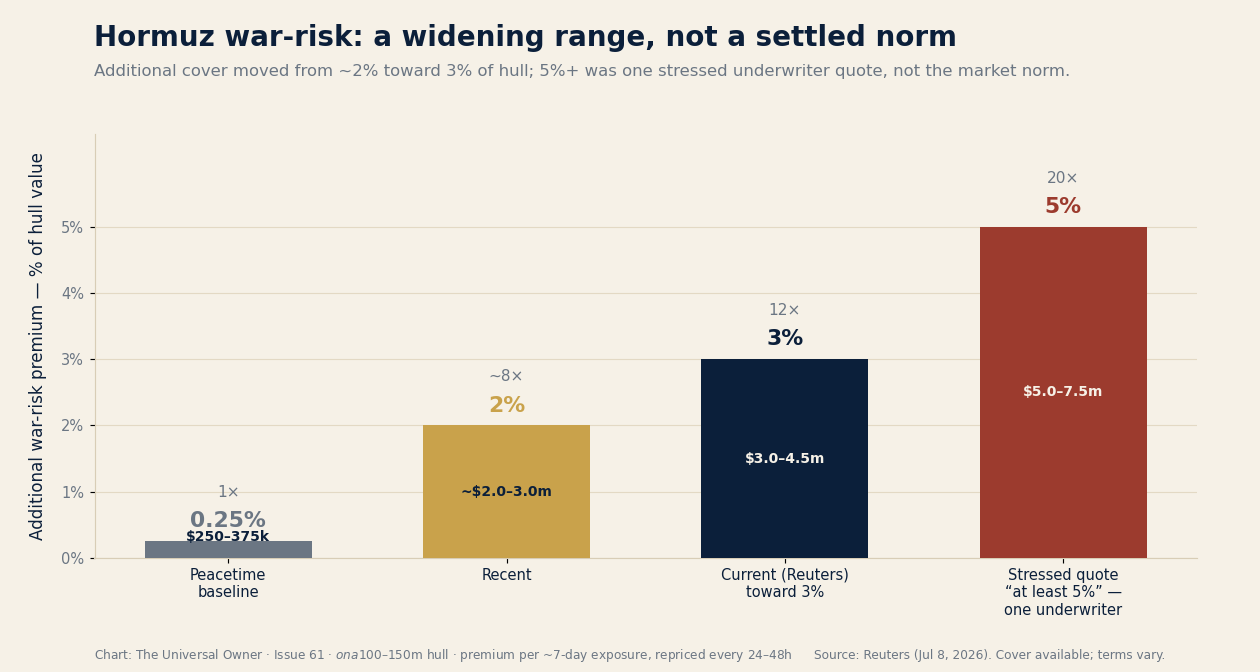 Additional war-risk cover moved ~2% toward 3% of hull; 5%+ was one stressed underwriter quote, not the norm. On a $100–150m hull: 0.25%=$250–375k; 3%=$3.0–4.5m (12×). Premium per ~7-day exposure. Source: Reuters, Jul 8. | The Hormuz fee died; the Iran blockade didn't The proposed 20% cargo fee was withdrawn; the U.S. blockade — on vessels tied to Iranian ports or cargo, not neutral passage — took effect ~16:00 ET Jul 14. "Gulf capital is the new price of passage" is a hypothesis attributed to the President: no amounts, counterparties or signed deals were disclosed. The UAE's $1.4tn framework is March-2025 background; PIF and QIA are separate. Front-month Brent settled ~$84.73 (Jul 14), above $85 early Jul 15. IRGC claimed strikes on Bahrain, Kuwait and Jordan (unverified).  | Korea's megaprojects meet the grid Seoul raised its 2026 growth forecast to 3.0% and will fast-track three megaprojects announced June 29 — a ~₩800tn chip build-out and a ~₩550tn/8.4 GW data-centre plan. These are mainly corporate plans (Samsung, SK, Naver), staged and conditional — not government appropriations. The owner point is the gap between announced capex and execution capacity: power, water, land, permits, timelines — with oversupply a real counter-case. (New York froze new ≥50 MW data centres; Switch lined up a possible ~$80bn IPO — power is scarce, but neither "proves" the trade.) The capital behind it: sovereign funds manage >$15tn; across 391 tracked direct deals over 18 months to Dec 2025, ~$404bn was spent and about a third of that tracked spending was AI-related — the abundant-capital side of a thesis whose scarce input is conversion capacity. | Macro — a real print with a live reversal risk U.S. June CPI −0.4% m/m (largest drop since April 2020); headline +3.5% y/y, core +2.6%; energy −5.7% m/m but +15.7% y/y. It was energy-driven — and that relief sits downstream of a live blockade. Fed Chair Warsh held the range at 3.50–3.75% and gave no guidance. On rate odds, cite a named source + meeting (e.g., CME FedWatch) — don't splice prints. China: Q2 GDP +4.3% — slowest since 2022, below the low end of the 4.5–5% range, but H1 growth of 4.7% is still within it (no annual-target miss). Property investment −18% H1. Counter-side: June exports +27%, industrial output +5.3%. Watch the late-July Politburo for the stimulus channel. | Today's scenario — interactive 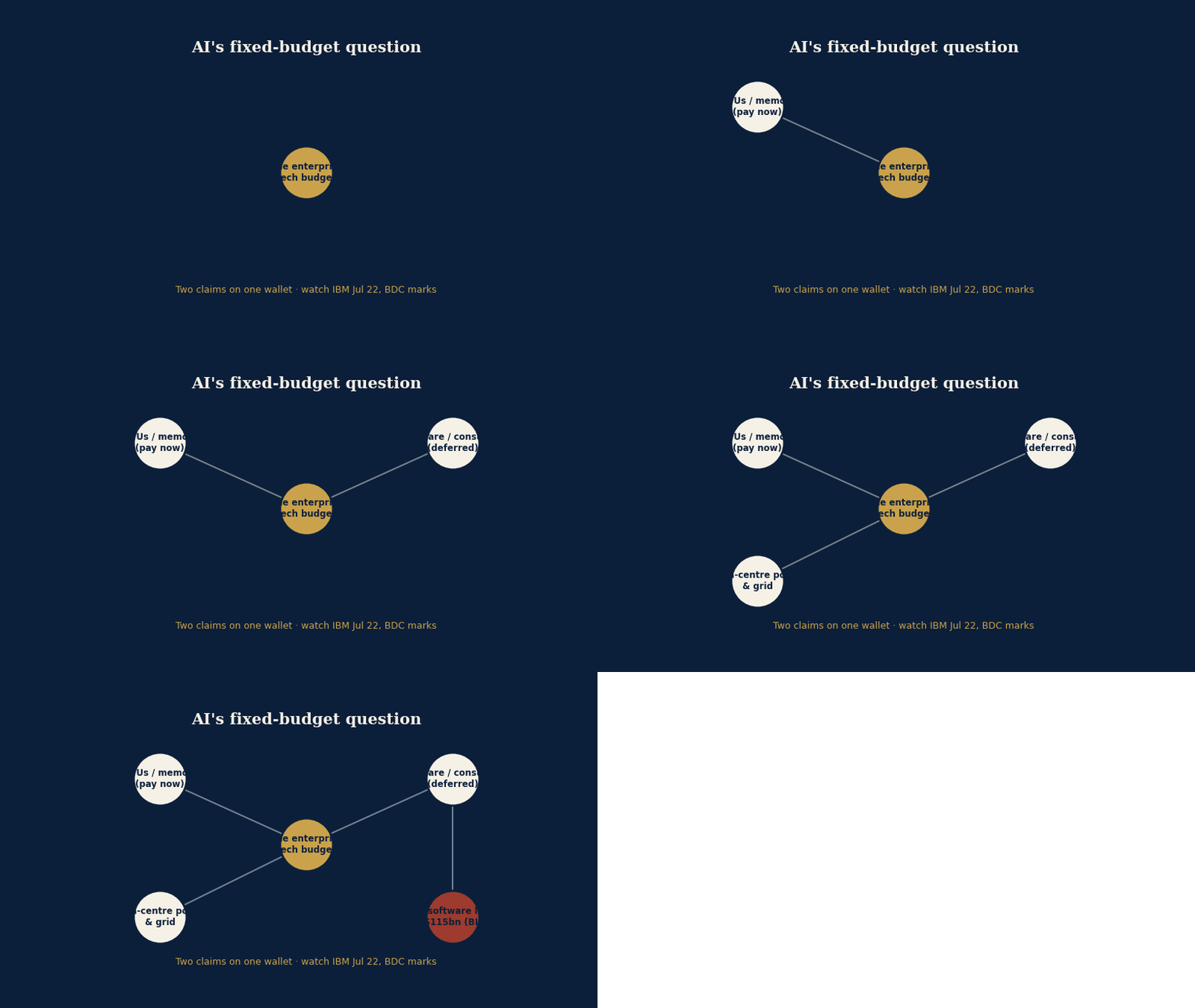 | Asset-owner & market moves CalSTRS/Nuveen — up to $2bn Energy & Power Infrastructure Credit (renewables, storage, decarbonisation, AI/digital). ASML raised FY2026 guidance to €43–45bn on AI demand. Switch hired banks for a possible Q4 IPO ~$80bn (incl. debt). New York — first U.S. state to pause discretionary permits for ≥50 MW data centres. Reserves: the dollar's COFER share rose to 57.1% (first increase since late 2024) even as 82% of central banks hold gold and >30% plan to add. Private credit: U.S. direct-lending volume fell ~55% q/q to $33.6bn. Nigeria — PenCom assets +51% in two years to ~$22.8bn, pivoting toward infrastructure. Stewardship: a Paris court held TotalEnergies' vigilance plan must address Scope 3. BoK — 36 of 37 economists expect a +25bp hike to 2.75% on Jul 16 (first in 3+ years). | Signals before consensus — watch, not fact Open-source / early-warning items — labelled unconfirmed, for the research queue: a BIS working paper (No. 1367) models the AI build-out as a winner-take-most race with over-investment ~50% above efficient; CoreWeave is reportedly exploring (not executing) memory-chip-price hedges; Colliers puts 2025 data-centre investment above $580bn, past new-oil-supply spend. Next 72h: IBM final Q2 (Jul 22) · BoK (Jul 16) · China Politburo (late July) · OFAC Iran-oil wind-down ends 12:01am ET Jul 17. | Today's deep dive Capital Commitments Are Abundant. Conversion Capacity Is Not. A blockade, a chip cluster and a sovereign-fund redesign all reprice the same thing: the machinery that turns capital into cash flow. Read the deep dive → |
|
Energy & physical risk — two correlated shocks Typhoon Bavi forced 260,000+ evacuations in Liaoning, China, shutting parts of the Shenyang subway and disrupting transport, while New York's Champlain Hudson Power Express (~20% of NYC's electricity) tripped offline a second time in July — two physical-risk events, in two economies, hitting portfolios that model them as uncorrelated. The U.S. Strategic Petroleum Reserve fell to ~316.5m barrels, its lowest since April 1983, thinning the buffer against exactly the Hormuz shock now live. On the build side, long-duration nuclear is gaining policy tailwinds: Sizewell B won a 20-year life extension to 2055, and the U.S., Japan and Korea signed an SMR cooperation memorandum — a pipeline of interest to infrastructure and real-assets allocators even as Western Europe bakes through a third heatwave. | People & mandates — the daily leadership check GIC named Choo Yong Cheen and Liew Tzu Mi deputy group CIOs (effective Oct 1). South Africa's PIC (~R3tn for the GEPF) placed CEO Patrick Dlamini on precautionary suspension amid a whistleblower probe — governance instability at the JSE's anchor investor. Future Standard named ex-BlackRock alternatives head Edwin Conway CEO (~$94bn). In the UK, Chancellor Rachel Reeves' Mansion House address set out plans for the first G7 digital sovereign bond (targeted early 2027), while TPR published a five-year strategy operationalising the Pension Schemes Act 2026 (value-for-money, guided retirement, multi-employer CDC). India's SBI Funds IPO (ADIA + GIC anchored) was fully subscribed — an offer for sale, so the manager takes no proceeds. | Sponsor · AssetOps by Corinium AssetOps — where the buy-side operating layer meets. The COO, operations, data and technology leaders behind the world's largest allocators gather at AssetOps Chicago on 11 August 2026, at the DoubleTree by Hilton – Magnificent Mile. Solve the operating problems scale can't out-invest. |
|
Listen · The Universal Owner  Today's episode (~7 min): Is AI adding to budgets or eating them? Sponsored by AssetOps Chicago, by Corinium. |
The Back Page with The Allocator A lighter look at the institutional week, from the desk of a man who owns a slice of everything and is pitched by everyone. The Allocator · "One Wallet, Two Invoices" — tap to watch on the web edition. 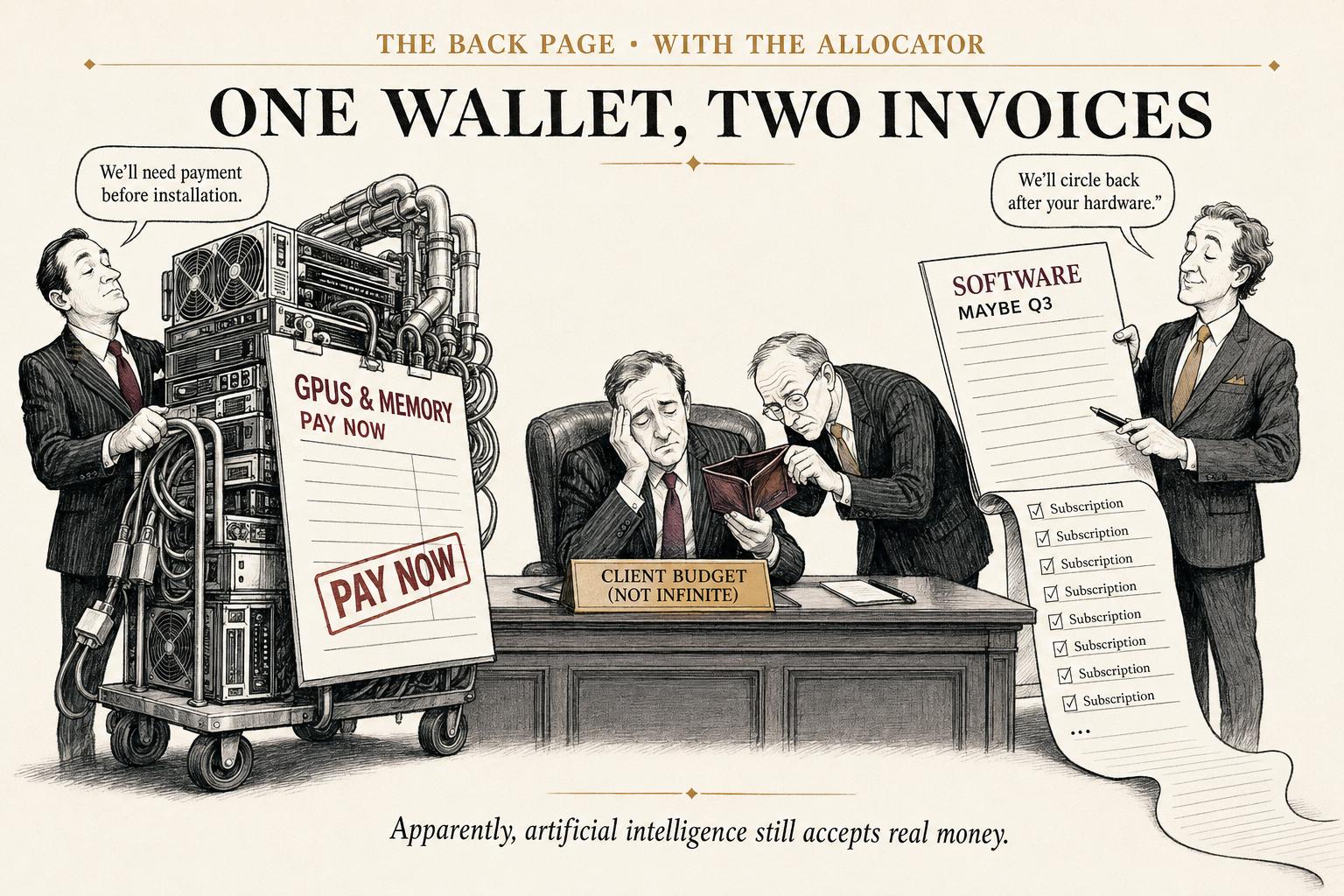 Follow The Allocator — a UAO editorial character. |
Follow The Universal Owner |
|
