Why it matters
Two panels, one argument.
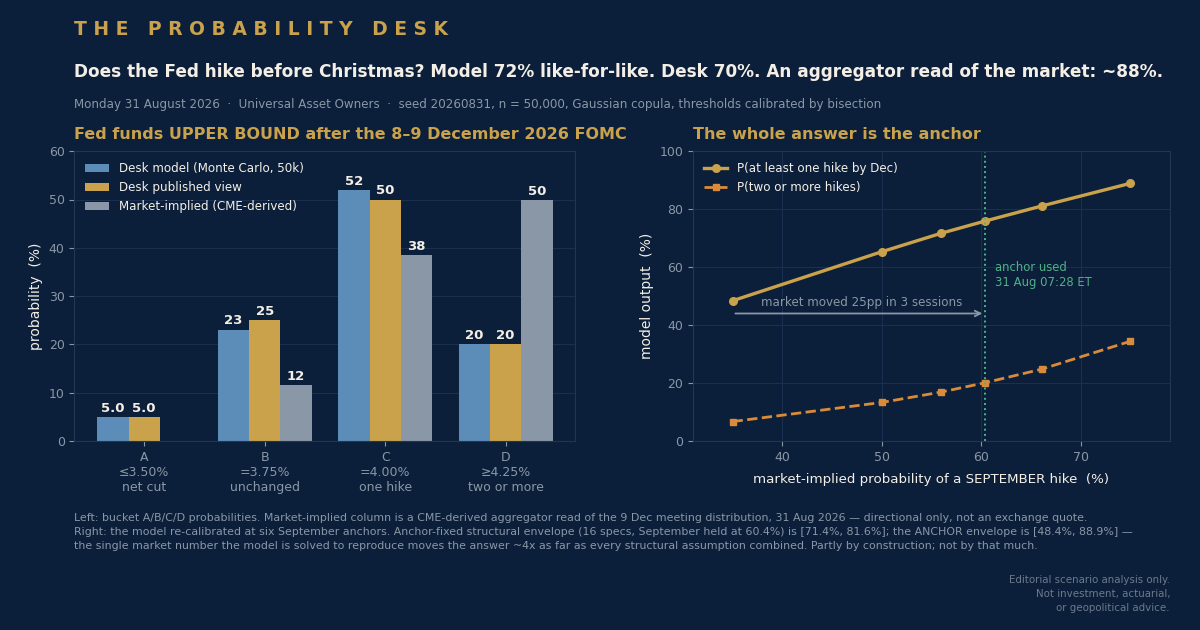
Left: where the federal funds target range lands after the 8–9 December FOMC. The Desk model puts 51.9 percent on exactly one increase and 20.1 percent on two or more — 71.98 percent between them. Our published view is 5 / 25 / 50 / 20, a 70 percent chance of at least one hike, two points below the model. A CME-derived aggregator read of the December meeting on 31 August implies roughly 88 percent, with nearly half its weight on two or more increases. That aggregator figure is the weakest number on the page and is treated as directional. The disagreement is not about whether the Fed moves. It is about whether it moves twice.
Right: the same model re-calibrated at each September probability the market has actually printed since Chair Warsh spoke at Jackson Hole on 28 August. At 35 percent — where pricing sat on 27 August, the day before the speech — the model returns 48 percent for at least one hike by December. At 60.4 percent, Monday morning's reading, it returns 75.9. At 75 percent it returns 88.9.
That is the finding. Hold the anchor genuinely fixed — every specification re-calibrated to the same September probability — and vary everything else in the model across sixteen specifications: the correlation matrix, the persistence terms, the gradualism and financial-feedback constants, a Student-t copula, the oil pass-through path. The answer spans 71.4 to 81.6 percent, a width of ten points. Vary the anchor across the readings of one week and it spans 48.4 to 88.9, a width of forty. The single market number the model is calibrated to is worth about four times every structural assumption combined. Some of that is by construction, since the model's threshold is solved to reproduce the anchor. The size of it is not.
For an allocator the practical use is the right-hand panel, not the left. Find your own view of September on the horizontal axis and read the December answer off the curve. If you think the market has over-extrapolated a speech, you are somewhere near the middle of that line, and so are we.
Read the full scenario
Editorial scenario analysis only. Not investment, actuarial, or geopolitical advice.