UNIVERSAL ASSET OWNERS DAILY
WEDNESDAY, 25 NOVEMBER 2026
Wednesday, 25 November 2026
The lead | Fiduciary purpose meets the decision record
Canada’s institutional investment community is putting fiduciary purpose at the centre of its responsible-investment work. In research released on 24 November, the Responsible Investment Association reported that 62% of respondents ranked fiduciary duty among their three leading reasons for responsible investment, compared with 48% in 2025.
The survey covered 93 organizations: 55 asset managers and 38 asset owners. Environics Research conducted the fieldwork from May to July. Its publication is new; its responses describe practices reported earlier in the year.
Our analysis: a stated objective becomes useful when the institution can show how it informed a decision. The board needs a record of the evidence, the authority delegated and the conditions that would trigger a review. Today’s briefing follows those questions through monetary policy, European trade, property transactions and investment governance.
RIA institutional survey, 24 November
Essential numbers
62% — respondents ranking fiduciary duty among their top three responsible-investment motivations.
€36bn — the EU’s third-quarter goods trade deficit, in Eurostat’s release today.
€96.3bn — the energy component’s trade deficit in that quarter.
2% — the inflation target retained in Canada’s renewed framework, within a 1–3% range.
€60m — EIB financing for the Tampere e-methane project, announced on 20 November.
Eurostat Q3 trade release, 25 November
Watch the Latest UAO LIVE with Ryan Lafield

Ryan’s latest programme, Episode 72, examines Jensen Huang, NVIDIA and the concentration of expectations around a single company and its leadership.
Watch Episode 72 on YouTube · Read Ryan’s programme notes
Listen to today’s podcast | The Universal Owner
Pensions and sovereign capital | KIC pairs investment and operating leaders
Korea Investment Corporation announced on 23 November that Shin Min-sik would become its chief investment officer and Shin Yong-sun its chief operating officer. Its own release identifies the former as previously investment CIO at Hanwha Life and the latter as KIC's head of alternative investments.
The paired appointments provide a useful starting point for our analysis of institutional continuity. Portfolio decisions depend on valuations, data access and the authority to appoint and challenge outside managers. A transition review should establish who owns each decision and which arrangements survive a change in personnel.
A board can test continuity before it is needed: ask a second team to reconstruct a significant recent decision from the records. Missing assumptions or unclear ownership are practical findings that can be corrected during a leadership transition.
KIC official appointments, 23 November
Norway and stewardship | A uniform ballot is market infrastructure
In a 20 November submission, Norges Bank Investment Management told the US Securities and Exchange Commission that it does not support rescinding Rule 14a-8, the federal route that allows qualifying shareholder proposals into company proxy materials.
NBIM manages more than US$2 trillion. At the end of June, the United States represented 53% of total investments, including US$905 billion in shares of 1,243 US listed companies. Its average holding is a minority stake, so the quality of market-wide shareholder rights matters.
The investment case is about infrastructure. NBIM says a uniform route to the ballot reduces cost, complexity and uncertainty. It also says financially material proposals can help investors identify and manage emerging risks across a diversified portfolio.
But this is not an argument for every proposal. NBIM supports filtering proposals that are immaterial, too prescriptive or poorly scoped. The transferable asset-owner lesson is to protect the mechanism, then apply a financial-materiality test case by case.
NBIM shareholder-proposal submission, 20 November
Governance and fiduciary affairs | The US rulebook may tighten
The US Department of Labor’s proposal announced on 23 November would revise how retirement-plan fiduciaries apply the loyalty and exclusive-purpose requirements. It would remove the existing tiebreaker provision and bring engagement activities within the same framework as proxy voting. The department’s fact sheet describes a 60-day comment period after Federal Register publication.
This remains a proposal. The practical task for affected institutions is to read the text, identify the decisions it would cover and distinguish prospective requirements from rules already in force. A consultation announcement does not establish that a plan must implement the proposed language today.
US Labor Department proposed loyalty rule; not final
Capital flows and acquisitions | PSP agrees London sale to Google
Yesterday, PSP Investments and BNP Paribas Asset Management Alts announced an agreement to sell Six Pancras Square in London's King's Cross district to Google, the occupier. The joint venture acquired the property in 2013 through a development forward-funding arrangement. The official announcement describes a planned sale and does not disclose consideration.
The distinction is important for a pension investor's liquidity report. An announced disposal is not the same as cleared cash available for commitments. The announcement does not disclose the price or confirm completion.
Our analysis is to review the remaining conditions, expected settlement and the treatment of proceeds. The buyer's decision to own the building is a separate economic choice from the sellers' decision to recycle capital after a long holding period.
PSP and BNP Paribas planned Google sale, 24 November
Credit support | The guarantee is not the asset
Our credit-support case comes from the European Investment Bank's 20 November announcement. It is providing €60 million for Nordic Ren-Gas's e-methane project in Tampere, backed by InvestEU. This is dated project-finance background, included to examine the allocation of risk among lenders, sponsors and public support.
A project memo should identify which obligation receives support and which risks remain with investors. Construction delays, technology performance and the terms of fuel sales can still determine repayment. Public involvement can change the financing structure without settling those operating questions.
Our analysis is to follow cash through each contract. Test what happens if the plant is ready before an essential connection, or if an input bill resets before the sale price. The relevant protection is the enforceable provision and the counterparty's capacity to honour it.
EIB Tampere e-methane project, 20 November
European direct lending | Follow the borrower across mandates
A European direct-lending review should begin with the borrower. Ask managers to identify borrowers shared with other funds, lending arrangements between related vehicles and any exposure that depends on the same private-equity sponsor.
Then examine amendments. A payment-in-kind election, extended maturity or revised covenant can change the timing and uncertainty of a loan's cash receipts. A valuation that appears stable does not establish that contractual risk is unchanged.
Our analysis favours a reconciled view across mandates: borrower, collateral, seniority, sponsor and expected cash collection. That gives an investment committee something it can act on when separate manager reports describe the same underlying stress in different ways.
Treasury and liquidity | Canada renews its inflation framework
Governor Tiff Macklem's speech yesterday explained the renewal of Canada's monetary-policy framework for five years, retaining the 2% inflation objective within a 1–3% range. He distinguished temporary price shocks from inflation that persists.
For an asset owner, that distinction matters when testing inflation-linked liabilities against nominal income. Our analysis separates a temporary change in prices from a persistent increase in costs. Neither the renewed target nor the speech fixes the next interest-rate decision.
Keep the treasury review practical: check collateral settlement, refinancing dates and access to cash under more than one rate path. An investment can have a reasonable long-term return and still be unsuitable for meeting a payment due before it can be sold.
Bank of Canada released speech, 24 November
Europe | New trade figures and the cost of resilience
Today's Eurostat publication puts the European Union's third-quarter goods imports at €730 billion and exports at €694 billion. The resulting deficit was €36 billion. The energy trade balance was negative €96.3 billion.
Trade values reflect prices as well as quantities. They should be read alongside the contracts and operating exposures of the businesses in a portfolio.
Our portfolio interpretation is to examine import dependence alongside customers' ability to absorb costs. Fuel buyers, transport operators and energy producers face different exposures. A single geopolitical label is too broad to tell a board which business needs liquidity first.
Eurostat Q3 trade release, 25 November
Yesterday, European Central Bank Vice-President Boris Vujčić discussed resilience in central and eastern Europe. His speech considered how economies absorb shocks and adapt, including through openness, diversification and buffers. This is a policy speech, not a new inflation or wage release.
For today's prices-and-wages analysis, examine operating contracts rather than assuming that every asset moves with a broad index. Wage agreements, input contracts and regulated tariffs can reset at different dates. A business may face a higher cash cost before it can raise revenue.
That timing difference is the question to put beside the portfolio's inflation assumptions. Today's new trade figures provide additional context for import costs, but they do not measure an individual company's pricing power.
ECB Vice-President speech, 24 November
European renewable gas | E-methane’s connected contracts
The Tampere project announced by the EIB on 20 November is expected to combine renewable hydrogen with captured biogenic carbon dioxide to produce e-methane. It also plans to recover heat for the local district-heating network. Completion is planned for 2029; these are intended operating outputs, not production already achieved.
This belongs in our European renewable-gas lane, with an important technical distinction: e-methane made from hydrogen and captured carbon is different from biomethane upgraded from biogas. The investment review should use the correct process, feedstock and certification assumptions.
Our analysis follows the links between electricity, carbon capture, gas delivery and heat sales. Multiple revenue streams may diversify income, but shared equipment and counterparties can also transmit a failure from one part of the project to another.
EIB Tampere e-methane project, 20 November
Climate, nature and stewardship | Measurement is widening
Climate Engagement Canada's English-language benchmark-results event appears on the Responsible Investment Association's calendar for today. It is a scheduled event in this edition; we are not presenting a future discussion as an already-verified outcome.
The practical climate question for trustees is how information changes a decision. Define the exposure being assessed, the evidence required and the person accountable for escalation. A disclosure can help identify a risk without establishing the best investment response.
A related governance question arises in philanthropy: how can an institution accelerate emergency grants while recording authority, intended purpose and follow-up? Our analysis is that urgency changes the timetable but does not remove the need to identify who can decide and how the result will be assessed.
RIA / Climate Engagement Canada event calendar
Chart | What governance is being asked to absorb
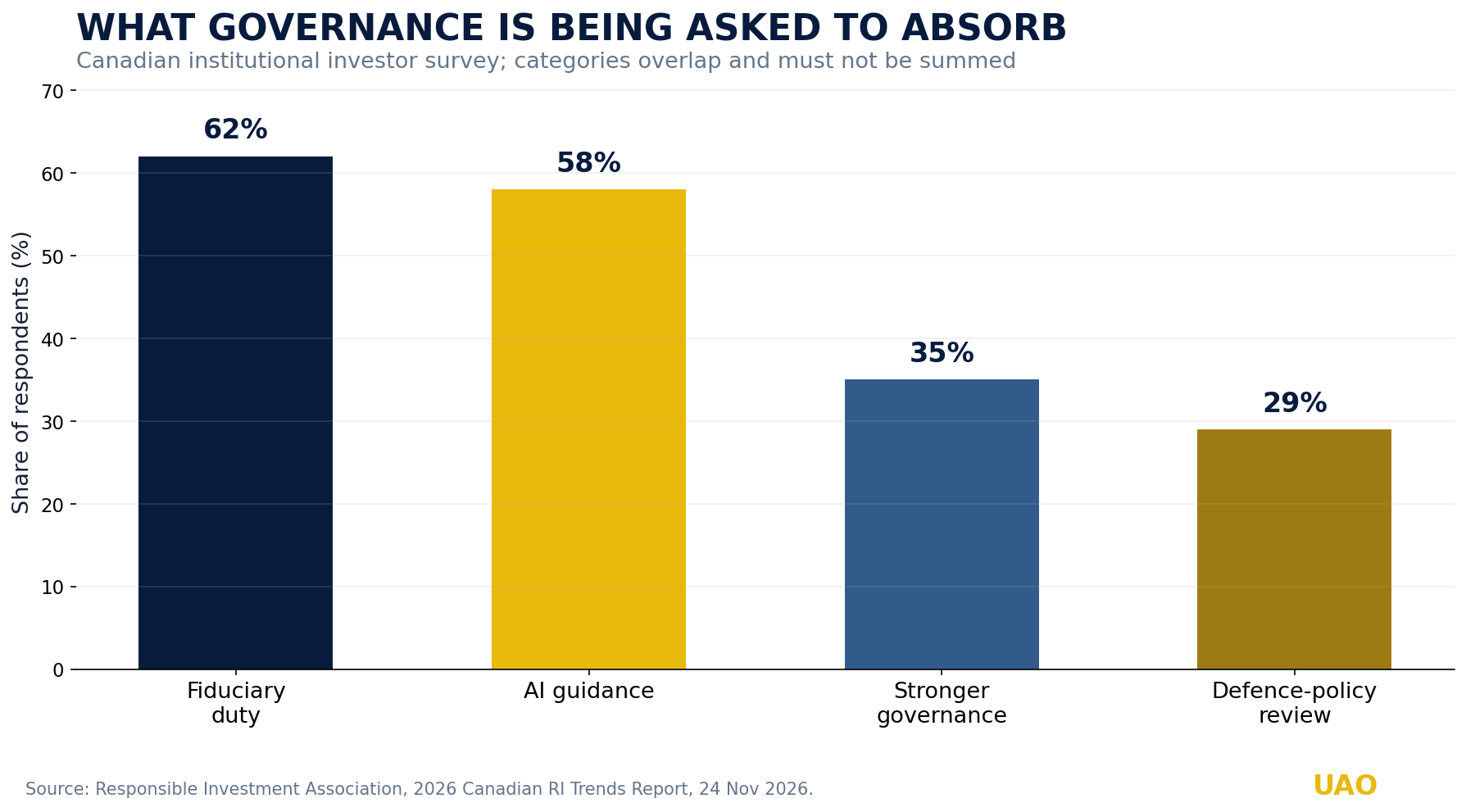
Four different measures from the Canadian institutional survey. The response groups overlap and must not be added. Survey fieldwork ran from May to July; the report was published on 24 November.
RIA institutional survey, 24 November
Executive profile | Patricia Fletcher and the work of board education
Patricia Fletcher leads Canada's Responsible Investment Association as chief executive. Her background places director education beside investment practice: before joining the association, she was vice-president of education at the Institute of Corporate Directors. The RIA's published biography describes her work on its director education programme and on environmental, social and governance education for Canadian directors. Those are relevant credentials for an association asking investors to explain how broad policies translate into decisions.
The same biography credits Fletcher with establishing Chapter Zero Canada, part of the Climate Governance Initiative, and serving on that initiative's global board-education committee. It also records earlier senior roles at the Canadian Institute, Hay Group and the Institute for International Research. The public account establishes experience in governance education and commercial information.
Her role is relevant to this week's research because the association is reporting what investment organizations say about their own practices. That is useful evidence, with limits. A survey can identify areas attracting attention and help a board ask better questions. It cannot determine whether a respondent's controls work in practice or whether another institution should adopt the same policy. Our analysis starts with that distinction between reported practice and demonstrated effectiveness.
An association leader faces a particular task when members have different mandates. A pension plan, an investment manager and an organization investing an endowment can face different liabilities, commercial obligations and decision processes. Publishing a common vocabulary can help them compare evidence. Prescribing an identical answer would require assumptions about each institution that a sector survey cannot supply. The value of research lies partly in showing where questions differ, as well as where respondents agree.
Director education offers a useful way to examine that problem. A board needs enough understanding to challenge an explanation without attempting to perform every specialist's job. Consider an investment proposal that relies on a new analytical model. Trustees should be able to ask what information entered the model, what uncertainty remains and who checked the conclusion. Those questions do not require the board to build the software. They require clarity about the decision and the chain of responsibility.
The same approach applies to climate or defence exposure. Before changing a mandate, an institution needs to identify the financial exposure, relevant restrictions and authority for an exception. It should also establish how it will judge the result. A committee can agree on a general objective while disagreeing about the evidence needed to act. Recording that disagreement can make a later review more useful than a policy document that hides the unresolved judgement behind broad wording.
Fletcher's published career therefore provides a starting point for an institutional question, rather than evidence of a particular investment outcome. How does information reach the people who can change a decision? Research may be well produced and still arrive too late, reach the wrong committee or lack an identified owner. Training has practical value when it helps directors recognize those gaps and ask for a process that can close them. That is our interpretation of the connection between education and governance.
For an asset-owner board reading the RIA's work, the next step is a comparison with its own records. Select a recent difficult decision. Identify the objective, the delegated authority, the evidence considered and the follow-up promised. Then check whether another informed person could reconstruct the reasoning. Peer research can supply questions for that exercise; the institution remains responsible for its answers. The useful measure is whether its next decision is better supported, more clearly owned and easier to review.
Patricia Fletcher official biography
People | What a transition needs beyond the organization chart
In today's institutional leadership file, we distinguish a new appointment from the work needed after it. KIC's announcement names both investment and operating leaders. Our interpretation is that a succession review should map responsibilities across the two functions rather than stopping at the organization chart.
For boards reviewing a transition, ask which judgements require a second sign-off, which manager relationships have another informed owner and which data can be reconstructed independently. Those are operational tests, not claims about undisclosed changes at KIC.
The profile above examines Patricia Fletcher at the Responsible Investment Association and the connection between director education and investment governance.
KIC official appointments, 23 November
Institutional careers
Today’s careers desk focuses on the evidence an investment professional can bring to an interview. Choose a decision you helped make and explain the alternatives, the information available at the time and how you assessed the outcome. A persuasive account includes what remained uncertain.
OMERS’ official careers search is linked in the Source Desk for readers exploring opportunities. Two previously advertised roles now show as filled, so neither is presented as an available vacancy. Check the individual employer posting before applying.
For investment and operations roles alike, show how you make work reviewable: clear assumptions, reproducible analysis and a record of who approved a judgement. That is more useful than a long list of tools without evidence of how they improved a decision.
OMERS official careers search; verify individual vacancy
Decision calendar | Wednesday, 25 November
Today's confirmed calendar includes the European Banking Authority's consultation deadline on the asset threshold for reclassifying certain investment firms as credit institutions. The authority gives 25 November at 23:59 as its response deadline; use the official page to confirm submission arrangements.
Climate Engagement Canada's benchmark-results event remains on today's watch list. The Fore's spring funding registration window opens today and runs to 4 December. Its programme includes the Benefact Group Small Charity Impact Fund; the fund was announced earlier, so today's development is the registration window, rather than the announcement of the fund.
Two previous watch items are now published material: the Bank of Canada's 24 November speech and Eurostat's 25 November trade release. Both are covered in this edition. For the US Labor Department proposal, retain the distinction between consultation and final regulation.
EBA investment-firm consultation, closes 25 November
The Fore funding registration, 25 November–4 December
Benefact fund announcement, 16 November
The Take | Policy speed is now an investment variable
The policy speed of an institution is becoming an investment variable. AI enters research workflows before boards finish the audit trail. Defence exposure changes meaning as security policy moves. Climate and nature risk travel through insurance, regulation and physical systems on different clocks. Private credit grows faster than the shared vocabulary used to measure it.
The answer is not a new policy for every headline.
It is a control system that can absorb new evidence: one objective, explicit authorities, issue-specific tests, portfolio aggregation, documented exceptions and a calendar for review.
The advantage belongs to institutions whose governance can move at the speed of the risk without moving faster than the evidence.
Source Desk
- RIA institutional survey, 24 November
- Eurostat Q3 trade release, 25 November
- Bank of Canada released speech, 24 November
- PSP and BNP Paribas planned Google sale, 24 November
- NBIM shareholder-proposal submission, 20 November
- EIB Tampere e-methane project, 20 November
- KIC official appointments, 23 November
- ECB Vice-President speech, 24 November
- US Labor Department proposed loyalty rule; not final
- Patricia Fletcher official biography
- RIA / Climate Engagement Canada event calendar
- OMERS official careers search; verify individual vacancy
- EBA investment-firm consultation, closes 25 November
- The Fore funding registration, 25 November–4 December
- Benefact fund announcement, 16 November
- Ryan’s latest programme, Episode 72
Universal Asset Owners Daily · The Editorial Team
Back Page | The printer and the conveyor belt
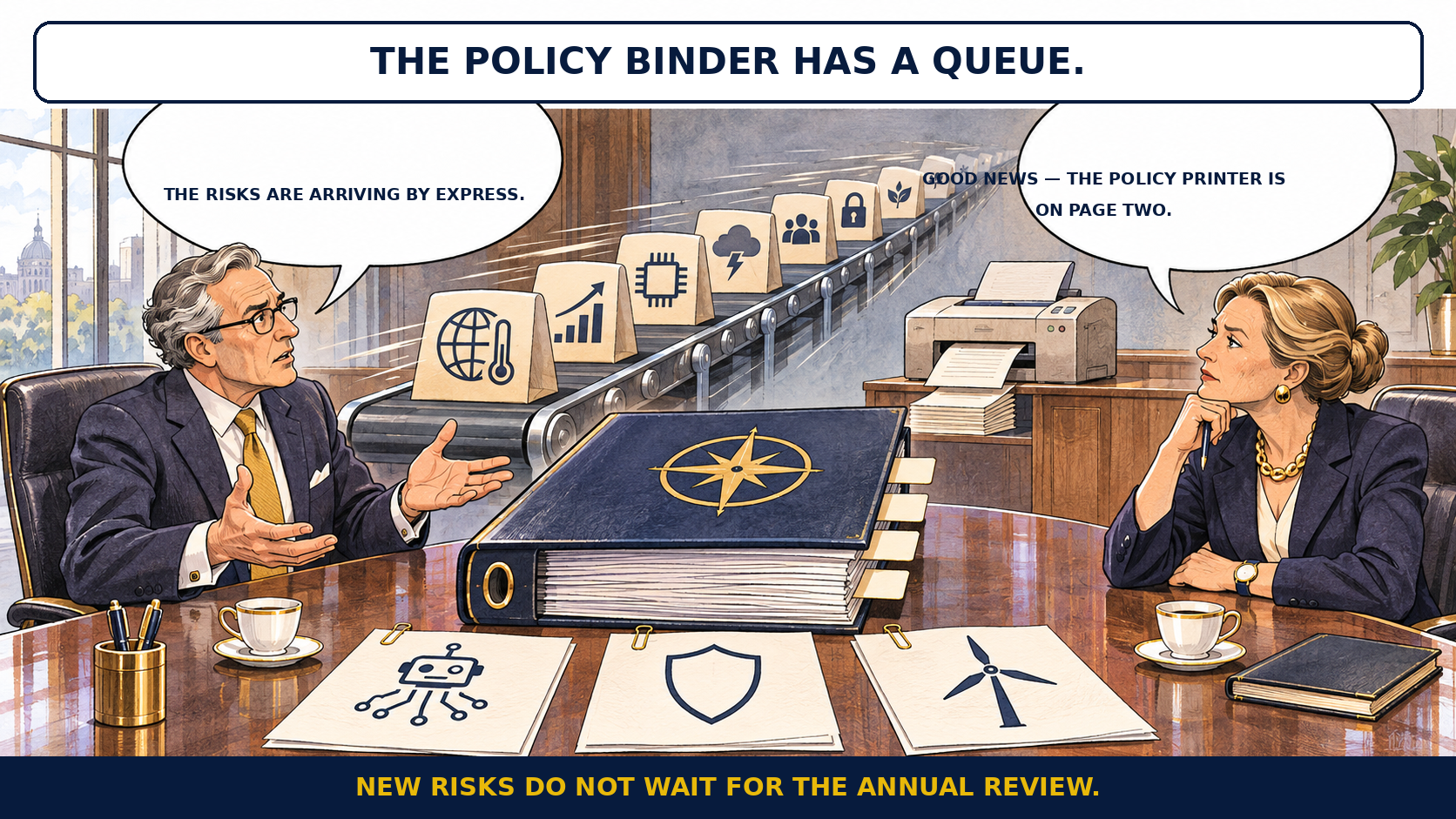
Investment committee: “The risks are arriving by express.”
Governance office: “Good news — the policy printer is on page two.”
New risks do not wait for the annual review.