
UAO Daily Brief — Wednesday, 5 August 2026
The Universal Owner
Recency floor for lead items: 3 August 2026; older items are dated explicitly. Every dated item carries a named source, and a link wherever a stable public URL exists. Primary or first-party sources where available; press reporting is identified as reporting; single-sourced reporting is labelled as single-sourced.
98% of the world’s sovereign wealth funds | 20 of 20 of the world’s largest pension funds | 10 of 10 of the largest charitable foundations | 85% of the world’s largest family offices | 100+ billionaires, every morning |
Lead — The risk didn't disappear. It changed hands.
Six systems have been made easier to operate — three of them this week, the rest earlier this year and reaching the tape in the last fortnight. In every case a real friction fell. In every case a different risk remained, moved, or changed owner.
A credit book: Apollo will provide estimated daily valuations across its credit business by 1 October — investment-grade fixed income went live on 1 July — so that defined-contribution plans and 401(k)s can administer private credit (Apollo Q2 8-K; the commitment itself is call-sourced, first made 6 May, and appears in neither quarter's filings). A currency defence: on 31 July, Japan's Ministry of Finance bought yen in coordination with the U.S. Treasury — only the third joint operation in twenty-eight years — and flagged that it plans to use the Federal Reserve's FIMA repo facility, which lets it raise dollars against its Treasuries instead of selling them (MOF statement, 3 Aug). A bond market: Hong Kong listed the only offshore Chinese government bond future on Monday. A sea lane: Iran and Oman are negotiating a Hormuz passage regime. A build-out: Microsoft, Meta, Oracle, Amazon and Alphabet have contracted $1.09 trillion of data-centre leases that have not yet commenced and so are not yet recognised as lease liabilities. A pension system: Kenya's National Infrastructure Fund Act names domestic pension funds and sovereign wealth funds, in statute, as the capital that will build national infrastructure.
Some of these genuinely reduce a risk — and that is precisely why the distinction matters. FIMA reduces forced-sale risk in the world's most important bond market; that is its purpose, and it is not cosmetic: Japan-attributed Treasury holdings fell $66.8 billion in the single month to end-May, from $1,209.9bn to $1,143.1bn (U.S. Treasury TIC Table 5, released 14 July — and note TIC measures holdings, which move with valuation and custody as well as transactions; that is a fall in holdings, not a measured sale). A futures contract genuinely reduces duration-management risk. Daily pricing genuinely solves administration.
But in each case the board question is not "is it safer now." It is: which risk fell, which risk remained, which risk moved — and whose balance sheet carries it in stress? A daily-priced private loan still cannot be sold at its mark; the exit risk moved toward DC members and plan sponsors. FIMA leaves the rate differential weakening the yen untouched, and makes access to dollar liquidity a matter of Federal Reserve counterparty policy. The CGB future arrives with foreign holdings of Chinese interbank bonds about 30% below their 2024 peak — a market easier to hedge and less owned. And a Hormuz reopening negotiated as inbound control and outbound notification would make the strait usable without making it free: the risk migrates from the oil price into a permanent compliance and insurance layer carried by shipowners, insurers, and ultimately cargo.
The tape priced the happy half of that. On Tuesday the S&P 500 and the Dow closed at records on optimism about the strait. Eight vessels transited it — five tankers, three bulk or gas carriers, on Kpler data reported by Reuters (an earlier print the same day said six; unreconciled), against roughly 130–140 on a typical pre-war day. Secretary of State Marco Rubio, on the record: "There are ships moving through the straits… So the straits are open" (State Dept transcript, 4 Aug). Both true. Different questions. And one instrument disagreed: the VIX rose 4.04% to 16.50 on a record day — protection got more expensive on the day the index got dearer, with Friday's payrolls and an unsigned arrangement both ahead.
The tape — Tuesday 4 August 2026, U.S. cash close
| Instrument | Close | Change |
|---|---|---|
| S&P 500 | 7,736.52 | +136.02 (+1.79%) — record |
| Nasdaq Composite | 26,584.99 | +671.10 (+2.59%) |
| Dow Jones Industrial Average | 54,085.88 | +907.47 (+1.71%) — record |
| VIX | 16.50 | +0.64 (+4.04%) |
| US 10-year Treasury | 4.63% | −7 bp |
| US 2-year Treasury | 4.20% | −5 bp |
| Brent, October | $79.36 | −5.3% — lowest since 10 July |
| WTI, September | $75.77 | −5.7% |
Equity levels as reported after the 4:00 p.m. ET cash close (source). Yields: U.S. Treasury par yield curve, ~3:30 p.m. ET fixing. Crude: exchange settlements. High-yield OAS 2.78% as of 3 August — there is no 4 August observation yet (FRED). Gold (~$4,075/oz), DXY (~99.86) and USD/JPY (~157.7) have no synchronized close and are indicative quotes. The Treasury Quarterly Refunding Statement and EIA weekly petroleum data are due this morning and are noted as pending, not anticipated.
Which risk fell, which moved, who holds it now
| What changed | Friction genuinely removed | Risk that remains or migrates | Now carried by |
|---|---|---|---|
| Apollo daily pricing credit only, by 1 Oct | Valuation frequency; DC administration; reporting | Model risk; executable exit; gates; settlement | DC members, plan sponsors |
| FIMA repo $60bn/counterparty; Fed has not acted on enlargement | Forced Treasury sales; dollar funding in a defence | Rate differential; access as policy; Fed balance-sheet exposure | JGB holders; the Fed; the yen's counterparties |
| HKEX CGB futures launched 3 Aug | Offshore duration hedging, cash-settled in RMB | Basis; capital controls; legal access; clearing concentration | Reserve managers; 13 liquidity providers |
| A Hormuz protocol proposed, unsigned | Physical navigability; traffic recovery | Permissioned passage; sanctions; insurance; charterparties | Shipowners, insurers, cargo — and U.S. persons' compliance desks |
| Uncommenced AI leases $1.09trn disclosed | Financing capacity at current headline leverage | Duration mismatch; customer concentration; power and water | Landlords, lenders, utilities — from 2027, the balance sheet |
| Kenya's NIF in force 25 Mar; under judicial supervision | An investable structure for domestic pension capital | Governance; political allocation; contingent liabilities | Kenyan pension beneficiaries |
The register is the edition's device: for each change, name the friction removed, the risk that moved, and the balance sheet that inherits it. "Safer" is not a permitted answer — the deep dive explains why.
Easier to Hold
The edition in two minutes — a record close, a river at its lowest recorded level, and six systems whose risks changed hands.
Hormuz: the fee apparatus is already sanctioned
The negotiation has acquired specific — and disputed — operating terms. Reuters, citing one senior Iranian source (single-sourced, and we label it as such), reports a framework giving Iran control over inbound shipping, notification of all outbound movements with an asserted right to intervene, and clearance through Oman for vessels exiting via the Omani lane. AP, citing two regional officials, describes entry via an Iranian-controlled route and exit via an Omani one with service fees. Axios, citing two regional sources and a U.S. official, describes a 60-day arrangement with no fees. AP and Axios directly contradict each other on fees, and we assert neither.
But here is why the fee question is not a detail — and this is first-party. On 29 July, OFAC designated the Persian Gulf Marine Insurance Company and the HormuzSafe Marine Services Authority, describing an IRGC-backed scheme that "forces commercial vessels to purchase mandatory maritime 'insurance' to transit the Strait" — cover against risks "overwhelmingly created by Iran itself" — with payments accepted in digital assets to evade sanctions (U.S. Treasury, "Treasury Disrupts Iranian Regime's Strait of Hormuz Extortion Network," 29 Jul 2026). Treasury Secretary Scott Bessent: "The United States will not allow Iran to hold global commerce hostage." This followed OFAC's designation of Iran's Persian Gulf Strait Authority on 27 May and its standing position (FAQ 1249) that U.S. persons may not receive prohibited Iranian safe-passage services — whether or not a payment is made. A related action hit Mahan Air's procurement networks the next day.
So the reopening question is now precise. The apparatus that would collect transit fees is designated. A fee-bearing protocol would ask the world's shipping to pay an entity the U.S. Treasury has sanctioned and called an extortion network; a no-fee protocol still leaves U.S. persons unable to rely on Iranian clearance services. Either way, passage becomes permissioned — and the risk that left the oil price reappears as a compliance and insurance layer that shipowners, marine insurers and cargo owners carry indefinitely. That is risk migration in its purest form, and it is why Brent settling at a three-week low and a record equity close are not the end of this story.
The physical record, inside the negotiating window: UKMTO logged a cargo vessel struck by an unknown projectile 20NM north-east of Al Khasab at 22:00 UTC on 3 August (WARNING 104-26) — the same bearing where a tanker master reported an explosion twenty-six hours earlier (ADVISORY 103-26). Iran's MFA confirms only talks with Oman on "safe inbound and outbound shipping lanes"; President Trump described an "all-day negotiation" with Iran — his characterisation — while Iran's spokesman publicly denied direct talks and Qatar says "there is no agreement." No Joint War Committee listed-areas revision is dated this week (last review July 2026, JWLA-034), and no war-risk premium print exists for 3–5 August; the latest datable figure is Marsh's 22 July estimate of 7.5–10% of hull value, two weeks stale.
The MOF/BOJ division of authority, the FIMA mechanism, and why the disclosure gap runs to end-August. Read the feature on the site.
The collateral becomes the policy
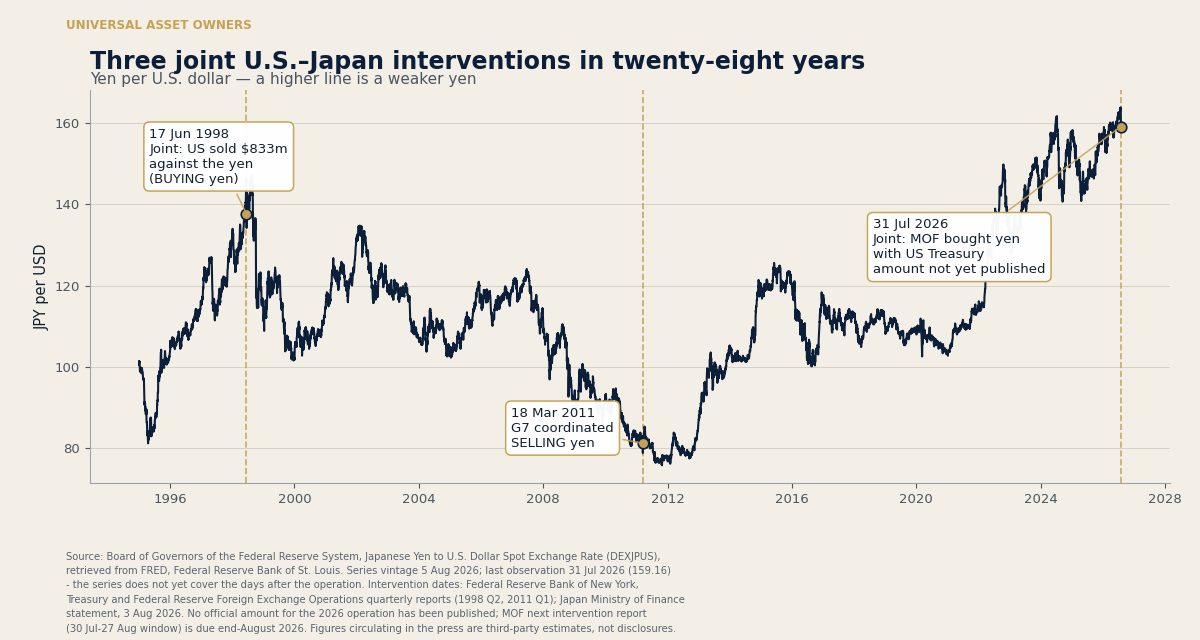
The 31 July operation was the first joint U.S.–Japan intervention since March 2011 and only the third in twenty-eight years (17 June 1998, buying yen; 18 March 2011, selling; 31 July 2026, buying — FRBNY 1998 Q2, 2011 Q1). No official size exists: MOF's published report covers 29 June–29 July and records ¥0; the window covering the operation is due end-August (MOF). The ~¥8.45tn (~$53bn) figure in circulation is Bloomberg's inference from BOJ current-account data — an estimate, not a disclosure.
The plumbing is the story. Japan flagged it will use the Fed's FIMA repo facility — overnight dollars against Treasuries held in custody at the New York Fed, capped at $60 billion per counterparty since July 2021 — and Treasury Secretary Bessent has publicly urged the Fed to consider enlarging it. Only Treasury has asked; the Fed has not acted (its FIMA policy page was last updated March 2022, and any change requires the FOMC). What FIMA does reduce, genuinely, is forced-sale risk: Japan-attributed holdings fell $66.8bn in a month to $1,143.1bn while total foreign holdings hit a record $9,371.1bn (TIC Table 5; holdings, not measured sales). What it does not touch is the rate differential: the Bank of Japan holds at 1.00% with inflation projected clearly above 2%. And what it quietly changes is the category: for approved official holders, a Treasury is no longer only a reserve asset — it is collateral for currency policy, and access to that collateral facility is itself a policy decision. Watch the Fed's H.4.1 tomorrow, and the June TIC data on 17 August.
Apollo: a price is a number; a sale is a transaction
Apollo will provide estimated daily valuations across its credit business by 1 October — investment-grade fixed income went to estimated daily NAV on 1 July. Three qualifications the coverage keeps dropping: it is not new (Marc Rowan committed on the 6 May call: "the totality of our credit business will be 100% daily pricing by 9/30"); it is credit only (asked directly about private equity, Apollo declined to extend it); and it is call-sourced — the word "daily" appears zero times in the Q2 8-K or the Q1 release. The purpose is distribution: defined-contribution, 401(k), wealth and insurance channels, atop a quarter of record $60bn organic inflows and $1.047tn AUM.
What daily valuation genuinely removes: administration friction — participant statements, rebalancing, target-date mechanics, comparability. What it does not create: an exit. A private loan can carry a fresh modelled mark every afternoon and remain unsellable at that mark for months. The four questions a board should refuse to let one word answer: How often is it valued? How often can an investor request an exit? How much liquidity is actually available when they do? How long does settlement take? The gap between the first and third is where retirement money gets hurt — not in a bad year for credit, but in the first year marks and redemptions disagree. One caution against assuming operability creates demand: Apollo's Global Wealth inflows went from $4bn in Q1 to $3bn in Q2 — a single quarter, not a verdict, but not confirmation either. Carried forward: Athene's pension-risk-transfer line was nil again in Q2 — but that is the second straight year of essentially none ($1m in Q2 2025), not a retreat; and Athene does write group annuities inside "Other spread products" ($321m).
A trillion dollars of leases that have not started
Microsoft, Meta, Oracle, Amazon and Alphabet have contracted approximately $1.09 trillion of future payments under leases that have not yet commenced — and are therefore not yet recognised as lease liabilities. From the companies' own filings: Microsoft $329.1bn (FY26 10-K, 30 Jun), Meta $278.99bn (Q2 10-Q — before a further ~$68bn disclosed for July), Oracle $260bn (FY26 10-K, 31 May), Amazon $137.2bn (Q2 10-Q; Amazon's figure covers a broader mix of facilities), Alphabet $85.2bn (Q2 10-Q). Against roughly $285bn of recognised lease liabilities — though the honest caveat is that the $1.09tn is undiscounted future payments while recognised liabilities are present values, so the like-for-like multiple is nearer three times than 3.8.
Nothing is hidden — every figure sits in a filed footnote, and recognition timing follows the accounting exactly. That is the point: the friction removed is financing capacity at a given headline leverage ratio. The risk that migrates is duration — Oracle's commitments run fifteen to nineteen years, commencing fiscal 2027–2029, against $37.9bn recognised — and the disclosure nobody provides is whether lease duration is matched by customer-contract duration. The obligation is economic now; it becomes accounting from 2027. Holders of the equity, the credit, the data-centre landlords and the utilities are, for a universal owner, frequently the same portfolio.
Africa: the constraint is intermediation — and the governance is now in court
The Africa Finance Corporation's State of Africa's Infrastructure Report 2026 (23 April) found non-bank domestic capital pools above US$2 trillion on AFC's definition — pension and insurance assets crossing $1 trillion for the first time, development banks $276bn, sovereign funds $164bn — against roughly $1.7 trillion of cumulative external flows over the decade 2014–2024 (a stock set against a decade of flows; AFC's aggregate, on AFC's definition). AFC's Samaila Zubairu: "Africa is not capital-poor — it is capital-rich but system-poor. The constraint is no longer capital — it is intermediation."
The evidence sits in Nigeria's own regulator: pension assets reached a record ₦30.94 trillion in April, with 56.1% in Federal Government securities and 1.01% in infrastructure funds (PenCom Monthly Industry Summary, April 2026). Not a shortage of savings — an absence of instruments those savings are permitted and structured to hold. Two 2026 attacks on exactly that gap: ARM-Harith's Climate Transition Fund ($76m first close, 8 June, toward $200m; dollars and naira in one structure, anchored by $20m from FSDAi and the AfDB's SEFA — FSDAi's Anne-Marie Chidzero: "The constraint has never been capital itself, but the absence of investment products structured to meet pension funds' liability-matching needs"), and the AfDB–PIDG guarantee collaboration extending the InfraCredit and Dhamana models.
And Kenya — where the fine print is the story. The National Infrastructure Fund Act, No. 4 of 2026 (in force 25 March, board gazetted 8 July) names "domestic pension funds and collective investment schemes, sovereign wealth funds, climate finance" in section 4. President Ruto's stated ambition — his, not the statute's — is KES 1.2 trillion initially and "about Sh5 trillion" over a decade, seeded by the Kenya Pipeline IPO. But on 23 July, the High Court (Constitutional Petition E183 of 2026, Katiba Institute v National Assembly & others, Justice Patriciah Nyaundi) declined to suspend the Act but found it raises arguable constitutional questions, noted the fund is "yet to be operationalized as both the investment policy and the business plan are not developed and adopted," and ordered the Treasury Cabinet Secretary to file Auditor-General-certified accounts by 24 August, then quarterly from 30 November, pending final determination. For an allocator, that order is the watchpoint — and the governance test in one line: domestic capital mobilisation is an opportunity precisely until it becomes a euphemism for directing captive pension savings into projects that would not pass independent fiduciary underwriting. The guarantee structure and the currency structure are the investment decision.
You hold these systems three ways, and the legs do not net. (a) The asset: if daily pricing widens access to private credit, the marginal buyer is a retirement plan with a monthly rebalancing cycle and no capacity to hold through a gate — you own that flow risk through your credit book whether or not you bought a unit. (b) The collateral: FIMA is the difference between Japan raising dollars against your Treasuries and selling them; if you hold long U.S. duration, the facility's size matters more than USD/JPY. (c) The plumbing: you own the exchanges, insurers and data standards that make any of this measurable — which is why AP7's opposition to the SEC's climate-disclosure repeal is a portfolio matter, not a policy opinion.
The practical tilt: for each private or semi-liquid mandate, require the four liquidity answers — valuation frequency, request frequency, available liquidity, settlement time — in the same document. If a manager's answer to all four is "daily," that is not an answer.
⚠️ Embedded-exposure flag: if this week's Danube coverage has you re-examining regulated utilities or listed infrastructure, check the natural-gas weight in the index first — a water-constrained thermal fleet is an argument about cooling, not for whatever the benchmark holds.
Climate: the measurement layer is the asset
Ortec Finance (21 Oct 2025) modelled 180 pension funds across the six largest systems: under a high-warming scenario, nominal portfolio returns fall 2% by 2028, 6% by 2035 and 33% by 2050 — against −8% under a delayed net-zero transition and −4% under a net-zero financial crisis. These are scenario-model outputs, not forecasts; the comparison is the finding — inaction costs more than transition.
Climate Policy Initiative (Dec 2025; 594 OECD pension funds, US$22.5tn) adds the geography, and it bridges straight into the Africa story: of energy projects indirectly financed by the 135 funds traceable in 2024, 62% sit in North America and Western Europe, ~25% in emerging and developing economies, 0.13% in least-developed countries — and 1% in Sub-Saharan Africa (CPI itself cautions the EMDE share is likely understated on limited China data; attribution is equity-based). The transition capital of the world's largest owners is being deployed where it is least catalytic — while the intermediation machinery that could absorb it in Africa is only now being built. For scale: global pension assets ended 2025 at US$68.3 trillion across the 22 largest markets (Thinking Ahead Institute, Feb 2026).
Physical systems, briefly — the fuller treatment runs separately
Danube: Paks ran at ~12% of normal output on its last operating turbine; Hungary's PM said — his characterisation — the plant came within "a few millimetres" of its first total shutdown in 44 years (the published gauge figures do not cleanly reconcile, and we treat the margin as unquantified). Romania is sinking four rock-filled barges to push water toward Cernavoda's one running unit after the 3 August detonation extended the window from ~5 days to at least a week; Dacia and Ford are halted to 19 August; the national energy alert runs all month. On the government's account, 300+ Hungarian companies committed ~400 MW of voluntary reduction (AP via Fortune; Xinhua).
Spokane: InciWeb, 5 Aug 00:19 PT — 10,546 acres, 0% contained, ~1,420 personnel; officials put structures destroyed above 700, possibly to 1,100, with assessment ongoing and no confirmed total; ~65,000 evacuated at peak with some zones since downgraded; all 14 unaccounted-for persons confirmed safe; an arson arrest in the Old Trails Fire; no known fatalities. Europe: France's fires may cost €10–15bn (Morningstar DBRS) with ~220,000 evacuated (French authorities) — and wildfire sits outside France's state-backed CatNat regime, so the loss lands on private insurers and reprices at January renewals. Wildfire-exposed cat bond issuance is at $5.18bn YTD against 2025's record $5.55bn.
Capital-flow watch
Unlike quantities — a deal tape, not a sum.
- PIF closed the $55bn Electronic Arts take-private (4 Aug) — $210/share, ~$36bn equity including PIF's rolled stake, $20bn JPMorgan debt, $18bn funded at close. The largest leveraged take-private on record, now delisted on a sovereign balance sheet (PIF).
- CalSTRS 13.9% net, $415.4bn, +0.4pp vs benchmark — Global Equity 25.1%, PE 7.5%, Real Estate 0.2% (CalSTRS). MassPRIM 12.7%, a 210bp miss vs 14.8%; CIO Michael Trotsky named equity-market concentration (CIO). Same year, same day; Trotsky named concentration — the read that CalSTRS's beat is the same fact from the other side is ours.
- Golub Capital BDC: 2.5 points of the book migrated into the two underperforming rating buckets in one quarter (2.7 left "acceptable") while NII held flat at $0.33 (release).
- Legal & General H1: £918m core operating profit, Solvency II 201%, £1.2trn AUM, £5.7bn global PRT written or exclusive at end-July (L&G). PGIM AUM $1.491tn within Prudential Financial's $1.642tn total (SEC).
- TotalEnergies → KKR insurance account: 50% of a 1.2 GW European renewables portfolio at €1.8bn EV — insurer balance-sheet capital pricing contracted generation (TotalEnergies). MetLife IM closed a ~$1.2bn Lexington-anchored managed secondary of its own affiliates' PE book (MetLife). Lotus Infrastructure ~$1.8bn across Fund IV, co-invest and a single-asset continuation vehicle.
- Border to Coast £400m for 866 UK homes (B2C); Mubadala up to €600m to ADD Capital European housing (CRE Herald); Clarkson record H1 — VLCC US Gulf–Far East earnings +166% at $120,000/day, in the company's own words (Clarkson).
- Central-bank gold: 288.9t net in Q2, a second-quarter record — Poland +51t, China +33t — though H1's 345.9t is the lowest first half since 2022 after heavy Q1 selling (World Gold Council).
- Bank of Korea: minutes (4 Aug) show one member arguing July's unanimous +25bp hike to 2.75% — the first in 3½ years — may not suffice; the board discussed chip-export spillovers, household debt, FX and asset-market liquidity. July CPI, same morning: a three-month low (BOK).
The Risk Radar
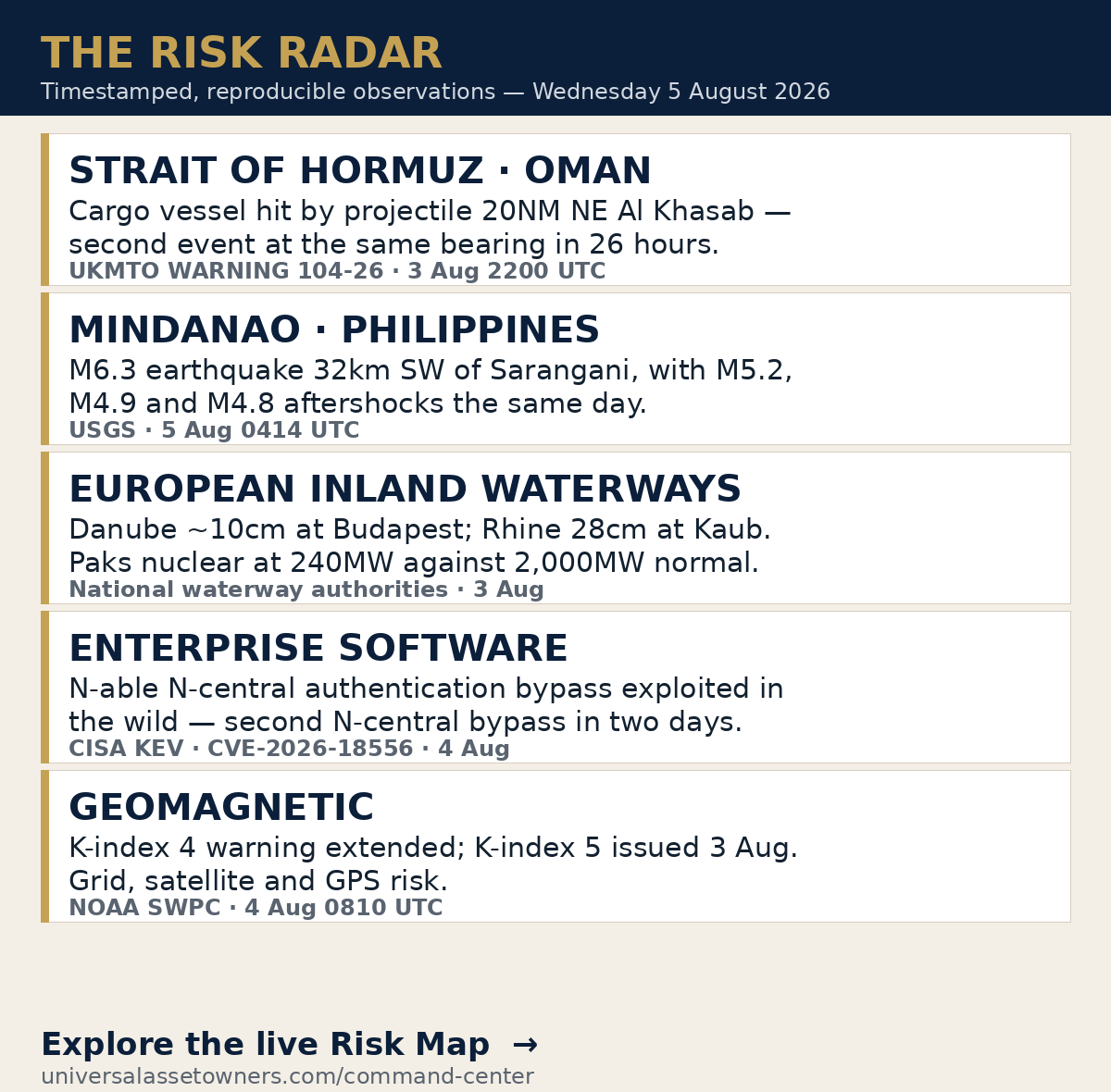
- Hormuz / Oman — UKMTO WARNING 104-26 (3 Aug, 2200 UTC): vessel struck by projectile 20NM NE Al Khasab; second event at that bearing in 26 hours (ADVISORY 103-26).
- Sanctions — OFAC designations of the Hormuz "insurance" network (29 Jul) and Mahan Air networks (30 Jul). Confirmation-based watch item; no probability is published.
- Seismic — M6.3, 32km SW of Sarangani, Philippines (5 Aug 04:14 UTC) with three aftershocks ≥M4.8; M5.7 NW of Ternate.
- Cyber — CISA KEV: CVE-2026-18556, second N-able N-central bypass in two days — MSP software, a supplier-concentration exposure.
- Space weather — NOAA SWPC K-index 4 extended (K5 issued 3 Aug). Disasters — GDACS Orange: Greece fires; Cyclone DOLPHIN-26.
- Black Sea — two Turkish-owned vessels struck (Yasar, Nadezhda), three seriously injured; Turkish MFA statement 4 Aug; attribution contested, resting on the captain's allegation.
- Chokepoint sea-state — all seven monitored chokepoints calm (waves 0.04–0.34m). Weather is not the constraint anywhere today; Hormuz is political.
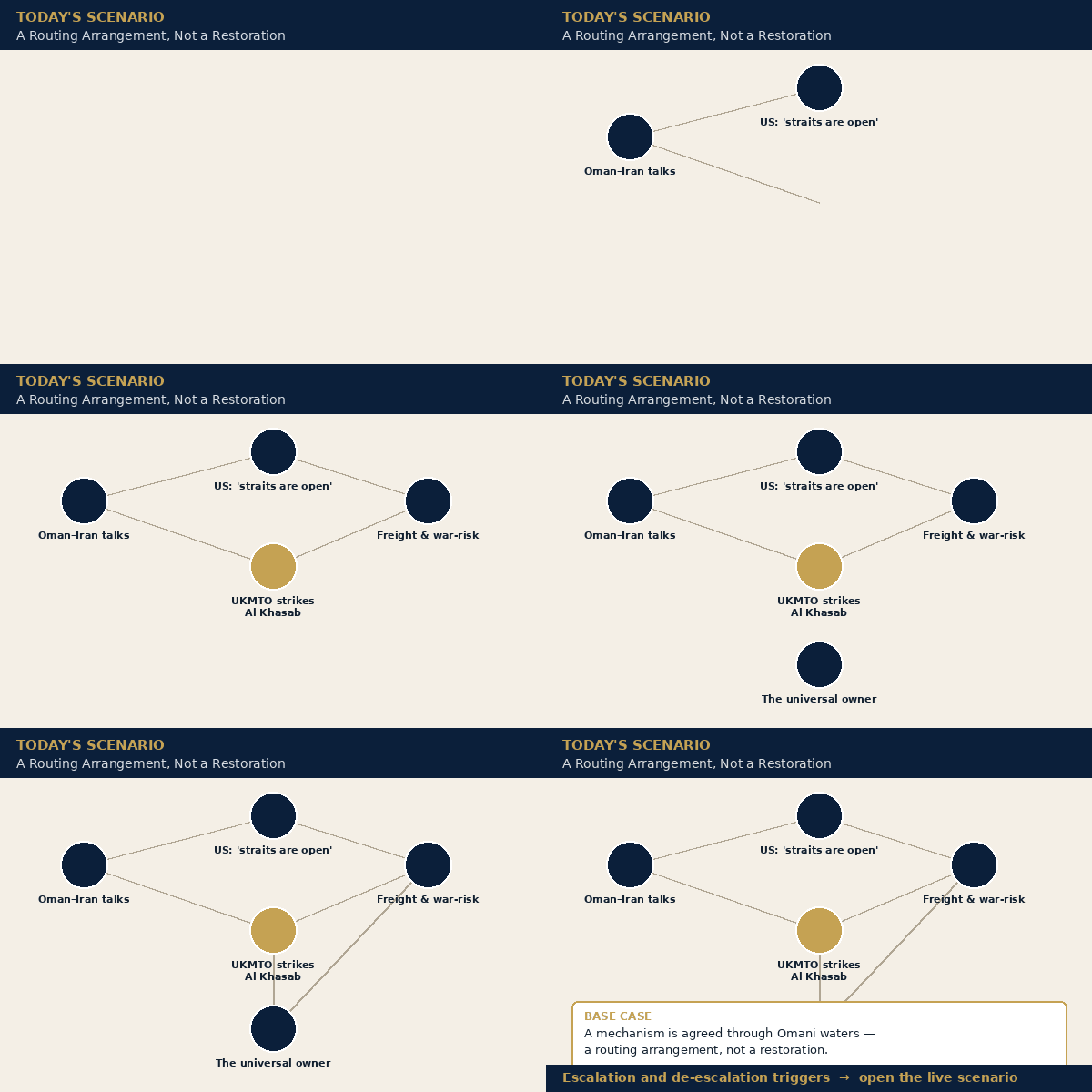
What a reopening through Omani waters does to freight, insurance and the portfolios that inherit both. Base case plus observable triggers — including the OFAC designations. No probability is published; the desk has no method that would survive scrutiny at this horizon.
Today's episode: which risk fell, which moved, and who holds it now — Apollo's daily price, Japan's collateral, the sanctioned fee apparatus at Hormuz, and Africa's intermediation problem.
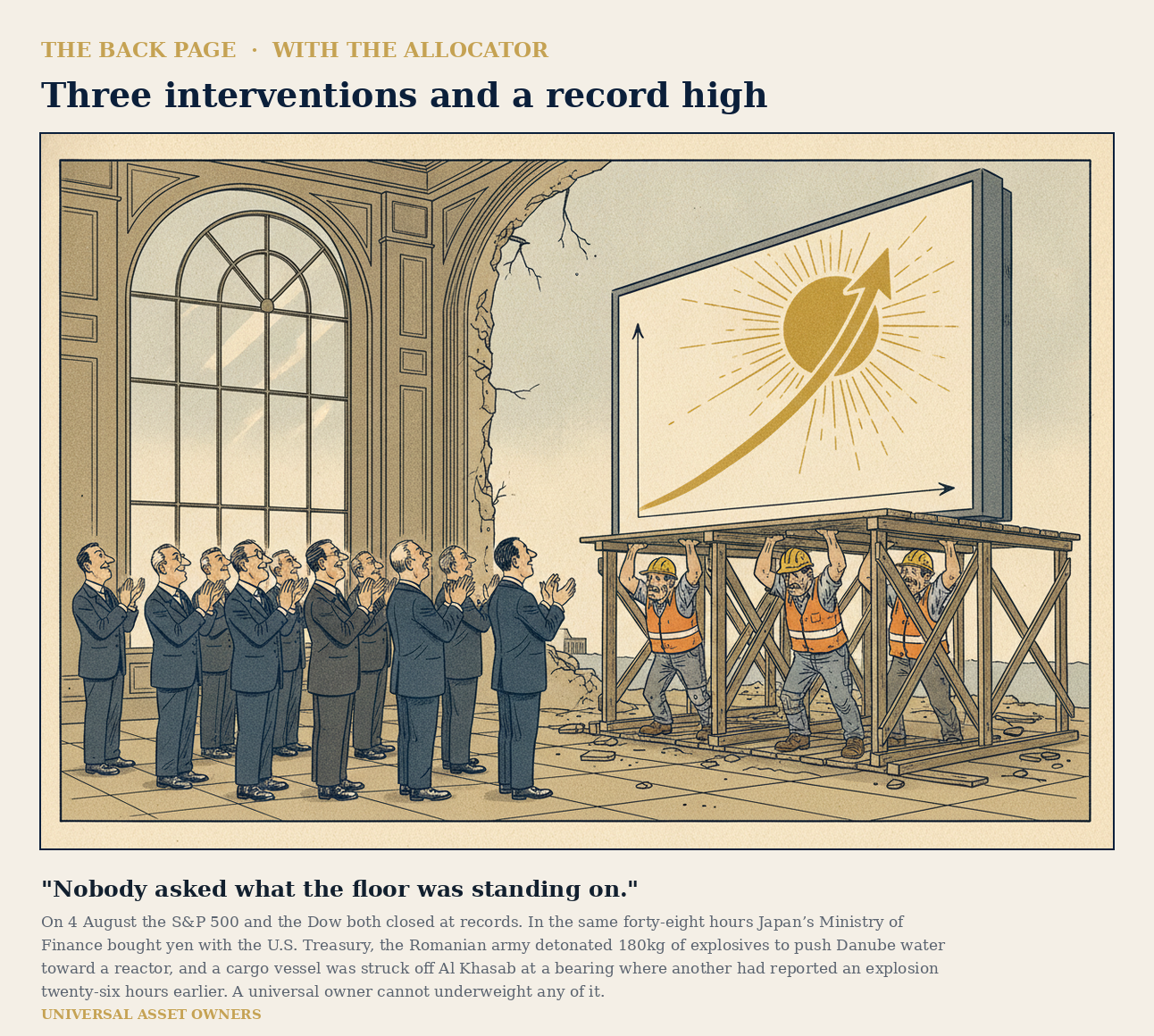
The Back Page — with The Allocator
The Allocator on a deck with the word "daily" in gold — and the difference between a number, a right, and a promise.
Japan just showed you how a reserve event gets managed
The long-form audio (7:49): the MOF/BOJ division of authority, why no official number exists until end-August, the FIMA facility, and what an intervention regime does to a hedging policy calibrated on realised volatility.
Careers & mandates
Dated and attributed; where no first-party release could be opened, that is stated.
- Kenya NIF — first board gazetted 8 July: James Mworia Mwirigi (Centum CEO), Fahima Ali Ahmed Zein, Christopher Kibui Maranga, Latoya Ouna (independent); Lawrence Kibet, Mohammed Abdirahman Hassan (public officers). Under the E183 conservatory orders above.
- Abu Dhabi Investment Council — Edward Winter (BlackRock GIP) appointed CIO for real assets, from September (22 Jul; trade press — no first-party release located).
- GPIF — Tetsuya Sogi joined the Board of Governors 1 Aug, replacing Michiaki Ozaki (GPIF).
- OMERS — CIO seat open five weeks after Ralph Berg's departure for Temasek; CEO Blake Hutcheson holds both roles (fund disclosures and trade press).
- Ontario Teachers' — up to €200m to M&G's Margay CLO platform (OTPP, 27 Jul). IMCO — City of Hamilton, ~$300m; AUM $90.7bn (IMCO, 30 Jul).
Source ledger
- Hormuz/sanctions: U.S. Treasury press releases sb0581 (29 Jul) and sb0582 (30 Jul); OFAC FAQ 1249; State Dept transcript 4 Aug; UKMTO advisory PDFs; Kpler transit data via Reuters (AIS-dark excluded; an earlier same-day print of six is unreconciled); proposed terms — Reuters (one anonymous Iranian source, labelled), AP (two regional officials), Axios (two regional sources + one U.S. official), conflicting on fees, neither asserted; LMA JWC last review July 2026 (JWLA-034); Marsh premium estimate 22 July, labelled stale.
- Japan/FIMA: Japan MOF statement 3 Aug and intervention report 31 Jul (¥0 for 29 Jun–29 Jul); Bank of Japan outline of intervention operations and July 2026 policy statement; Federal Reserve FIMA statement 28 Jul 2021 and policy page (no action since); FRBNY quarterly FX reports 1998 Q2, 2011 Q1; U.S. Treasury TIC Table 5 (May data, released 14 Jul; holdings, custody-attributed). The ~¥8.45tn figure is a Bloomberg estimate; the euro-funding leg is FT reporting — both labelled.
- Apollo/markets: Apollo Q1 and Q2 2026 releases and earnings calls (daily pricing is call-sourced); SEC filings for Prudential/PGIM; exchange settlements, Treasury par yield curve, Cboe, FRED BAMLH0A0HYM2 (3 Aug).
- Leases: Microsoft FY26 10-K; Meta Q2 10-Q; Oracle FY26 10-K; Amazon Q2 10-Q; Alphabet Q2 10-Q — lease footnotes via SEC EDGAR; undiscounted-vs-PV caveat carried.
- Africa: AFC SAIR 2026 (23 Apr); PenCom April 2026; Kenya Law (Act No. 4 of 2026; Gazette Vol. CXXVIII-No. 116); Katiba Institute publication of the E183 conservatory orders (23 Jul); ARM-Harith release 8 Jun; AfDB–PIDG May 2025.
- Climate/physical: Ortec Finance 21 Oct 2025 (scenario-model outputs); CPI Dec 2025 (594 funds; location analysis equity-attributed, EMDE share likely understated per CPI); Thinking Ahead Institute Feb 2026; AP7 4 Aug; Morningstar DBRS and Marsh via Reuters analysis; Artemis 3 Aug; InciWeb 5 Aug 00:19 PT; Spokane County Sheriff's Office; AP via Fortune and Xinhua for the Danube, quoting named national authorities; World Gold Council 30 Jul; Bank of Korea 16 Jul decision and 4 Aug minutes.
This is editorial analysis for institutional readers and is not investment advice.