
UAO Daily Brief — Tuesday, July 21, 2026
Vol 1, Issue 66 · The Universal Owner
Sources checked through 21 July 2026. Material claims are linked to named sources; primary or first-party sources are used where available.
AssetOps Chicago — August 11, 2026. The operating-model summit for institutional asset owners and allocators. Register →
Lead — The backup routes are becoming chokepoints
The energy system built three layers of partial redundancy around an impaired Strait of Hormuz: some tankers still transit under approved routes; shuttle tankers carry cargo out to ship-to-ship transfers in the Gulf of Oman; and Saudi Arabia redirects volumes through its East–West pipeline to the Red Sea port of Yanbu. In the past 72 hours, all three came under pressure at once.
Only four commodity vessels crossed Hormuz on Monday, down from seven on Sunday, with no visible VLCC or LNG carrier (Reuters; Marine Insight). Ship broker Clarksons says supertanker sailings averaged two per day over the past week — down from five the week before and eight in late June. Satellite imagery reviewed by Reuters showed one tanker pair conducting ship-to-ship transfers off Oman on 18 July, versus three pairs on 11 July (Reuters).
Then Yemen's Houthis declared a naval blockade of Saudi Arabia — a threat, not yet demonstrated enforcement, aimed at the Red Sea bypass. Red Sea war-risk insurance jumped to roughly 0.75% of hull value, from about 0.3% on Friday (Reuters; Insurance Journal). More than 3 million barrels a day of Saudi crude shipped to Asia via the Red Sea could face Cape of Good Hope reroutings — roughly a month's delay on some cargoes.
The strongest counter comes from Washington: Energy Secretary Chris Wright says ~14 million b/d is still moving through the waterway and bypass pipelines combined — near two-thirds of pre-conflict flows — and disputes the public tracking data. That gap between official flow claims and independently visible traffic is itself information: a commercial owner needs a reproducible, insurable route, not an aggregate assurance.
Why it matters for universal owners. Institutions count pipelines, transshipment chains, alternative ports and inventory as separate resilience measures. They are not diversified when they share the same conflict system, overlapping war-risk markets, a constrained tanker pool and connected geography. Resilience is not the number of backup routes you own — it is the number that remain independently operable, insurable and financeable under the same shock.
- 4 commodity vessels crossed Hormuz Monday (vs 7 Sunday); 0 visible VLCC/LNG carriers
- Supertanker sailings ≈ 2/day past week vs 5 prior week vs 8/day late June (Clarksons)
- Gulf of Oman STS pairs: 3 → 1 (11 → 18 July, satellite via Reuters)
- Red Sea war-risk cover ≈ 0.75% of hull value vs ~0.3% Friday
- about 3m b/d Saudi crude to Asia via the Red Sea at risk of Cape rerouting
- Counterclaim: ~14m b/d combined flows ≈ two-thirds of pre-conflict (US Energy Secretary Wright)
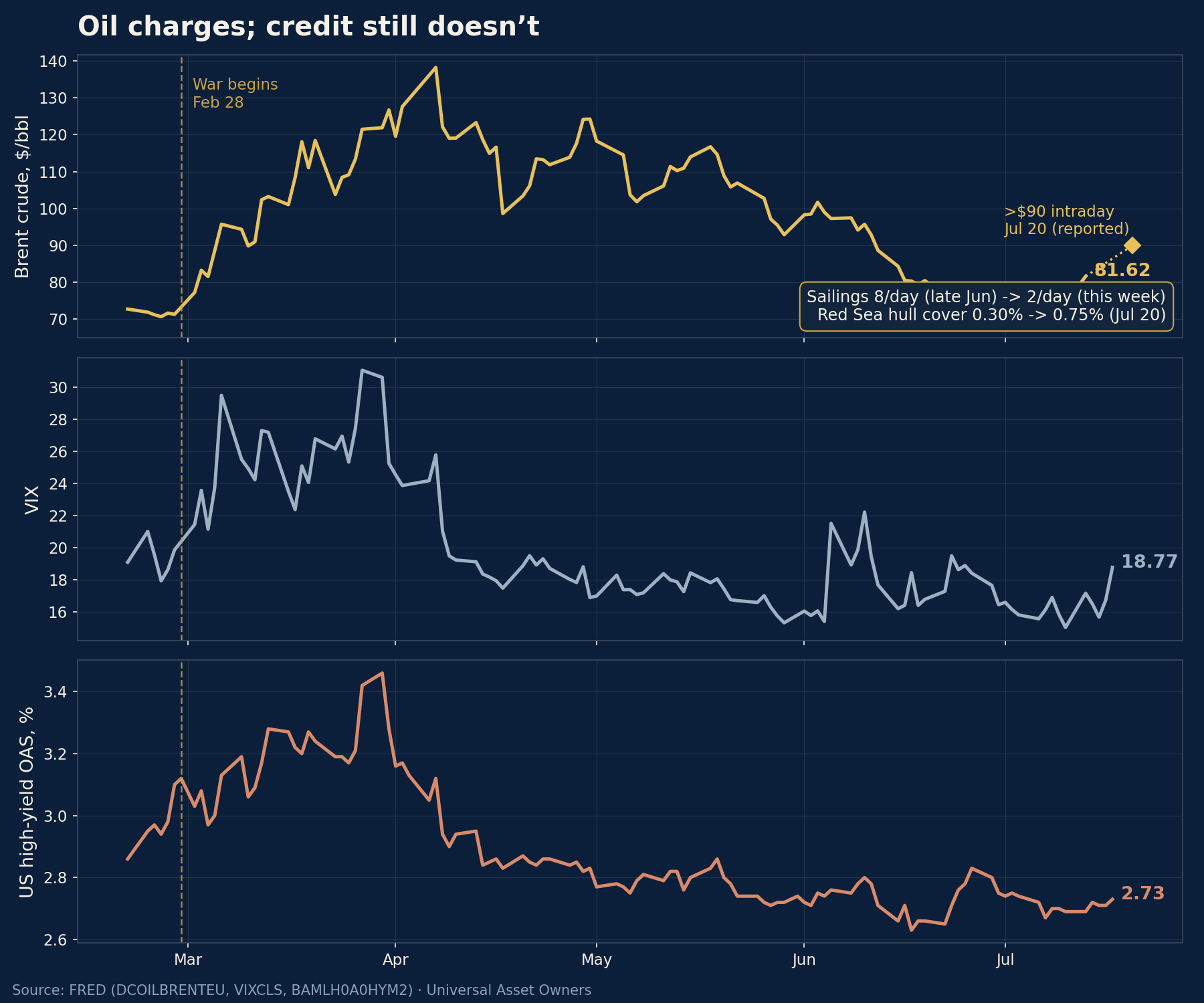
- Tape: Brent briefly topped $90 Monday, settling at $89.22; ~$88 Tuesday; US HY OAS 273bp (FRED, as of 17 Jul); VIX 18.77 (17 Jul)
Three Routes, One War
The lead as a 1 min 36 sec cinematic — how the Gulf's three-layer redundancy started failing together, and why the insurance market repriced on a statement. Watch it before the deep dive.

When every backup route shares the same risk: how to count resilience by shared dependencies, not assets — with the Allocator Lens on the triple exposure. Read the feature.
The theme underneath the tape: one risk, three uniforms
On a map, Hormuz, the Omani anchorages and the Red Sea occupy different water. On a balance sheet they share nearly everything: linked conflict actors; the same war-risk insurance market, where a handful of London and Nordic underwriters reprice all Gulf-adjacent water together; the same finite pool of supertankers and crews; the same Gulf load ports upstream; the same trade-finance structures underneath the cargoes. Redundancy built from shared components is not redundancy — it is one exposure wearing three uniforms. Today's deep dive proposes a Route Independence Index for doing that count formally.
Route risk is a triple exposure, not an energy trade: it sits in the energy and transition sleeve (gas-bridge and logistics holdings), in the liability book (imported fuel inflation — see New Zealand's 4.1% print below), and in the fiscal capacity of the Gulf sovereigns whose surpluses fund co-investment pipelines. The tilt: prioritise grids, storage and interconnection — constraints that cannot be blockaded — over seaborne logistics whose "diversification" shares one war. And ask any listed-infrastructure climate mandate to quantify its embedded gas exposure.
2 — The rebound is rented: Asia's chip bounce meets the earnings test
South Korea’s KOSPI closed 3.6% higher on Tuesday after falling 4.5% on Monday, while Taiwan’s TAIEX rose 4.2% (AP). The scale of the rebound suggests positioning and short-covering as much as renewed conviction. It rests on two temporary supports — Beijing’s state buying (story 4) and this week’s earnings. Alphabet and Tesla report Wednesday evening, Intel Thursday (CNBC). Intel trades near 25-year highs after roughly tripling in 12 months; options imply a ~12–15% post-print move (TradingKey).
Why it matters. Megacap earnings now function as macro releases: three corporate prints can move a multi-trillion-dollar slice of every diversified portfolio inside a week. Last week's rout took the CSI 300 down 5.3% and the STAR Market ~25% off its 1 July peak (>¥4tn erased) — and Beijing judged that systemic enough to answer with central-bank-financed buying. Treat megacap weeks like FOMC weeks in governance calendars: schedule rebalancing around them, not into them.
- KOSPI +3.6% Tuesday close, after −4.5% Monday; TAIEX +4.2% (AP, synchronized closes)
- US Monday: S&P 500 −0.19% to 7,443.28 · Dow −307.16 to 51,839.26 · Nasdaq −0.05% to 25,508.07 (CNBC)
- Intel ≈ 3× in 12 months, 25-year highs; implied post-print move ≈ 12–15%
3 — Japan's ¥370tn ambition meets the sovereign-yield constraint
Japan's cabinet approved a growth blueprint targeting more than ¥370 trillion (~US$2.3tn) of combined public and private investment through fiscal 2040, across 17 strategic sectors — including ¥68tn for semiconductors (Nikkei). The telling detail is the drafting history: the document was revised repeatedly after language on monetary-policy coordination unsettled the JGB market, and the final text pairs its call for government–BOJ alignment with a footnote citing the Bank of Japan's statutory independence — with long-term yields at multi-decade highs (Reuters via Yahoo).
Why it matters. This is state-capital mobilization at sovereign scale — and a live experiment in whether strategic investment targets can coexist with an independent central bank and a heavy debt stock. ¥370tn is a projection, not committed public capital; what matters for owners is which funding vehicles emerge — guarantees, development-bank balance sheets, and any nudge toward pension home-bias (watch GPIF mandate language). The first stress reading comes from JGB auctions and term premiums, not the headline number.
4 — The state put, day two
China Reform says its subsidiary has utilized more than ¥50bn from the PBoC's special buyback-relending facility (plus matching funds); Chengtong reports nearly ¥10bn of recent cumulative SOE-stock purchases — the ~¥60bn (≈$8.9bn) "National Team" signal both firms pledge to continue, extending to tech stocks and ETFs (Xinhua; Caixin). The Reserve Bank of India has been intervening with the rupee near record lows, and Hungary's MNB is expected to cut 25bp to 5.75% this afternoon (Portfolio survey). The marginal buyer in a growing set of markets is a policy actor; a stabilized tape is not a discovered price.
5 — The oil shock reaches central banks unevenly
New Zealand's annual CPI hit 4.1% in the June quarter — petrol +27.5% (nearly a quarter of the whole increase, per Stats NZ), diesel +71%; strip fuel and it would have been 2.9%, with domestically-generated inflation easing (Stats NZ via NZ Herald). Meanwhile euro money markets have fully priced two additional ECB hikes by early 2027 — driven by energy, even as the ECB's own survey shows firms expecting slower wage and price growth. The scenario for long-duration owners is not simply "higher inflation": it is higher policy rates alongside weaker domestic demand, with liabilities repricing before it is clear the second round ever arrives.
Capital Flow Watch — the real-assets deal tape
- CPP Investments and Brookfield agreed to take LXP Industrial Trust private for ~$5.2bn (including net debt/preferred): $61.20/share cash, a 12.3% premium to the 30-day VWAP; 108 industrial properties, ~53m sq ft across the Sunbelt and Midwest; unanimous board approval, Q4 close, 40-day go-shop (company 8-K; Reuters). CPP Investments buying the logistics grid while public markets argue about chips.
- Segro rejected Prologis's third proposal at £13.5bn (~$18.2bn) as undervaluing its logistics and data-centre pipeline (Reuters). Price discovery for powered, permitted, development-ready land.
- Partners Group closed its fourth direct infrastructure programme above $15bn, 50%+ larger than the prior vintage (Partners Group).
- Hut 8 signed a second 15-year AI data-centre lease worth $9.8bn (352MW), fully commercializing its 1GW Texas campus: 949MW contracted portfolio-wide against 1,330MW of utility capacity, $26.6bn of base-term contract value — contract value, not cash earned; a single unnamed investment-grade tenant holds 704MW; delivery from Q2 2028 (Reuters).
- Samsung Biologics bid $1.8bn all-cash for PolyPeptide (board-recommended; 55.65% holder committed) — contract-manufacturing exposure to the GLP-1 supply chain (Reuters).
- Blackstone invested in Korean actuator maker Futronic (~₩1tn valuation, per a person familiar); Andrew Forrest took 16.8% of tungsten producer EQ Resources — physical-AI and critical-minerals capital in one day (Reuters).
- Supply-chain watch: China exported zero gallium, dysprosium, terbium or yttrium to Japan in June even as overall magnet exports rose (Reuters).
People & mandates
- Abu Dhabi Investment Council named Edward Winter (BlackRock veteran) CIO for real assets, effective September (Markets Group).
- legalsuper appointed Stephen Reilly (ex-HESTA) as CEO and Chris Grogan as CIO (Investment Magazine).
- Pershing Square Holdings added Ranjani Kearsley as independent non-executive director (Business Wire).
- Harrison Street named Driss Benkirane and Paul Bashir co-heads of Europe (GlobeNewswire).
The Universal Owner Risk Radar — dated physical & systemic signals
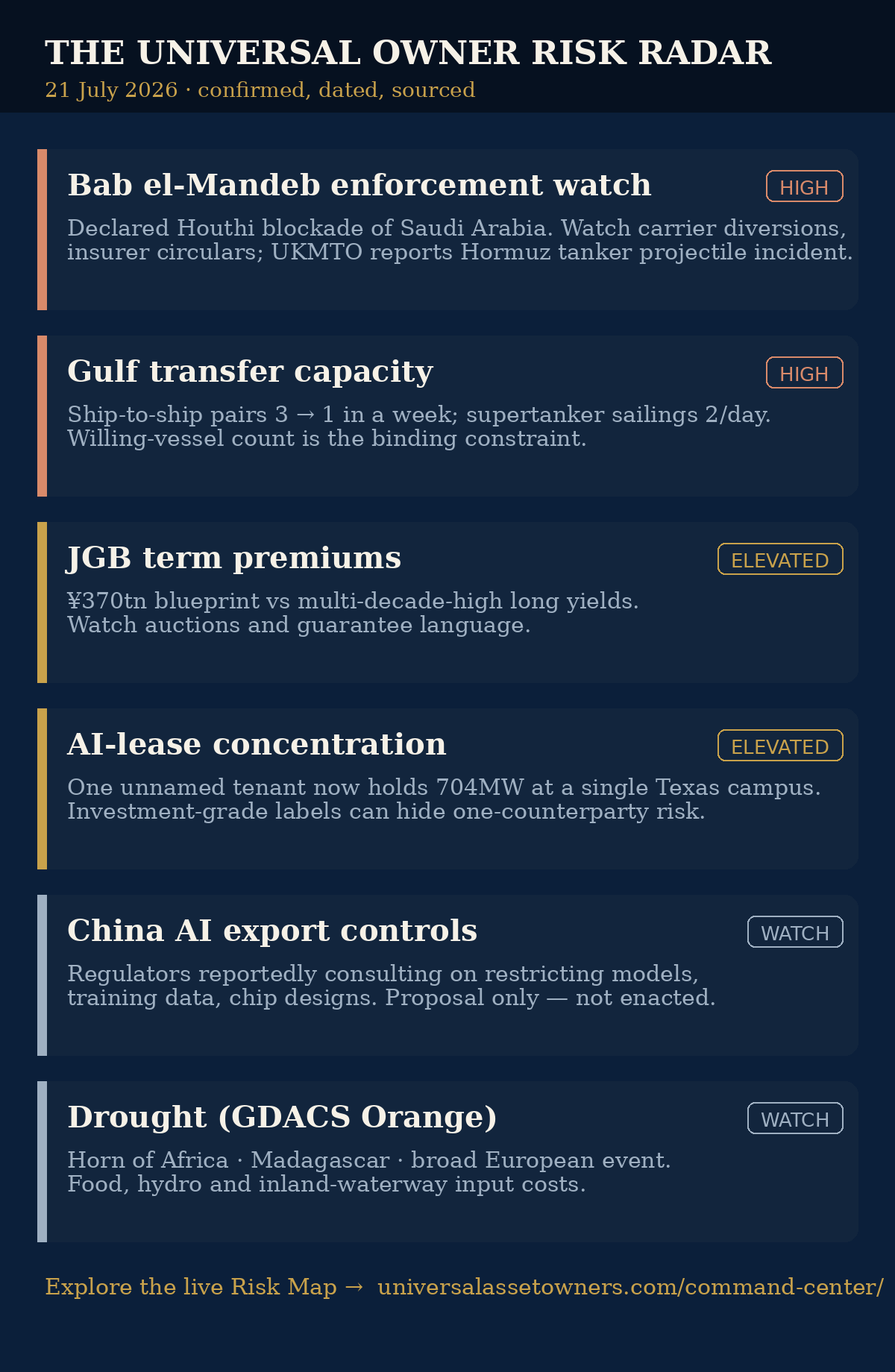
- Bab el-Mandeb enforcement watch: declared Houthi blockade of Saudi Arabia — watch carrier diversions and insurer circulars; UKMTO separately reported a Hormuz tanker incident involving an unidentified projectile (Reuters/UKMTO).
- Seismic: M5.6, northern Mid-Atlantic Ridge (20 Jul); M5.6, 208km SW of Port McNeill, British Columbia (20 Jul) — no tsunami warnings.
- Drought (GDACS Orange): Horn of Africa (Ethiopia/Kenya/Somalia, since April); Madagascar; a broad multi-country European drought event — food prices, hydro output, inland-waterway logistics.
- Space weather (NOAA SWPC 3-day forecast): G1 minor geomagnetic storms expected 22 Jul; 40% probability of R1–R2 radio blackouts each day 21–23 Jul; continued 2MeV electron-flux alert (satellite-charging risk).
- Cyber (CISA KEV): actively-exploited flaws added — Microsoft SharePoint (CVE-2026-58644) and Fortinet FortiSandbox ×2 on 16 Jul; Oracle E-Business Suite on 15 Jul — patch-priority for portfolio companies.
- Chokepoints (Open-Meteo marine obs, 06:00 UTC): Hormuz sea-state calm (waves 0.26m) — the constraint on transit is policy, not weather.
- Crowd odds (Polymarket, 06:00 UTC): "France sends warships through Hormuz by 31 July" — 98% No.
Watch — the next 72 hours (the high-signal three)
- The capex commentary, not the EPS — Alphabet + Tesla (Wed), Intel (Thu, ~12–15% implied): listen for AI capex guidance and cloud-backlog conversion; that commentary is this week's real macro release.
- The oil/vol/credit divergence — Brent >$90 and hull cover repricing daily while HY OAS sits at 2.73%: watch which side closes the gap first (today's chart).
- Any Hormuz/Red Sea insurance advisory — underwriter circulars, carrier notices near Bab el-Mandeb, Gulf of Oman STS counts, Yanbu loadings. The insurance market moves before the press conference.
- Also: Hungary MNB today 14:00 CET (guidance > the cut); and the mediation track — a senior Iranian official says Tehran has received a mediators' proposal for a 10-day ceasefire (Reuters/CNBC, Jul 21) — the two-way headline risk in every position above.
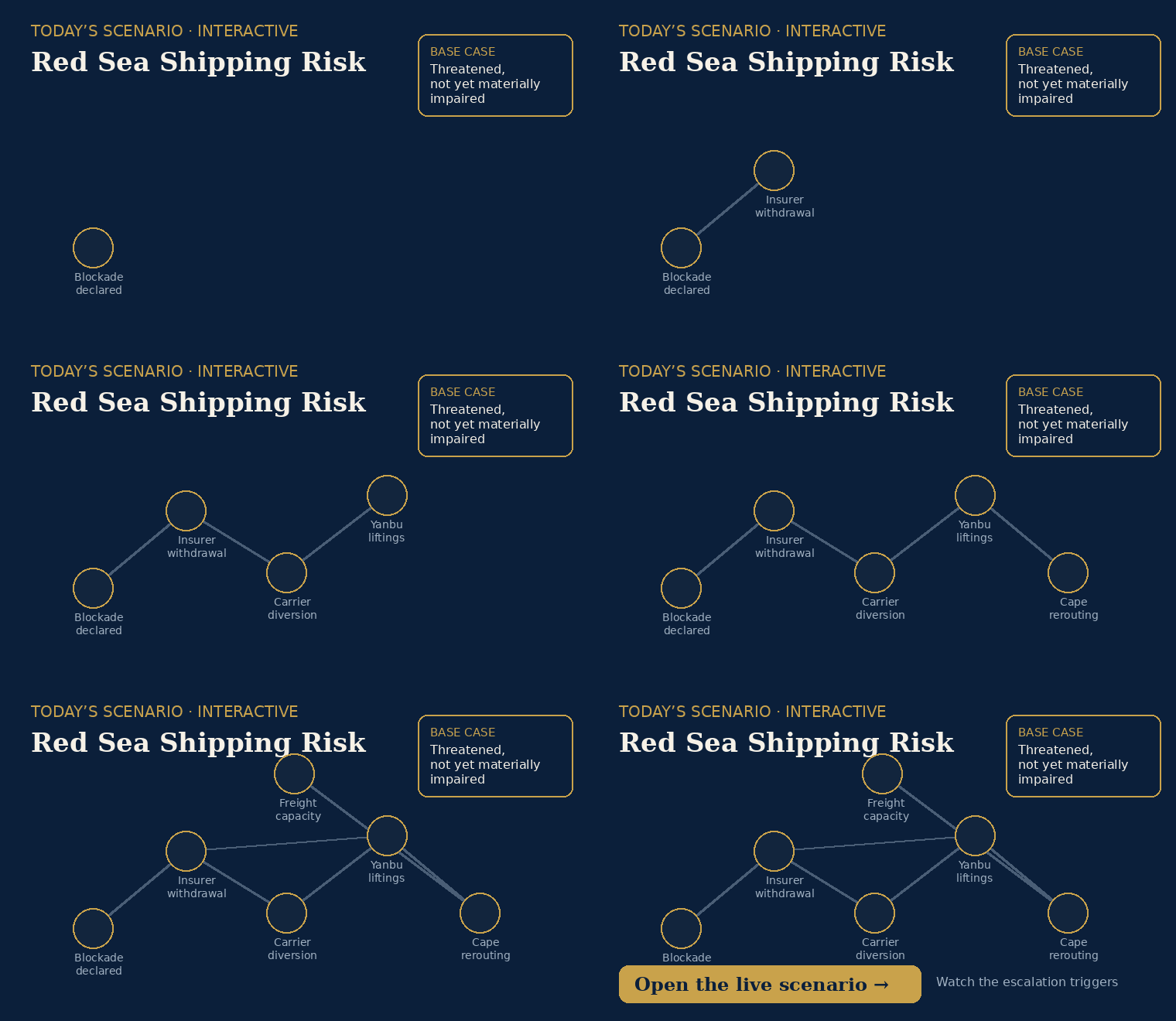
The Houthis have declared a blockade of Saudi Arabia's bypass route. Is the Red Sea/Yanbu corridor materially impaired for Saudi crude by 31 August? Base case: threatened, but not yet materially impaired. Escalation triggers: a major carrier suspending Yanbu calls, underwriters withdrawing rather than repricing cover, or loadings falling materially for three consecutive days. Probe the desk's agents — Energy, Insurance, Shipping, Sovereign-Fiscal, Macro.
Today's episode (~8 min): three routes, one war — the redundancy illusion at sea, Japan's ¥370tn test, the rented rebound, and a dense real-assets deal tape. Supported by Corinium's AssetOps Chicago.
The Back Page — with The Allocator
Meet The Allocator: the calm, world-weary owner of a slice of nearly everything — pitched by everyone, surprised by nothing, disappointed mostly by footnotes. Tonight: his infrastructure team's three "independent" export routes, and the earnings that own his week.

The Global Oil Redundancy Illusion
The edition’s most contested question, argued from both sides (~20 minutes): are the Gulf’s three export routes genuinely independent alternatives, or one correlated exposure — and are markets right to stay calm while war-risk insurance doubles? One voice presses the redundancy-illusion case; the other defends the official view that flows are holding. Listen for the collision, then decide where your board would land.
Source ledger (primary/named, dated)
- Hormuz: 4 commodity vessels Monday, none VLCC/LNG; STS pairs 3→1 (Jul 11→18); supertanker sailings 2/day vs 5 vs 8 (Clarksons): Reuters / Marine Insight / MarineLink, Jul 20–21, 2026.
- Houthi naval blockade of Saudi Arabia declared; Red Sea war-risk ~0.3%→~0.75% of hull value; >3m b/d Saudi crude to Asia exposed; ~1-month Cape delays: Reuters (insurance sources), Jul 20, 2026.
- Wright: ~14m b/d combined waterway+pipeline flows, ~two-thirds of pre-conflict; disputes tracking data: Reuters, Jul 20, 2026.
- Kospi +3.6% to 6,747.95, Samsung +6.8%, SK Hynix +4.9%: AP, Jul 21, 2026. Taiex −0.52%, TSMC +1.31%: Taipei Times, Jul 21, 2026. US closes: CNBC, Jul 20, 2026.
- Alphabet/Tesla Wed, Intel Thu; Intel ~3× in 12 months, 25-year highs, ~12–15% implied move: CNBC earnings playbook Jul 19; TradingKey Jul 20; TheStreet.
- China Reform >¥50bn via PBoC buyback-relending + matching funds; Chengtong ~¥10bn cumulative; STAR −~25% from Jul 1 peak, >¥4tn erased: Xinhua, Jul 20, 2026; Caixin Global.
- Japan ¥370tn (~$2.3tn) through FY2040, 17 sectors, ¥68tn semiconductors; BOJ-independence footnote after market-moving drafts: Nikkei Asia / Reuters, Jul 21, 2026.
- NZ CPI 4.1% (Jun qtr); petrol +27.5% ≈ quarter of the increase; diesel +71%; ex-fuel 2.9%: Stats NZ, Jul 21, 2026. ECB: two hikes fully priced by early 2027: Reuters, Jul 20, 2026.
- LXP/CPP-Brookfield $5.2bn at $61.20/share (12.3% premium), Q4 close, 40-day go-shop: LXP 8-K / Reuters, Jul 20, 2026. Segro rejects £13.5bn Prologis third proposal: Reuters. Partners Group infra IV >$15bn: Partners Group, Jul 20, 2026. Hut 8 $9.8bn lease, 949MW/1,330MW, $26.6bn contract value: Reuters, Jul 20, 2026.
- China exported zero Ga/Dy/Tb/Y to Japan in June: Reuters, Jul 20, 2026. ADIC (Winter) / legalsuper (Reilly, Grogan) / Pershing Square (Kearsley) / Harrison Street (Benkirane, Bashir) / SCERS $1.2bn: Markets Group / Investment Magazine / Business Wire / GlobeNewswire, Jul 20, 2026.
- Radar: USGS event pages; GDACS; NOAA SWPC; CISA KEV; Open-Meteo marine; Polymarket; UKMTO.
Material claims above are linked to named sources; primary or first-party sources are used where available. This is editorial analysis for institutional readers and is not investment advice.