
UAO Daily Brief — Monday, July 20, 2026
Vol 1, Issue 65 · The Universal Owner
When chokepoints, chips and state capital collide. Recency floor: July 19, 2026. Every dated item is verified to a named primary source.
 AssetOps Chicago — August 11, 2026. The operating-model summit for institutional asset owners and allocators. Register →
Lead — The transition's bridge fuel is stuck in the Strait
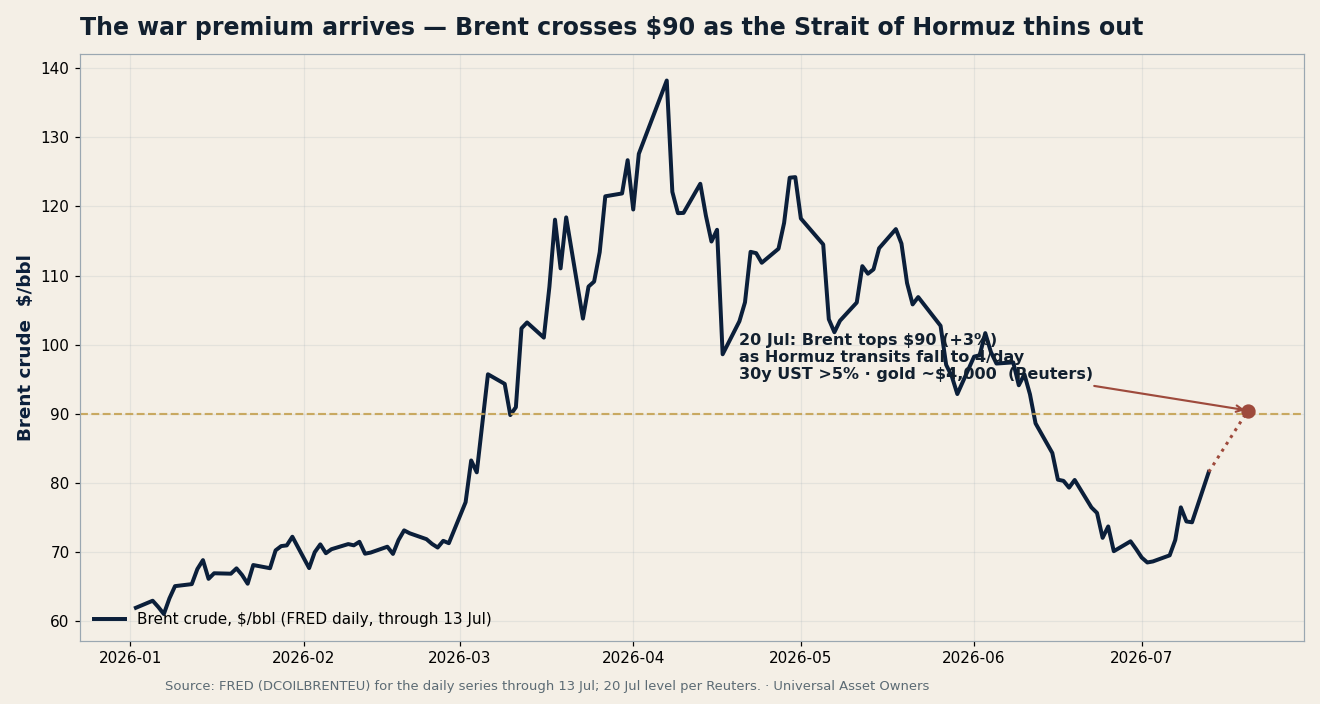
The strongest signal of the past 24 hours was an energy-investor story, not a headline-risk one. Reuters reported that only four vessels crossed the Strait of Hormuz on Sunday, down from eight the day before, and that no LNG tanker had been visible passing through the strait since Thursday — with seven laden Qatari carriers estimated to be holding about 0.57 million tonnes of gas offshore. The strait normally moves roughly a fifth of global oil trade. The shock went straight into prices: Brent rose about 3% to cross $90, 30-year Treasury yields pushed back above 5%, gold neared $4,000, and futures priced 29bp of Fed hikes by year-end.
For universal owners this is a natural-gas and reserve-management problem as much as an oil one. Gas is the fuel the large funds have leaned on as the transition's "bridge" — and it is the molecule most exposed to a seaborne chokepoint. The same event reprices inflation-linked liabilities, energy-importer sovereign debt, transition-infrastructure cash flows and the dollar leg of reserve portfolios at once. The underappreciated wrinkle: Qatari and UAE production and loadings reportedly stayed robust, so the binding constraint is transit, insurance and visibility — not supply.
The Hormuz LNG squeeze collides with the sovereign climate trade. Who's investing, and what to watch.
2 — China turns on the policy put
China supplied the day's market-structure lesson. Reuters reported that state operators China Reform Holdings (a reported ¥50bn) and China Chengtong (nearly ¥10bn) bought equities over the weekend, while the CSRC convened brokerages, fund managers and listed companies for a market-stability meeting after a two-week ¥10 trillion market-cap loss. For global allocators this is a governance and market-structure story: sovereign-adjacent capital acting as an explicit volatility-suppression instrument — and a ~¥60bn bid is modest against a ¥10tn hole, so it may signal intent more than firepower. The countercase: a small direct purchase can carry an outsized signalling effect if it shifts expectations or crowds in other buyers — the 0.6% ratio is a comparison of scale, not proof the intervention cannot stabilise prices.
3 — TSMC's $265bn Arizona bet: an infrastructure story inside an AI story
TSMC said it sees "strong, multi-year" AI-chip demand and is adding $100bn to its Arizona build-out, lifting the total plan to $265bn across 12 fabrication and advanced-packaging facilities in total, plus an R&D centre. The subtext for owners is physical: the executive flagged construction-labour and infrastructure constraints and did not rule out new bond issuance — even as the Philadelphia Semiconductor Index fell ~10% on the week and 20% from its June high. AI capacity can be structurally real and financially unstable at the same time.
ESG & the sovereign transition trade — who's allocating, and why it matters
The through-line beneath the tape is the sovereign climate trade, and it is moving in real mandates — the reason today's Hormuz gas squeeze lands where it does:
- Taiwan's Bureau of Labor Funds awarded a $3bn passive climate-transition infrastructure mandate to five global managers — Amundi, BNP Paribas AM (Europe), Geode, Northern Trust AM (Australia) and SSGA (Singapore), $600m each, five-year term (each $600m = $400m Labor Pension Fund + $100m each Labor Insurance & National Pension Insurance). Listed infrastructure as the liquid on-ramp to the transition. P&I · Responsible Investor
- Singapore's MAS — Responsible Investor reports that MAS is shifting climate money from passive to active to navigate decarbonisation-vs-returns "trade-offs"; the official sustainability report was not independently inspected. Responsible Investor
- Reserve managers keep leaning into gold: the World Gold Council's 2026 Central Bank Gold Reserves Survey (16 June; record 76 central banks) finds 93% of respondents now hold gold (up from 81%), a record 45% expect their own holdings to rise over the next 12 months, 74% expect a lower US-dollar share of global reserves in five years, and gold's role as a geopolitical risk hedge features prominently among emerging-market respondents (85%). WGC press release
- UBC Investment Management (Canada) will surveil how its external managers vote on contested names like Palantir (working with the Heartland Initiative) — because a universal owner can't divest a widely-held holding; its only lever is manager behaviour. Responsible Investor
Why it matters: the "energy-security" case and the "energy-transition" case for gas have merged into the same allocation — and Hormuz just stress-tested it. See today's deep dive.
Capital Flow Watch — reported, not yet verified
Items below are from our monitoring desk and are single-source or pending primary confirmation; they are watchlist entries, not verified transactions.
- PIF — Electronic Arts (pending, not approved). EA's formal announcement describes a $55bn acquisition by PIF, Silver Lake and Affinity Partners at $210/share, with closing expected in EA's first fiscal quarter of 2027, subject to regulatory approvals. Reports of imminent EU clearance (review dates around 22 and 30 July) remain single-source and unconfirmed (Al Arabiya, 19 Jul).
4 — The macro read: a stagflationary Asia (ADB) and private-credit risk (ASIC)
ADB cut developing Asia & Pacific 2026 growth to 4.9% (from 5.1%) and raised 2026 inflation to 4.3% (from 3.6%), explicitly tying the revision to Middle East energy disruption and Hormuz shipping — a stagflationary mix that complicates duration hedges (it kept 2027 growth at 5.1%, implying eventual normalisation). ADB July outlook.
Australia's ASIC warned that private-credit loans have grown to about A$250bn from ~A$35bn a decade ago, more than half concentrated in property development and construction, with the A$4.5tn superannuation sector "high on the regulator's worry list" — a governance-and-disclosure problem for retirement savers, not just a credit-quality one. ABC.
The Universal Owner Risk Radar
- Energy chokepoint — Strait of Hormuz (OPERATIONAL FREEZE): vessel crossings halved to 4 on Sunday; no LNG tanker visible in transit since Thursday; ~0.57 Mt Qatari LNG holding offshore. The constraint is hostilities, insurance and transit risk — weather is a non-factor (sea-state calm). Reuters
- Cyber — CISA KEV: actively-exploited Microsoft SharePoint deserialization flaw CVE-2026-58644 (16 Jul), plus Oracle E-Business Suite and Fortinet FortiSandbox. CISA KEV
Does the Hormuz LNG squeeze become a sustained 30-day transit shock? Rather than a point probability, watch three triggers: (1) a formal war-risk insurance withdrawal or premium step-change from a major marine underwriter; (2) UKMTO-verified incidents against LNG carriers rather than visibility gaps; (3) whether the laden Qatari carriers holding offshore resume transit within the week. Two of three triggers firing would mark regime change; none firing implies normalisation.
Listen to today's brief — 6 min
Chokepoints, chips and state capital — the day in six minutes, read by the UAO editorial desk.
A small net under a big fall
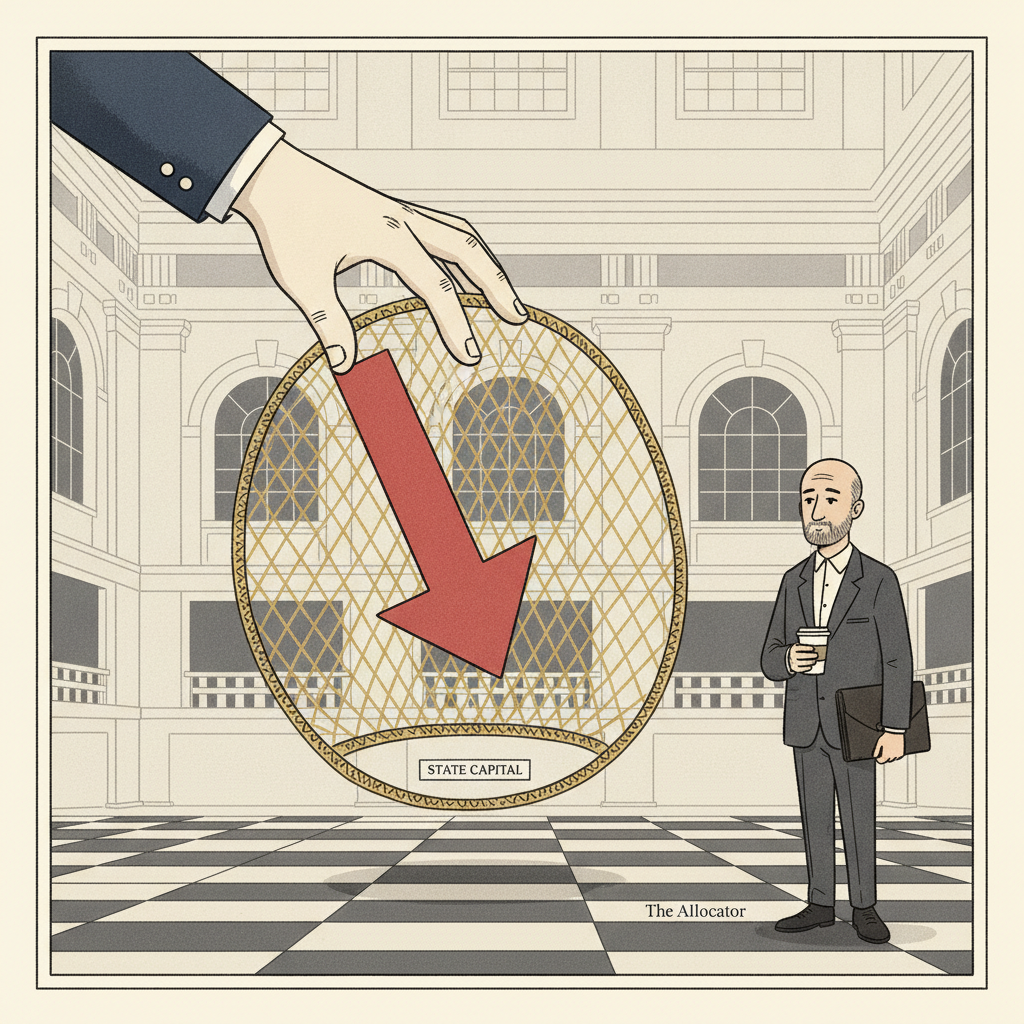
Meet The Allocator — the calm, world-weary steward who owns a small piece of nearly everything and is rarely surprised, only disappointed by the footnotes. Today he watches a giant state hand lower a modest safety net labelled "state capital" under a plunging market — a policy put worth about ¥60bn against a ¥10 trillion drop.
Corrections
An earlier version of this article misstated South Korea's Monday market move (now 4.1% per Reuters), attributed two gold-survey figures to the wrong source (the WGC survey's figures are 93% holding gold and 85% of emerging-market respondents citing the geopolitical hedge), and described China Reform Holdings' purchases with an unsupported funding mechanism. These have been corrected.
Source ledger
Reuters (Hormuz shipping, global markets, CSRC, TSMC) · ADB July outlook · ABC (ASIC) · P&I (Taiwan BLF) · Responsible Investor (UBC IM) · Responsible Investor (MAS) · World Gold Council · FRED · USGS · CISA · NOAA SWPC.
Universal Asset Owners scans the PEI Group platforms (Responsible Investor, Infrastructure Investor, Private Debt Investor, PERE, Private Equity International, New Private Markets, Agri Investor, Secondaries Investor) daily. Not investment advice.