
The Saturday Edit — oil charged for the war; equities sold the machines
The lead
Two things happened into Friday's close, and they point in opposite directions.
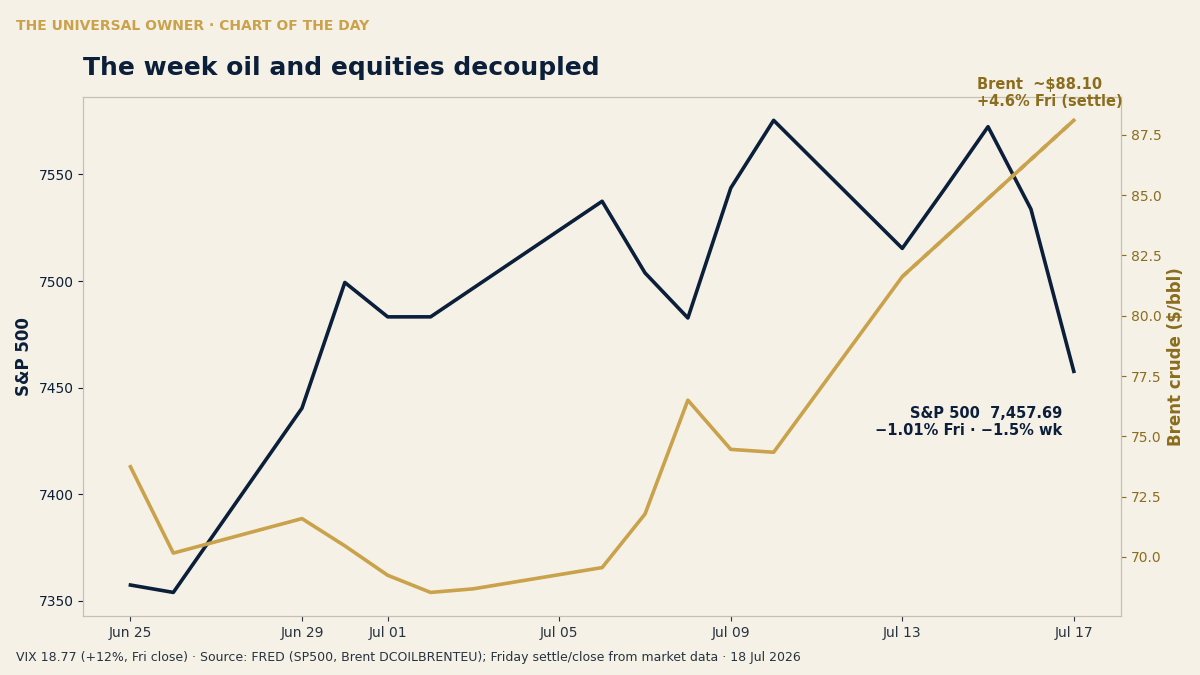
Oil finally re-priced the conflict. Brent crude rose about 4.6% to settle near $88.10 a barrel on Friday, after Kuwait said Iran had struck a power-and-desalination plant and US Central Command confirmed a sixth consecutive night of strikes on Iranian coastal, military and maritime targets. Vessel traffic through the Strait of Hormuz has thinned sharply — Kpler counted roughly 14 transits one recent Sunday, four of them crude tankers, some 60% below the 37 a week earlier, with average inbound capacity down to about 6 million barrels a day over 10–12 July from ~8.5 million in early July — even as more than 8 million barrels still moved that Sunday under US military escort. The 17 June US–Iran memorandum of understanding is at the halfway point of its 60-day window; President Trump has called the ceasefire "over."
But the equity market sold something else entirely. The S&P 500 closed at 7,457.69, down 1.01% — and more than 1.5% on the week — as an aggressive semiconductor sell-off spread across the tape. The VIX jumped about 12% to 18.77, its highest in several weeks.
Why it matters. For a week the story was that markets had stopped pricing the Gulf. On Friday oil re-priced it — yet the drawdown in equities did not come from energy or war. It came from the AI and semiconductor complex. An owner who holds both the tanker route and the chip supply chain watched the risk they were warned about show up in the commodity, while the loss of capital showed up in the asset they were told was the secular safe bet. That divergence — not either move alone — is the signal.
Deep dive — The J-curve and the middleman
What the semiconductor rout is really telling universal owners.
Friday's sell-off was a price event. Underneath it sit two verified, structural developments that matter far more to a thirty-year owner than one red session.
1. The productivity payoff is a 2030s event, not a 2026 margin story
Goldman Sachs economist Elsie Peng, in a July 2026 note — "From Innovation to Productivity Boom: Lessons from the ICT Revolution for the AI Era" — argues that transformative technologies have historically taken roughly twenty years from breakthrough to meaningful economy-wide productivity, implying the generative-AI payoff arrives in the early-to-mid 2030s, after a J-curve in which firms must first spend on "organizational capital" — retraining, workflow redesign — before output rises. Grounding the caution: only about 2% of S&P 500 companies mentioned "AI productivity" on Q1 2026 calls, and those that did emphasised cost-cutting over revenue.
2. Agentic AI is beginning to eat the software rent
Starbucks — which spends roughly $400 million a year on enterprise software — is building its own AI-generated tools to replace Microsoft and IBM systems, expecting to save ~$30 million in enterprise tech and ~$10 million in software spend in 2026, with a replacement system due late 2027. Industry estimates put up to 20% of enterprise-software spend exposed to this "agentic arbitrage." As Stride founder Debbie Madden put it: "It's cost-cutting on the surface and an ownership shift underneath."
The universal-owner insight
Put the two together. If the productivity boom is a next-decade event, and the incumbents' recurring revenue is now contestable by their own largest customers, then the market's present willingness to capitalize AI margins today is a terminal-value question, not a quarterly one. A universal owner who passively holds the whole enterprise-software and semiconductor complex is long both the build-out and the disruption of the build-out's business model. The correct response is not to time the chip trade; it is to ask which of your external managers are underwriting AI cash flows that quietly assume the middleman keeps his cut — and for how long.
The counter-case, kept honest: the J-curve is a historical analogy, not a law — AI diffusion could compress the ICT timeline; and Starbucks-style in-housing needs scarce engineering capacity most firms lack, making 20% an upper bound. The defensible claim is narrower than "SaaS is over": a meaningful portion of software rent is now structurally contestable, and the payoff is arriving later than the multiples imply.
Asset-owner moves
CPP Investments posted a 7.8% return for fiscal 2026, lifting net assets to C$793.3 billion at 31 March (from C$714.4 billion). GIC named Bryan Yeo as its next Group Chief Investment Officer and Boon Chin Hau as CIO for Infrastructure. For scale: sovereign wealth funds hold roughly $13 trillion; state-owned investors as a whole — SWFs, public pensions and central banks — about $60 trillion, projected to reach $80 trillion by 2030; Norway's NBIM alone is above $2 trillion.
The Risk Map — Risk Radar
- Strait of Hormuz chokepoint — emerging. Confirmed vessel transits sharply lower; watch Lloyd's marine war-risk premia.
- Southern Mexico earthquake swarm — confirmed. An M7.3 struck 58 km WSW of Puerto Madero at 14:48Z on 17 July, followed by an M6.0 and several M5s offshore Chiapas. Material for regional infrastructure, insurance and cat-bond exposure — not a broad market mover.
- GDACS — Orange alerts: Mayon volcano (Philippines) and droughts across the Horn of Africa, Madagascar and parts of Europe.
- NOAA space weather — Geomagnetic K-index 4 warnings (14–17 Jul), below the G1 minor-storm threshold: low-severity background, not a trading tail-risk.
Today's scenario
Does the AI/semiconductor drawdown deepen into a >10% Nasdaq correction within 30 trading days? Explore the interactive scenario and the agent debate in the Scenario Lab.
The Back Page — with The Allocator
MEET THE ALLOCATOR
The Allocator owns a small piece of nearly everything, is rarely surprised and is often disappointed by the footnotes. This week he stopped waiting for the waiter.

Source ledger
CNBC / Kpler (Hormuz shipping, 13 & 17 Jul); CNN live (Iran strikes, 17 Jul); Yahoo Finance & BBN Times (equities, VIX, 17 Jul); FRED (S&P 500, Brent, stress dashboard); Fortune (Goldman/Peng AI-productivity; Starbucks software in-housing, Mar & Jul 2026); CPP Investments FY2026; Global SWF / Visual Capitalist (SWF scale); USGS (M7.3 Chiapas); GDACS; NOAA SWPC.
Not investment advice. The Universal Owner is published by Universal Asset Owners.