The Probability Desk · June 13, 2026
Executive Summary — Desk View in One Paragraph
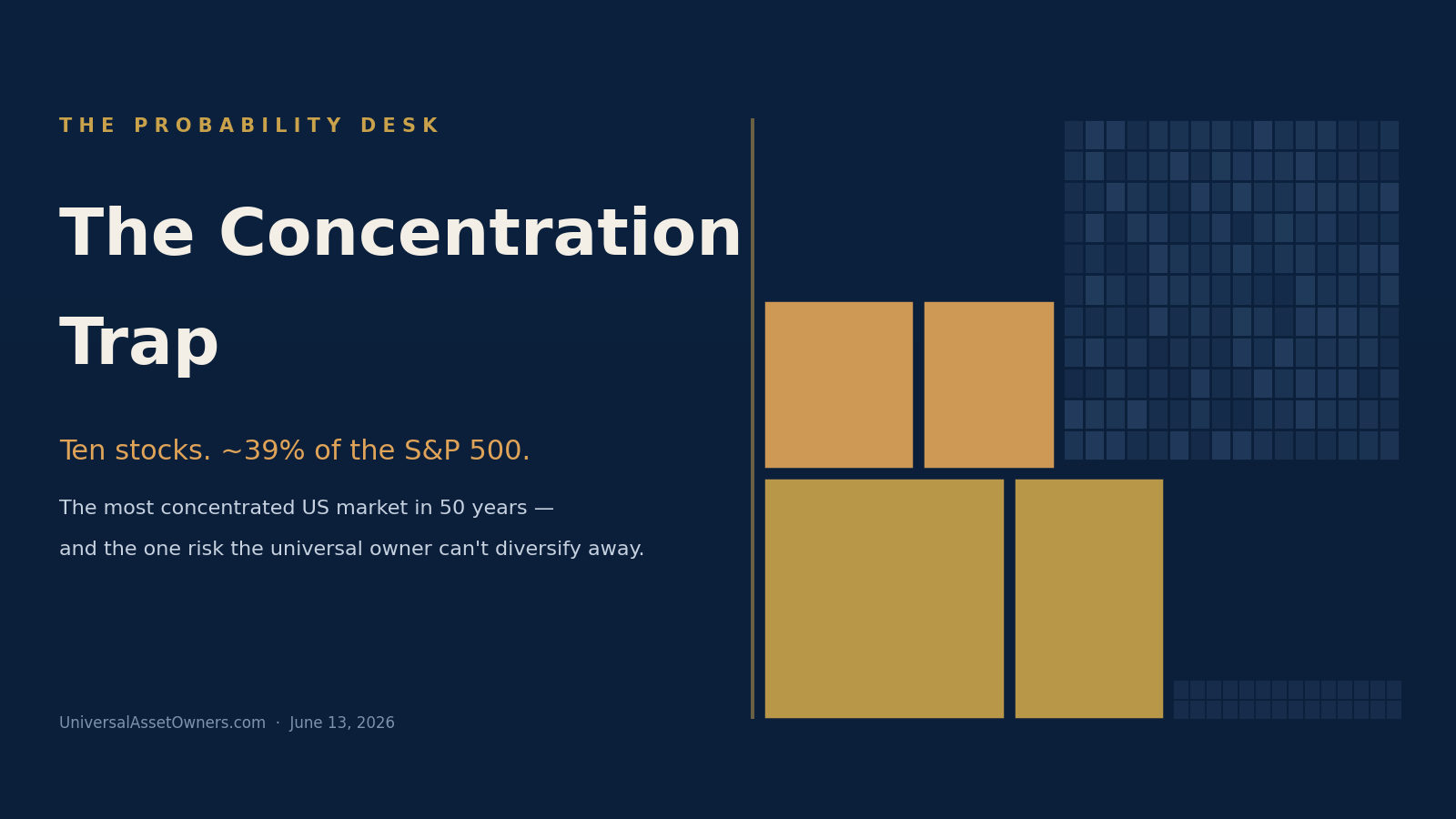
The S&P 500 closed Friday, June 12 at 7,431 — near record territory — while its ten largest companies command roughly 39% of the index by market value, past the ~27% peak of the 2000 dot-com bubble and the most top-heavy the US market has been in fifty years. For a universal owner who holds the whole market by design, this is the single exposure indexing cannot diversify away: you are structurally long a handful of AI-levered mega-caps whether you chose them or not. The Probability Desk frames the next twelve months as four mutually exclusive paths and assigns a 45% base case to a Sticky Plateau (concentration stays ~36–41%, the index grinds), a 20% upside to Orderly Broadening (the other ~490 names catch up without a mega-cap crash — the benign de-concentration already flickering in 2026's tape), a 20% tail to a Disorderly Unwind (a ≥20% de-rating in the top cohort that drags the cap-weighted index down ≥10%), and a 15% weight to a Melt-Up in which concentration intensifies toward the 50% that Apollo's Torsten Slok says is possible. A 50,000-path Monte Carlo puts the median 12-month index total return at +4.5%, but the distribution is deliberately fat-tailed on the downside: the 10th percentile is −25%, and we model a ~14% probability of an index drawdown of 20% or worse and a ~23% probability the top-10 cohort itself de-rates 20%+. The analytical point for decade-horizon capital is not whether the AI names are "good companies" — by earnings they plainly are — but that concentration is a portfolio-construction risk that has decoupled from the fundamentals, and the owner of everything cannot opt out of it.
The Trigger
There is no single press release behind today's report; the trigger is a standing structural condition that reached a fresh extreme this week, and a market that keeps printing highs on a narrowing base.
- The index, the level, the date. The S&P 500 closed Friday, June 12, 2026 at 7,431.46 [Source: FRED, S&P 500 series (SP500), June 12, 2026]. It is up roughly 8% year-to-date — but technology, media and telecom names have accounted for about 85% of that return [Goldman Sachs, via Investing.com, June 2026]. The index level is broad; the engine underneath it is not.
- The concentration number. The ten largest S&P 500 constituents are now roughly 38–40% of the index by market capitalization — above the ~27% intra-year peak reached in 2000 and the highest in five decades [Guinness Global Investors, "Is there a rising concentration risk in the S&P 500?"; Columbia Threadneedle]. The "Magnificent Seven" alone are about 34% of the index, with a combined market value near $22.7 trillion, and Nvidia alone is roughly 7% of the S&P 500 — its single largest constituent (early 2026) [S&P Dow Jones Indices; The Motley Fool, 2026].
- The fresh wrinkle — and why now. The genuinely new development is not that concentration is high; it is that 2026 has produced the first sustained broadening signal in three years. Through the first half of 2026 the Magnificent Seven underperformed the index — up about 5.4% versus the S&P's 7.9% — and equal-weight strategies have been outperforming [The Motley Fool; 24/7 Wall St., March 2026]. That makes the next twelve months a genuine fork rather than a foregone conclusion. On June 2, Goldman Sachs flagged the rally as "increasingly unsettling" beneath the surface — more crowded, concentrated and leveraged around AI, with downside protection unusually cheap. And on Monday, June 15, CalPERS — the largest US public pension — reviews its private-debt program, part of the same story: owners hunting for the diversification the public index no longer provides [CalPERS, Investment Committee agenda, June 15, 2026].
This lands on a decade-horizon balance sheet because a universal owner's strategic asset allocation assumes the equity beta it buys is diversified. When 39% of that beta is ten correlated, AI-levered names trading at a premium multiple, the assumption is quietly false — and the risk is undiversifiable by construction.
The Forecast Question
Over the twelve months to June 30, 2027, does the top-10 share of the S&P 500 (≈39% today) fall materially — and if so, through orderly broadening or a disorderly unwind — or does concentration persist or intensify?
Resolution criteria (gradeable on June 30, 2027): the top-10 weight then versus ~39% now; the 12-month cap-weight S&P total return; the top-cohort drawdown; and the equal-weight-vs-cap-weight relative return. Base rate: concentration is sticky — it has historically built over years before breaking — but unconditional 12-month drawdowns of ≥20% occur roughly one year in five to six, and more often from rich, concentrated regimes.
Prior & Analogues
Three reference episodes anchor the outside view. All argue the same two-part lesson: concentration can persist far longer than value investors expect, and when it breaks it breaks through the leaders, sharply.
- The Nifty Fifty (c.1969–1973). A cohort of "one-decision" growth stocks drove concentration higher into 1972. The 1973–74 bear market then took roughly a third off the S&P 500, and the reversion was violent: the equal-weight index beat the cap-weight index in nine of the ten years from 1974 to 1983, returning 410% versus 173% [RBC Wealth Management, "The Great Narrowing"; qualitative lesson: Border to Coast, "Lessons from the Nifty Fifty and the dot-com bubbles"]. Relevance: a high-quality leadership cohort is not protection against a de-rating when the entry multiple is rich. Caveat: 1970s inflation/rate dynamics differ from today.
- The dot-com peak (2000). The top 10 reached roughly 27% intra-year (Cisco, Microsoft, Intel) before falling back toward 23% by year-end as the leaders de-rated through 2000–2002 [Border to Coast; RBC Wealth Management, "The Great Narrowing"]. Relevance: the most direct concentration analogue. Caveat — and it is the central caveat of this report — today's leaders have far more profit behind them: the current top cohort generates ~70% of S&P economic profit [Russell Investments] and an estimated ~46% of 2026 S&P earnings growth [Goldman Sachs], where many 2000 leaders were priced on revenue and story.
- 2023–2026, the AI cohort. Concentration roughly doubled off its early-2020s base on real earnings delivery. Relevance: this is a partly fundamental concentration, which is precisely why a simple "it's a bubble, it must pop" prior is too crude. Caveat: fundamentals justify a level of concentration; they do not make a 27.5x cap-weight multiple immune to a de-rating.
The prior, then, is not "a crash is overdue." It is: concentration this extreme is rarely unwound gently in a single year, the modal outcome is persistence, but the conditional probability of a sharp, leader-led drawdown is materially higher than in a broad market.
Evidence-Update Table (Bayesian)
No probability below appears without the evidence that moved it.
| # | Evidence (dated, sourced) | Direction | Strength | Effect on the model |
|---|---|---|---|---|
| 1 | Top-10 ≈ 39% of S&P 500, above the 2000 peak [Guinness; Columbia Threadneedle] | Raises tail & melt-up; lowers benign | High | Anchors the level of undiversifiable risk; pushes tail above its unconditional base rate |
| 2 | Cap-weight fwd P/E ~27.5x vs equal-weight ~22.4x — widest discount since 2010 [Benzinga, May 2026] | Raises tail; raises broadening | High | A rich top and a cheap tail of 490 names is the setup for both a de-rate and a catch-up |
| 3 | H1-2026: Mag-7 +5.4% vs index +7.9%; equal-weight outperforming [Motley Fool; 24/7 Wall St.] | Raises broadening | Medium | The benign de-concentration is already happening — the single biggest reason upside is a real scenario, not a hope |
| 4 | Top cohort = ~70% of economic profit [Russell Investments], ~46% of 2026 EPS growth [Goldman Sachs] | Raises base/melt-up; caps tail severity | High | Fundamental floor under the leaders vs 2000; argues against a full dot-com-scale collapse |
| 5 | Goldman (June 2): crowded, concentrated, leveraged; cheap downside protection [Goldman, via Investing.com] | Raises tail | Medium | Positioning/structure fragility on top of valuation; cheap hedges = complacency |
| 6 | Apollo/Slok: top-10 could reach 50% [Seeking Alpha, 2026] | Raises melt-up | Medium | A credible house view that concentration extends, not reverses |
| 7 | VIX 19.4, HY OAS 278bp, 10Y 4.45% [FRED, June 11] | Lowers near-term tail | Medium | No stress priced today; a tail would have to be triggered, not extrapolated |
| 8 | TMT = ~85% of YTD index return [Goldman/Investing.com] | Raises tail & base | High | Confirms the index's gains rest on the cohort — broad return is an illusion of breadth |
Posterior (published weights): Sticky Plateau 45% · Orderly Broadening 20% · Disorderly Unwind 20% · Melt-Up 15%.
The Scenarios
Base — Sticky Plateau — 45%. Concentration stays roughly where it is (top-10 ~36–41%). AI capex and earnings keep delivering enough to justify the cohort without re-rating it sharply higher; the 490 grind along; the index posts a mid-single-digit to low-double-digit total return. This is the modal outcome because concentration has proven sticky in every prior episode and because the leaders' profits are real. Resolves it: top-10 weight in the 36–41% band on June 30, 2027; equal-weight-vs-cap-weight spread range-bound; no 20%+ cohort drawdown.
Upside — Orderly Broadening — 20%. The benign path, and the one with the freshest supporting evidence. The other 490 names — cheaper at ~22x, leveraged to rate relief and a broad capex cycle — re-accelerate on earnings, while the AI cohort merely lags rather than falls. Breadth improves, concentration eases gently, and the index still rises. This is the outcome a universal owner should want, because it de-risks the portfolio without a drawdown. H1-2026's Mag-7 underperformance and equal-weight outperformance are early tells. Resolves it: RSP (equal-weight) outperforms SPY (cap-weight) over rolling three-month windows; share of S&P names above their 200-day average rises; index 12-month return positive; no cohort crash.
Tail — Disorderly Unwind — 20%. The path that matters most to the owner of everything. An AI-monetization disappointment, a hyperscaler capex "air-pocket," an investment-grade credit scare at a mega-cap, or an exogenous macro shock triggers a ≥20% de-rating in the top cohort, and because that cohort is 39% of the index, the cap-weighted S&P falls ≥10% even if the other 490 hold up. This is the mechanical danger of concentration: the index cannot diversify away from its own largest holdings. Our model puts the cohort de-rate probability at ~23% and the index ≥20% drawdown at ~14%. Resolves it: top-cohort drawdown ≥20%; index drawdown ≥10%; VIX sustained >25 (now 19.4); HY OAS >400bp (now 278bp).
Melt-Up — More Concentration — 15%. AI productivity gains re-rate the cohort higher, passive inflows mechanically buy the biggest names, and the top-10 weight pushes past 42% toward the 50% Apollo's Slok flags as possible. Concentration intensifies — the undiversifiable risk grows. Resolves it: top-10 weight >42% on June 30, 2027; Nvidia >10% of the index (≈7% now).
The four are mutually exclusive and collectively exhaustive across the concentration outcome: weight roughly flat (Base), weight down via the 490 rising (Upside), weight down via the cohort falling (Tail), weight up (Melt-Up).
The Monte Carlo (Simulation Results)
We ran a real 50,000-path Monte Carlo (mc.py, seed 20260613; reproducible). It simulates 12-month total returns for two cohorts — the top-10 (start weight 39%) and the rest-490 (61%) — under a two-regime mixture: a normal regime and, with 18% annual probability, an "AI de-rate / concentration-break" stress regime in which the top cohort takes a large negative shock. Cohort means, volatilities and correlations are documented in the Methodology box.
Headline outputs:
- Index 12-month total return: P10 −25.2% · P25 −10.2% · median +4.5% · P75 +18.2% · P90 +30.1%; mean +3.3%.
- P(index drawdown ≥ −10%) = 25%; P(index drawdown ≥ −20%) = 14%.
- Top-10 cohort 12-month return: P10 −39% · median +3.5% · P90 +39%; P(cohort de-rate ≥ 20%) = 23%.
- Ending top-10 weight: P10 31% · median 39% · P90 43%; mean 37.6%. P(weight falls below 35%) = 23%; P(weight rises above 42%) = 18%.
- Raw scenario frequencies: Plateau 43.7% · Broadening 18.4% · Unwind 20.3% · Melt-Up 17.6% — blended with the base rate and expert priors to the published weights above.
Read of the distribution. The center of mass is mildly positive (the leaders have real earnings; the 490 are cheap), but the left tail is deep and the right tail is fat — exactly what a richly-valued, concentrated index should produce. A universal owner reading this should not fixate on the +4.5% median; they should price the fact that one path in seven is a ≥20% index drawdown driven by names they did not choose to over-weight.
Limitations: a four-quadrant classification compresses a continuous outcome; the 18% stress probability and the cohort correlation (0.82 normal / 0.70 stress) are judgment calls calibrated to valuation and the historical drawdown frequency, not estimated from a fitted model; the model is silent on timing within the year and on contagion to credit/private markets (addressed qualitatively below). It is a scenario engine, not a forecast.
Market Pricing vs. Desk View
| Market is pricing | The Desk's view | |
|---|---|---|
| Near-term volatility | Calm — VIX 19.4, hedges cheap [FRED] | Underpricing conditional tail risk; cheap protection is itself a fragility signal |
| Credit | Benign — HY OAS 278bp [FRED] | Agrees there is no stress today; a tail must be triggered, not extrapolated |
| The 490 | Discounted — equal-weight ~22x vs cap-weight ~27.5x [Benzinga] | The clearest positive mispricing: the cheap tail is where broadening pays |
| Concentration | Treated as permanent / still rising (passive flows, Slok 50% call) | Sticky, yes — but mean-reverting on a multi-year horizon; persistence is over-priced as certainty |
Highest-conviction read: the market is correctly pricing that nothing is wrong today and is under-pricing the asymmetry — that the same concentration powering the melt-up is what makes the drawdown mechanical if a trigger arrives. What consensus is missing is that for a universal owner, the relevant risk is not "will AI earnings beat" but "is my equity beta still diversified" — and it is not. What would prove the Desk wrong: a clean, sustained broadening in which the 490 carry the index higher and concentration eases with no drawdown (our 20% upside) — a perfectly happy outcome we would gladly be "wrong" about.
Universal-Owner Portfolio Heatmap
Direction of 12-month reprice by scenario (strategic, not advice). ▲ = supportive, ▼ = pressured, ≈ = neutral.
| Asset / exposure | Base (45%) | Upside (20%) | Tail (20%) | Melt-Up (15%) |
|---|---|---|---|---|
| S&P 500 cap-weight | ≈/▲ | ▲ | ▼▼ | ▲▲ |
| S&P 500 equal-weight / broad value | ≈ | ▲▲ | ▼ (less) | ▼ (lags) |
| Mega-cap AI cohort | ▲ | ≈/▼ | ▼▼▼ | ▲▲▲ |
| Ex-US developed & EM equity | ≈ | ▲ | ▼ (less correlated) | ≈ |
| Long-duration Treasuries | ≈ | ≈ | ▲ (flight-to-quality) | ▼ |
| IG credit (mega-cap issuers) | ≈ | ≈ | ▼ (spread widening) | ≈ |
| Private equity / venture (AI-levered) | ≈ | ≈ | ▼▼ (marks lag, then catch down) | ▲ |
| Private credit | ≈ | ▲ | ▼ (first stress cycle) | ≈ |
| Real assets / infrastructure / gold | ▲ | ▲ | ▲ (diversifier) | ≈ |
The strategic signal across all four columns: the cap-weight index is the most exposed line, and the cheapest insurance against three of the four outcomes is owning more of what the index under-owns — the 490, ex-US equity, real assets — rather than trying to time the cohort.
Second- & Third-Order Effects
- The diversification illusion propagates. Many "global" equity benchmarks and target-date glide-paths inherit US mega-cap concentration through US weightings. A US cohort de-rate is therefore a global equity event, not a US-sector event.
- Passive flows are pro-cyclical both ways. Index inflows mechanically buy the largest names (amplifying the melt-up); redemptions mechanically sell them (amplifying the unwind). Concentration makes the index a momentum vehicle in disguise.
- Private markets mark with a lag, then converge. AI-levered PE/VC valuations reference public comparables; a public de-rate flows into private marks over subsequent quarters — which is precisely why allocators (CalPERS reviewing private debt Monday, June 15) are probing whether private allocations diversify or merely re-package the same AI beta [CalPERS IC agenda, June 15, 2026].
- Credit linkage. The mega-caps are now meaningful investment-grade issuers funding AI capex; an equity de-rate plus an IG re-pricing would tighten financial conditions faster than headline calm suggests — the channel Goldman flagged June 2.
- The owner's governance problem. For a sovereign fund or large pension, "we passively hold the market" is increasingly a concentration decision an investment committee has not explicitly made. The stewardship question — do we actively under-weight our largest involuntary exposure? — is now a board-level one.
Watch Dashboard
| Indicator | Now | Threshold that moves the model |
|---|---|---|
| Top-10 share of S&P 500 | ~39% | >42% = Melt-Up; <35% = de-concentration underway |
| Equal-weight vs cap-weight (RSP/SPY) 3m | EW outperforming | Sustained EW lead = Upside; sharp EW lead with index down = Tail |
| Mag-7 vs S&P 500 relative | Mag-7 lagging (H1) | Cohort −20%+ = Tail trigger |
| Cap-weight fwd P/E | ~27.5x | >30x = Melt-Up stretch; <22x = de-rate done |
| Equal-weight fwd P/E | ~22.4x | A close of the EW/CW discount = broadening |
| VIX | 19.4 | >25 sustained = Tail confirming |
| HY OAS | 278bp | >400bp = credit stress / Tail |
| US 10Y | 4.45% | <4.0% supports the 490 (Upside); >5.0% pressures multiples |
| Nvidia share of index | ~7% (early 2026) | >10% = single-name fragility rising |
| TMT share of index return | ~85% YTD | A fall = breadth improving (Upside) |
| Hyperscaler capex guidance | Rising | A cut/air-pocket = Tail trigger |
| % S&P above 200-day avg | — | Rising = breadth/Upside; collapsing = Tail |
| Passive equity net flows | Positive | Sustained outflows = unwind accelerant |
| AI-cohort IG credit spreads | Tight | Widening = Tail channel opening |
| Mag-7 share of S&P earnings | ~46% of growth | A miss vs guidance = fundamental crack |
Red-Team — How This Could Be Wrong
- Concentration is fundamentally justified and we are pattern-matching to 2000. The strongest counter: this cohort earns ~70% of S&P economic profit; if AI productivity compounds, 39% may be too low, not too high, and our 20% tail is alarmist. We accept this is the core risk to the call — it is exactly why the Melt-Up scenario carries real weight and why we cap, rather than maximize, the tail.
- The broadening is already the answer, quietly. If H1-2026's equal-weight outperformance is the start of a multi-year rotation, the Upside (20%) is too low and concentration de-risks gently without anyone needing a drawdown. We would happily be wrong this way.
- The model's stress probability is a judgment call. The 18% annual stress-regime weight and the cohort correlations are calibrated, not estimated; a lower stress weight would pull the tail toward its unconditional ~15% base rate. We disclose this rather than hide it.
- Timing is unmodeled. Concentration can stay extreme for years (it did into 1972 and into 2000). A 12-month horizon may simply be too short to resolve a multi-year setup — the honest answer to "when" is "we don't know, which is why we weight rather than predict."
Falsifiers: a sustained EW-over-CW rotation with a positive index (kills the tail emphasis); top-10 weight pushing past 42% with no drawdown (validates Melt-Up, not Tail); a cohort earnings collapse (validates Tail). All are gradeable by June 30, 2027.
Methodology Box
Probabilities are the UAO Probability Desk's, weighted across three inputs by a written rule (base rate 0.4 / expert prior 0.3 / simulation 0.3; MiroFish multi-agent run unavailable this cycle, so the Monte Carlo fills the simulation slot). Base rate: historical 12-month outcomes following extreme concentration (Nifty Fifty, dot-com, 2023–26) and the unconditional ≥20% drawdown frequency. Expert priors: Goldman Sachs (desk note June 2, 2026; house view), Apollo/Torsten Slok, and realized 2026 breadth data — cited and dated, weighed as house views. Simulation: a 50,000-path two-cohort, two-regime Monte Carlo; normal regime returns top-10 N(9%, 26%) and rest-490 N(7.5%, 15.5%) at 0.82 correlation; an 18%-probability stress regime returns top-10 N(−32%, 30%) and rest-490 N(−10%, 20%) at 0.70 correlation; returns floored at −85%; ending weights and index return derived per path and classified. Weights normalized to 100% and rounded to 5%. Live data via FRED (S&P 500, DGS10, VIXCLS, BAMLH0A0HYM2). The scenario is logged to the public calibration ledger for Brier-scoring at resolution.
Disclaimer: This report is for informational and research purposes only and does not constitute investment, legal, tax, or financial advice. Editorial scenario analysis only — not investment, actuarial, or geopolitical advice.
Source Ledger (selected; 25+ named, dated sources)
Live market data — FRED (St. Louis Fed), accessed June 13, 2026: S&P 500 close 7,431.46 (June 12); 10-Year Treasury (DGS10) 4.45% (June 11); VIX (VIXCLS) 19.44 (June 11); ICE BofA US High Yield OAS (BAMLH0A0HYM2) 2.78% (June 11).
Concentration & valuation: Guinness Global Investors, "Is there a rising concentration risk in the S&P 500?"; Columbia Threadneedle, "The rise of the Magnificent 7"; The Motley Fool, "The Magnificent Seven's Market Cap vs. the S&P 500" (June 2026); MacroMicro, "US — Magnificent Seven Total Market Cap & Share of S&P 500"; Benzinga, "The S&P 500 Equal Weight vs. Market Cap Weight Debate" (May 2026); 24/7 Wall St., "Equal Weight ETFs Beating the S&P 500 in 2026" (March 2026); S&P Dow Jones Indices, "S&P 500 Equal Weight Index FAQ."
Earnings concentration: Russell Investments (Mag-7 ~70% of S&P economic profit); Goldman Sachs (Mag-7 ~46% of 2026 S&P EPS growth, via FactSet/Benzinga, "Magnificent Seven earnings outlook 2026 / S&P 493").
Expert priors / house views: Goldman Sachs trading-desk note (Lee Coppersmith, June 2, 2026, via Investing.com & Bitget); Goldman Sachs, "The S&P 500 Expected to Rally 12% This Year"; Apollo Global Management — Torsten Slok (top-10 toward 50%), via Seeking Alpha.
Historical base rates: Border to Coast, "Lessons from the Nifty Fifty and the dot-com bubbles"; RBC Wealth Management, "The Great Narrowing: S&P 500 concentration"; Silvercrest, "Concentration Conundrum — Lessons from the History of S&P 500 Giants"; Commonfund, "The New Era of Market Concentration"; Financhill, "Market Concentration and S&P 500 Performance: 50-Year Analysis."
Allocator context: CalPERS, Investment Committee agenda (June 15, 2026); McKinsey, Global Private Markets Report 2026; ECB, Financial Stability Review special article (May 2026).
*Probabilities are the UAO Pr
Continue the briefing. Read the daily brief · watch the daily video briefing · listen to The Universal Owner · view the chart of the day.
Produced and edited by the UAO editorial desk. Not investment advice.