
98% of the world’s sovereign wealth funds |
18 of 20 of the world’s largest pension funds |
10 of 10 of the largest charitable foundations |
85% of the world’s largest family offices |
100+ billionaires, every morning |
The reroute needs an underwriter
Physical alternatives matter only if ships, crews and insurers will use them. The disruptions around Hormuz, the Red Sea and the Black Sea do not prove that one insurance pool binds all three. They do give asset owners a reason to test where their supposedly diversified exposures share the same contractual bottlenecks.
U.S. equities and maritime-risk indicators are sending different signals. The S&P 500 and Dow Jones Industrial Average closed at records on Tuesday, 4 August, amid strong corporate forecasts and reported hopes for de-escalation in the Middle East. On Wednesday, the S&P 500 slipped while the Dow set another record; the Cboe Volatility Index closed at 15.81. Those market moves describe investor positioning, not a settled judgment on the safety of the world’s shipping lanes.1, 2, 3
The operating picture remains severe. In its 4 August advisory, the U.K.-led Joint Maritime Information Center rated the Strait of Hormuz SEVERE, meaning hostile action was highly likely, and Bab el-Mandeb and the southern Red Sea SUBSTANTIAL. Reuters reported that Kpler counted only two visible commodity-vessel transits through Hormuz on Wednesday and one through Bab el-Mandeb, down from eight and 20 respectively a day earlier. Ships operating without public transponders may not appear in those counts, so they should not be read as a complete census.4, 5
Iran and Oman have reached a preliminary understanding on the geographic coordinates of a route through Hormuz. A joint statement was still being drafted on Wednesday, and material terms remained under discussion. The development is diplomatic progress; it is not yet a security guarantee, a signed operating protocol or proof of normalised traffic.6
The Red Sea picture also worsened on Wednesday. Yemen’s Houthis said they had attacked two Saudi tankers, one near Yanbu and another in the Gulf of Aden. Saudi Arabia had not confirmed the claims at publication review. The claims therefore remain attributed, not established.5
The Black Sea offers a different version of the same operating problem. Ukraine’s infrastructure ministry said Russia carried out 67 attacks on port infrastructure in July and attacked 35 civilian vessels in ports and 22 in the maritime corridor. Ukraine’s deputy economy minister told Reuters that more than 30 million metric tons of export volume could be at risk unless the port problem is resolved — a conditional statement, not a forecast that the volume would inevitably be lost. Ukraine has been developing alternative routes, but officials said those routes would initially cover only 50% to 55% of usual agricultural export capacity.7, 8
At the Caspian Pipeline Consortium’s Black Sea terminal, repeated suspensions have reflected a combination of safety concerns, tanker shortages and shipowner reluctance. Kazakhstan’s oil output fell 14% in July. The episode matters because a route can be technically intact yet commercially constrained when owners, crews or insurers decline the voyage. It does not establish that insurance alone caused the stoppages.9
The insurance thesis — and its limit
The strongest defensible conclusion is narrower than a “one insurance market” claim.
Marine insurers and reinsurers can transmit stress across ports, routes and policy lines. The International Union of Marine Insurance has described geopolitical events as increasingly interconnected and persistent, with high-risk zones expanding and insurance capacity tightening. That supports a shared-friction thesis: several disruptions can compete for underwriting attention, reinsurance protection and risk appetite. It does not demonstrate that Hormuz, the Red Sea and the Black Sea draw on one fixed pool whose depletion in one corridor automatically reprices the others.10
There is also material counterevidence. Howden Re reported that primary marine, energy and terrorism capacity was at an all-time high, with roughly $1 billion of maximum single-programme capacity, and that reinsurer capital remained robust. Its public work describes a market under pressure, but still functioning.11
For an investment committee, the useful question is therefore empirical: where do our managers, portfolio companies and logistics counterparties depend on the same insurers, reinsurers, brokers, protection-and-indemnity clubs, ports or flag-state permissions? The answer belongs in a counterparty map, not in a slogan.
Physical bypass capacity is smaller than the headline system
Roughly 20 million barrels a day of crude oil and oil products normally pass through Hormuz, according to the International Energy Agency. The IEA estimated in February that available pipeline capacity capable of bypassing the strait was about 3.5 million to 5.5 million barrels a day. Even at the top of that range, roughly 14.5 million barrels a day of the baseline flow could not be rerouted through those pipelines. Current spare headroom is uncertain, and nameplate capacity should not be confused with capacity immediately available for export.12
The distinction also corrects a common category error. Saudi crude exports from Yanbu averaged about 770,000 barrels a day in January and February; that was an export-flow figure, not throughput on the East-West Pipeline. Aramco restored the pipeline’s gross capacity to 7 million barrels a day in April, but about 2 million barrels a day can feed domestic refineries, leaving roughly 5 million barrels a day potentially available for export.13, 14
Liquefied natural gas is less flexible. The IEA says Qatar and the United Arab Emirates route 93% and 96% of their LNG exports respectively through Hormuz and have no alternative LNG shipping route. That makes sustained safe passage more important than a temporary fall in spot oil prices.12
Ask portfolio companies and external managers for four things:
- Route dependency: volume by port and chokepoint, including the first and second alternatives.
- Usable capacity: the difference between nameplate capacity and immediately available capacity.
- Risk-transfer concentration: insurer, reinsurer, broker and protection-and-indemnity counterparties by route.
- Contract mechanics: exclusions, cancellation rights, waiting periods, deductibles and the party that bears rerouting costs.
A route is not redundant because it exists on a map. It is redundant when it can carry the cargo, at the required time, under contracts that remain enforceable and insurable.
Read the deep dive: The reroute is not the redundancy ›
Aramco: the cash-flow shortfall needs context
Saudi Aramco reported second-quarter adjusted net income of $33.4 billion, operating cash flow of $25.4 billion and free cash flow of $12.3 billion. The board declared a $21.9 billion base dividend, payable in the third quarter. Gearing rose to 6.2% at 30 June from 4.8% at 31 March.15
That sequence does not prove that debt rose “to pay the dividend.” Aramco said a $13.6 billion working-capital build reduced reported free cash flow. Adding that temporary movement back produces $25.9 billion of free cash flow before the working-capital change, above the declared dividend. Working capital can reverse or persist; the point is that the unadjusted cash-flow comparison is incomplete.
Aramco’s preferred adjusted-income measure rose 33% from a year earlier. Other reports have used different percentages for statutory profit. Publication should identify the metric, period and denominator every time.
Allocator read: watch the interaction among realised oil prices, export volumes, working capital, capital spending and distributions. Lower oil prices can reduce receipts even if export volumes recover; higher volumes can offset part of that pressure. The net fiscal effect cannot be inferred from either price or volume alone.
CalSTRS: a 13.9% year led by listed equities
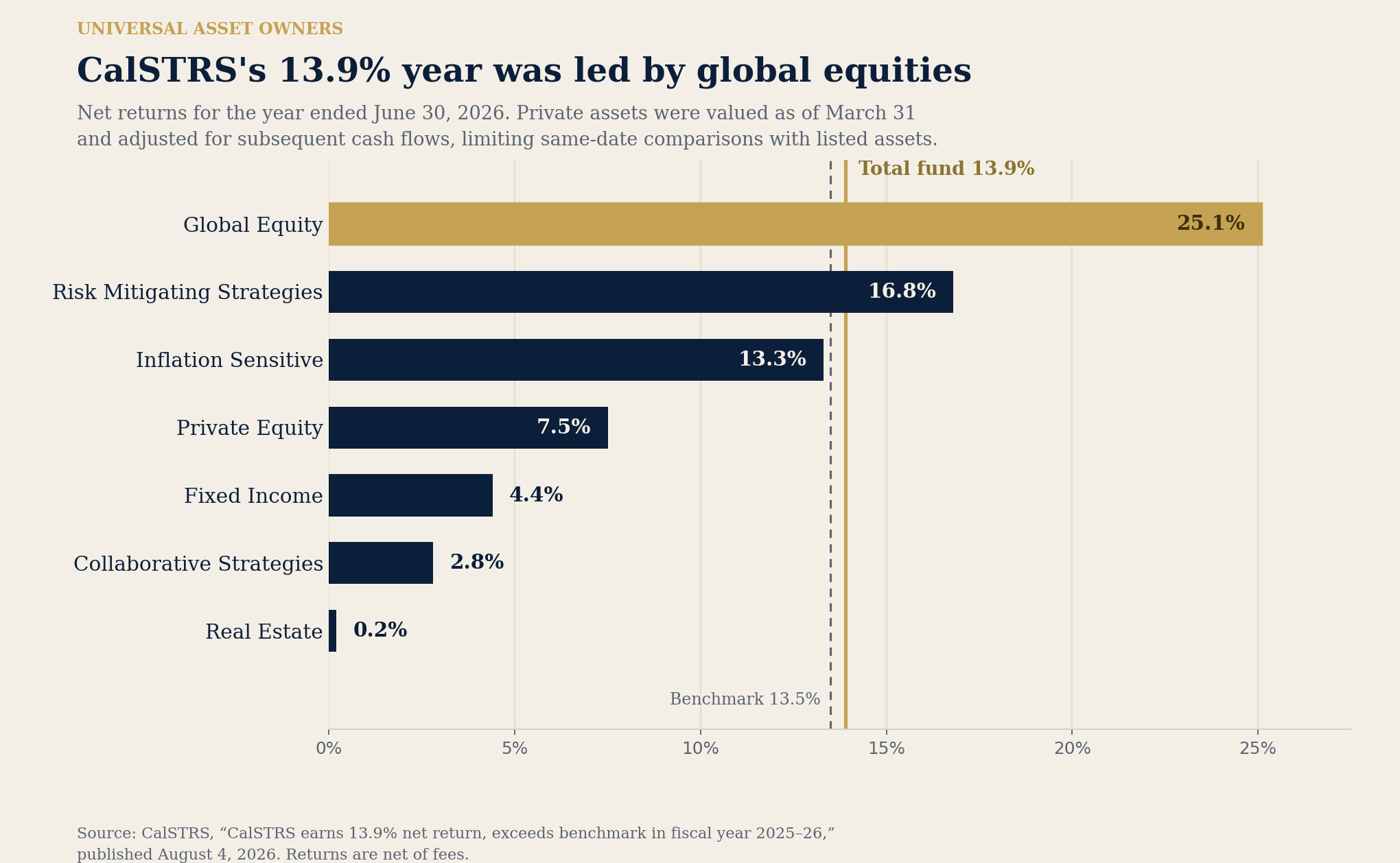
The California State Teachers’ Retirement System earned 13.9% net for the year ended 30 June, finishing 0.4 percentage point above its benchmark and taking assets to $415.4 billion.16
The result was led by public equities, but that does not make it merely “beta” or negate the benchmark outperformance. Nor does one year establish an allocation victory. CalSTRS said private assets, about 35% of the portfolio, were valued as of 31 March and then adjusted for cash flows through 30 June. That lag makes same-date comparisons with listed assets imperfect.
The fund’s 10-year annualised return was 9.4%, and its latest reported funded ratio was 79.3% as of 30 June 2025. Those are more useful governance anchors than the one-year league table. The committee questions are whether the policy benchmark still represents the risks being taken, whether private-market marks are comparable across managers, and whether the liquidity plan can withstand a public-market drawdown before private marks catch up.
Private markets: separate gross fundraising from new discretion
Brookfield Asset Management reported a record $77 billion of second-quarter fundraising and $98 billion for the first half. Of the quarterly total, a $40 billion Just Group mandate accounted for about 52%. Brookfield also reported $16 billion across its private-equity and infrastructure flagships.17
The proper comparison is not “fundraising good” or “fundraising weak.” It is mandate capital versus commingled capital; flagship closes versus separately managed accounts; and committed capital versus capital already fee-bearing or deployed. Those categories create different economics for the manager and different governance burdens for the client.
Carlyle reported $16.8 billion of second-quarter inflows and $485 billion of assets under management. Its materials said $5 billion of commitments were earmarked for the next vintage of its U.S. buyout fund. An earmark is not the same as a conventional first close, and the wording should remain precise.18
Allocator read: manager concentration is not demonstrated by two large quarterly announcements. Test it with the plan’s own exposure data — commitments, net asset value, unfunded commitments, co-investments, continuation vehicles and insurer-owned mandates, aggregated by manager and strategy.
Electronic Arts: the sovereign-led take-private has closed
Electronic Arts said its acquisition by a consortium of Saudi Arabia’s Public Investment Fund, Silver Lake and Affinity Partners closed on 4 August. The transaction valued EA at about $55 billion, and public stockholders received $210 a share in cash. EA’s shares were delisted. PIF rolled over its existing 9.9% stake; the announced financing package comprised about $36 billion of equity investment and $20 billion of committed debt financing, of which $18 billion was expected to be funded at closing.19
Those financing totals do not mean PIF alone supplied $36 billion of cash equity, and the public closing materials reviewed here do not establish a 93% post-close PIF ownership share. Nor do they support describing all committed debt as a PIF obligation. The defensible governance point is simpler: a PIF-led consortium now owns the company, so operating influence should be assessed through the final board, control and reporting arrangements rather than inferred from the headline purchase price.
Allocator read: a sovereign investor’s exposure can combine direct equity, rolled ownership, consortium governance and acquisition leverage. Capital-call timing at other holdings may be a scenario to monitor, but no public evidence reviewed here establishes that this transaction will slow PIF’s unrelated commitments.
Policy and monetary signals
Australia: a proposed standard, not a law
Australia’s federal energy minister said proposed national standards would require new data centres to be majority powered by renewable energy; gas-only proposals would not qualify for registration. Queensland and the Northern Territory opposed the plan. The proposal may change project economics, but it is not enacted law.20
Federal Reserve: the debate has shifted toward tightening
The Federal Open Market Committee held its target range at 3.5% to 3.75% on 29 July in a 9–3 vote; three members preferred a quarter-point increase. Governor Lisa Cook said on 5 August that inflation risks were tilted higher and that she was prepared to support a rate increase if necessary. That was a conditional policy statement, not a declaration of her vote at the next meeting.21, 22
Brazil and India: different tools, different signals
Brazil’s central bank cut the Selic rate by 25 basis points to 14% on 5 August, its fourth consecutive reduction, while retaining restrictive guidance. Its 3.2% inflation projection referred to the policy horizon, not current inflation; comparing the two as though they described the same period would be misleading.23
India’s foreign-exchange reserves reached $692.9 billion in the week ended 31 July. Foreign-currency non-resident deposits were $36.7 billion. The Reserve Bank of India’s temporary zero-cost hedging facility runs through September; its effect should be judged from deposit and forward-book data, not from the reserve headline alone.24
Climate disclosure: the rule is proposed for rescission
The Securities and Exchange Commission has proposed rescinding its 2024 climate-disclosure rules. The comment deadline was 3 August. Sweden’s AP7 opposed rescission and said more than 60% of its equities were in North America. The proposal is not final, and AP7’s objection does not establish that large owners will impose substitute reporting requirements on managers or portfolio companies. That is a possible response to monitor, not a reported fact.25, 26
Risk radar
Hormuz — SEVERE
The latest reviewed JMIC advisory rates hostile action highly likely and flags mine-risk reporting around the traffic-separation scheme. A useful public signal of improvement would be a lower threat assessment sustained across successive advisories, but no single classification can establish normalisation.4
Bab el-Mandeb and southern Red Sea — SUBSTANTIAL
Houthi claims of attacks on two Saudi tankers were not confirmed by Saudi Arabia at review time. Watch for independent confirmation, route changes, war-risk notices and sustained transit data rather than a single day’s vessel count.5
Black Sea — operating disruption
Ukraine’s July attack figures and the CPC loading interruptions show pressure on both Ukrainian export infrastructure and the Kazakhstan–Russia export route. The mechanisms differ; they should not be combined into one loss estimate.7, 9
What committees should request this week
- A route-and-counterparty map for every material portfolio-company exposure to Hormuz, Bab el-Mandeb and the Black Sea.
- A reconciliation of gross, available and already-used bypass capacity.
- Current war-risk and protection-and-indemnity terms, with quote date, vessel class and route.
- A liquidity bridge that separates listed-market marks from lagged private valuations.
- Private-market fundraising classified by commingled fund, mandate, co-investment, rollover and debt financing.
Bottom line: the evidence does not show that three corridors are governed by one fixed insurance pool. It does show that physical infrastructure, commercial willingness and risk transfer can fail at different points in the same supply chain. Asset owners should measure those dependencies before calling a route — or a portfolio — diversified.
Listen & Watch
Podcast · The Universal Owner
Today’s episode — Three corridors, one question about insurance (7:53). The overlap hypothesis, the Howden Re countercase, and the three public signals that can test both.
Listen on Apple PodcastsListen on Podbean
Watch · Today’s briefing (1:52)
The day’s signal in under two minutes, from the UAO Editorial Desk.
THE BACK PAGE — Meet The Allocator
A fictional veteran of institutional portfolios, asking the question the room skipped.

Sources
Every numbered marker in this edition links here. Each entry links to the underlying document.
- Reuters, US stocks close, 4 August 2026
- Reuters, US stocks close, 5 August 2026
- Cboe, VIX index data
- UKMTO / Joint Maritime Information Center, Update 080 advisory note, 4 August 2026 (PDF)
- Reuters, Gulf shipping traffic down after Houthi tanker claims, 6 August 2026
- Reuters, Iran and Oman reach understanding on Hormuz route coordinates, 5 August 2026
- Ministry for Communities and Territories Development of Ukraine, Attacks on transport infrastructure and civilian shipping, 3 August 2026
- Reuters, Ukraine turns to alternative grain export routes, 4 August 2026
- Reuters, CPC oil loadings falter over safety issues and tanker shortages, 5 August 2026
- International Union of Marine Insurance, Geopolitics and war-risk insurance, 9 June 2026
- Howden Re, Strait of Hormuz: (re)insurance impact, 27 March 2026 (PDF)
- International Energy Agency, Oil security and emergency response: Strait of Hormuz
- Reuters, Crude exports from Saudi Arabia's Yanbu port, 24 March 2026
- Reuters, Saudi Arabia restores full East-West pipeline capacity, 12 April 2026
- Saudi Aramco, Second-quarter and half-year 2026 results
- CalSTRS, CalSTRS earns 13.9% net return, exceeds benchmark in fiscal year 2025-26
- Brookfield Asset Management, Second-quarter 2026 results (PDF)
- Carlyle, Investor relations
- Electronic Arts, EA announces completion of acquisition
- Reuters, Australia's new data centres must be majority renewable powered, 5 August 2026
- Federal Reserve, FOMC statement, 29 July 2026
- Federal Reserve, Governor Lisa D. Cook, speech, 5 August 2026
- Banco Central do Brasil, Copom statements
- Reuters, India's forex reserves hit three-month peak, 5 August 2026
- US Securities and Exchange Commission, Rescission of climate-related disclosure rules, File No. S7-2026-19
- AP7, AP7 opposes SEC proposal to rescind climate disclosure rules
- S&P Global, Middle East shipping insurance costs rise on Hormuz risks (Marsh), 22 July 2026
- Lloyd's Market Association, Joint War Committee listed areas guidance