The Allocation Nobody Made
Wednesday 12 August 2026
98% of the world’s sovereign wealth funds |
18 of 20 of the world’s largest pension funds |
10 of 10 of the largest charitable foundations |
85% of the world’s largest family offices |
100+ billionaires, every morning |
Norges Bank Investment Management reported the largest half-year kroner return in its history this morning: 1,753 billion kroner, a 9.4 per cent return, on a fund worth 22,683 billion kroner. It disclosed a holding in SpaceX for the first time. And in its own attribution, the decisions its managers actually took across asset classes subtracted 0.14 percentage points from relative return. The day before, its chief executive told an audience in Arendal that the fund could disappear.
What happened
The day’s controlling facts, taken from the fund’s own report before anyone else’s framing of them.
Norges Bank Investment Management published its half-year 2026 report at Arendalsuka this morning.1 The Government Pension Fund Global returned 9.4 per cent in the first half, ahead of its benchmark index by 0.22 percentage points, worth 45 billion kroner. The accounting return was 1,753 billion kroner — in the fund’s own words, “the highest half-year krone return on record.”2 The fund closed June at 22,683 billion kroner, roughly $2.29 trillion at the exchange rate implied by the fund’s own holdings file.4
The fund’s value rose by less than it earned. Of the 1,753 billion kroner of return and 89 billion of net inflows, 427 billion was given back to krone appreciation — leaving the fund 1,416 billion kroner larger than it started. A universal owner reports in a currency it does not earn in.
Chief executive Nicolai Tangen’s only published remark on the result was this:
“The result is driven by good returns in the equity market, particularly from Asian technology stocks.”1
He is precisely right, and the precision is the story. Equities returned 13.0 per cent. Asian and Oceanian equities returned 31.3 per cent, against 10.8 per cent in North America and 8.4 per cent in Europe. Telecommunications returned 42.9 per cent; technology 25.3 per cent. Fixed income returned 0.9 per cent. Unlisted real estate returned 3.0 per cent.
And unlisted renewable energy infrastructure — the smallest book in the fund, at 0.5 per cent of assets, and the one line on the balance sheet that exists because somebody decided it should — returned minus 0.2 per cent. It is the only negative asset class in the report.
The attribution nobody quoted
The four-line table inside the report that shows where the outperformance actually came from.
Broad equity-market gains produced most of the return; active equity management added 0.23 percentage points against the benchmark. The fund’s own breakdown of where its 0.22 percentage points of relative return came from is the most interesting table it published, and it is not in any of the coverage:2
| Source of relative return | Contribution |
|---|---|
| Equity management | +0.23 pp |
| Real assets | +0.08 pp |
| Fixed income | +0.05 pp |
| Asset-class allocation | −0.14 pp |
Read that column downward. Everything the fund did inside asset classes added. The one thing it did across them — running underweight equities and overweight bonds against the benchmark — took 0.14 percentage points back out. In a half-year when equities returned thirteen per cent and bonds returned less than one, the fund’s considered top-down judgment was a cost.
This is not a criticism of Norges Bank. It is the defining condition of a universal owner, stated by the largest one in its own numbers. The portfolio’s dominant risks were not allocated. They were received.
The SpaceX holding, and what it is not
How a $1.23 billion position arrived without a decision — and the larger pattern it belongs to.
The fund disclosed a position in Space Exploration Technologies for the first time: $1.23 billion of equity, a 0.05 per cent ownership stake carrying 0.01 per cent of the votes. Its holdings file also shows something the coverage has missed — $552 million of SpaceX corporate bonds. Norway is a lender to the company as well as an owner of it.4
It is worth being exact about how this happened, because the obvious inference is wrong. This is not a private-markets position and no mandate was changed. SpaceX listed on Nasdaq on 12 June 2026, priced at $135 and opened at $150. Norway’s mandate still bars general investment in unlisted equities; the Storting did not change it this spring.6 SpaceX entered the fund’s benchmark index — the FTSE Global All Cap is its basis — effective 22 June, before the 30 June holdings date. The fund’s deputy chief executive, Trond Grande, had made the point in a column before the flotation: a company of SpaceX’s size would with high probability enter the fund’s reference index “and thus something the fund would have to own.” The fund owns SpaceX for the simplest reason there is: the company listed and became ownable, and a fund that owns 1.28 per cent of Nvidia and 1.24 per cent of Apple owns 0.05 per cent of whatever else arrives.
The $552 million bond position is a separate matter from the index point: an equity benchmark cannot deliver a bond.
The gap between 0.05 per cent of the equity and 0.01 per cent of the votes is worth a moment too. The world’s largest fund bought into a company on terms that give it a fifth of the governance its capital would normally carry. It did not negotiate that. It inherited it, in the same delivery.
And SpaceX is not the exception. It is the newest instance of something much larger, which the fund’s own holdings file makes possible to measure.
By our calculation from NBIM’s published holdings file, $188 billion of Norway’s equity portfolio — 11.3 per cent of it — sits in companies where the fund’s voting rights are smaller than its economic ownership. In $116 billion of that, seven per cent of the book, it holds half or less of the votes its capital would carry. That is 440 of the fund’s 7,077 equity positions.4
The largest cases are not obscure. Alphabet is the fund’s third-biggest holding at $50.5 billion, and its 1.17 per cent ownership carries 0.52 per cent of the votes — 44 per cent of the governance the money would ordinarily buy. Meta Platforms, at $17.1 billion, runs 1.19 per cent ownership against 0.54 per cent of votes. At Roche, $7.5 billion of ownership at 2.23 per cent carries 0.24 per cent of the votes, under eleven per cent of its economic weight.
The votes that went missing
| Company | Value | Ownership | Voting | Votes as share of economic weight |
|---|---|---|---|---|
| Alphabet | $50.47bn | 1.17% | 0.52% | 44.4% |
| Meta Platforms | $17.05bn | 1.19% | 0.54% | 45.4% |
| Roche Holding | $7.45bn | 2.23% | 0.24% | 10.8% |
| Novo Nordisk | $3.40bn | 1.58% | 0.50% | 31.6% |
| SpaceX | $1.23bn | 0.05% | 0.01% | 20.0% |
Our calculation from NBIM’s published holdings file, 30 June 2026. 440 of 7,077 equity positions; $188bn in total.4
This is the part of universal ownership that does not appear in a return figure. The entire intellectual case for the model is that an investor too large to sell must instead influence what it owns — that stewardship is the substitute for the exit that scale forecloses. That substitution runs on votes. On an eighth of this portfolio, the votes have already been discounted, and every dual-class listing adds to the total without anyone at the fund agreeing to it.
What Tangen said the day before
The chief executive’s warning, set against the result he reported the next morning.
On 11 August, twenty-four hours before this report, Tangen delivered the finanstalen at Arendalsuka under the title “The oil fund can disappear, and it is more likely than we like to think.”5 His argument was that a fall in the share prices of the major artificial-intelligence companies would hit the fund significantly. His own institution’s framing was blunter: “Norway is not safely rich. We are exposed.”
The following morning, the same institution reported that its largest single holding is Nvidia, at $61.8 billion and 1.28 per cent of the company, followed by Apple at $52.7 billion, Alphabet at $50.5 billion and Microsoft at $35.1 billion.4 Technology returned 25.3 per cent. The exposure he warned about is the exposure that produced the record.
Both statements are true, and holding them together is the job. A universal owner can identify a concentration risk with total clarity and remain unable to do very much about it, because the concentration is not a position it took. It is the shape of the listed equity market, and the fund’s mandate and benchmark orientation make large deviations from the market difficult.
The counter-case
The strongest argument against this edition’s reading, stated fairly.
The obvious rebuttal is that this is exactly what indexation is for. A fund of this size cannot express views at scale without becoming the market it is trading against; capturing the global return at minimal cost is the mandate operating as designed, and the 0.22 percentage points of outperformance say the active margin earned its keep.
That case is strong, and Norway’s own attribution is the best evidence for it — selection added, allocation subtracted. But it concedes the more interesting point rather than defeating it. The question for an owner of everything is not whether to have views, but where a view is worth holding: inside asset classes, where this fund made money, or across them, where it lost some. That is a narrower and more answerable question than the one the industry usually argues about.
The energy chokepoint the portfolio cannot allocate away
What the Strait of Hormuz is doing to oil prices, shipping and insurance — every figure dated and attributed.
While the fund reported, the physical constraint on its energy book got worse.
The US Energy Information Administration published its August Short-Term Energy Outlook on 11 August and moved its assumptions materially.18 Crude and liquids flows through the Strait of Hormuz ran at 4.9 million barrels a day in the second quarter, against 21.6 million in the fourth quarter of 2025. Flows through Bab el-Mandeb have risen, to 8.1 million barrels a day from 5.4 million, as Saudi barrels re-route across the East–West pipeline to Yanbu. Production shut-ins averaged 5.5 million barrels a day in July. Global inventories drew 4.2 million barrels a day in the second quarter.
The EIA price path
In its August Short-Term Energy Outlook, published on 11 August, the agency expects Brent to average $85 a barrel in the third quarter — eleven dollars above its July forecast — easing to $78 by the fourth quarter, averaging $87 for 2026 and $69 for 2027. Its stated assumption is that the strait remains severely constrained through August and recovers only slowly from September, with no return to pre-conflict production and trade patterns until early 2027.
Traffic through Hormuz remains a fraction of normal, and the two tracking providers do not agree on the fraction. Kpler counted six vessels on Monday 10 August, with a ten-day average of about eleven. Windward counted ten on the same day. Both are against a pre-war baseline of roughly 130 to 140 transits a day. The gap between six and ten is not noise; it is two different definitions of which vessels count, and any figure quoted without its provider is worth nothing.
On 11 August, the small general-cargo ship Tihamah was struck at anchor north-east of Perim Island, in the Bab el-Mandeb. The UK Maritime Trade Operations centre reported a cargo vessel hit by an unknown projectile “resulting in casualties,” without a number or a name.26 Yemen’s Ministry of Transport says four crew were killed — three Pakistanis and one Indonesian — and Yemen’s Coast Guard says two rescuers from the National Resistance Forces were killed and ten people injured.20 Those are the accounts of a party to the conflict; no neutral authority has confirmed a toll, the maritime security firm Ambrey has confirmed only that an attack occurred, and published counts elsewhere range from three to six. The ship’s owners have not commented. Its cargo is disputed — Yemen’s ministry says food, the Houthis say military equipment.
This was not the first loss of life at sea in this conflict. Citing IMO figures, BIMCO, the International Chamber of Shipping, INTERCARGO and INTERTANKO said on 12 June that 46 attacks on shipping had been verified in and around Hormuz since 28 February, resulting in 14 confirmed seafarer fatalities.21 Three Indian seafarers were killed aboard the Settebello on 9 June; one sailor died and eight were injured aboard two ADNOC L&S supertankers on 14 July.
Separately on 11 August, US Central Command disabled the steering gear of the Panama-flagged container ship Vela Nova with two Hellfire missiles, saying it was sailing toward an Iranian port in violation of the naval blockade — the twelfth vessel struck by US forces since April and the third since the blockade was reimposed on 14 July.20 CENTCOM places the strike in the Gulf of Oman; the maritime risk group Vanguard places it about 71 nautical miles off the Pakistani coast.
Brent’s October contract closed at $88.91 on Tuesday, up 1.4 per cent, and was quoted around $89.61 in intraday trade at 03:00 GMT on Wednesday — roughly a quarter above its pre-war level.19
On insurance, the honest position is narrower than the one circulating. Marsh’s global head of marine, cargo and logistics, Marcus Baker, put Gulf war-risk rates at 3 to 10 per cent of hull value in mid-July, against roughly 0.25 per cent before the war — three to ten million dollars a voyage on a hundred-million-dollar tanker, against about a quarter of a million.22 S&P Global, reporting five days later, used a pre-war baseline of one to three per cent, which is why the multiples quoted in circulation vary by more than an order of magnitude and are best not quoted at all. Every war-risk figure available is dated late July. And the claim that underwriters are withdrawing does not survive contact with the market: Lloyd’s List published a piece headed “No, P&I clubs have not ‘cancelled war risk cover’”,23 and the Lloyd’s Market Association states that safety concerns, not insurance availability, are what is keeping ships out of the strait.24
Iran’s terms
Iran’s Supreme National Security Council has set six conditions for reopening the strait, stated through its secretary, Mohammad Bagher Zolghadr — press-reported, with no primary text published:25
- an end to the naval blockade;
- the lifting of sanctions;
- the withdrawal of US forces from the region;
- the payment of war reparations;
- the release of frozen assets;
- a halt to attacks on Iran’s allies.
Qatar described Oman–Iran talks as “advanced” this week. Washington is demanding compensation.
Allocator Lens: what this means for the portfolio Three exposures, one delivery mechanism. A fund that owns the listed equity market owns the artificial-intelligence trade at index weight, owns the energy complex that the Strait of Hormuz is repricing, and owns the shipping and insurance chain that carries both. None of the three was allocated. All three arrived. The practical tilt is not to sell the concentration — it is to stop calling it an allocation. Norway’s attribution is the template: separate what selection earned from what allocation cost, and report them apart. An investment committee that cannot see which of its returns were decisions cannot tell whether it is being paid for judgment or for beta. The specific test to run this quarter: take your technology and communications weight, and compute how much of the change since January was purchase and how much was appreciation. Then do the same for any position that entered the portfolio through a listing rather than a mandate — SpaceX being the live example, in Oslo and in Toronto simultaneously. If the second number dominates, your risk budget was set by an index committee, not by yours. Embedded gas exposure flag. Any climate-transition or listed-infrastructure mandate referenced in this edition carries gas exposure that its label does not disclose. Norway’s own unlisted renewable energy infrastructure book returned −0.2 per cent this half — the only negative line in the fund — while its energy equities returned 17.1 per cent. The transition book and the hydrocarbon book are not hedges of one another; in this half they moved in opposite directions for the same reason. |
Capital flows
Institutional transactions and results from the last 24 hours, with stage language kept precise.
Ontario Teachers’ Pension Plan, whose 9.5 per cent half-year return and C$303.2 billion of net assets we covered on Monday, is worth returning to for one line in its allocation table.7
Venture growth rose from 6 per cent of the fund to 9 per cent — from C$15.3 billion to C$25.9 billion. Infrastructure rose from 13 to 15 per cent. Public equity rose from 18 to 21; private equity fell from 19 to 16. None of that is described by the plan as an allocation decision, because it largely was not one: these are outcome weights that moved with market value. SpaceX listed on 12 June and re-rated, and the release says only that it “was a significant contributor to Ontario Teachers’ total-fund net return in the first half of the year.”
It puts no number on the position. The US$8.7 billion figure in circulation comes from an OTPP filing with the US Securities and Exchange Commission showing roughly 50.7 million shares — about 0.7 per cent of the company — at 30 June.8 It is a mark, at a date, from a filing, not from the results release; and reporting since suggests the stake has given back close to a fifth of that value in the weeks after.
The point is the symmetry. The same listing, on the same day, moved a Canadian pension’s venture-growth weight by three percentage points and put a new line on the balance sheet of the world’s largest sovereign fund. Neither institution decided to increase its exposure to space launch. Both did.
OMERS reported on 11 August a 4.8 per cent net return for the half, a gain of C$6.9 billion, and net assets of C$151.6 billion at 30 June.9 Public equities returned 12.2 per cent; private equities returned 1.1 per cent; infrastructure 5.1; real estate 5.5; private credit 7.8. Currency added 1.4 percentage points. Chief executive Blake Hutcheson restated the plan’s commitment to add at least C$10 billion of new investment in Canada over five years — a pledge first made in April and repeated here, and an intention rather than a deployment. Separately, OMERS put C$1 billion into Canadian equities in the first half.
Japan’s Government Pension Investment Fund reported on 7 August a first-quarter gain of ¥24.09 trillion, a return of 8.20 per cent, taking assets to ¥317.76 trillion — above ¥300 trillion for the first time.10 Domestic equities returned 14.48 per cent and foreign equities 16.94; domestic bonds lost 1.11. The “record” framing belongs to Jiji and Bloomberg — GPIF’s own release does not use the word. The political context is live and attributable: Prime Minister Sanae Takaichi said on 17 July that it was important to encourage households and pension funds, “including the Government Pension Investment Fund,” to increase investment in Japanese assets.11 No change to GPIF’s target allocations has been made.
Korea is not launching a sovereign wealth fund, whatever the headlines say. The government dropped that plan; what it announced on 31 July is a Strategic Investment Account inside the existing Korea Investment Corporation, with a headline size of roughly 20 trillion won.13 Bloomberg reported on 11 August that more than 1 trillion won of fresh capital is expected next year — but the account’s actual new-investment capacity is closer to 600 billion won, because most of its capital is government-held shares rather than cash: more than 16 trillion won of stakes in the Korea Development Bank and Eximbank, and about 4 trillion won of private shares received in payment of inheritance and gift tax.12 The enabling amendments to the Korea Investment Corporation Act go to the National Assembly this month, targeted for passage by year-end and operation from 2027. Nothing is committed and nothing is deployed.
The State Oil Fund of Azerbaijan disclosed on 7 August that it has invested as an underlying investor in an I Squared Capital continuation vehicle holding 50 per cent of Inkia Energy, the largest independent power producer in Peru — 2.6 GW of effective capacity, 22 per cent of the country’s generation market and a pipeline above 4 GW.14 CPP Investments is on the other side of that structure, having acquired the direct 50 per cent in February at a US$3.4 billion enterprise value; ALTÉRRA is a further disclosed co-investor.15 No SOFAZ amount was disclosed. The transaction dates from February; 7 August is the announcement of SOFAZ’s participation, not a closing.
Apollo has agreed a $2.6 billion minority investment in the New York Yankees, according to reporting by Markets Group on 11 August, with the Steinbrenner family retaining control.38 The stake size is not disclosed; Major League Baseball caps a single private-equity firm at 15 per cent. The item rests on that named reporting; no primary release from Apollo or the club accompanies it.
The comment file on the SEC’s climate-disclosure rescission is becoming an asset-owner census. The Securities and Exchange Commission proposed on 29 May to rescind its 2024 climate-related disclosure rules in their entirety; the proposal ran in the Federal Register on 3 June and the comment period closed on 3 August. Large public pension funds filed in opposition — the New York City Comptroller’s letter, on behalf of the city’s retirement systems, argues that eliminating standardised emissions reporting would raise costs for investors and degrade the information available for investment decisions — while trade reporting this morning describes managers and insurers filing on both sides of the question. For universal owners the mechanics matter more than the politics: a portfolio that cannot diversify away from climate exposure is the buyer of the disclosure, and the comment file now records, name by name, which institutions said so.
The information layer under the semiconductor trade
How one unconfirmed report moved two of the world’s largest chipmakers — and why an index holder should care.
One item this week is worth carrying not for what it says but for how little stands behind it.
On 12 August, the Korean outlet Asia Business Daily published an exclusive reporting that Temasek is preparing its first direct investments in Samsung Electronics and SK hynix, made through its in-house team rather than external managers, on the thesis that memory semiconductors are the most undervalued part of the artificial-intelligence value chain.16 The sourcing inside the piece is to unnamed “relevant ministries and authorities” — Korean government officials, not Temasek. Temasek did not respond to a request for comment. There is no size, no stake, no timing, no filing and no second independent source.
Both stocks rose more than 8 per cent intraday. The KOSPI was up more than 4 per cent at one point and closed at a record.17
For an owner of everything, that sequence is the point. A single unconfirmed report in one regional outlet, sourced to officials rather than the investor named, moved the two largest memory manufacturers on earth by eight per cent and a national index by four. Whatever Temasek does or does not do, the sequence illustrated how quickly an unconfirmed report can move a highly concentrated market — and every universal owner is long that trade at index weight, whether or not it has an opinion about memory.
Decisions due and the week ahead
The three prints and meetings most likely to move a long-horizon portfolio this week.
The three that matter this week:
- US CPI for July. Released this morning at 8:30 a.m. Eastern: headline prices rose 0.1 per cent on the month and 3.4 per cent on the year, with core at 0.2 per cent and 2.5 per cent — each in line with consensus, and each a tenth cooler on the year than June. The energy base effect is doing the work: June’s 9.7 per cent fall in gasoline is now being priced against a Brent contract back near $89.27, 28 The June print fell 0.4 per cent on the month — the largest one-month decline since April 2020 — on a 9.7 per cent drop in gasoline, while energy remained 15.7 per cent higher than a year earlier. The base effect is the whole story: the energy relief that pulled June down is being priced against a Brent contract that has since gone back to $89.
- Capex commentary. Norway’s report is the cleanest available read on what the artificial-intelligence capital cycle has done to the world’s most diversified portfolio: 25.3 per cent from technology, 42.9 per cent from telecommunications, minus 0.2 per cent from the renewable infrastructure that is supposed to power it.
- Insurance advisories. Every published war-risk figure is now three weeks old. The next broker circular after the Tihamah attack is the number that matters, and it has not appeared.
Also this week: the RBA held at 4.35 per cent on 11 August with an explicit hiking bias — unanimous, after three increases already this year, with inflation not expected back near the target midpoint until late 2027; minutes on 25 August.29 A G10 central bank still leaning toward tightening is now the outlier. OPEC’s Monthly Oil Market Report lands today. Federal Reserve officials are in blackout.
The Universal Owner Risk Radar
Dated, reproducible observations with links to the issuing authority — market risks first, operational watch second.
Market risks
| Signal | Observation | As of | Authority |
|---|---|---|---|
| Hormuz transits | 6 vessels (Kpler) / 10 vessels (Windward) against a 130–140 baseline | 10 Aug | Tracking providers, via wire |
| Hormuz crude flows | 4.9m b/d in 2Q26 vs 21.6m b/d in 4Q25 | 11 Aug | EIA STEO |
| Bab el-Mandeb | Tihamah struck at anchor NE of Perim Island; UKMTO reports “casualties,” no number | 11 Aug | UKMTO |
| War-risk premiums | 3–10% of hull value, Gulf; vs ~0.25% pre-war — quote is three weeks old | 17 Jul | Marsh |
Operational watch
| Signal | Observation | As of | Authority |
|---|---|---|---|
| Earthquake | M5.2, 42 km ESE of Naalehu, Hawaii | 12 Aug 03:48Z | USGS |
| Earthquake | M5.1, 51 km E of Tobelo, Indonesia | 11 Aug 20:14Z | USGS |
| Flood | Orange alert, China — active window to 13 Aug | 31 Jul–13 Aug | GDACS |
| Space weather | G1 geomagnetic storm watch cancelled; sudden impulse recorded earlier that day | 11 Aug 20:55Z | NOAA SWPC |
| Exploited vulnerability | CVE-2026-20349, Cisco Secure Firewall ASA/FTD — added to the exploited catalogue | 11 Aug | CISA KEV |
| Exploited vulnerability | CVE-2026-68820, Windows Ancillary Function Driver for WinSock, use-after-free | 11 Aug | CISA KEV |
| Chokepoint weather | All seven monitored chokepoints calm; no sea-state constraint on transits | 12 Aug | Open-Meteo marine |
Chart of the Day
One chart, one message, sources and vintages disclosed.

Source: Norges Bank Investment Management half-year report 2026, published 12 August 2026. Returns are for the six months to 30 June 2026; asset-class returns are measured in the fund’s currency basket, and the relative-return contributions are the fund’s own attribution. These are the fund’s published figures, not a market data series, and are not mixed with any market price series appearing elsewhere in this edition.
The tape
Synchronized closes for the most recent completed session. Not exchange settlements.
| Close, Tue 11 Aug 2026 | Change | |
|---|---|---|
| S&P 500 | 7,728.20 | −0.32% |
| Nasdaq Composite | 26,445.45 | −0.60% |
| Dow Jones Industrial | 53,791.85 | −0.34% |
| US 10-year (Treasury par yield) | 4.70% | from 4.72% |
| US 2-year (Treasury par yield) | 4.22% | from 4.25% |
| 10y–2y spread | +48 bp | |
| VIX (Cboe close) | 15.28 | from 15.46 |
| Brent, October contract | $88.91 | +1.36% |
| WTI, September contract (CLU26) | $83.20 | +1.30% |
| Gold, COMEX front month | $4,383.00 | +0.49% |
| US Dollar Index | 99.82 | +0.01 |
| US high-yield OAS | 2.70% | as of 10 Aug |
Front-month futures closes, not exchange settlements. Treasury yields are the official par yield curve.30 VIX is the Cboe close.31 The high-yield OAS is the ICE BofA series as published by FRED, as of 10 August.32 Brent’s October contract traded around $89.61 intraday at 03:00 GMT on Wednesday — an intraday quote, not a close.
These are not a “day” in aggregate. Three indices fell, oil rose, yields fell and volatility fell. The tape did not have a thesis. We are not going to give it one.
The deep dive · The Allocation Nobody Made
The long read: one number in the report, and what a serious allocator does with it.
Norway beat its benchmark by 0.22 percentage points and lost 0.14 of them to its own asset-class decisions. That single line is the clearest statement yet of what a universal owner actually controls.
There is a table on page fourteen of Norges Bank Investment Management’s half-year report that did not make a single headline this morning, and it is the most useful thing the fund published.2
The Government Pension Fund Global beat its benchmark index by 0.22 percentage points in the first half of 2026 — 45 billion kroner of relative return on a fund of 22,683 billion. The fund then breaks that number into its parts. Equity management contributed 0.23 percentage points. Real assets contributed 0.08. Fixed income contributed 0.05. And asset-class allocation — the top-down decision about how much of the fund sits in equities versus bonds versus property — contributed minus 0.14.
Every decision taken inside an asset class made money. The decision taken across them lost some.
Why this is not an embarrassment
It would be easy, and wrong, to read that line as a failure. The fund ran underweight equities and overweight fixed income against its benchmark in a half-year when equities returned 13.0 per cent and bonds returned 0.9. Any such position would have cost something. The cost was fourteen basis points of relative return on a portfolio that made 1,753 billion kroner. In the ordinary run of institutional performance reporting, that is a rounding error and it would be reported as one.
The reason to stop on it is that it is a rare, honest, quantified statement of a question that almost no large asset owner answers publicly: how much of what we earned did we decide?
For Norway, this half, the answer is unusually clean. The fund earned 9.4 per cent. Almost all of it came from owning the market. Of the sliver that did not, all of the positive contribution came from selection within asset classes, and the cross-asset judgment was a net drag.
The same pattern, in Toronto, without the disclosure
Ontario Teachers’ reported two days earlier.7 Its venture-growth book went from 6 per cent of the fund to 9 per cent in six months — from C$15.3 billion to C$25.9 billion. Read quickly, that looks like a decisive shift into growth assets by one of the world’s most sophisticated pension plans.
It is not. SpaceX listed on Nasdaq on 12 June. The position re-rated. The weight moved. Ontario Teachers’ release is careful about this: it says SpaceX “was a significant contributor to Ontario Teachers’ total-fund net return” and puts no figure on the position at all. The US$8.7 billion mark in circulation comes from the plan’s own filing with the US Securities and Exchange Commission — roughly 50.7 million shares, about 0.7 per cent of the company, valued at 30 June.8 Reporting since suggests the stake has given back close to a fifth of that in the weeks after.
Meanwhile private equity fell from 19 per cent of the fund to 16, and public equity rose from 18 to 21. Almost none of that is transactional. It is denominator arithmetic and mark-to-market, and it describes a portfolio whose shape at 30 June was substantially set by what happened to prices between January and June rather than by what any committee resolved.
Then note what happened in Oslo. Norway disclosed a SpaceX position for the first time in the same week: $1.23 billion of equity and $552 million of the company’s bonds. Same company, same listing, same cause. Two of the most capable institutional investors on earth, on two continents, acquired exposure to the same asset in the same quarter for the same reason, which is that it became ownable.
The governance number nobody has run
Norway’s SpaceX equity stake is 0.05 per cent of the company and carries 0.01 per cent of the votes — a fifth of the governance its capital would ordinarily buy.
Taken alone that is a footnote. It is not alone. The fund publishes its complete holdings file, and running it produces a number that has not appeared anywhere:
$188 billion of Norway’s equity portfolio — 11.3 per cent of it — is invested in companies where the fund’s voting rights are smaller than its economic ownership. In $116 billion of that, seven per cent of the book, it holds half or less of the votes its capital would carry. 440 of 7,077 equity positions. Our calculation from NBIM’s published holdings file, 30 June 2026.
The concentration is at the top. Alphabet — the fund’s third-largest holding at $50.5 billion — pairs 1.17 per cent ownership with 0.52 per cent of the votes. Meta, at $17.1 billion, pairs 1.19 per cent with 0.54 per cent. Roche pairs 2.23 per cent ownership with 0.24 per cent of votes, under a ninth of its economic weight. Novo Nordisk, Dell, AppLovin, Robinhood and Nebius all sit in the same column. So, now, does SpaceX.
For most investors this is trivia. For a universal owner it is the whole argument. The intellectual case for universal ownership is that an investor who cannot diversify away from systemic risk must instead influence the systems it owns — that stewardship is the substitute for the exit that scale forecloses. That substitution runs entirely on votes.
On an eighth of the largest equity portfolio in the world, the votes have already been marked down. Not through any failure of stewardship, and not through a decision the fund took. Through the terms on which companies choose to list, applied to a buyer whose mandate and benchmark orientation make large deviations from the market difficult.
And the mechanism compounds quietly. Every dual-class IPO that enters a global benchmark adds to that $188 billion, and the universal owner’s consent is not sought at any point in the process — the capital is committed by index construction before a stewardship team has a view. The place to contest it is therefore not the annual meeting, where the votes are already counted, but the index-inclusion consultation, where the terms are still being set and where almost nobody from the asset-owner side turns up.
What a serious allocator does with this
Three things, none of which require a view on artificial intelligence.
First, split the attribution and publish it internally. Norway’s four-line table is a template any fund can build: what selection earned, what allocation cost, reported separately, every period. Most investment committees receive a single relative-return number and cannot tell whether they are being paid for judgment or for beta. The number that matters is not whether you beat the benchmark; it is which of your decisions were decisions.
Second, decompose every weight change into purchase and appreciation. If your technology and communications weight rose this half, compute how much you bought and how much re-rated. Ontario Teachers’ venture book grew by C$10.6 billion; the plan is explicit that a listing drove it. Run the same arithmetic on your own book and you will usually find that your largest active position was taken by the market on your behalf.
Third, be specific about what you actually chose, and hold it to a higher standard than what you inherited. This is where Norway’s report becomes uncomfortable. Its unlisted renewable energy infrastructure book — 0.5 per cent of the fund, deliberately built, mandated by the Storting, defended in public as the fund’s contribution to the energy transition — returned minus 0.2 per cent this half. It is the only negative asset class in the report. In the same period the fund’s energy equities returned 17.1 per cent.
That is not an argument against the transition book. It is an argument for reporting it honestly: a deliberate allocation, held for reasons that are partly non-financial, that cost money in a half-year when the hydrocarbon complex it is meant to displace was the fund’s third-best sector. A fund that buries that line inside a 9.4 per cent headline has learned nothing from its own data.
The uncomfortable conclusion
A universal owner’s most consequential exposures are not chosen, its most deliberate choices are small, and its capacity to influence what it owns is being diluted at the moment of acquisition by capital structures it does not negotiate.
That is not a counsel of despair. It is an argument for spending institutional energy where it can actually bite: on attribution honest enough to distinguish luck from judgment, on stewardship fights over dual-class listings while index inclusion is still being decided rather than after, and on holding the small deliberate books to a standard the large inherited ones never have to meet.
The fund made 1,753 billion kroner. Working out how much of it was a decision is worth more than the number.
Allocator Lens: what this means for the portfolio The exposure you did not choose is still your exposure — but it should not be scored like a decision. Separate selection from allocation in every internal performance report, and stop rewarding committees for beta that arrived on its own. The practical tilt: run a purchase-versus-appreciation decomposition on every weight that moved more than one percentage point this half. Where appreciation dominates, the position is an index outcome and belongs in a risk conversation, not a performance one. The stewardship item: dual-class listings now deliver universal owners economic exposure with a fraction of the votes — Norway’s SpaceX stake is 0.05 per cent of the equity and 0.01 per cent of the votes. If stewardship is the substitute for the exit that scale forecloses, that substitution is being quietly weakened one IPO at a time. The place to contest it is at index-inclusion consultation, not at the annual meeting. Embedded gas exposure: the transition and hydrocarbon books in this piece moved in opposite directions this half — unlisted renewables −0.2 per cent, energy equities +17.1 per cent. Any listed-infrastructure or climate-aligned mandate referenced here carries gas exposure its label does not disclose. They are not hedges of one another. |
The contradiction, in one line
The edition, compressed to a single sentence.
Nicolai Tangen stood up at Arendalsuka on Tuesday and said the oil fund could disappear because of its exposure to artificial intelligence; on Wednesday he reported the largest kroner return in the fund’s history, produced by that exposure, from a portfolio in which his own allocation decisions subtracted 0.14 percentage points of relative return.
Scenario Lab · The concentration nobody allocated
A trigger-based scenario — what would have to happen, not a guessed probability.
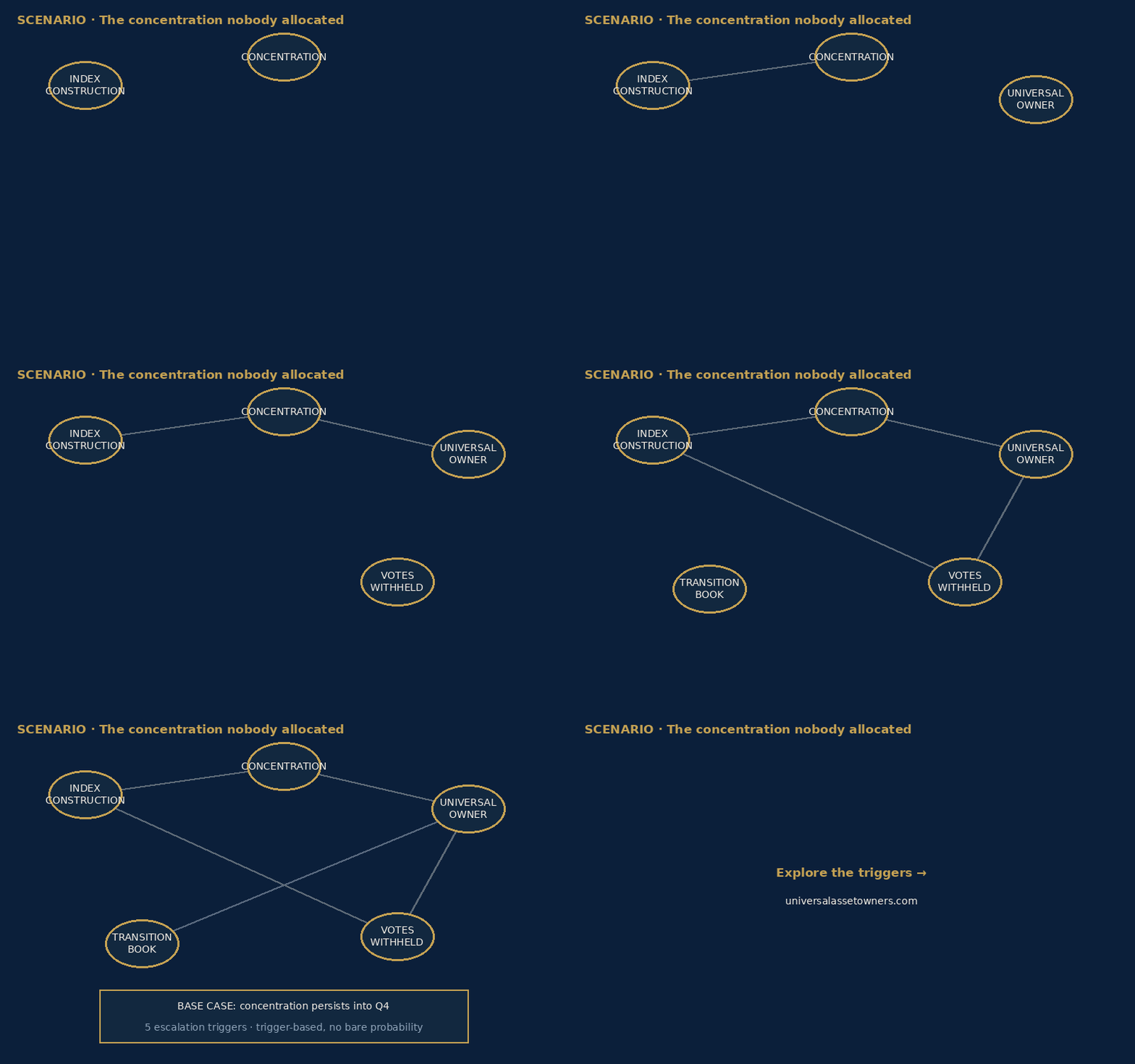
Base case. The concentration in global equity indices that produced Norway’s record half-year persists into the fourth quarter. Technology and communications weights stay near current levels; universal owners continue to receive exposure through index construction rather than allocation; and the gap between selection attribution and allocation attribution stays small in absolute terms and remains unreported by most funds.
Escalation triggers — each observable and dated:
- A drawdown greater than 15 per cent in the largest five index constituents over any rolling 20 sessions. Observable in daily index data — the specific event Tangen described on 11 August.
- A change to free-float or inclusion methodology at a major index provider affecting dual-class listings. Observable at provider consultation. It would alter the voting-rights problem at source.
- A public attribution disclosure by a second top-ten asset owner splitting selection from allocation in the manner of Norway’s report. Observable in half-year reporting. It would move this from a Norwegian idiosyncrasy to a disclosure norm.
- A sovereign mandate change permitting general unlisted-equity investment at a top-five fund. Observable in the legislative record. Norway’s has not changed; Meld. St. 7 (2025–2026) declined to open it.
- Brent sustained above $95 for ten consecutive settlements, or a verified reopening of the Strait of Hormuz. Either would reprice the energy complex against which the transition book is being judged.
De-escalation triggers: a negotiated Hormuz reopening with transits recovering above 60 a day on a ten-day average from a named tracking provider; index technology weight falling more than three percentage points on a rolling quarter.
No probability is published with this scenario. It is deliberately trigger-based: what would have to happen, and where you would see it first.
Podcast · The Universal Owner
The edition, argued aloud in seven minutes.
Apple Podcasts Spotify Podbean
The Back Page — with The Allocator
Our resident owner of a little of everything, on the week’s institutional absurdity.
The editorial cartoon

Sources
Every claim above, resolved to the article that carries it.
Norges Bank Investment Management
- Norges Bank Investment Management, “Record high krone return in the first half of the year”, 12 August 2026
- Norges Bank Investment Management, “Half-year report 2026”, 12 August 2026
- Norges Bank Investment Management, “Half-year report 2026 — web report”, 12 August 2026
- Norges Bank Investment Management, “All investments — holdings as at 30 June 2026”, 12 August 2026
- Norges Bank Investment Management, “Oljefondet kan forsvinne, og det er mer sannsynlig enn vi liker å tro” (Arendalsuka finanstalen), 11 August 2026
- Ministry of Finance (Norway), “Meld. St. 7 (2025–2026): Statens pensjonsfond 2026”, 27 March 2026
Pensions
- Ontario Teachers’ Pension Plan, “Ontario Teachers’ delivers 9.5% total-fund net return in first half of 2026”, 10 August 2026
- The Globe and Mail, “Ontario Teachers’ Pension Plan gets boost from SpaceX shares”, 10 August 2026
- OMERS, “OMERS earns $6.9 billion in the first six months of 2026”, 11 August 2026
- Government Pension Investment Fund, “2026年度第1四半期運用状況(速報)”, 7 August 2026
- Bloomberg, “Japan’s Takaichi says GPIF investing in Japan assets is key”, 17 July 2026
Sovereign funds
- Bloomberg, “Korea sovereign wealth fund to join global race for AI, robotics”, 11 August 2026
- Korea JoongAng Daily, “Korea to launch $14 billion sovereign wealth fund”, 31 July 2026
- AZERTAC, “Azerbaijan’s State Oil Fund invests alongside I Squared Capital in Inkia, Peru’s largest independent power producer”, 7 August 2026
- Power Technology, “CPP Investments, I Squared complete Inkia Energy stake deal”, 13 February 2026
- Asia Business Daily, “[Exclusive] Singapore’s Temasek to invest in Samsung and SK hynix — ‘first investment in Korean stock market’”, 12 August 2026
- Bloomberg, “SK hynix, Samsung extend gains after report Temasek to invest”, 12 August 2026
Energy and maritime
- US Energy Information Administration, “Short-Term Energy Outlook — Global oil markets”, 11 August 2026
- Al Jazeera, “Oil prices rise as attacks dent hopes for Strait of Hormuz reopening”, 12 August 2026
- Al-Monitor (licensed Reuters mirror), “Four crew, two rescuers killed in Red Sea attack; US strikes ship in Gulf of Oman”, 11 August 2026
- gCaptain, “Shipping industry condemns attacks on seafarers as Hormuz death toll reaches 14”, 12 June 2026
- The National, “War risk shipping premium surges again as tensions escalate at Strait of Hormuz”, 17 July 2026
- Lloyd’s List, “No, P&I clubs have not ‘cancelled war risk cover’”
- Lloyd’s Market Association, “Safety concerns, not insurance availability, driving reduced vessel traffic in the Strait of Hormuz”
- NBC News, “Iran sets steep demands for reopening Hormuz as hopes rest on Oman deal”
- UK Maritime Trade Operations
Macro and markets
- US Bureau of Labor Statistics, “Consumer Price Index Summary — June 2026” (USDL-26-1191), 14 July 2026
- US Bureau of Labor Statistics, “Consumer Price Index release schedule”
- Reserve Bank of Australia, “Statement by the Monetary Policy Board: Monetary Policy Decision”, 11 August 2026
- US Department of the Treasury, “Daily Treasury Par Yield Curve Rates”, 11 August 2026
- Cboe, “VIX historical data”, 11 August 2026
- Federal Reserve Bank of St. Louis, “ICE BofA US High Yield Index Option-Adjusted Spread”, as of 10 August 2026
Signals
- US Geological Survey, “M 5.2 — 42 km ESE of Naalehu, Hawaii”, 12 August 2026
- US Geological Survey, “M 5.1 — 51 km E of Tobelo, Indonesia”, 11 August 2026
- GDACS, “Orange alert — Flood in China”
- NOAA Space Weather Prediction Center, “Cancel watch: Geomagnetic Storm Category G1 predicted”, 11 August 2026
- CISA, “Known Exploited Vulnerabilities Catalog”, 11 August 2026
Private markets
- Markets Group, “Apollo’s $2.6bn Yankees deal signals growing private equity interest in MLB”, 11 August 2026
- FTSE Russell, “Russell US Equity Indexes — Fast Entry, Market Consultation Results FAQ (v1.2)”, June 2026
- E24, “Oljefondet med SpaceX-aksjer verdt 12,1 milliarder”, 11 August 2026
- US Securities and Exchange Commission, “Rescission of Climate-Related Disclosure Rules (S7-2026-19)”, 29 May 2026
- Office of the New York City Comptroller, “Comment letter to the SEC re: rescission of climate disclosure rules”, 2026
Sources checked through 12 August 2026. Material claims are linked to named sources; primary or first-party sources are used where available.