The Daily Brief of the Universal Owner
Written for the desks that steward the world’s long-horizon capital — sovereign wealth funds, public pensions, endowments, insurers and family offices, an institutional class managing more than $40 trillion. One edition a day. Every claim carried to its source. The second-order read the headlines don’t give you.
If this was forwarded to you, you are reading what the largest allocators read before the market opens.
KKR closed the largest infrastructure fund in its history on Monday: $19.2 billion, with more than $9 billion already committed to investments. Caterpillar reported its first $20 billion quarter on Tuesday morning and disclosed a record $72.1 billion order backlog — up 92% year on year — with Power Generation sales rising 29% on what the company calls, in its own words, “primarily data center applications.” A single grid-infrastructure index fund took $3.1 billion last quarter, more than the entire US sustainable fund category’s net inflow. And in the Danube basin, Romania’s navy spent two days detonating explosives on a rock outcrop to push cooling water toward Cernavodă, while Hungary’s Paks plant produced 230 megawatts out of roughly 2,000.
The capital is ready and the order book is at a record. Whether the assets deliver is a separate question, and it is not answered in any of the announcements.
The briefing
Ninety seconds: a record fund, a record backlog, and a river being re-engineered to keep a reactor cool.
What happened
Three things, across three days, that belong in the same paragraph.
KKR announced on 3 August the final close of KKR Global Infrastructure Investors V at $19.2 billion, a Core+ vehicle targeting critical infrastructure “primarily in North America and Western Europe.” In the announcement text carried by trade press, the firm said the fund “has already committed over $9 billion across investments” — capital committed to deals, not investor commitments to the fund. KKR puts its infrastructure equity platform at roughly $120 billion, against about $13 billion in 2019.
Caterpillar reported on 4 August sales and revenues of $20.543 billion, up 24% from $16.569 billion a year earlier — the first time the company has passed $20 billion in a quarter. Within that, Power Generation sales rose 29% to $3.098 billion, attributed to “large reciprocating engines and in turbines and turbine-related services, primarily in data center applications.” Dealer-reported retail power-generation sales were up 72%. The data-centre language explains the Power Generation line; it does not explain the other three-quarters of the company.
The forward number is the one that matters most. Caterpillar’s results presentation discloses a record order backlog of $72.1 billion — up 92% year on year, $9.4 billion higher than the first quarter — and guides to mid-to-high-teens full-year sales growth, raised from low double digits.
And on 2 and 3 August, Romania’s Naval Forces detonated explosives on a rock outcrop in the Danube’s Bala Arm, attempting to redirect flow into the channel that cools the Cernavodă nuclear plant. The first attempt failed — “two explosions occurred, but they failed to break the rock.” Unit 1 has been offline since the night of 29–30 July. Unit 2 is running under close monitoring. Nuclearelectrica states its two units together supply about 20% of Romania’s energy demand.
Upstream, Hungary’s Paks plant — which its operator MVM says provides “more than 50%” of Hungarian electricity — was producing 230 megawatts on 3 August, per the Hungarian government’s daily reports, against roughly 2,000 megawatts installed. The Danube gauge at Paks stood at −134 centimetres late on 1 August, water at 27.1°C. The previous record low on that gauge was −98 centimetres, in 2018.
The largest fund in the firm’s history
Fund V is the fifth vintage of a strategy that did not exist at scale a decade ago. What it buys is a specific promise: essential services, high barriers to entry, contracted or regulated income, inflation linkage, long duration. That promise is precisely what a pension or an insurer with forty-year liabilities is trying to purchase.
The nine assets KKR names as already committed describe the shape of the bet — Altitude III, EDF’s North American power solutions business, Enilive, FiberCop, Global Technical Realty, Gulf Data Hub, Metronet, Sempra Infrastructure and The Parking Spot. Fibre, power, data centres, energy infrastructure.
The counterclaim is straightforward, and the committed list supports it: a manager of this scale can create assets rather than only bid for existing ones. A carve-out such as EDF’s North American power solutions unit is a different transaction from buying a built asset at auction.
But the arithmetic of a record close is unforgiving in one respect. Nearly half of Fund V is already committed. The question for an allocator is not where the remaining capital goes. It is what the committed half paid — and whether “high barriers to entry” was priced as scarcity of permission or scarcity of physics. Those are not the same scarcity, and only one of them showed up in the Danube this week.
The river becomes the covenant
A power purchase agreement can guarantee a price. It cannot guarantee a river.
Cernavodă’s two CANDU units are rated 706 and 705 megawatts gross, 650 net each. They are cooled by water drawn from a channel whose flow depends on how the river divides at the Bala Arm. When the split moved the wrong way, the response was not financial. It was more than a hundred soldiers, sixteen pieces of equipment, two days of explosives, and four barges carrying roughly 500 tonnes of stone to be sunk in the arm.
At Paks, four VVER-440 units were reduced to a single turbine. Prime Minister Péter Magyar said that turbine, at 240 megawatts, could run “today, and maybe tomorrow.” The government’s own bulletins recorded 215 megawatts at 01:30 on 2 August, 233 at 13:00, and 230 on 3 August.
The demand side did the rest. Acting Prime Minister Ilie Bolojan said on 3 August that Dacia’s Mioveni plant and Ford’s Craiova plant were down until 19 August, “which means savings of around 200 MW” — his estimate, and worth being precise: those shutdowns were already scheduled as annual maintenance. The timing helped the grid; it was not a rescue. In Hungary, Gedeon Richter said on 3 August it would cut electricity consumption by more than half for three weeks and offer 4 megawatts a day from its solar park. Magyar said voluntary reductions took 700 megawatts off Sunday demand; the government’s own 1 August notice records 240 megawatts pledged by the largest industrial users.
This is a disclosure point, not an accusation. KKR’s fund announcement emphasises essential services, barriers to entry and resilient cash flows. It does not disclose how the committed assets allocate water, cooling, outage or grid-access risk at the contract level — and a fund-closing release is not an underwriting file, a purchase agreement or an insurance policy. Not disclosed in a press release is not the same as not underwritten. But an allocator writing a cheque into a Core+ vehicle has no way to tell from the public record which of the two it is, and this week supplied a live demonstration of why the difference matters.
What the earnings said
Caterpillar’s quarter is a direct read on whether AI capital expenditure has reached the physical economy. It has. Construction Industries sales rose 35% to $8.346 billion, with North America up 50% to $5.065 billion. Power & Energy rose 17% to $8.238 billion. Resource Industries rose 20%. Operating profit rose 50% to $4.295 billion; margin went from 17.3% to 20.9%.
Three qualifications belong in the same breath, because a universal owner is buying the durability, not the print.
First, operating profit included $392 million of expected recoveries under the International Emergency Economic Powers Act tariff regime. Real cash, legitimately booked. Not demand.
Second, Caterpillar attributes the North American construction increase partly to “the impact from changes in dealer inventories.” Dealer-reported retail construction sales in North America rose 27% against a reported segment increase of 50%. Some part of that gap is dealers restocking rather than end users buying.
Third, a note on where to read the numbers. The earnings release filed with the SEC carries no backlog figure and no numeric outlook — Joe Creed refers only to “a growing backlog.” The $72.1 billion and the mid-to-high-teens guidance come from the separately published results presentation. Same morning, same company, two documents with materially different disclosure. The Form 10-Q has yet to be filed.
Saudi Aramco, reporting the same morning, showed the other side of the same energy system. Net income of $32.69 billion for the second quarter, up 44% year on year on an IFRS basis; adjusted net income of $33.4 billion, up 33% — two different measures of one quarter, and the two percentages now circulating are a category confusion, not a discrepancy.
The price line is worth sitting with. Aramco’s average realised crude oil price in the second quarter — April to June — was $108.1 a barrel, against $76.9 in the first quarter and $66.7 a year earlier. That is not a comment on today’s tape; Brent’s front contract settled at $83.77 on Monday. It is a record of the quarter in which the Hormuz disruption ran. Dated Brent itself averaged $117.29 in April, $107.14 in May and $85.40 in June, on Energy Information Administration spot data. Aramco produced less into that price: total hydrocarbon production averaged 9.5 million barrels of oil equivalent a day, down from 12.6 million in the first quarter — a production measure, not a sales measure.
The board declared a $21.9 billion base dividend, payable in the third quarter, with no performance-linked component declared. Free cash flow fell to $12.3 billion on a $13.6 billion working-capital build. Gearing rose from 4.8% to 6.2%. Amin Nasser’s language on the strait is worth quoting exactly: “Despite the unprecedented supply disruption through the Strait of Hormuz, we continued to demonstrate our ability to maintain business continuity by capitalizing on our diverse asset base and multi-decade planning, including strategic infrastructure such as the East-West Pipeline, storage capacity, and export terminals.”
A universal owner may hold both. Aramco captured part of the upside from higher realised prices on fewer barrels; Caterpillar captured rising demand for power-generation equipment. The two run through the same energy system, but the reported evidence does not put them on one causal chain, and it would be tidier than the facts to say it does.
Where the money actually went
The allocation data published this week says the market worked out the grid problem before the earnings confirmed it — and something less comfortable about everything else.
Morningstar reported, as carried by ESG Today, that US sustainable funds took roughly $3.0 billion of net inflows in the second quarter, ending fourteen consecutive quarters of redemptions and lifting the category to a record $398 billion. Read as a headline, that is a recovery in sustainable investing.
Read as an allocator, it is one trade. A single exchange-traded fund — First Trust’s Nasdaq Clean Edge Smart Grid Infrastructure Index ETF — took $3.1 billion in the quarter. That is more than the entire category’s net inflow. Passive vehicles took $6.5 billion; actively managed sustainable funds lost $3.6 billion.
Morningstar’s inclusion test is a prospectus test, not a holdings test: a fund qualifies where the sustainability commitment is “clear and prominent in their prospectus, offering document, or regulatory filings, usually through binding criteria.” A grid-infrastructure index fund clears that bar. Which is how one thematic vehicle comes to stand in for a whole category’s revival.
On the rounded figures, removing that one fund would leave the category somewhere between flat and slightly negative. The defensible reading is therefore about concentration, not conversion: the quarter’s apparent recovery was one passive grid-infrastructure trade. It does not establish why any particular investor bought, and an ETF creation does not map dollar-for-dollar onto purchases of transformers or switchgear — GRID tracks a defined index, not a list of hardware.
What it does establish is where the marginal dollar went: to an index of electrical infrastructure, not to sustainable equity selection, at the same time as active managers in the same category were redeemed by $3.6 billion. Two facts — and an allocator should be careful about welding them into one motive.
A further caution. GRID expresses one part of the physical build-out — transmission and electrical equipment. The Danube episode exposes a different one — water-dependent generation. Both sit underneath contracted electricity revenues. They are not the same failure mode, and equipment did not fail in Romania or Hungary.
Allocator Lens
The covenant nobody underwrote
The triple exposure. An owner of the whole market meets this week three times. Once in listed equities, where the flow data shows a single grid-infrastructure index fund absorbing more than an entire fund category’s net inflow while active managers were redeemed. Once in private infrastructure, where a record fund is competing for the same contracted assets and the entry yield is set by that competition. And once in the liability book, where physical-climate perils are being placed into the capital markets faster than they are being modelled — a separate peril from the Danube’s low water, but the same underlying question about which balance sheet ends up holding the physical world.
The practical tilt. Water availability, cooling method, basin-level hydrology and cross-border transmission access belong in the same underwriting memo as leverage, contract tenor and inflation linkage — not in an appendix on climate risk. The question to put to a manager is not “is the revenue contracted?” but “under what physical conditions does this asset stop delivering the service, and who bears the loss when it does?” Cernavodă and Paks answered that question this week for two nuclear operators, two grids, two sovereigns and three named industrial companies — Dacia, Ford and Gedeon Richter.
The embedded-fossil flag. Any listed-infrastructure or climate-aligned mandate that gained from this week’s power-generation demand is worth examining for embedded fossil exposure. Caterpillar’s Power Generation growth came, in its own words, from “large reciprocating engines and in turbines and turbine-related services” — a book that spans gas and diesel and is not disaggregated in the release. A mandate can be long the energy transition in its stated policy and long combustion in its actual revenue, and the disclosure needed to tell the difference is not in the quarterly.
Capital flows
Each figure below measures a different thing — a fund size, an enterprise value, a share price, a debt commitment — and they do not add up to a day’s total.
| Institution | Action | Amount | Stage |
|---|---|---|---|
| KKR | Final close, Global Infrastructure Investors V (Core+) | $19.2bn fund; over $9bn committed to investments | Closed (fundraise) |
| KKR | Acquisition of Integer Holdings (NYSE: ITGR), medical-device CDMO | $127.00/share cash; ~$5.7bn enterprise value | Definitive merger agreement; close expected by year-end, subject to shareholder and regulatory approval |
| TotalEnergies → KKR insurance account | Sale of 50% of a 1.2 GW onshore wind and solar portfolio in Germany, Spain, France, Poland | €1.8bn enterprise value for the whole portfolio | Agreement signed; completion expected in 2026 |
| TotalEnergies | Acquisition of Shell’s European onshore renewables business — 4 GW, ~500 MW operating or under construction | Undisclosed | Agreement signed; close expected end-2026 |
| PIF / Silver Lake / Affinity Partners | Take-private of Electronic Arts | $210.00/share; ~$55bn enterprise value; ~$36.4bn equity; $20bn JPMorgan debt commitment | All regulatory approvals obtained 30 July; expected to close on or about the close of trading 4 August — not confirmed complete |
| UK Sovereign AI fund | Equity investment in OLIX, London inference-chip developer — the fund’s fifth equity investment | UK amount undisclosed; the company reports a $312m Series B at a $3.3bn valuation | Announced 3 August |
The 93.4% post-close PIF stake in EA does not appear in EA’s Form 8-K of 30 July; it was reported by the Wall Street Journal, citing a filing with Brazil’s antitrust regulator. PIF’s pre-deal holding is 9.9%, rolled over rather than bought out. The renewables buyer is described in both releases only as “an insurance account managed by KKR.” GOV.UK describes OLIX’s round as a “nine-figure fundraise”; the $312m and $3.3bn figures come from the company.
Decisions due
| When | What | Why it matters |
|---|---|---|
| Wed 5 Aug, 08:30 | US Treasury quarterly refunding statement. Treasury said on 3 August it expects to borrow $739bn in privately held net marketable debt in July–September — $68bn above its May estimate, or $87bn excluding a higher opening cash balance — assuming an end-September cash balance of $950bn, and $628bn in October–December assuming $850bn at end-December. | The refunding statement carries the auction sizes and maturity mix. More duration placed at the long end pushes the term premium, which feeds the discount rate an allocator applies to a thirty-year contracted asset. That is the chain by which a Treasury announcement reaches an infrastructure entry yield. |
| Wed 5 Aug | Romania’s works on the Bala Arm continue; barge sinking and dredging under way. | Whether Cernavodă Unit 2 keeps running. |
| Wed 5 Aug | Brazil’s Copom decision. Thirty-eight of 42 economists surveyed expect a 25bp cut to 14%. | A survey of forecasts, not an outcome. Copom’s own statement settles it. |
| Fri 7 Aug | AIG earnings call, 08:30. | First large-cap US insurer read on the wildfire season. |
| Tue 11 Aug | RBA decision. Cash rate 4.35%; trimmed-mean inflation 3.6% y/y to June. The Board has raised three times in 2026 — February, March and May — taking the cash rate from 3.60% to 4.35%, and has held since. The March move carried on a five-four vote. | A developed-market central bank tightening into an energy shock, with a divided board. |
| Wed 12 Aug | NBIM half-year 2026 results, 10:00 CEST, Arendalsuka. | The largest single asset owner’s half-year mark. |
| Wed 12 Aug | US July CPI, 08:30 ET. June was +3.5% headline, +2.6% core. | The Fed held on 29 July at 3.50–3.75% with three dissents in favour of a hike — Hammack, Kashkari and Logan. One of the most consequential scheduled US data points before the 16 September meeting. |
| Thu 17 Sep | Bank of England, next decision. Bank Rate 3.75%, held 30 July; the MPC does not meet in August. The ECB next meets 9–10 September, deposit rate 2.25%. | A six-week gap in both the US and UK policy calendars. |
The week ahead — the high-signal three. Capex commentary: Caterpillar’s earnings call against its record backlog. Oil, vol and credit divergence: Brent fell 4.7% Monday while the S&P 500 rose; the VIX was 15.99 on 31 July and the St. Louis Fed Financial Stress Index was −0.83 on 24 July, both via FRED. Insurance advisories: whether the Joint War Committee updates JWLA-034, last listed 29 July.
The Universal Owner Risk Radar
1 · Hormuz passage remains impaired. The Joint Maritime Information Center’s Advisory Note Update 079, published 2 August, records 40 US-facilitated Strait of Hormuz transits for the period it labels 31 July–1 August, its past-72-hours count, against a stated historical average of ~138 vessels a day on a 2025 baseline. The two figures are measured on different bases — the 40 counts US-facilitated transits only, from NCAGS data, while the baseline counts all cargo vessels above 1,000 deadweight tonnes — and should not be divided into one another. The regional threat level is SEVERE.
2 · Bab el-Mandeb is running at roughly half its baseline. The same advisory records 93 transits over 30 July–1 August — about 31 a day — against ~61 vessels a day on a 2023 baseline, both from S&P Maritime on the same vessel definition. Threat level SUBSTANTIAL.
3 · Danube-basin generation. Cernavodă Unit 1 offline since the night of 29–30 July; Unit 2 running under close monitoring. Paks at 230 MW on 3 August per government bulletins. Danube gauge at Paks −134 cm on 1 August, water 27.1°C.
4 · Wildfire risk is moving onto institutional balance sheets. Artemis reported on 3 August that $5.183 billion of risk capital has been deployed year to date across 20 catastrophe bond series carrying some wildfire exposure, against $5.55 billion for all of 2025 and $2.84 billion in 2024. Most of that is multi-peril issuance in which wildfire is one named peril among several — Artemis says so explicitly — and three wildfire-only 144A bonds have priced this year, against four in 2025. Separately, the modelling firm KatRisk told Bloomberg that insured wildfire losses are rising roughly 12% a year; the basis for that growth rate is not stated.
5 · Newly exploited vulnerabilities in remote-management software. CISA added CVE-2026-18577 (N-able N-central, authentication bypass) to the Known Exploited Vulnerabilities catalogue on 3 August, and CVE-2026-20316 (Cisco Secure Firewall Management Center, hard-coded password) on 29 July. Both sit in the remote-monitoring and firewall-management layer that service providers run across client estates — the transmission path worth naming in operational due-diligence questionnaires to managers and administrators.
6 · The EU’s high-risk AI obligations have moved to December 2027. 2 August was the AI Act’s general application date under Article 113. Regulation (EU) 2026/1744, the Digital Omnibus on AI, entered into force on 27 July and defers the Annex III high-risk obligations — covering AI used as a safety component in “the supply of water, gas, heating or electricity” — to 2 December 2027, with the Article 3(14) “safety component” definition narrowed so optimisation-only systems fall outside it. Penalties unchanged at up to €15 million or 3% of worldwide turnover under Article 99(4). For a covered system the compliance date has moved out sixteen months; whether a given utility’s systems remain covered depends on the amended test — the question to put to the operator, not to assume.
7 · Rule 14a-8. Six investor and pension signatories — Ceres, For the Long Term, ICCR, New York State Comptroller Thomas P. DiNapoli, the Shareholder Rights Group and US SIF — petitioned the SEC on 23 July to largely retain Rule 14a-8 and restore staff no-action review, suspended for the 2026 proxy season. The Spring 2026 Unified Agenda carries a 14a-8 rulemaking, RIN 3235-AN47. The petitioners say they expect it to sharply curtail or rescind the rule; that is their reading.
8 · Watching briefs. NOAA’s Space Weather Prediction Center issued an extended K-4 warning at 08:10 UTC on 4 August after a K-5 on 3 August — routine levels, logged because grid margin in one European basin is currently thin. The largest earthquake in 24 hours was M4.9 southeast of Severo-Kurilsk; GDACS carries an orange alert for Tropical Cyclone Dolphin-26 (Marshall Islands, Japan). No catastrophe-bond attachment or named insured exposure at these levels.
Chart of the day
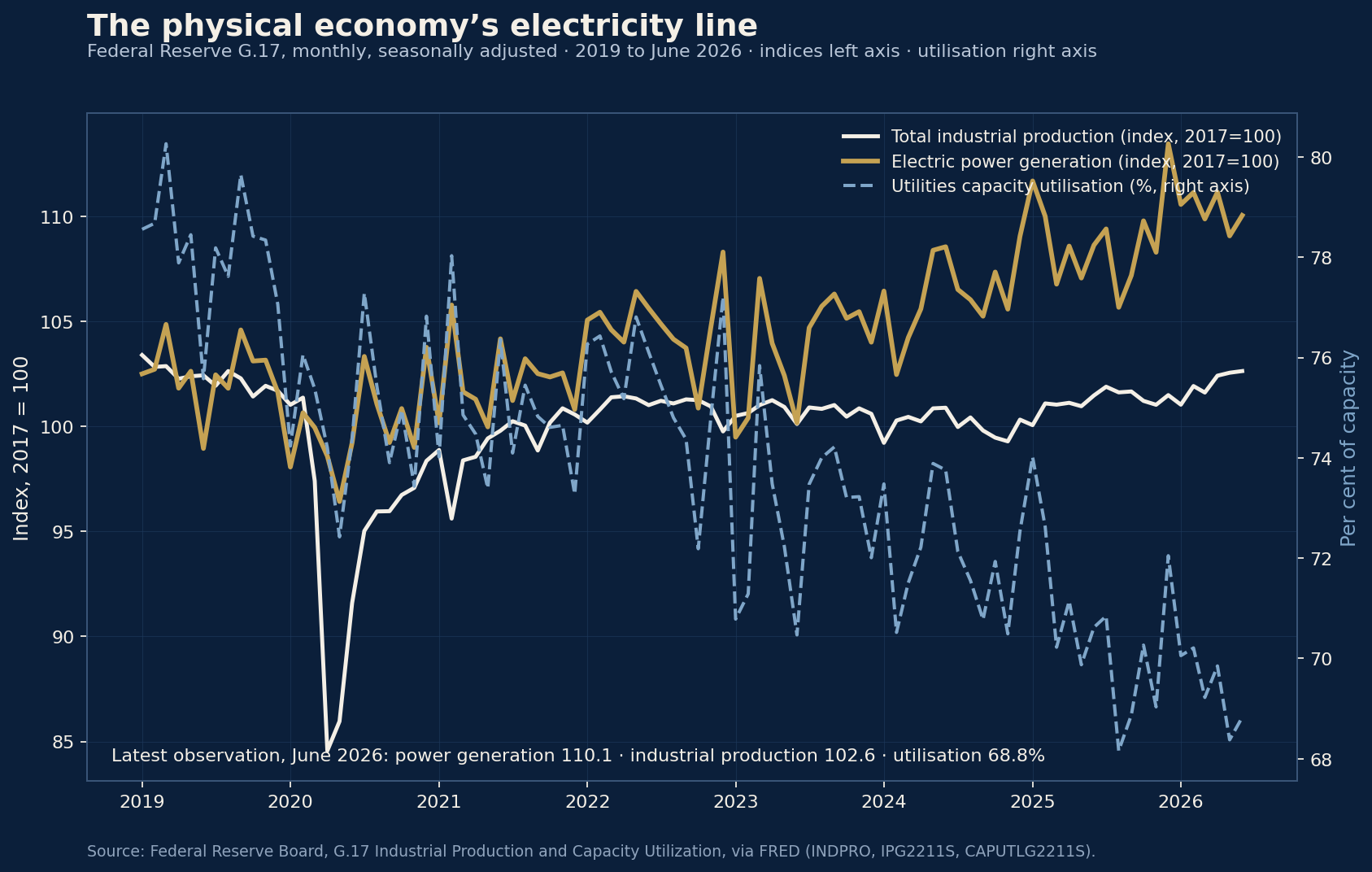
The chart asks a narrow question: are aggregate electric power output and utility utilisation moving in the same direction as the equipment demand Caterpillar reported? It cannot isolate data-centre load — generation responds to weather, industrial activity, residential demand and fuel switching. It is a consistency check, not a proof. As of June: power generation at 110.1 against total industrial production at 102.6, with utilisation at 68.8% — output pulling away from the aggregate while utilisation falls, which is what a rapid capacity build looks like.
The contradiction
Brent’s October contract settled Monday at $83.77, down 4.7%; WTI’s September contract settled at $80.34, down 5.1%. Crystol Energy’s Carole Nakhle attributed the fall to a geopolitical risk premium unwinding: “much of the earlier price increase reflected geopolitical concerns rather than a fundamental deterioration in the supply-demand balance.” SEB’s Bjarne Schieldrop said the optimism was “most likely totally misplaced.” TD Securities’ Ryan McKay said the market “may be quickly disappointed when the flows don’t surge.”
On July’s move: the widely quoted ~24% monthly gain is measured on a continuous front-month series that rolled from September to October on 31 July — a step down of $2.19, or 2.4%, from the roll alone. A single percentage taken off that continuous series embeds the roll; one measured October-to-October does not. Brent’s October contract settled 31 July at $87.93; the expiring September contract at $90.12.
Meanwhile the OPEC+ voluntary-adjustment group agreed on 2 August to add 188,000 barrels a day from September, completing the rollback of the 1.65 million barrel layer announced in April 2023. That group is now seven countries — Saudi Arabia, Russia, Iraq, Kuwait, Kazakhstan, Algeria and Oman. It was eight as recently as OPEC’s 1 February statement, which named the United Arab Emirates among them. The UAE announced on 28 April that it would leave OPEC and OPEC+, effective 1 May, with energy minister Suhail Al Mazrouei saying “the time has come to focus our efforts on what our national interest dictates.” It is the fourth departure since 2019, after Qatar, Ecuador and Angola.
So: the futures curve says the risk premium is coming out. The transit data says passage is still impaired and the threat level is severe. The earnings say forward demand is real, booked and at a record. And in the Danube basin, one reactor is offline, another is running under monitoring, a river is being re-engineered, and Hungarian industry is curtailing voluntarily.
Those four readings are not mutually exclusive, and treating them as a contradiction would be the easy mistake. They run on different clocks. Futures price expected marginal supply. Transit data describes passage as it is now. An order backlog describes demand already committed. And the Danube describes a location-specific operating constraint that has nothing to do with the other three.
The allocator’s job is not to pick which reading is true. It is to work out which clock prices each asset and each liability on the balance sheet — and to notice that only one of those four clocks is disclosed in the documents most infrastructure capital is committed against.
Scenario · The river becomes the covenant
Base case. Cernavodă Unit 2 continues operating; Paks recovers output as the Danube stabilises; Romanian and Hungarian industrial curtailments end on schedule. Infrastructure entry yields do not reprice on hydrology within the quarter.
Escalation triggers — each an observable, dated event: Cernavodă Unit 2 shutting (operator disclosures, ENTSO-E per-unit generation) · Paks reaching zero output (government bulletins, MAVIR notices) · curtailment moving from voluntary to mandatory (MAVIR, Transelectrica) · Dacia or Ford extending the Mioveni or Craiova shutdown beyond 19 August (company statements) · a regulated utility or infrastructure fund disclosing a water-availability covenant or hydrology-linked valuation adjustment (quarterly filings).
De-escalation: the Danube gauge at Paks recovering above −100 cm; Cernavodă Unit 1 restarting; the Bala Arm works completing and holding.
Open the interactive scenario →
Podcast · The Universal Owner
The Capital Is Ready. The River Isn’t. · 11 minutes.
Apple Podcasts Spotify Podbean
Careers
Openings desks are hiring into this week’s themes — live listings on the institutions’ own boards.
CPP Investments — Careers · infrastructure and sustainable energy roles, Toronto and London
Norges Bank Investment Management — Careers · investment and risk roles, Oslo, London, New York
KKR — Careers · infrastructure and real assets openings across regions
The Back Page — meet The Allocator
This week, on the difference between a covenant and a riverbed.
— The Editorial Team