
Korea's benchmark fell 10.84% on Tuesday. The Bank for International Settlements published, the same day, that lending to AI firms now accounts for 8% of all private credit. The Bank of England did not publish the level of the leverage connecting the two. In every case the market plumbing is working. In every case the measurement an owner would need is missing.
The briefing
Ninety seconds: what fell on Tuesday, what the Bank of England actually described, and the number that is not in the report.
What happened
On Tuesday the KOSPI closed at 6,023.66, down 732.09 points — a fall of 10.84%. It was briefly down as much as 11.3% intraday, below 6,000 for the first time since 14 April, and the Korea Exchange halted trading for twenty minutes once the index sat more than 8% below the previous close. It was the eighth marketwide circuit breaker of 2026. Samsung Electronics fell 14.4%, its largest single-day decline since October 2008. SK hynix fell 14.7%, its American depositary receipts dropping below their US offering price. Together those two companies are more than half the index.
The proximate causes were specific and fundamental, and each is reported rather than desk-verified: Chinese memory maker CXMT was reported to have debuted on Shanghai's STAR Market up more than 400%; reports circulated that China has begun mass-producing its own deep-ultraviolet lithography equipment; and Nvidia had fallen overnight on renewed questions about circular revenue arrangements. That is a competitive shock to Korean memory — a repricing of who will own the margin in a critical supply chain. It is not, on the available evidence, a margin call.
The distinction matters, because much of the coverage of Tuesday does not draw it.
The Bank of England’s assessment
On 7 July, the Bank of England's Financial Policy Committee published its Financial Stability Report. Section 1.3 contains a passage that reads, in retrospect, with particular force:
“Hedge funds' equity prime brokerage balances are at record levels, with supervisory intelligence indicating that these balances globally have increased by around 40% over the past year. In addition, market intelligence suggests that hedge fund equity positions have become more concentrated in particular sectors, such as semiconductors, in recent months, coinciding with the ongoing AI-linked stock price momentum.”
It continues:
“Higher and more concentrated leverage can pose risks to hedge funds, and create financial stability risks, via potential losses to prime brokers and cross-market interconnections if funds making losses on equity positions deleverage across other markets – including sovereign debt – in response.”
Read that as an owner rather than as a supervisor. The Bank is not saying semiconductors are expensive. It is describing a cable. At one end, a concentrated equity position in the exact sector that fell 14% in Seoul on Tuesday. At the other, sovereign debt — the asset most universal owners hold precisely because it is supposed to behave differently from the first one.
The Bank describes this as a channel that could operate, not one it has observed operating. Separately, in the same report, it records a different episode — and the distinction between the two matters more than the resemblance:
“During the most significant period of volatility following the onset of the Middle East conflict, moves in gilt yields were amplified by hedge fund deleveraging.”
Read that carefully, because it is not the same event as the paragraph above it. In the Bank's account, hedge funds reduced government-bond positions following a reassessment of expected policy rates, with energy and inflation concerns contributing to rising European yields; the repositioning amplified some gilt moves, and the market continued to function. That is deleveraging in sovereign debt driven by a rates view. It is not a case of equity losses forcing gilt sales. The Bank has mapped a plausible equity-to-gilt channel, and separately observed government-bond deleveraging amplify gilt moves. It has not established that the first caused the second.
And note which indices the Bank chose for its own concentration chart: the S&P 500, TAIEX, KOSPI 200, TOPIX 100 and FTSE 100. Tuesday was not an emerging-market event happening to someone else. It was a constituent of the supervisor's own concentration measure.
The unpublished measure
Here is what should change how allocators read that passage.
The 40% figure is attributed by the Bank to “supervisory intelligence.” The concentration claim is attributed to “market intelligence.” Neither is a published dataset, and the Bank says so. Nowhere in the report — we read all of it — is there an absolute level for equity prime brokerage balances. No currency figure. “Record levels” is the only level language on offer.
So the single most important quantity for understanding how an equity drawdown in Seoul reaches a gilt portfolio in London is reported by the Bank only as supervisory intelligence and a rate of change. No absolute level appears in the report.
What the supervisor will not size can be partly inferred from the firms that sell the service — and they are not being coy. In second-quarter results reported in mid-July, Goldman Sachs disclosed a record quarter in its prime business, with equity financing revenue up 91% year on year and record average prime balances, growth the bank attributed in part to Asia. Financing revenues across its FICC and equities businesses rose 62% to $4.5bn, about 37% of the combined total. Citi reported prime balances up nearly 60%. (Reuters, 15 July: “Wall Street banks enjoy record windfalls from prime brokerage business.”)
Those are individual firm disclosures, not a market total, and they do not size the concentrated semiconductor book. But note what they do establish. The intermediaries are reporting records in the same quarter the Bank of England describes record balances — and the growth Goldman names is Asian. The system-wide number is still missing. The direction is not.
Now contrast that with the retail layer of the same trade, where disclosure is immaculate. CSOP is moving twelve Hong Kong-listed leveraged products to variable leverage from 3 August. Korea's Financial Services Commission imposes a ₩30m cash requirement from 31 July. The Bank itself notes levered equity ETF holdings of around $200bn in the United States against roughly $15trn of unlevered equity ETF holdings — small, and disclosed to the decimal.
The Bank is explicit that levered ETFs can amplify price moves, so the visible layer is not harmless. The point is narrower: the layer that is disclosed to the decimal is not the layer whose absolute size is missing.
The case for calm
The strongest argument against reading Tuesday through the Bank's paragraph is that the two have nothing to do with one another. An honest brief carries it.
No prime-broker loss has been disclosed. No margin shortfall has been reported. No bank has announced an impairment. The Bank of England's own report says plainly that “an equity shock in isolation would be unlikely to present a direct risk to UK financial stability.” Korea fell because a Chinese competitor listed at a spectacular multiple and because of a lithography report — causes requiring no leverage at all to explain. There is an FT report, relayed on 29 July, that the Prudential Regulation Authority has begun reviewing London prime brokers for concentrated Asian-equity exposures; the Bank has not confirmed it, and we do not treat an unacknowledged press report as evidence.
Before Tuesday's selloff, broad US financial conditions were calm. The St. Louis Fed Financial Stress Index sat at −0.70 (17 July), below average, and the 10-year/2-year Treasury spread was +0.35 (28 July). The credit and volatility readings are dated 27 July, and therefore predate the 28 July session entirely. They describe the conditions Korea fell into, not the conditions it produced.
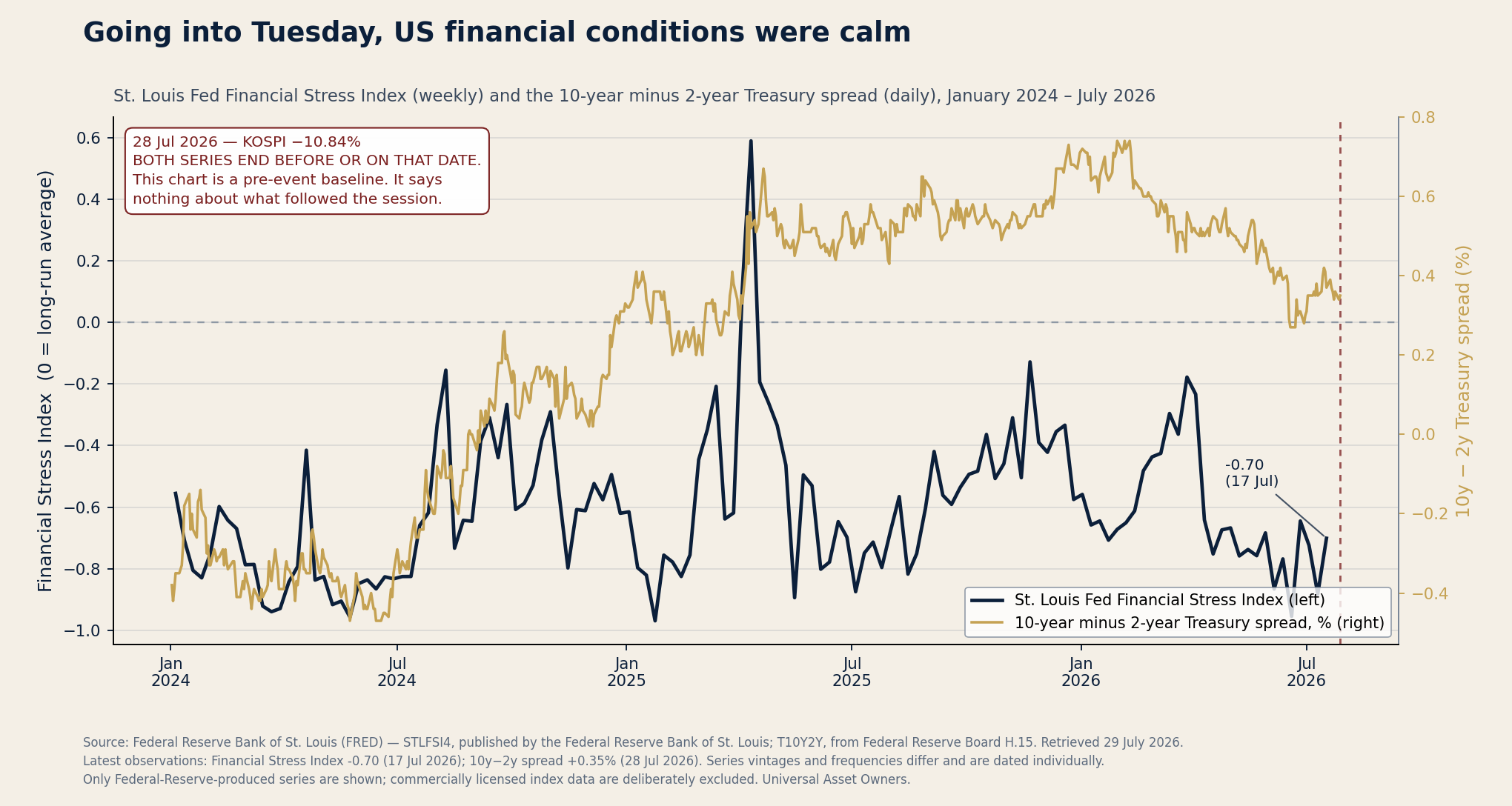
So the claim here is deliberately narrow. Not that a cascade has begun, and not that Korea has moved gilts. Rather: a mechanism by which concentrated equity losses could reach sovereign debt has been described by a central bank, sits at record levels, is growing at roughly 40% a year, is concentrated in the sector that just fell 14% — and is unmeasurable from outside. An owner cannot precisely size or calibrate this channel from the published data. Broad factor hedges remain available; a calibrated one does not.
The pattern across markets
Tuesday’s significance extends beyond the drawdown itself. Across four further markets in the same session, the same structure was visible: a functioning market, and a missing measurement.
1. The BIS put a number on the AI–private credit link
On 28 July the Bank for International Settlements published Bulletin No 130, “AI and the global economy: implications for central banks” (Aldasoro, Gambacorta, Kharroubi and Rottner). Its key takeaways, verbatim:
“The AI boom is driving a large, increasingly debt-financed investment surge and boosting trade and equity markets, generating sizeable terms-of-trade and wealth effects that differ across countries.”
“By simultaneously affecting demand and supply, AI blurs cyclical signals, complicating central banks' assessment of underlying economic conditions and monetary policy calibration.”
Then the figures that say where the financing actually sits:
“Outstanding private credit loans to AI-related firms grew from near zero in 2016 to $200 billion in 2025, while their share in total private credit loans rose from less than 2% to 8% over the same period… AI firms raised $243 billion through bonds in 2025, up from $79 billion in 2023.”
Read that beside the equity story. The AI trade is not only a concentrated equity position financed by prime brokerage the Bank of England will not size. It is also, on the BIS's measure, 8% of total private credit loans — the asset class institutional investors have been rotating into precisely to escape public-market volatility.
The BIS is blunt about what this does to policy: “Greater uncertainty increases the risk of policy miscalibration. If central banks overestimate supply improvements or underestimate the rise in underlying demand, policy may remain too accommodative; the opposite risk could lead to unnecessarily restrictive conditions.” For a universal owner that is not a footnote. It is a statement that the discount rate on your liabilities is being set from signals its own setters describe as blurred.
2. Private credit only received instrument identifiers this week
On 27 July, Intercontinental Exchange announced ICE IDs — “unique, persistent identifiers” for private credit instruments, it said, “for the first time.” Apollo, the anchor partner, now applies them to its originated credit assets. They are designed to span an instrument's life “from origination through to the final payoff date and closure… including through potential credit events.” Eric Needleman of Apollo Capital Solutions framed the goal as “an investor experience for private credit that more closely resembles that of public markets.”
One precision, because the figure is easy to misread: ICE provides reference data on over 35 million financial instruments across more than 210 markets. That is its footprint across all asset classes, not a private credit number. How many private credit instruments carry an ICE ID has not been disclosed.
Put the two facts in one sentence and the week acquires a shape. The BIS says $200bn of private credit has been lent to AI-related firms, 8% of that market. ICE says it launched persistent instrument identifiers for private credit for the first time on 27 July 2026. Both statements are true. Sit with that.
3. The entrance widened; the exit was rationed in the same document
On 27 July, T. Rowe Price and Goldman Sachs Asset Management launched an interval fund bundling private equity, private credit, private infrastructure, private real estate and leveraged loans for individual investors. Retail share classes open at a $2,500 minimum; institutional shares require $1m. The fund intends quarterly repurchase offers of between 5% and 25% of outstanding shares — and discloses that it will likely offer only the 5% minimum in a given quarter, that offers may be oversubscribed, and that requests may be prorated.
Nothing here is hidden; the disclosure is exemplary. That is the point. Democratisation of private markets is not creating liquidity. It is creating legible rules for rationing it. The number that will matter — requested versus offered versus fulfilled repurchases, and the length of the remaining queue — does not exist yet because the fund is four days old. The prospectus indicates an initial repurchase offer expected in the fourth quarter of 2026, and no later than the second full calendar quarter after effectiveness. If the fund goes on to disclose requested against fulfilled repurchases, that series would be among the more informative in private markets — the first regular public reading on what investors ask to withdraw versus what they get.
4. Aggregate transit counts are published. Who passes is not.
Reuters reported on 28 July, citing six sources, that China has held direct talks with Yemen's Houthis to obtain safe passage for tankers carrying Saudi crude through Bab el-Mandeb, with officials clearing vessels individually. At least four China-bound tankers have transited since restrictions were announced on 20 July; two supertankers, the New Champion and New Prime, reversed into open water. Beijing, Tehran and the Houthis have not publicly confirmed any arrangement. Separately, Oman proposed a regional joint-management framework for the Strait of Hormuz funded by voluntary contributions from shipping companies. Updated, 29 July: Iran has ruled it out. A senior Iranian official said the proposal has no chance of success, that the entire inbound route and part of the outbound route must be under Iranian control, and that the United States and Saudi Arabia are pressuring Oman to advance what he called unrealistic plans. Roughly a fifth of global oil and LNG moved through the strait before the February attacks on Iran. The framework is therefore not an outstanding proposal; it has been rejected by the party whose consent it required. (Reported 28–29 July; corroborated across Al Jazeera, Middle East Eye and SBS.)
Bab el-Mandeb is not closed: 28 vessels passed on Monday, the most in four days, against a July peak of 46 recorded on 14 July, per Kpler data. And the composition is more informative than the count. Of 12 vessels entering the Red Sea that day, four were oil tankers; of 16 exiting, ten were. Traffic rose amid optimism about the US–Iran talks. The aggregate is exactly the problem. A route can be statistically open and commercially unavailable to a particular owner. The published series counts hulls. It does not record beneficial ownership, flag, cargo destination, or which vessels obtained clearance and which turned back — the variables that now determine whether your cargo moves.
For an owner this converts physical route risk into counterparty and political-credit risk. The aggregate public series available to us do not disclose the ownership, cargo, destination or clearance variables needed to assess a particular owner's exposure. These are linked conflict actors, not a single adversary: US Central Command and Saudi forces said on 28 July they struck Iran-aligned groups in eastern Iraq that had attempted attacks on US forces and Saudi energy infrastructure; Iran denied responsibility and warned against attributing militia action to Tehran. Aramco's Jizan refinery was reported shut on 27 July after an attack; Aramco has not confirmed damage, duration or lost output. Separately, the Islamic Revolutionary Guard Corps has claimed it struck three tankers in Hormuz. That claim is unverified.
And a fifth, briefly. The People's Bank of China injected 600bn yuan through overnight reverse repos and 206.5bn yuan through seven-day operations, with 2.1trn yuan of overnight operations scheduled from 29 July to 3 August. The amounts were publicly announced. The overnight rate was not: a 1.25% figure has appeared in anonymous-source reports we cannot independently verify, and the PBOC has not disclosed it. A large headline injection can be technical settlement management or the beginning of easing, and the distinguishing variable — the price — is the one withheld.
5. The institution that published a number called it an undercount
There is an exception this week, and it is instructive. Last Thursday, the Equable Institute published State of Pensions 2026. It projects the US state and local funded ratio at 85.0% for fiscal 2026, up from 81.2% in 2025, a fourth consecutive year of improvement and the best level since 2009, with unfunded liabilities down to about $1.13trn from $1.37trn.
It then does what nobody else in this edition did, and it shows its working. Equable reviewed the 25 largest public pension funds, found disclosed holdings for 23 of them, and measured at least 8.6% of those assets in a basket of 50 AI-related companies — then estimated upward, to a range of roughly $513bn to $642bn, because externally managed public equity and company-level private-market holdings are not fully disclosed. Its own characterisation of the result is that it is “likely an undercount given limited transparency in private equity and externally managed holdings.”
That is the entire argument of this brief, written by a pension research institute about its own subject. Someone published the number and immediately told you it is too small, because the parts of the portfolio that would complete it do not report. For scale: the Thinking Ahead Institute's Global Pension Assets Study 2026, published 9 February, put the 22 largest pension markets at US$68.3trn after a 9.6% rise, with the seven largest markets holding 91% of it.
One thing we should not do with that number is over-read it. Equable attributes the funding improvement principally to historically high employer contributions and strong investment returns — not to AI exposure. The two facts sit side by side: funded ratios at their best since 2009, and a concentration inside them that the measuring institution says it cannot fully see. That is a visibility observation, not a causal one.
Allocator Lens: what this means for the portfolio The triple exposure — for whom. This applies to a large multi-asset owner with material semiconductor equity exposure, exposure to the banks that run prime-brokerage books, and a sovereign-bond sleeve used for liquidity or liability hedging. If your mandate lacks any of the three, the argument weakens accordingly. For an owner that has all three, the same shock arrives through three sleeves, and only the first shows up in a manager review. 1. As an owner of the assets. The Korea sleeve, the semiconductor complex, the AI-linked share of the S&P 500 — which the Bank puts at around half of an index that is itself around half of global equity capitalisation, up from about a quarter in 2022. The BIS puts US AI firms' share of total market cap at 24% to 40% between 2022 and 2025. 2. As an owner of the counterparty. Universal owners hold the banks running the prime-brokerage books whose balances are at record levels. The drawdown and the intermediary are in the same portfolio. 3. As an owner of the supposed hedge. The sovereign-debt sleeve is held because it should behave differently. The Bank's description of the channel is that, under stress, it might not — and it has separately observed hedge-fund deleveraging amplify gilt moves, for its own reasons. Neither observation proves the other. Both belong in the same risk report. The practical tilt — three questions answerable this quarter. (a) Of the managers running your concentrated equity mandates, which finance through prime brokerage, and at what gross exposure? The market cannot answer this. You can, because you are the client. Ask before you need to know. (d) What share of your private-credit or direct-lending book sits in AI infrastructure, data centres, or software names that are themselves levered to the semiconductor cycle — who marks those positions, and on what lag? The BIS says AI-related lending is 8% of the private credit market. Equable's 8–10% listed-equity estimate for public pensions is already described by its authors as an undercount. The private layer is less visible than either. This is an internal data request, not a market one. One caution against over-rotating. On the last published readings, credit shows no stress: stress indices below average, high-yield spreads under 3%. This is a structural-visibility problem to solve while it is cheap, not a drawdown to trade. |
The deal tape
Enterprise values, fund closes, AUM stocks, a securitisation and a set of talks. Unlike quantities, so there is no day total.
- PIF anchors Brookfield's first Middle East vehicle. Brookfield announced an approximately $2bn first close of Brookfield Middle East Partners, committing $500m alongside. PIF's own commitment size and the fund's target were not disclosed. (PIF press release, 27 July.) A GP raising a dedicated regional vehicle off a single sovereign anchor is one route for converting balance-sheet scale into third-party fee income. Whether it becomes the template, and what it implies for co-investment pricing elsewhere, is our inference and not something the release establishes.
- Invesco posts a record quarter. Ending AUM $2,470.3bn, up 14.4% on the quarter with $256.8bn of net market gains, and record net long-term inflows of $45.1bn — ETFs and index, QQQ, the China joint venture and private markets — plus $16.9bn into money market funds. (Invesco, 28 July.) The flow mix is index plus private markets, not active core: the barbell allocators run themselves, now visible in a public manager's P&L.
- Data-centre ABS upsized 30%. Aligned Data Centers completed a $1.183bn securitisation, its first since 2023, upsized roughly 30% from a $905m initial target. (Aligned, 28 July.) Rated ABS is a plausible entry point into AI infrastructure for institutions that cannot hold the equity. We should be clear that the allocation book has not been disclosed, so who actually bought this deal is unknown to us; the 30% upsize evidences demand, not its composition.
- Ares tests the private-credit mark. Ares Management is in talks to sell €3bn (~$3.4bn) of LP interests in the fourth vintage of Ares Capital Europe, which would rank among the largest credit-secondaries transactions ever. Talks are ongoing; there is no deal certainty. (Private Equity Wire, reporting Bloomberg, 27 July.) If it completes and pricing becomes observable, a GP-initiated liquidity event of this size could create a visible reference mark for NAVs that LPs have so far marked only internally — the same transparency question ICE is answering from the other end.
- Multi-family-office consolidation continues. Corient agreed to acquire Seven Bridges Advisors, $4.9bn in client AUM. Price undisclosed; not yet closed.
- The Canadian benchmark. Canadian defined-benefit pension assets stood at C$3.514trn at 31 December 2025, on the Pension Investment Association of Canada's survey of its members. (PIAC, reported 27 July.)
On the allocator side of the table. Family office GreenBear is reducing private-equity exposure in favour of full-service separately managed accounts, investment chief Vishnu Amble citing cost efficiency amid lower PE returns. At Private Equity International's London Investor Council the recorded mood was “risk-on, but you'd better earn it” — members watching AI, defence and liquidity dynamics and asking managers to distinguish their strategies from what is available elsewhere. Morgan Stanley Investment Management hired Mark Wang, formerly global CIO of HSBC Life, as Asia insurance solutions lead, as GPs push harder for insurance capital. Investment-consulting RFPs are live at WRS, SJCERA and Chicago FABF.
The Film
Ninety seconds. The week in six frames and one sentence.
The deck · The Opaque Conduit
Twenty-one slides. The edition's argument, one frame at a time. Use the arrows, your keyboard, or swipe.
Watch · Anatomy of the Unseen Margin Call
An eight-minute visual walk-through of today’s mechanism: how record financing against one sector could reach the assets held to hedge it — and where the measurement stops.
Decisions due today
- The FOMC statement is due at 2:00pm ET today, 29 July. As of this brief the Federal Reserve had published no July statement. Pre-decision pricing on 28 July put a hold at 68.5% and a hike at 31.5%, with a 77.4% probability that rates are higher by the 16 September meeting. Those are prices as of 28 July — not a forecast, and not an outcome. Anything asserting the decision before 2:00pm ET is restating expectation as fact.
- Bank of England, 30 July. Bank of Japan, 30–31 July. Neither has met.
- China's market regulator meets solar-industry representatives on 31 July, reportedly on pricing compliance and cost accounting. Agenda and any enforcement measures are unconfirmed.
- Korea's ₩30m cash requirement for leveraged products takes effect 31 July; CSOP's variable-leverage change lands 3 August.
The Universal Owner Risk Radar
Each item carries a dated observation and a link to the issuing feed or catalogue.
- Japan — M6.8 earthquake. GDACS Orange alert, 28 July 07:27:15 UTC. → GDACS event feed
- China — Red flood alert. GDACS Red, 25–28 July. → GDACS event feed
- Satellite-charging risk elevated. NOAA SWPC continued alert: electron 2MeV integral flux exceeded 1,000pfu, 27 July 14:53 UTC. Relevant to satellite operators and any insurance book carrying them. → NOAA SWPC alerts
- Two network-edge vulnerabilities added to CISA's exploited catalogue, 27 July: CVE-2026-16812 (Arista VeloCloud Orchestrator, OS command injection) and CVE-2025-68686 (Fortinet FortiOS). Both sit at the corporate network perimeter — portfolio-company exposure, not an IT footnote. → CISA KEV catalogue
- Red Sea passage appears selective rather than closed. See the lead. 28 vessels passed Bab el-Mandeb on Monday against a July peak of 46; composition, not the count, is the signal. Reported clearances are unconfirmed by any named party.
- India curtailed 8,133 GWh of solar generation in April–June — 2,417 GWh in April, 3,235 in May, 2,481 in June — attributed by the government to transmission delays, early project commissioning and grid-security requirements. (Reuters, 28 July.) For infrastructure allocators this is the covenant risk absent from a levelised-cost model: the asset works and the wire does not.
- Europe's wildfire protection gap. Swiss Re said on 28 July that wildfire losses generally sit outside southern European national insurance pools and depend on private homeowner cover, estimating global insured wildfire losses have grown roughly 12% a year in real terms since 1970 — faster than other major weather perils. The European Commission proposed crisis-response funding of €10.7bn against a member-state compromise of €9.1bn, with a permanent fleet of 12 Canadairs and five helicopters not scheduled for delivery until 2027–2030. Uninsured loss migrates to sovereign balance sheets.
Financial conditions
All series via FRED, with as-of dates. Retrieved 29 July, 06:01 UTC.
| Series | Latest | As of |
|---|---|---|
| St. Louis Fed Financial Stress Index | −0.70 | 17 Jul 2026 |
| 10y−2y Treasury spread | +0.35 | 28 Jul 2026 |
| US high-yield OAS | 2.81% | 27 Jul 2026 |
| VIX | 18.67 | 27 Jul 2026 |
| Broad USD index | 120.71 | 24 Jul 2026 |
These are a pre-event baseline. They describe conditions before Tuesday and cannot tell you what the session produced. The honest position is that we do not yet know.
The week ahead — the high-signal three
- Capex commentary, not capex. The BIS says the five largest hyperscalers are set to spend over a trillion dollars on AI-related capital expenditure from 2025 through 2026, and that these commitments are “outpacing earnings and the free cash flow of these firms, leading some to issue debt.” Fitch, in coverage of its Q3 Global Risk Outlook, is reported to put capital expenditure at Alphabet, Amazon, Meta and Microsoft on track to rise more than 75% this year, to $700bn. The number that moves portfolios now is not the spend. It is the first management team to describe a return on it in specific unit economics. Listen for that sentence.
- The oil / volatility / credit divergence. Middle East risk is doing work in energy and in rate expectations and none in credit spreads. One of those three is wrong. Watch which converges.
- Insurance advisories. Marine war-risk wording out of the Red Sea, and European wildfire cover, are where repricing appears before it appears anywhere else. Insurance advisories are a leading indicator most allocators read last.
Scenario · Semiconductor leverage and sovereign debt
Base case and escalation triggers. Built 29 July 2026, horizon 12–24 months.
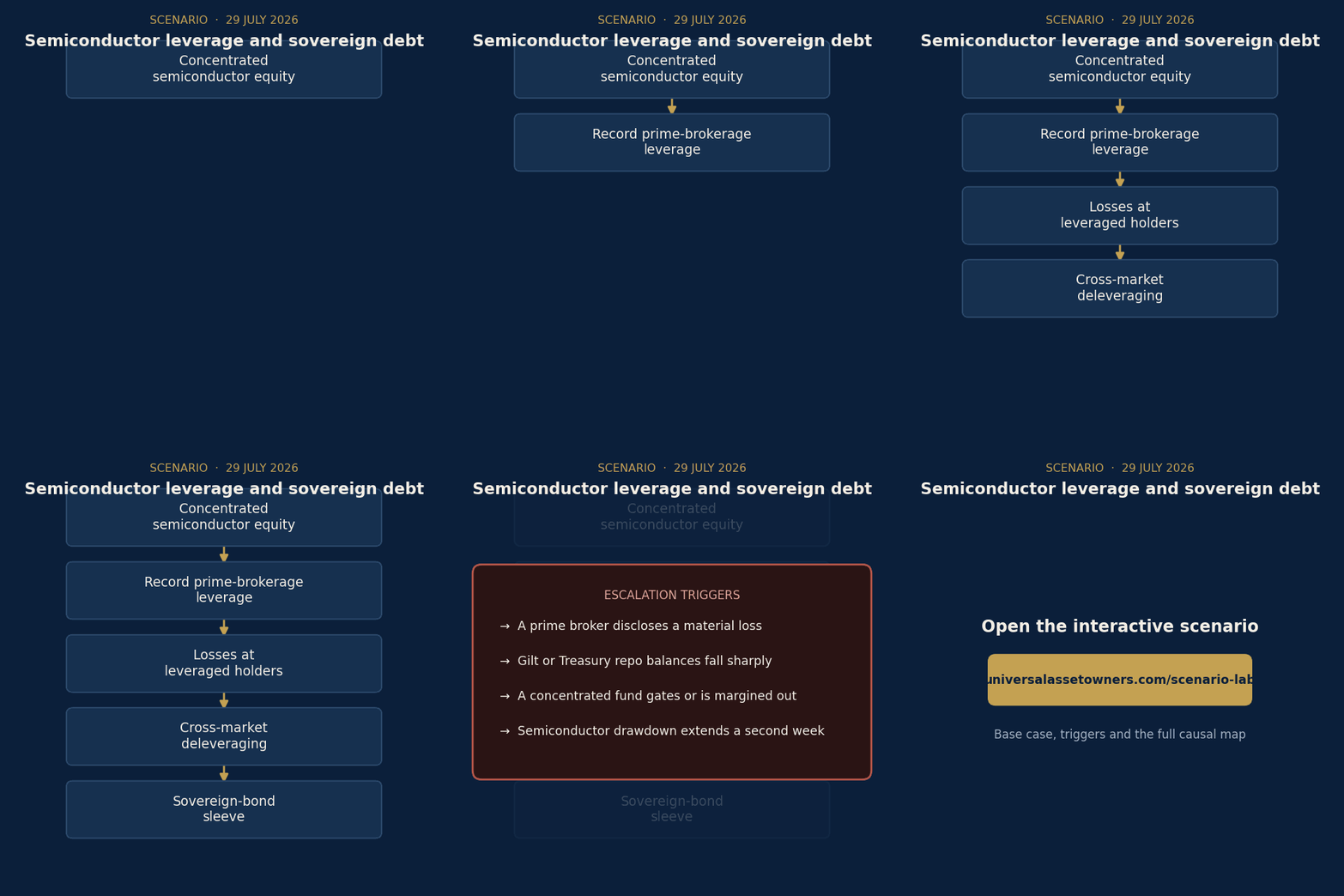
Base case: the channel stays open and unused. Leverage remains at record levels and concentrated, and no forced cross-market selling is disclosed.
It escalates if a prime broker discloses a material loss; gilt or Treasury repo balances fall sharply; a concentrated fund gates or is margined out; or the semiconductor drawdown extends into a second week.
Open the interactive scenario →
Podcast · The Universal Owner
Nobody Publishes That Number · 15 minutes.
Apple Podcasts Spotify Podbean
The Debate · Hidden leverage between tech and sovereign debt
Two voices take opposite sides of today's question for twenty-four minutes: is the unmeasured leverage channel a real risk, or a supervisor's abundance of caution?
The Back Page — meet The Allocator
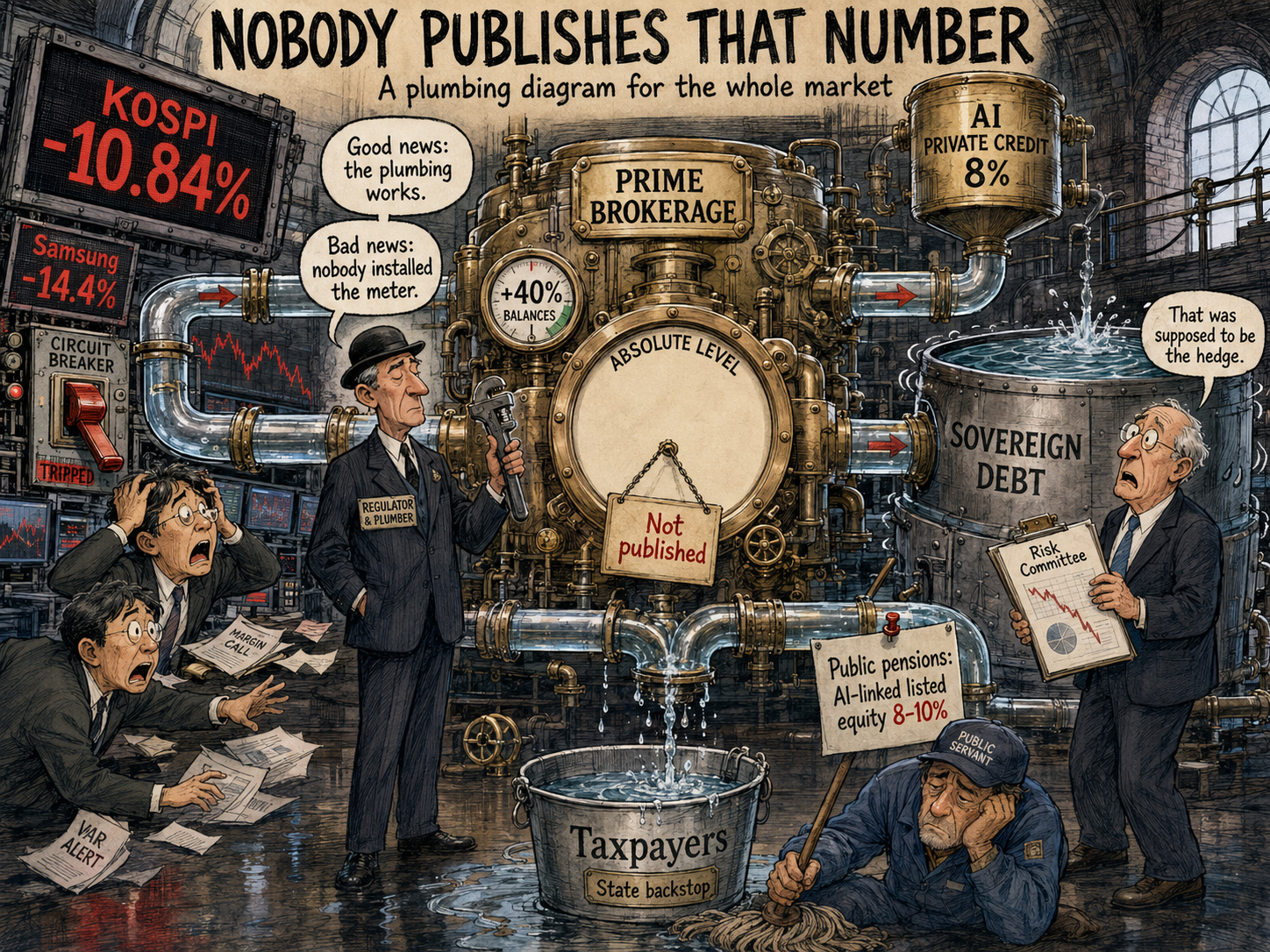
The Allocator is our resident universal owner: a composite chief investment officer who holds a slice of every listed company on earth, cannot sell her way out of a systemic problem, and takes the day's contradiction personally.
The contradiction, in one line
Every measurement in this edition that would let an owner size an exposure is either unpublished, undisclosed, four days old, or counts the wrong thing — and every market it describes is functioning normally. Those two facts are not in tension. The second is why nobody has had to fix the first.
Sources checked through 29 July 2026. Material claims are linked to named sources; primary or first-party sources are used where available.