
UAO Daily Brief — Thursday, July 16, 2026
Vol 1, Issue 62 · The Universal Owner
Recency floor: July 14, 2026. Every dated item below is verified to a named primary source.
AssetOps Chicago — August 11, 2026. The operating-model summit for institutional asset owners and allocators. Register →
Lead — The disinflation you got is the one you can least rely on
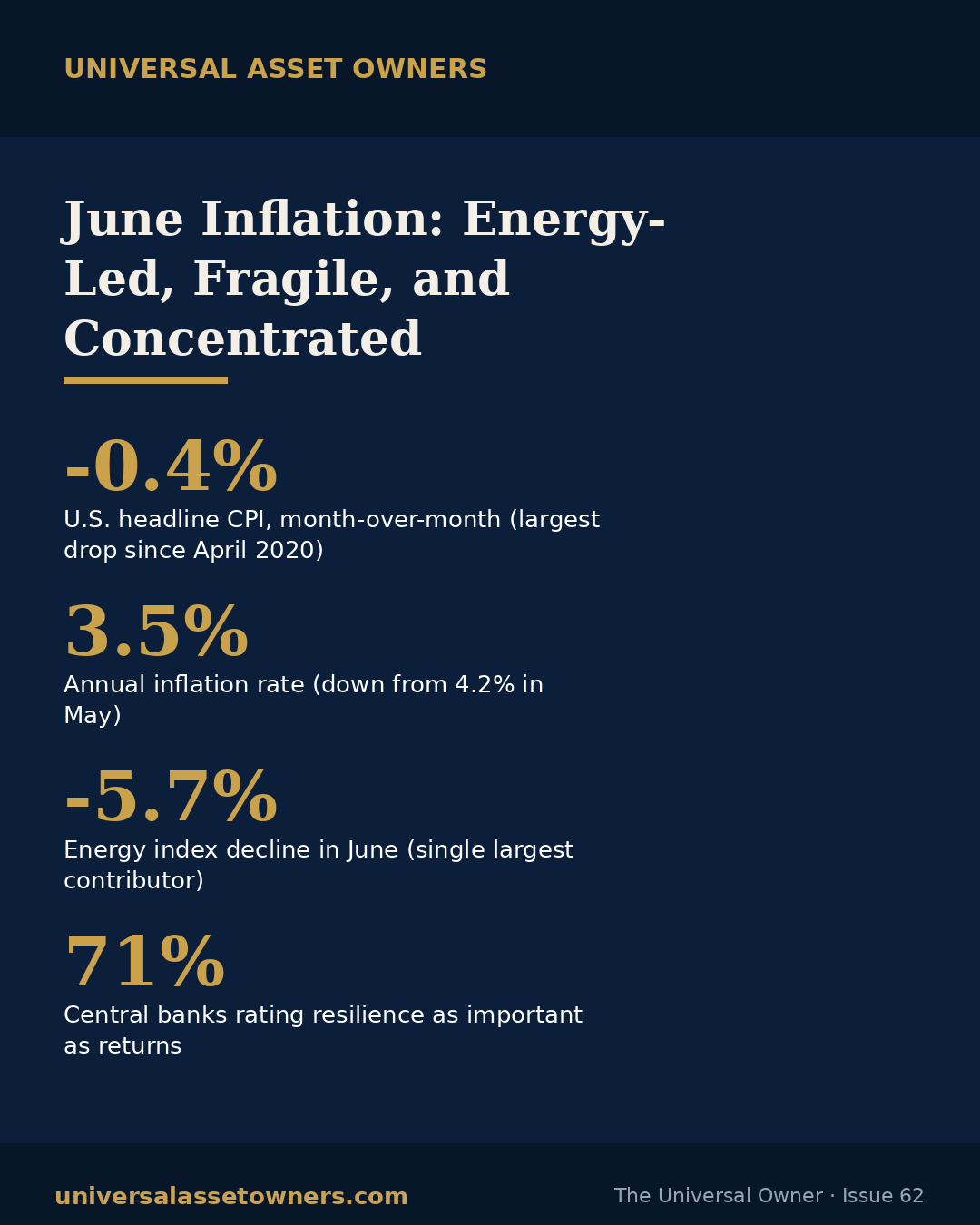
June inflation did the thing the market had been praying for, and did it harder than anyone forecast. U.S. headline CPI fell 0.4% on the month — the largest single-month decline since April 2020 — dragging the annual rate down to 3.5%, below the 3.8% consensus and well under May's 4.2%. Core, stripped of food and energy, was flat on the month at 2.6% annual, also below expectations (BLS, June CPI, released Jul 14). The print sharply reduced the odds of an immediate rate increase and strengthened the case for a July hold — though markets still expected at least one hike before year-end.
Read the composition and the comfort drains out of it. The move was energy-led: the energy index fell 5.7% on the month and was, by the BLS's own account, the single largest contributor to the decline — yet energy still sits 15.7% higher year over year. Disinflation that arrives through the fuel line is disinflation you are renting, not owning — and the universal owner has spent the last month watching exactly that fuel line get repriced by geopolitics. A number built on cheaper energy is a number one Gulf headline can reverse.
That is precisely why Fed Chair Kevin Warsh has refused to declare "mission accomplished" on inflation — a caution we read as a higher-for-longer lean, though he gave no explicit rate guidance. Warsh was also pointed about where business-investment momentum now sits: in his July 14 testimony he noted equipment investment rose about 8% and that "high-tech spending logged an especially impressive growth rate of nearly 25 percent on a four-quarter basis," with data-centre construction contributing substantially. Business investment, in other words, is increasingly influenced by data-centre construction and AI-related equipment spending. Which hands the long-duration owner an uncomfortable synthesis: the disinflation is energy-led and therefore fragile, and the investment momentum leans increasingly on one category — data centres and the equipment that fills them.
Implication for owners: do not re-rate discount rates off a single energy-led print. Stress the disinflation path against an energy re-acceleration, and the growth path against an AI-capex pause. The two tails are correlated through the same macro engine.
Fragile Disinflation and the AI Bottleneck
The edition in three and a half minutes — why June's energy-led inflation drop masks the true trend, and where the AI build-out actually bottlenecks. Watch it before the deep dive.
AI is becoming the operating layer the largest allocators run on — while the same owners buy the power it consumes. Read the feature.
The theme underneath the tape: AI is becoming the owner's operating system
The more durable story this week is a change in category — AI is crossing from a research tool that allocators use into an operating layer that allocators run on. The clearest disclosed case remains Norges Bank Investment Management, the world's largest sovereign fund at $2.1 trillion, where roughly half of its 700 staff now build their own tools on a large-language model and AI already helps screen the fund's ~7,000 holdings for ESG and financial risk — with management stressing that human oversight remains essential and that delegating decisions to agents is "not yet" (Reuters, Mar 24 2026). (Dated note: a spring-2026 disclosure, carried as the anchor for the structural point, not as fresh news.)
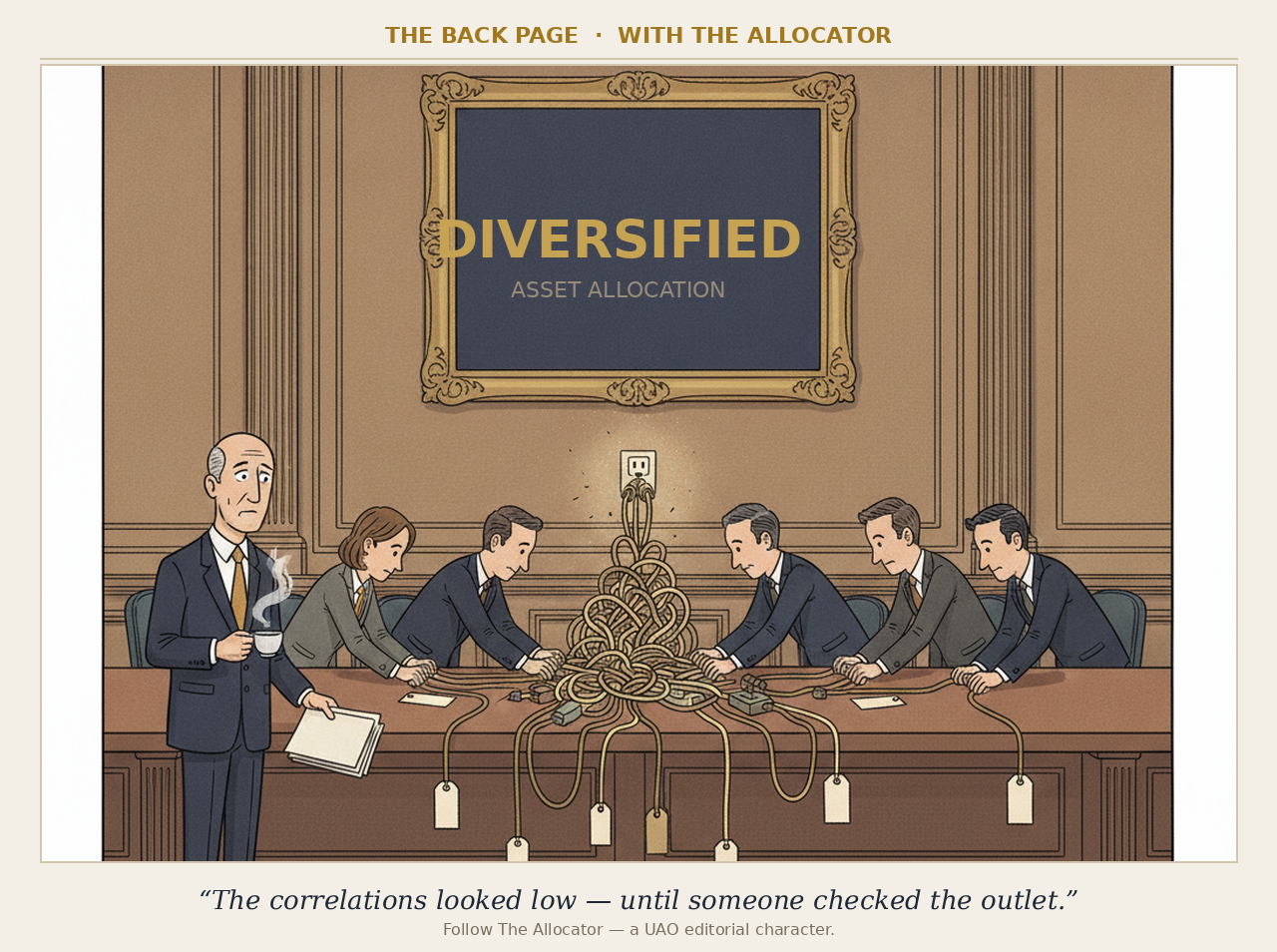
The structural point is what matters for every board reading this. When the largest owner turns AI into a surveillance-and-stewardship layer across thousands of positions, it raises the operating bar for every peer — and quietly changes the risk map. The same institutions industrialising AI internally are, externally, among the marginal buyers of the compute and power the technology consumes. That is the spine of today's deep dive: AI exposure that looks diversified across semis, data centres, utilities and software can still share a hidden common dependency on the same regional power, transmission and interconnection — not the same trade, but the same bottleneck.
Implication for owners: treat AI as three exposures at once — a productivity gain in your own operations, a governance question in your holdings, and a concentration risk hiding inside "diversified" buckets. Ask managers to map the AI book to its physical constraint, not its sector label.
Capital-flow watch — resilience is repricing, quietly
Three data points frame where sovereign and official capital is leaning. First, the Invesco Global Sovereign Asset Management Study 2026 finds 71% of central banks and 54% of sovereign wealth funds now rate resilience as important as returns in portfolio design, with funds tilting toward energy and infrastructure — spanning both energy security and energy-transition assets (Invesco GSAMS, Jun 29). Second, and most relevant to today's theme, the same study finds 69% of sovereign investors now use AI in their investment process, up from 33% in 2024. Third, sovereign funds are estimated to have deployed roughly $66bn into AI and digitalisation in 2025 (Global SWF, a disclosed-deal estimate) — a figure we read as a floor, given the opacity of co-investment, with Gulf funds leading the build-out of the "backbone of AI."
The political tail sits on top: a Verasight survey (June 29; n=1,690, ±2.8%) found 69% of Americans support forcing covered AI companies to transfer 50% of their equity to a public sovereign wealth fund — falling to 64% when the proposal was attributed to Senator Sanders. Sanders, separately, has proposed a mechanism he estimates would create a roughly $7tn public AI fund (Jun 18) taking public stakes in major AI firms. (Two distinct items — a public-opinion survey and a legislative proposal; neither is enacted, and the $7tn is Sanders' own estimate, not an appropriation.) For owners of AI equity, that is a low-probability, high-consequence governance risk to price, not to dismiss.
The Universal Owner Risk Radar — dated physical & systemic signals
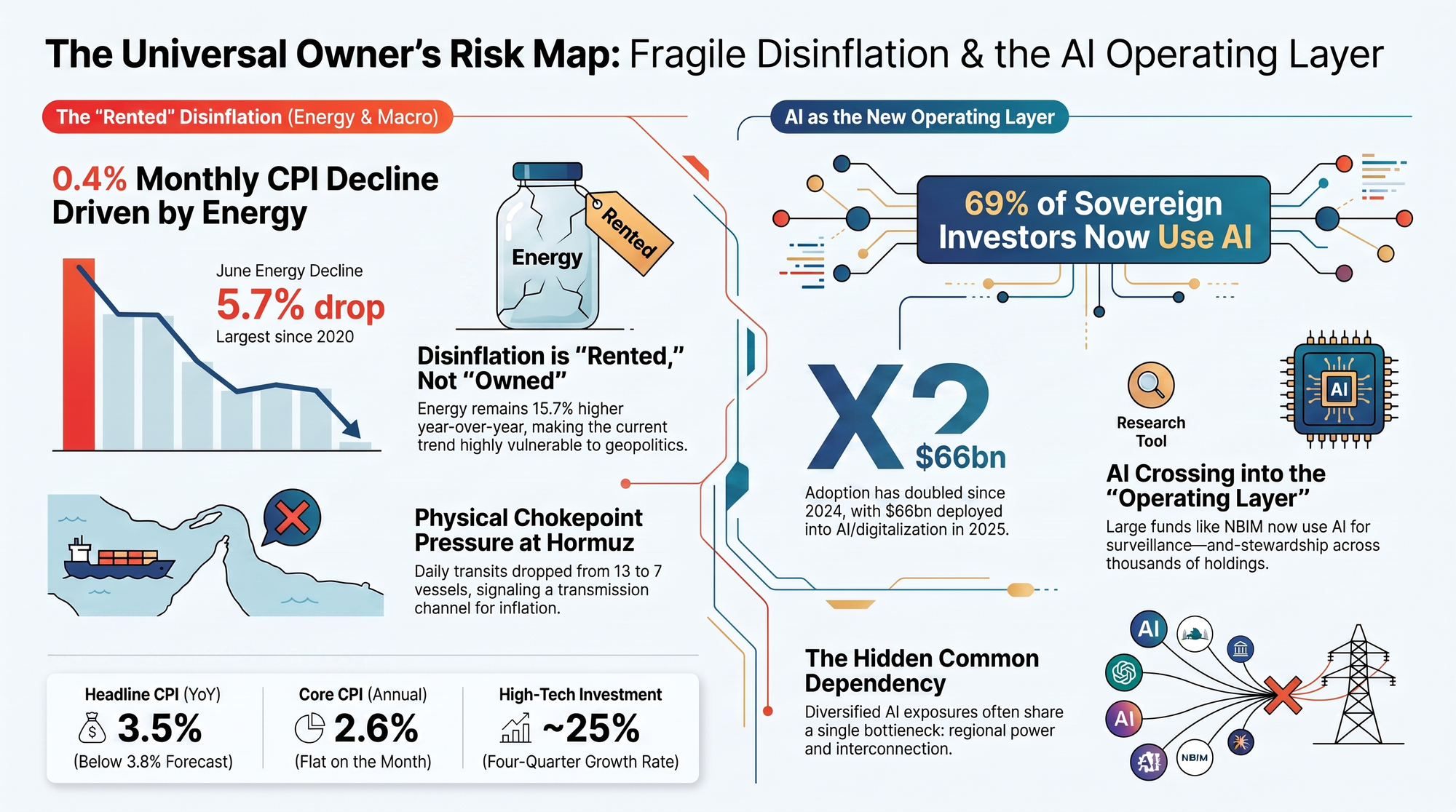
- Hormuz — the chokepoint is now visible in the transit data, not just the rhetoric. Only seven vessels crossed the Strait on Wednesday, down from 13, with no VLCC crude supertanker or LNG carrier transits; separately, India has instructed shipowners not to deploy Indian seafarers on Hormuz routes (Reuters). This is the physical constraint showing up as measured flow — the transmission channel into energy, freight, insurance and inflation, well ahead of any headline price move.
- Natural disasters (GDACS): an Orange-level flood in China (active through mid-July) and an Orange-level drought in Madagascar — the flood a supply-chain-and-property signal, the drought a food-security-and-sovereign-stress signal.
- Seismic (USGS, 24h): the largest event was M5.8 south of the Fiji Islands (Jul 15), with M5.7 near the South Sandwich Islands and M4.9 in Alaska; no populated-area damage reported.
Watch — the next 72 hours
- Energy tape after a soft CPI: whether June's energy-led disinflation survives contact with Gulf risk. Watch Brent, war-risk premiums and Hormuz transit counts, not the CPI headline.
- Fed communication: any follow-through from Warsh's higher-for-longer framing versus the market's rate-path pricing against the composition of the June print.
- Sovereign & pension disclosures: the next fund to move AI from pilot to delegated workflow — the trend NBIM illustrates — and fiscal-year return prints from large public pensions.
- AI-infrastructure policy: any concrete move on AI-chip / data-centre export controls would reprice cross-border AI-capex efficiency directly.
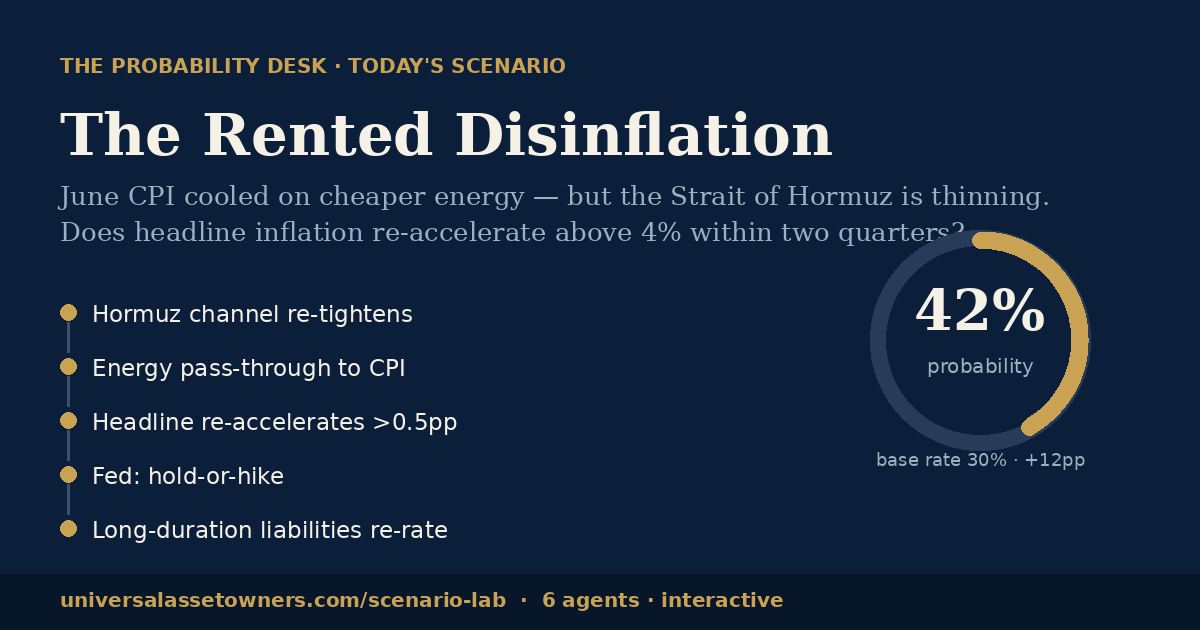
June's disinflation was energy-led; the Strait of Hormuz is thinning. Does headline CPI re-accelerate above 4% within two quarters? Probe six allocator agents — the Reserve Manager, Pension CIO, Energy Strategist, Insurance CRO, Sovereign Allocator and Macro Economist. Desk probability 42% (base rate 30%).
Today's episode (~2.5 min): why the disinflation you got is the one you can least rely on — and how AI is becoming the owner's operating system. Sponsored by AssetOps Chicago, by Corinium.
AI Nationalization and the Energy Chokepoint
The most contested questions in today's edition, argued from both sides (~22 minutes): should the public own a stake in the AI franchises its data and power make possible — and who absorbs the cost when the corridor that fuels them thins? One voice presses the 69%-public-support case for nationalization; the other answers with the governance record of state ownership and the price signals a thinning Hormuz is already sending. Listen for the collision, then decide where your board would land.
The Back Page — with The Allocator
A lighter look at the institutional week, from the desk of a man who owns a slice of everything and is pitched by everyone.
Inflation Mirages and AI Power-Grid Risks
The long-form audio feature on today's theme (~18 minutes): why June's disinflation may be a mirage built on cheap energy, and how the AI build-out concentrates portfolio risk at the power grid. Best with headphones.
Source ledger (primary/named, dated)
- June CPI −0.4% m/m, +3.5% y/y; core flat, +2.6% y/y; energy −5.7% m/m but +15.7% y/y (largest monthly drop since Apr 2020): BLS, released Jul 14, 2026.
- Warsh higher-for-longer lean; "high-tech spending logged... nearly 25 percent on a four-quarter basis" (verbatim); equipment investment ~8%: Federal Reserve, Warsh testimony transcript, Jul 14, 2026.
- NBIM $2.1tn; ~half of 700 staff build own AI tools; ~7,000 holdings screened; human oversight remains essential; agentic decisions "not yet": Reuters, Mar 24, 2026 — spring-2026 disclosure.
- Invesco GSAMS 2026: 71% of central banks / 54% of SWFs rate resilience ≥ returns; 69% of sovereign investors now use AI (up from 33% in 2024): Invesco press release, Jun 29, 2026.
- SWF ~$66bn into AI/digitalisation (2025): Global SWF — disclosed-deal estimate; "likely a floor" is a UAO inference.
- Verasight survey (Jun 29; n=1,690, ±2.8%): 69% support forcing covered AI firms to transfer 50% of equity to a public SWF (64% when attributed to Sanders): Verasight. Sanders' proposed mechanism, which he estimates would create a ~$7tn fund (Jun 18): sanders.senate.gov — neither enacted.
- Hormuz transit collapse: 7 vessels crossed Wed (down from 13), no VLCC/LNG; India seafarer directive: Reuters, Jul 2026. GDACS Orange flood (China) / drought (Madagascar): GDACS. USGS M5.8 Fiji (Jul 15): USGS.
Every material figure above is verified to the named primary source. Fed references reflect Chair Kevin Warsh. This is editorial analysis for institutional readers and is not investment advice.