|
UNIVERSAL ASSET OWNERS
The UAO Daily Brief
Volume 1, Issue 50 · Thursday, July 2, 2026 · 7:00am ET / 15:00 GST
GOVERNANCE WATCH · BUILD THE CIO, OR RENT ONE?
|
|
The world's largest owners aren't just changing portfolios — they're choosing operating systems. CalPERS is building investment judgment inside the fund; British Coal is renting it from BlackRock; Gulf sovereigns and Washington are contesting the AI cap table; and reserve managers are re-routing the pipes beneath the dollar.
The question is no longer only what they own. It's who controls the judgment, the votes, the plumbing and the strategic upside. State-owned investors now steer $62.5tn — $16tn in sovereign funds, $28tn in pensions, $17.6tn in central banks and $0.9tn in royal family offices (Global SWF).
CalPERS builds the CIO; British Coal rents one.
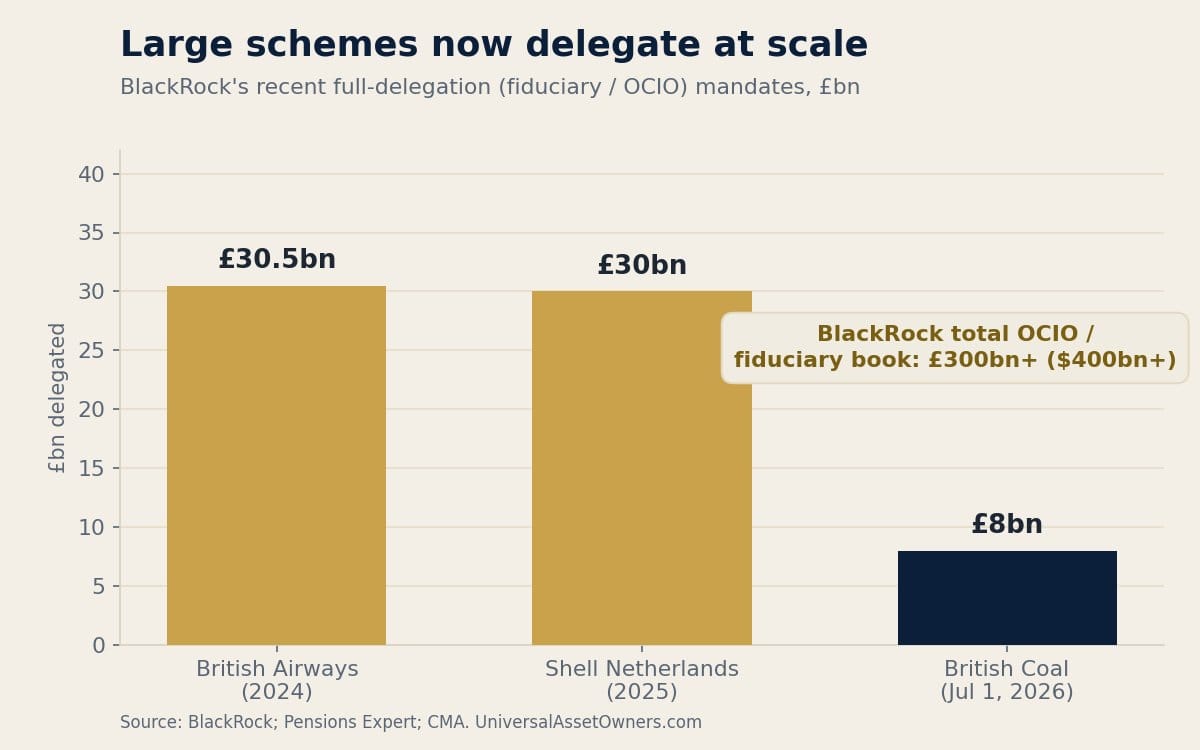
On July 1, CalPERS' Total Portfolio Approach went live — America's largest public pension (now ~$650bn, up from $556bn a year ago) moving off 11 asset-class benchmarks toward a single total-fund reference portfolio. The same day, the £8bn British Coal Staff Superannuation Scheme (~39,000 members) named BlackRock its fiduciary manager. One fund is formalizing internal judgment; the other is deciding an internal model is no longer the answer.
Read it precisely: BlackRock runs the money day-to-day within parameters, while trustees keep full control of strategy and risk. Full fiduciary delegation was historically a sub-£1bn solution (per the UK CMA); an £8bn scheme delegating is the model moving up-market — into a BlackRock outsourced book now past $400bn.
CHART · Large schemes now delegate at scale — BlackRock full-delegation / OCIO mandates, £bn (book now $400bn+).
For a universal owner the sharper question isn't "who runs the portfolio?" but "who votes it?" As one manager runs more of the index, ETF, private-markets, risk (Aladdin) and stewardship stack, delegating implementation can mean delegating market voice (BlackRock's climate-stewardship pushback: NYC's index rebid; PFZW's partial exit, per Reuters). And British Coal's benefits carry a statutory Government Guarantee — taxpayer backstop, private execution, trustee accountability.
In fairness: British Coal may be right — closed since 1994 and maturing, its job is disciplined management toward an endgame, which a scaled fiduciary may serve better than a thin in-house team. The old middle model is simply breaking; the future is a real internal investment office or a real external one.
Sovereigns buy the AI stack; the AI company invites the state in.
From the outside, Abu Dhabi's MGX (anchored by Mubadala and G42) closed MGX Fund 1 at $49bn, above its $45bn target — ~14 companies across chips, AI infrastructure and platforms, having co-led Anthropic's and OpenAI's rounds and backed xAI. Gulf sovereigns deployed a record $53.9bn across 108 deals in H1 (Mubadala first at $15.2bn), and Saudi Arabia's PIF reported 2025 assets up 5% to $1.21tn.
From the inside, OpenAI has proposed handing the US government a ~5% stake (~$42.6bn at its ~$852bn valuation) to seed a "Public Wealth Fund" (FT, via Bloomberg; no final terms). MGX buys the stack from outside; OpenAI offers it to the state from inside — AI is becoming public-strategic infrastructure, not just venture-backed tech. And a third path opened the same day: Qatar's QIA joined Trian and General Catalyst to take asset manager Janus Henderson private in a ~$7.4bn deal (completed July 1) — the sovereign that neither builds the CIO nor rents one, but buys the manager outright. Global M&A hit a record $2.8tn in H1 even as deal count fell to a six-year low: the middle is hollowing in deal flow, too.
The tension worth naming: sovereigns are deploying most aggressively just as the Hormuz reopening (below) pulls oil toward $70 — and at ~$70 Brent, Saudi Arabia sits below its ~$86–94 fiscal breakeven (IMF), so the record deployment is no longer funded by surplus alone. And the AI build-out is increasingly financed in the dark, via private credit — when owners become the lenders, they need the very in-house or external sophistication this issue is about. Read the deep dive →
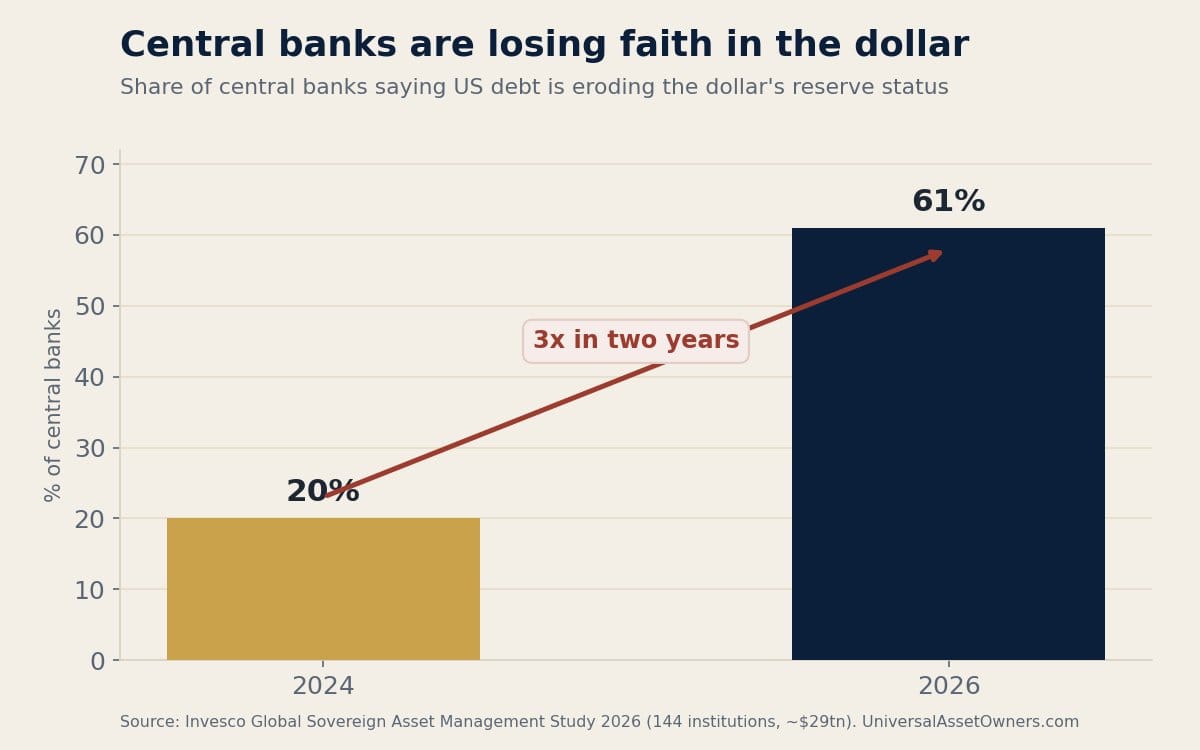
The Invesco Global Sovereign Asset Management Study (144 institutions, ~$29tn) captures the shift: 61% of central banks say US debt is eroding the dollar's reserve status — up from 20% in 2024; a third plan to raise gold; 80% cite energy security and transition infrastructure as the top resilience play; infrastructure is now 9% of SWF assets. The UBS Global Family Office Report echoes it: 47% of family offices feel overexposed to the dollar. Even Norway's $2tn NBIM — the world's most conservative sovereign — is leaning in, expanding unlisted renewable-energy infrastructure (its infra sleeve returned 18.1% in 2025).
CHART · Share of central banks saying US debt is eroding the dollar’s reserve status — 20% (2024) → 61% (2026).
Resilience is no longer only about currency weights — Reuters reports reserve managers reviewing reliance on US custodians. The reserve question is shifting from "what currency do we hold?" to "whose pipes do we pass through to use it?" The fragility went live in 48 hours: a Bloomberg-reported Meta plan to lease out idle AI compute raised a scarcity→overcapacity fear (Samsung/SK Hynix −8%+; Korea's Kospi fell ~7% and the exchange suspended program selling), while the US–Iran ceasefire and Hormuz reopening erased crude's war premium — Brent back toward ~$72, with Morgan Stanley modeling a 4.8m bpd oil surplus by 2027. The BIS flagged the backdrop: elevated equity valuations disconnected from spiking geopolitical risk.
Track it live: Reserve Rotation Tracker · Chokepoint Pressure Index
In-sourcing and out-sourcing look like opposite decisions. They're the same diagnosis — the old middle model is breaking. A part-time board, a consultant deck and a roster of managers may no longer be enough for a portfolio exposed to private credit, AI infrastructure, geopolitics, liquidity gates and positive stock-bond correlation. The future is a real internal investment office or a real external one. The danger is pretending the middle still works.
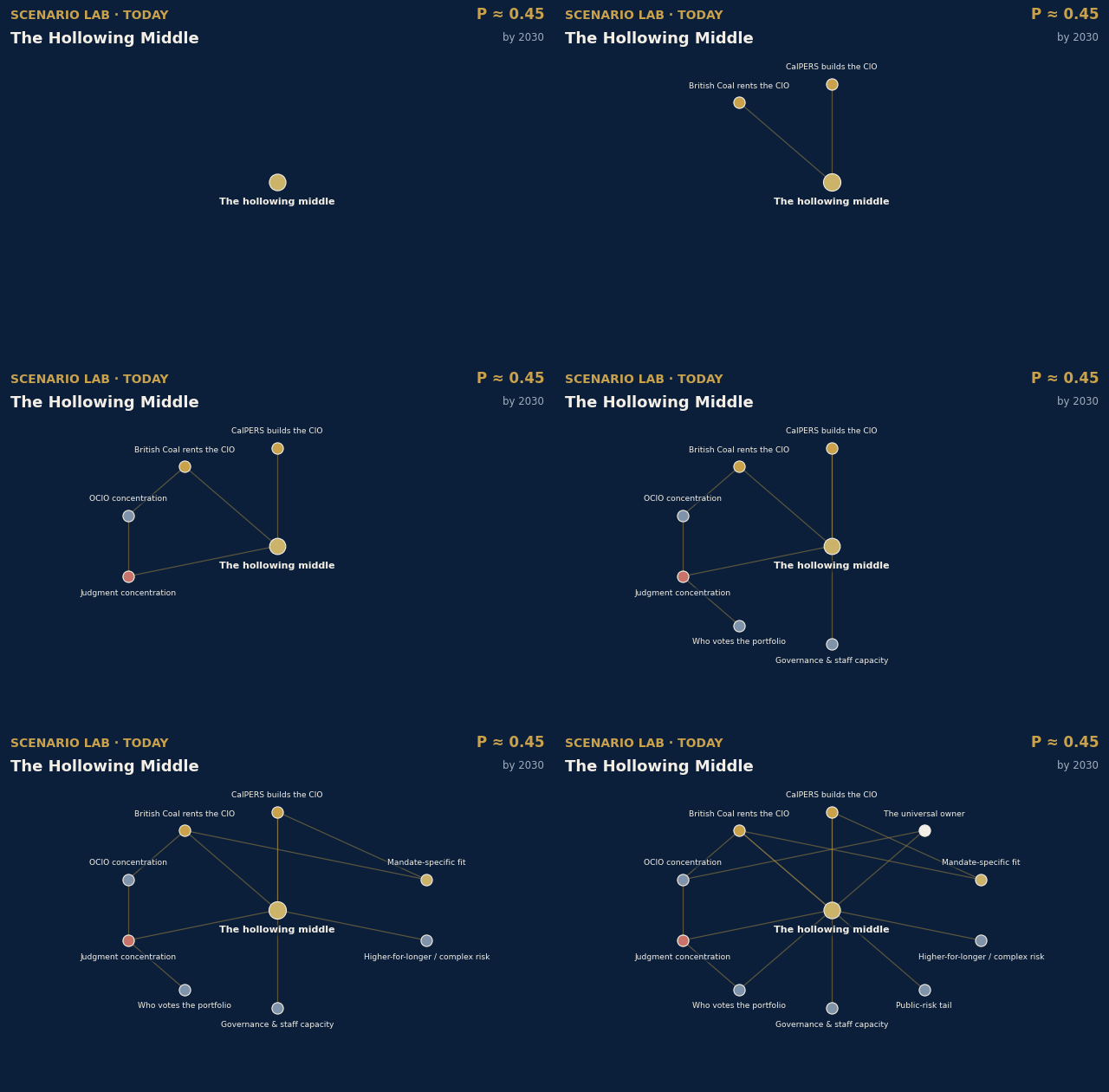
Base case: partial migration — build some, delegate some. Upside: the complex risk regime forces owners to a pole; the middle empties. Downside: the out-source pole concentrates into a few managers — judgment concentration becomes the systemic risk.
| Open the live scenario → |
The new floor for full delegation. If £8bn schemes delegate, the OCIO market re-rates upward — watch the next large DB scheme to follow.
Stewardship concentration. As one manager votes more of the market, regulatory and governance scrutiny rises with it.
The AI-ownership question. Does Washington take equity in frontier AI — and do other states follow?
The oil/fiscal squeeze. Can record sovereign deployment survive $70 oil?
The custody question reaches family offices. If reserve managers are reviewing US custodians, family offices holding assets through US-domiciled structures face the same question at smaller scale.
Who can move when rates stay higher. The governance model that matters is the one that can actually rebalance under stress — not the one that looks clean in a policy deck.
The Real Concentration Isn't AUM. It's Judgment.
The question. In two trading days the institutional world staged a live debate about who should control investment judgment on behalf of beneficiaries and states. CalPERS concentrated judgment inside its own office; British Coal handed day-to-day management to BlackRock. The interesting question isn't which board is right — it's what happens to the market when the middle of the governance spectrum empties toward the two ends, and an ever-larger share of the out-source end flows to one firm.
The first-order concentration is obvious; the second-order one matters more. The visible story is AUM — one manager's outsourced book past $400bn. The deeper story is judgment. As OCIO scales, more owners use the same risk systems (Aladdin), liquidity assumptions, manager rosters, capital-market views — and the same voting and stewardship framework. For a universal owner that already owns a slice of the whole market, that isn't manager concentration; it's judgment concentration — the risk that arises when many independent owners unknowingly share the same decision-making infrastructure, assumptions and market voice, a correlation risk in the governance layer that no asset diversification hedges. Quantify the footprint: BlackRock's Aladdin monitors roughly $25tn of assets (its own and third parties'); its index-equity book — the base for its stewardship votes — runs to about $7.7tn (with ~$3.76tn eligible for its Voting Choice program); and its OCIO book tops $400bn. One firm's judgment infrastructure touches a material share of professionally managed global capital. And it sits on a live fault line: BlackRock has already drawn pension pushback on climate stewardship (NYC; PFZW, per Reuters). Outsourcing implementation can quietly become outsourcing market voice.
The wider pattern. CalPERS centralizes judgment inside the fund. British Coal centralizes it at BlackRock. QIA, Trian and General Catalyst took Janus Henderson private the same day — the sovereign that doesn't build the CIO or rent one, but acquires the judgment factory outright. MGX centralizes access to the AI stack; OpenAI may centralize public legitimacy through a government stake; and central banks are de-centralizing custody (settlement, clearing) because they no longer trust the old pipes.
Capital is reorganizing at the operating layer — who controls the judgment, the votes, the infrastructure and the strategic upside — not just the allocation layer.
The contrarian view. British Coal isn't a failure of nerve. A closed, maturing scheme under a government guarantee has an endgame job a well-governed fiduciary with scale may serve better than a small in-house team. The right answer is mandate-specific: a ~$650bn open plan belongs at the in-source end; an £8bn closed scheme managing to buy-out may belong at the out-source end. The danger is the board that "sort of" delegates — taking the conflicts of out-sourcing (a manager evaluating its own performance, which the CMA's 2019 Order exists to police) without the accountability of in-sourcing. And the efficiency defense is real: a single platform with superior risk analytics, execution and global reach can genuinely serve beneficiaries better than fragmented alternatives — but efficiency and fragility are not opposites. The same concentration that makes the system efficient in calm markets makes it brittle under stress, when correlated assumptions and correlated liquidity needs collide. The question scales down, too: a family office delegating to a multi-asset platform, or an individual handing a discretionary mandate to a wealth manager, is renting the same judgment — and regulators today have a framework for conflicts, not yet for correlation.
SOURCES · BlackRock & BCSSS (Jul 1, 2026); Pensions Expert; CMA Order 2019; Reuters (stewardship / NYC / PFZW); Global SWF ($62.5tn); CNBC / The National (MGX $49bn; Gulf $53.9bn); FT via Bloomberg (OpenAI 5% stake); LSEG (M&A $2.8tn); Invesco 2026; UBS 2026; BIS (Jun 2026); Reuters / Morgan Stanley (Hormuz; 4.8m bpd 2027); Bloomberg / KED Global (Meta; Kospi).
AI scalability is fundamentally an energy and infrastructure problem — and a concentration problem. Test your own portfolio's exposure to the AI mega-cap and power-supply bottleneck the sovereigns are now hedging.
| Run the self-test → |
|
WATCH & LISTEN · THE UNIVERSAL OWNER
Today's episode — “Build the CIO, or Rent One?” (~5 min) The governance divide, the AI cap table, and the resilience pivot.
|
|
UNIVERSAL ASSET OWNERS
Intelligence for long-horizon capital.
universalassetowners.com |