ON THE RECORD: THE BIG READ
In statements to Universal Asset Owners, three of the world's largest allocators — managing more than US$1.3 trillion between them — set out where they stand on counter-cyclical deployment, the benchmark debate, American concentration and the private credit question.


When Universal Asset Owners put the same discipline of questions to three of the world's most consequential pools of capital this month — Abu Dhabi's Mubadala, Canada's CPP Investments and the California State Teachers' Retirement System — we expected the usual polite deflection. What came back instead was something closer to a doctrine: three institutions, on three continents, with three different mandates, converging on a single argument about how permanent capital should behave when everyone else is hesitating.
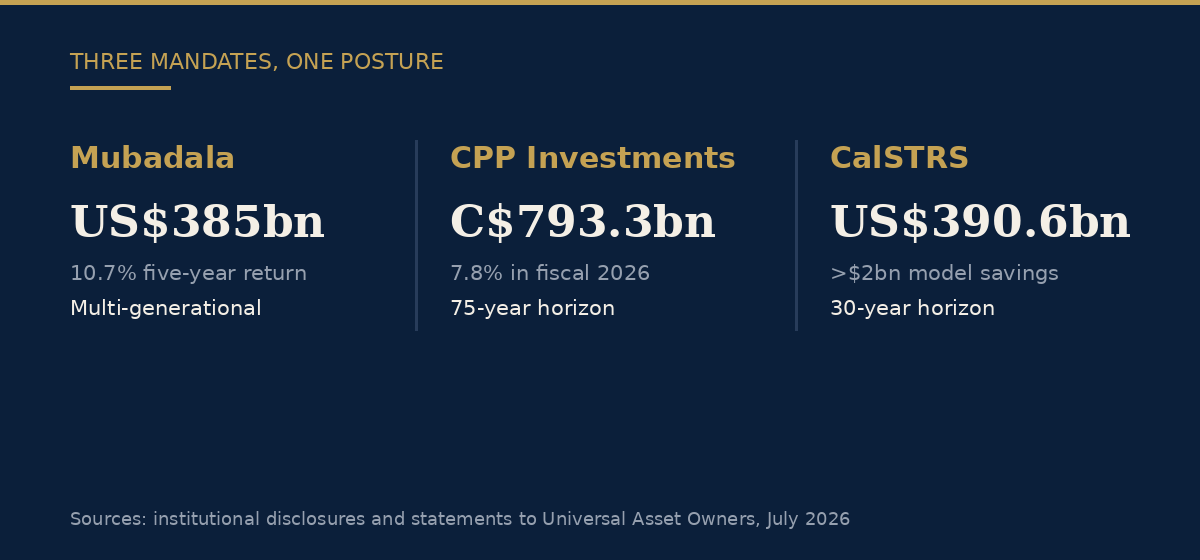
Between them, the three manage more than US$1.3 trillion: Mubadala closed 2025 at AED 1.4 trillion (US$385 billion) in assets under management, CPP Investments finished its fiscal year in March at C$793.3 billion, and CalSTRS oversees a portfolio of roughly US$390.6 billion. None of them is judged quarter to quarter. All three told us, in different registers, that this is precisely the point.
The counter-cyclical case
Mubadala's numbers frame the question. The fund grew assets 17% last year while deploying US$39 billion of new capital — up 20% on the prior year — at a moment when several sovereign peers slowed their pace. Its five-year annualised return stands at 10.7%.
Asked what gives it the confidence to keep deploying through the cycle, the fund was unambiguous. "Mubadala invests with a long-term horizon, which allows us to look through short-term volatility and remain focused on structural megatrends," the fund said in a statement to Universal Asset Owners. "The resilience of our portfolio, built with disciplined underwriting and strong partnerships, gives us confidence to remain active across cycles."
On what drove the five-year number, Mubadala pointed to "disciplined capital deployment, active portfolio management and exposure to areas where we have conviction and scale."
The benchmark heresy
At CPP Investments, the argument goes a step further: the scoreboard itself is the wrong one. The fund returned 7.8% in fiscal 2026 and has now trailed its reference portfolio for three consecutive years — a fact its critics cite often. Michel Leduc, the fund's Chief Public Affairs Officer, told Universal Asset Owners that this reading misunderstands the model CPP helped pioneer.
"The biggest misconception is that success can be judged against a single benchmark," Leduc said. "A genuine Total Portfolio Approach is about optimizing the entire Fund — not individual asset classes — by balancing risk, diversification, liquidity and long-term resilience. That means we may deliberately accept short-term benchmark headwinds if it strengthens the Fund over decades. For a pension investor with a 75-year horizon, our ultimate test is whether we're improving long-term outcomes for contributors and beneficiaries, not whether we outperform a market index in any given year."
It is the most direct defence the fund has offered of a stretch that has drawn scrutiny at home — and a preview of the debate every US fund adopting the total-portfolio approach, CalPERS included, will eventually face.
The America question
The most striking number in the exchanges was geographic. Leduc told us that roughly 48% of CPP's fund is invested in the United States — "well below its share of global public markets," as he put it — and that this is deliberate.
"We're not making top-down bets on one geography versus another," Leduc said. "The U.S. remains a critical market because of its size, depth and innovation, but our focus is on building a resilient global portfolio rather than mirroring market concentration... We continually review geographic exposures as conditions evolve, particularly in light of geopolitical and policy developments."
Mubadala's own book tells a similar story from the opposite direction: 44% North America, 24% UAE, 15% Europe and 13% Asia-Pacific — a Gulf fund that is simultaneously America's partner and increasingly its hedge. For allocators wrestling with index concentration, two of the world's largest long-horizon investors are on record: they are underweight America by design.
Private markets, defended
Private credit has spent the year under a cloud of commentary. CPP, whose credit platform spans public and private books, is not retreating. "We view it as a long-term strategic capability built on disciplined underwriting, diversified exposures and strong partnerships — not as a short-term liquidity business," Leduc said. "While there's increased scrutiny of parts of the private credit market, our program is differentiated by its long-term institutional capital, rigorous risk management and focus on resilient, risk-adjusted returns through market cycles."
Mubadala, for its part, holds 42% of its portfolio in private investments, and framed its edge within Abu Dhabi's crowded sovereign ecosystem in private-markets terms: "Mubadala combines the stability and scale of a sovereign investor with the agility of a global private equity platform, enabling us to both allocate capital and actively build businesses," the fund said, describing "an integrated model, spanning direct investing, an endowment platform and GP-led businesses."
CalSTRS, meanwhile, pointed us to the machinery rather than the marketing. On private markets positioning, the fund said its "investments team recommends, and the board approves, steps (interim targets) to move asset allocations from current targets to long-term targets," weighing "current asset allocation and market conditions, the efficiency of trading certain asset classes, and investment costs." Its Collaborative Model — more internal management, more co-investment — has now saved the fund more than US$2 billion in fees since 2017, including over $550 million in 2024 alone, the largest annual saving since the model's inception.
The anchor
Where the three converge most completely is on what the portfolio is for. "Everything CalSTRS does is grounded in our mission to secure the financial future of California's public-school educators," the fund said in its statement to UAO. "We use a 30-year investment horizon and make decisions with long-term stability in mind — not short-term gains." On its 2050 net-zero pledge, CalSTRS said it has "been actively integrating climate-oriented solutions into our portfolio" since 2004 "and [has] invested more than $55 billion."
Thirty years in Sacramento. Seventy-five in Toronto. Multi-generational in Abu Dhabi. The horizons differ; the posture does not. The three largest lessons from a fortnight of correspondence with US$1.3 trillion of permanent capital: keep deploying when others pause, refuse to be marked to a single index, and hold your geographic nerve.
That is not consensus positioning. It is, increasingly, the universal owner's playbook.
Mubadala, CPP Investments and CalSTRS were responding to written questions from Universal Asset Owners between July 8 and July 15, 2026. Mubadala's responses were provided on the record for attribution to the fund; CPP Investments' responses are attributed to Michel Leduc, Chief Public Affairs Officer; CalSTRS responded through its newsroom.
More On the Record
- CPP Investments on benchmarks, the 48% America weighting and private credit
- Mubadala on counter-cyclical deployment and its lane in Abu Dhabi
- CalSTRS on net zero, the Collaborative Model and interim targets
Run an allocator and want to put something on the record? Write to info@universalassetowners.com.
Watch: the ten-minute briefing
Listen: the extended audio briefing
A 38-minute audio deep dive through all three statements — Mubadala, CPP Investments and CalSTRS — and what they add up to.
The playbook, on one page