ON THE RECORD
In a statement to Universal Asset Owners, the US$390 billion teachers' pension reaffirms its 2050 net-zero pledge, points to more than $55 billion invested in climate-oriented solutions since 2004 — and lets a $2 billion savings number do the talking on its Collaborative Model.

CalSTRS answers questions the way it invests: deliberately, and with the paper trail attached. When Universal Asset Owners asked the US$390 billion fund how its Collaborative Model is evolving under Chief Investment Officer Scott Chan, where it is adding or trimming in private markets, and how it squares its net-zero commitment with its return duty to more than a million California educators, the answers came with citations — and a few lines that deserve to be read carefully.
The mission, restated
The clearest statement came on the question every US public pension now faces: how to hold a climate commitment and a fiduciary duty in the same portfolio.
"Everything CalSTRS does is grounded in our mission to secure the financial future of California's public-school educators," the fund told UAO. "We use a 30-year investment horizon and make decisions with long-term stability in mind — not short-term gains."
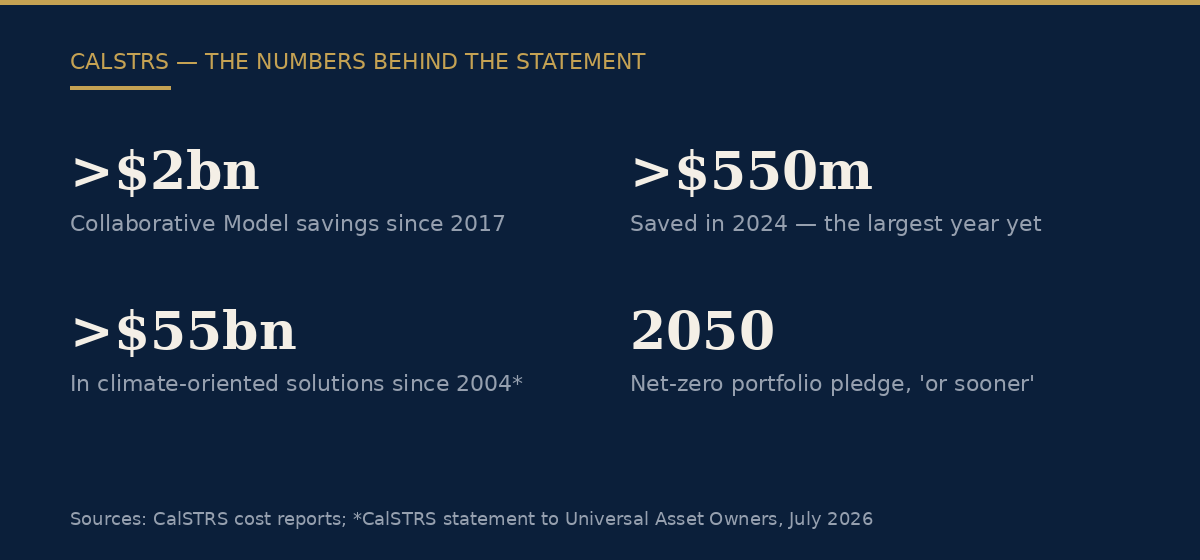
And on the pledge itself: "We remain committed to achieving a net zero portfolio by 2050 or sooner as part of our mission to ensure a secure retirement for our more than 1 million members and beneficiaries. Since 2004, we've been actively integrating climate-oriented solutions into our portfolio and have invested more than $55 billion."
At a moment when several US pensions are quietly softening climate language under political pressure, CalSTRS chose — in writing, to a publication read by its peers — to restate the 2050-or-sooner pledge without qualification. That is itself news.
The Collaborative Model, by the numbers
On its signature strategy — bringing more assets in-house and leaning into co-investment — the fund pointed UAO to its most recent annual cost report and to its board's November 2025 Investment Committee discussion, with the next savings report due in November 2026.
The record it points to is substantial. The Collaborative Model has saved CalSTRS more than $2 billion in management fees and carried interest since 2017, including more than $550 million in 2024 — the largest annual saving since the model's inception. Chan, CIO since July 2024 and one of the model's architects during his years as deputy, now oversees a portfolio valued at roughly $390.6 billion.
Private markets: watch the interim targets
On the denominator effect and private markets positioning, CalSTRS declined to signal direction — but explained the mechanism, and the mechanism is the story.
"Our investments team recommends, and the board approves, steps (interim targets) to move asset allocations from current targets to long-term targets based on several factors," the fund said. "These include our current asset allocation and market conditions, the efficiency of trading certain asset classes, and investment costs. Our asset class allocations have target ranges to allow for flexibility to adapt to changing market conditions."
Translation for allocators: CalSTRS does not rebalance by press release. The fund moves through board-approved interim targets, and the published allocation ranges — not executive commentary — are where its private markets intentions will show up first.
Why it matters
Three signals, each understated and each significant: a US mega-pension reaffirming net zero on the record in 2026; a cost-discipline model that has crossed the $2 billion savings mark and become the template for internalisation debates worldwide; and a reminder that at genuine scale, allocation policy is a governance process, not a market call. For the funds studying the Collaborative Model — and the managers pricing against it — November 2026, when the next savings report lands, is the date to circle.
CalSTRS was responding to written questions from Universal Asset Owners through its newsroom on July 8, 2026.
More On the Record
- The Big Read: how long-horizon capital is playing 2026
- CPP Investments on benchmarks, the 48% America weighting and private credit
- Mubadala on counter-cyclical deployment and its lane in Abu Dhabi
Run an allocator and want to put something on the record? Write to info@universalassetowners.com.
Watch: the special episode
Listen: the audio briefing
A 31-minute audio deep dive into the CalSTRS statement — the 30-year horizon, the 2050 net-zero pledge and the Collaborative Model.
The playbook, on one page