ON THE RECORD
Three years of benchmark shortfall, a deliberate underweight to the United States, and no retreat from private credit — Michel Leduc, CPP Investments' Chief Public Affairs Officer, answers the three questions critics keep asking about the C$793 billion fund.
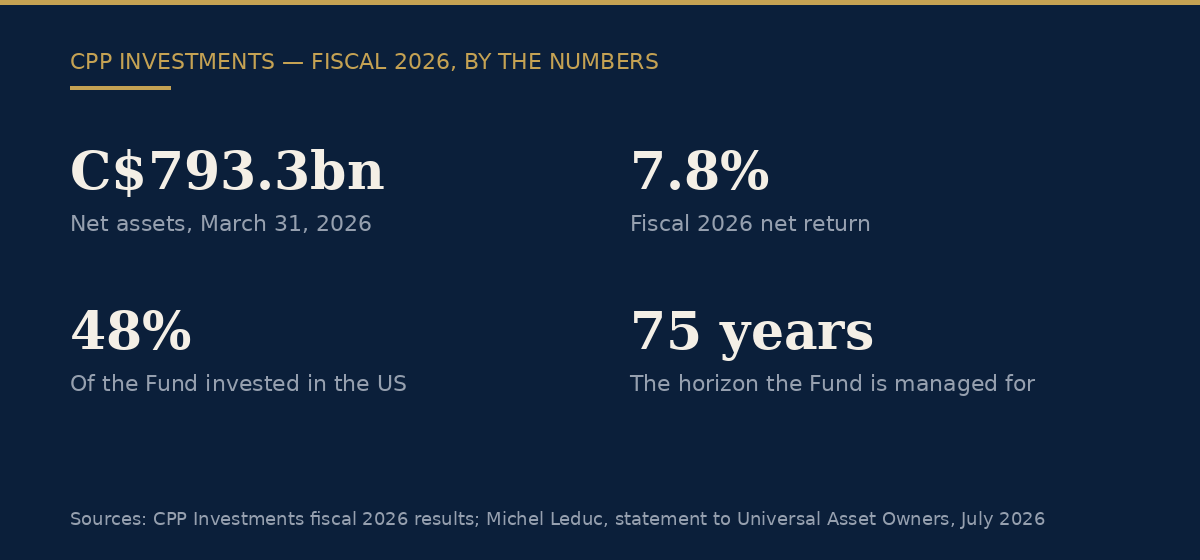
There is no institutional investor whose operating model has been more imitated — or more second-guessed — than CPP Investments. The Canadian fund helped pioneer the total-portfolio approach now being adopted by CalPERS and studied by allocators worldwide. It has also just posted a 7.8% return for fiscal 2026 — its third consecutive year behind its reference portfolio — while net assets climbed to C$793.3 billion.
Universal Asset Owners put three questions to the fund. Michel Leduc, its Chief Public Affairs Officer, answered all of them on the record.
"The biggest misconception"
Asked what outsiders most misunderstand about running a genuine total-portfolio approach at CPP's scale, Leduc went straight at the benchmark question.
"The biggest misconception is that success can be judged against a single benchmark," he told UAO. "A genuine Total Portfolio Approach is about optimizing the entire Fund — not individual asset classes — by balancing risk, diversification, liquidity and long-term resilience. That means we may deliberately accept short-term benchmark headwinds if it strengthens the Fund over decades."
Then the line that defines the philosophy: "For a pension investor with a 75-year horizon, our ultimate test is whether we're improving long-term outcomes for contributors and beneficiaries, not whether we outperform a market index in any given year."
It is a candid acknowledgement that the fund knows exactly what its critics are counting — and a warning to the American funds now importing the model. The total-portfolio approach buys resilience with tracking error. Boards that adopt it must be prepared to defend years like these.
48% — and staying there by design
The sharpest disclosure in the exchange concerned geography. At a moment when US equities dominate global indices and every allocator is debating concentration risk, Leduc put a number on CPP's position.
"Today, roughly 48% of the Fund is invested in the U.S. — well below its share of global public markets — because diversification across regions, sectors and asset classes is central to how we manage long-term risk and return," he said. "We're not making top-down bets on one geography versus another. The U.S. remains a critical market because of its size, depth and innovation, but our focus is on building a resilient global portfolio rather than mirroring market concentration."
He added that the fund "continually review[s] geographic exposures as conditions evolve, particularly in light of geopolitical and policy developments" — as close as a Canadian Crown-adjacent institution will come to saying the policy environment in Washington is now an input to portfolio construction.
Private credit: "not a short-term liquidity business"
On the year's most scrutinised asset class, CPP is unmoved. "Private credit is an important part of our broader Credit Investments platform, alongside public credit," Leduc said. "We view it as a long-term strategic capability built on disciplined underwriting, diversified exposures and strong partnerships — not as a short-term liquidity business."
And on the mounting commentary about stress in parts of the market: "While there's increased scrutiny of parts of the private credit market, our program is differentiated by its long-term institutional capital, rigorous risk management and focus on resilient, risk-adjusted returns through market cycles."
The subtext matters. As banks, insurers and retail-facing vehicles crowd into the asset class, the largest pension investors are drawing a line between permanent-capital credit platforms and the liquidity-mismatched newcomers — and positioning themselves on the safe side of it.
Why it matters
CPP's answers are a preview of the argument every large asset owner will be having with its board over the next decade: what is the right yardstick for a fund that cannot fail, must not be forced to sell, and measures itself in generations? Leduc's answer — the fund, not the index — is now on the record. The 48% America number gives every allocation committee a data point from the world's most-watched pension investor. And the private credit defence signals that the largest players intend to keep underwriting through the cycle.
Michel Leduc, Chief Public Affairs Officer of CPP Investments, was responding to written questions from Universal Asset Owners on July 9, 2026.
More On the Record
- The Big Read: how long-horizon capital is playing 2026
- Mubadala on counter-cyclical deployment and its lane in Abu Dhabi
- CalSTRS on net zero, the Collaborative Model and interim targets
Run an allocator and want to put something on the record? Write to info@universalassetowners.com.
Watch: the briefing
For all three institutions in one sitting: the special episode of The Universal Owner
Listen: the audio briefing
A 33-minute audio deep dive into why CPP Investments rejects a single market benchmark — the total-portfolio approach, the U.S. underweight and private credit.
The playbook, on one page