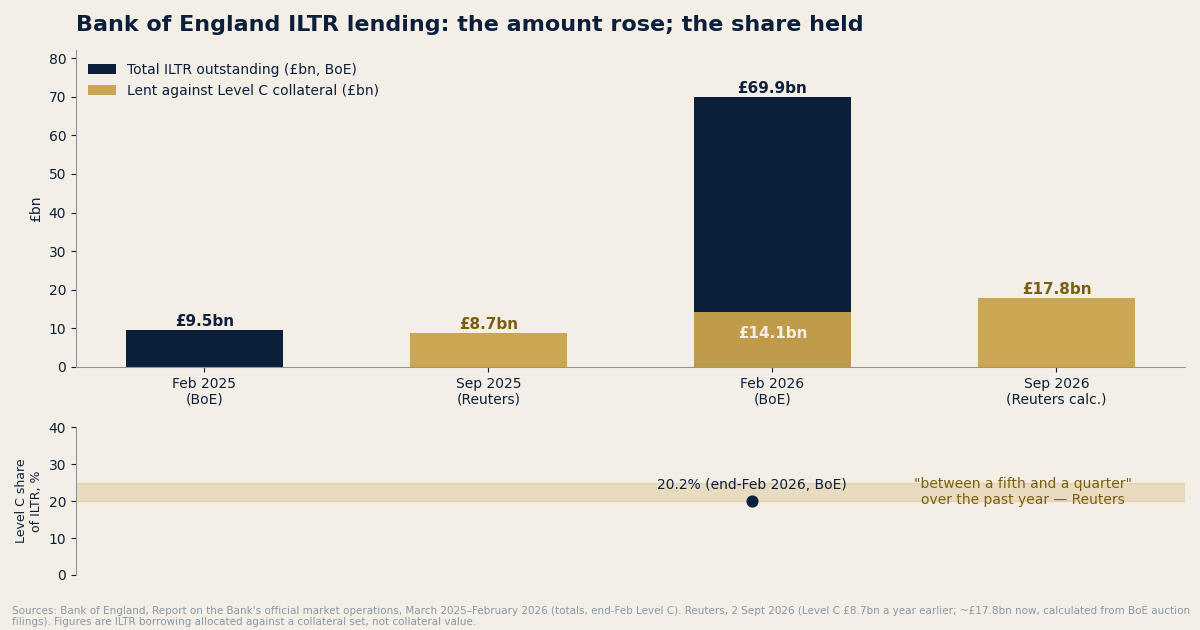
Quantitative tightening is changing what British banks pledge for cash. A Reuters review of Bank of England filings puts about £17.8 billion of central-bank lending against the Bank’s broadest collateral tier — double a year ago. That is not a bank in trouble. It is a list that has become a price — paid by every investor who holds the same paper and never sees the auction. |
|
Window: 1 Sep 01:40 ET → 2 Sep 04:30 ET. Event dates distinguished from article dates. |
Who reads this
Before the market opens, this brief is read at the desks that direct more than $50 trillion in permanent capital.
98% of the world’s sovereign wealth funds |
18 of 20 of the world’s largest pension funds |
10 of 10 of the largest charitable foundations |
85% of the world’s largest family offices |
100+ billionaires, every morning |
|
Advertisement   |
|
The Daily Podcast · 8 min 25 sec “The amount doubled. The share held.” |
|
The Lead |
The BoE’s £17.8bn collateral signalQuantitative tightening is usually described as a subtraction problem: the central bank bought bonds, now it lets them run off, the balance sheet shrinks. That framing misses the more consequential change. When a banking system stops receiving reserves passively through asset purchases, it has to go and borrow them — and what it pledges to borrow them against becomes a market-structure fact, not a technical footnote. Britain now has a number for that. The Bank of England’s Indexed Long-Term Repo facility lends six-month reserves against three tiers of collateral: Level A, essentially gilts and their equivalents; Level B; and Level C, the broadest and least liquid set, which includes eligible securitisations and pre-positioned loan pools. According to the Bank’s own report on its market operations, outstanding ILTR borrowing rose from £9.5bn in February 2025 to £69.9bn in February 2026, and the number of firms with outstanding drawings rose from 43 to 79. Of that February stock, £50.6bn was allocated against Level A collateral, £5.3bn against Level B and £14.1bn against Level C. A Reuters review of subsequent auction filings, published on Tuesday, calculates that the Level C figure has since climbed to roughly £17.8bn — against about £8.7bn a year earlier and under £1bn in mid-2024. In the 18 August operation alone, banks pledged £1.9bn of Level C collateral, the largest single-auction amount since March 2020. Among the assets Reuters identified in that tier: loans linked to high-interest store cards and vehicle leases. None of this is evidence that British banks are in trouble, and the Bank of England has said as much. The ILTR was redesigned to do exactly this — to supply reserves on demand, against a deliberately broad collateral pool, as QT withdraws the reserves that QE created. Level C is priced higher and haircut harder than the safer tiers. And the proportion matters: Reuters’ own reading of the past year is that Level C has made up “between a fifth and a quarter” of what the facility accepts. The amount has doubled; the share has held in a band. Both facts should travel together, because an edition that reports only the first is telling a different story from the one the data supports. What the data does support is narrower and, for a credit allocator, more useful. Collateral eligibility affects a bank’s funding cost. When the central bank’s list of what it will lend against reaches into consumer credit and small-business loan pools, that list starts to influence the economics of originating, packaging and holding those assets. That effect may be marginal. It may also be the beginning of a relative-value gap between paper that qualifies and paper that does not. The European Central Bank has narrowed eligibility for certain asset-backed structures that remain inside the Bank of England’s Level C universe. That is a divergence on one slice of the market, not a philosophical split between Frankfurt and London — both institutions are shrinking their bond holdings while lending freely against broad collateral. But it is the kind of gap that structurers notice before allocators do. |
Allocator Lens. Treat this as a market-structure question, not a bank-distress call. Three things to ask a credit desk this week: Is UK ABS primary issuance or spread behaviour changing alongside ILTR usage — that would suggest crowding-out rather than routine adaptation? Which asset types are becoming more valuable specifically because they are BoE-eligible, and is that priced? And do the private-credit and securitised-credit sleeves in the book draw on the same underlying borrower cash flows — consumer credit, auto finance, SME lending — that are now central to the Bank’s collateral framework? The thesis strengthens only if the first answer is yes. It does not strengthen on rising Level C usage alone. |
|
What would confirm it: ILTR clearing spreads rising above their floors; UK ABS spreads widening as Level C usage rises; a visible pricing gap between BoE-eligible and ECB-eligible paper. What would weaken it: Level C usage plateauing or rising with no change in issuance, spreads or haircuts — the Bank’s own “designed, not distressed” account holding unmodified. |
Sources: Bank of England, Report on the Bank’s official market operations, March 2025–February 2026; Reuters, “Banks rush to swap higher-risk credit assets for BoE cash,” 2 September 2026. |
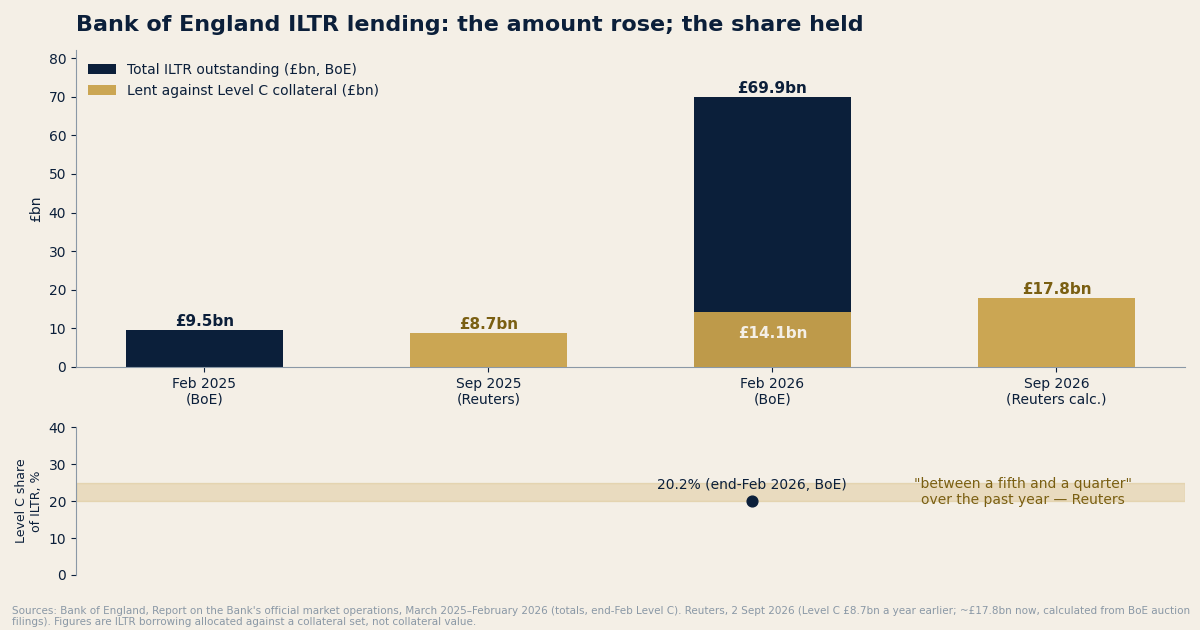 |
Chart of the day · Totals and end-February Level C from the Bank of England’s 2025–26 market-operations report; the September 2025 and September 2026 Level C points are Reuters calculations from BoE auction filings. Figures are ILTR borrowing allocated against a collateral set, not collateral value. |
Long Horizon |
Tangen’s warning, in his own wordsOn 12 August, presenting a record first-half return for Norway’s $2 trillion sovereign fund, Norges Bank Investment Management chief executive Nicolai Tangen was asked whether the fund could disappear. “The answer is yes,” he said. “And the worst part is that, in the world we live in today, it’s not totally improbable.” He named nuclear conflict, biological terrorism, an AI bubble bursting alongside a US–China trade war, and a prolonged depression as the scenarios that could impair the fund materially. It is an unusual thing for the operator of the world’s largest single pool of universal-ownership capital to say out loud, and it deserves more than a quotation. Tangen’s argument is not that a crash is imminent. It is that three decades of globalisation, disinflation and falling rates produced a tailwind that has quietly been written into expected-return assumptions as if it were a baseline — and that an institution too large and too diversified to hedge the system it belongs to has no instrument for the risk that the regime itself changes. |
Allocator Lens. The useful question for an investment committee is not “should we be worried” but “which of our assumptions require the last thirty years to continue?” Three places it hides: rebalancing policy, the expected-return inputs behind actuarial discount rates, and private-market pacing models built on exit multiples from the low-rate era. |
|
Sources: CNBC, 12 August 2026; NBIM half-year report 2026. |
Advertisement  |
Risk Radar · Energy and Duration |
Hormuz, and the day the market did not buy safetyDirect US–Iran exchanges resumed at the end of August. On 31 August, two laden tankers carrying Saudi crude were struck by projectiles off Oman; the UK Maritime Trade Operations centre confirmed at least one strike by unidentified projectiles. On 1 September, US Central Command began a wider wave of strikes on Islamic Revolutionary Guard Corps targets, saying it was responding to attempted attacks on commercial shipping and on US personnel. That is the US government’s stated rationale; independent attribution of the tanker strikes has not been established. Brent and WTI rose more than $4 on the session. The same day, Japan’s Ministry of Finance sold ten-year government bonds at an average yield just under 3 per cent, and the secondary-market benchmark crossed 3 per cent for the first time since 1996. Demand at the auction itself was solid. Yields rose across other major sovereign markets. The temptation is to draw a straight line from the tankers to the bond desks. That line is not supported by the evidence. Sovereign yields have been rising for weeks on fiscal supply, term-premium repricing and policy expectations; the same-day oil move may have reinforced inflation concerns, but it cannot be shown to have caused the global move. What can be said is narrower: on a day of military escalation in the world’s most important energy chokepoint, the market repriced inflation and duration rather than reaching for havens. That pattern — oil up, yields up — is consistent with an inflation-and-policy repricing, and it is the pattern universal owners should model, because it is the one in which the equity–bond offset that most balanced portfolios rely on stops working. The next data points are physical: whether verified cargo volumes through the strait fall and stay down, whether war-risk insurance is withdrawn or repriced, and whether Thursday’s 30-year JGB auction shows the same demand as Tuesday’s ten-year. A rapid restoration of traffic and a calm long-end auction would suggest the episode was a scare, not a regime. |
Allocator Lens. The exposure is cross-asset and institution-specific. Higher yields reduce bond values but also reduce the present value of long-dated liabilities; the net effect on funded status depends on the hedge ratio, the duration gap, inflation linkage and base currency, not on a general rule that higher yields hurt. Gulf capital-flow counterparties add a third channel: sovereign fiscal capacity tightens at exactly the moment co-investment calendars assume it will not. |
|
Sources: UKMTO advisory; US Central Command statement, 1 September, as reported by CNBC and Stars and Stripes; Japan Ministry of Finance auction result, 1 September; Reuters. |
Capital Flow Watch |
CPP’s week in platformsIt is tempting to add up three headlines and call it a single day’s shopping. It was not — one was a fund commitment, one a fund commitment with a cornerstone position, and one the completion of a take-private that went legally effective in August. But the three, read together, describe a preference worth naming. India. NIIF Infrastructure Fund II took a first close of ₹19,000 crore, roughly $2bn, on 31 August against a $3.2bn target, with some ₹9,000 crore of co-investment expected alongside the fund. The limited-partner list is a near-repeat of the first fund: an Abu Dhabi Investment Authority subsidiary, Temasek, CPP Investments, Ontario Teachers’, AustralianSuper, and a group of Indian banks and insurers. CPP disclosed a commitment of up to ₹2,070 crore, about $215m. Jersey. Permira’s take-private of JTC plc, the fund administrator, completed on 1 September; the scheme had become effective and the shares delisted on 20–21 August. The transaction valued JTC’s fully diluted equity at about £2.3bn and implied an enterprise value of about £2.7bn. CPP confirmed an investment of roughly £350m (C$660m) for a stake it describes as about 20 per cent. Japan. Ares closed Japan Logistics Development Partners V at its ¥612bn hard cap, about $4bn, the largest closed-end institutional raise in the firm’s real-estate history. CPP is cornerstone investor at ¥150bn (roughly $970m), and has backed every vintage of the series since 2011. The pattern is not “platforms instead of blind pools” — two of the three are new closed-end fund commitments, and a repeat manager does not remove blind-pool risk. The pattern is repeat-relationship concentration: an allocator returning to managers, co-investors and geographies it already underwrites, and paying for co-investment rights alongside. The portfolio question that raises is about fee load, pacing and concentration in a small number of trusted relationships — not about whether three assets were “bought” on one day. SB Energy: what $439bn of backlog is, and is notThe SoftBank-backed developer filed for a US IPO on 1 September. The filing reports roughly $439bn of contracted backlog, first-half revenue of $138.7m and a first-half net loss of $3.21bn, and states that the company is “substantially dependent” on OpenAI and SoftBank. It had no operating data centres at the filing date. Roughly $357bn of the backlog — about 81 per cent — is expected beyond year eight, and the figure assumes construction, permitting, grid interconnection, financing and tenant acceptance all occur. Readers should also check the composition of the net loss in the filing itself: a loss of that size against that revenue is likely to be dominated by non-cash items, and the operating cash figure is the more informative number. None of this makes the contracts fictitious. It makes them a contractual category, not an operating one — and the useful dashboard for any allocator being pitched AI infrastructure is capacity operating versus under construction versus merely contracted, expected revenue by period, tenant concentration, and committed financing. HaynesvilleAzerbaijan’s SOCAR signed a letter of intent — not a definitive agreement — to acquire interests in Comstock Resources’ Haynesville assets for $1.65bn, with a target of signing by 31 October. Separately, Comstock confirmed a drilling joint venture with a partnership owned by the family of Jerry Jones, its majority shareholder, covering a 27-well programme with an expected total cost of about $450m, most of it funded by the Jones partnership. The two should not be collapsed into one “SOCAR deal.” The interesting sentence in the SOCAR letter is the one about international marketing: a state oil company buying non-operated US gas is, among other things, buying molecules that do not transit Hormuz. |
Sources: NIIF announcement via Business Standard; CPP Investments (NIIF); CPP Investments (JTC); JTC Group; Ares Management release; SB Energy Form S-1; Comstock Resources release. |
Sovereign Wealth Monitor |
The number is not the residualSenegal. IMF staff and Dakar reached a staff-level agreement on 1 September on a proposed 36-month, roughly $2.2bn Extended Credit Facility (SDR 1,537.1m, 475 per cent of quota). It is staff-level only: Executive Board approval still requires corrective actions tied to an earlier debt-misreporting case. In parallel, Senegal has launched its own debt-treatment plan, a process distinct from the IMF facility. The government says its deficit fell from 13.4 per cent of GDP in 2024 to 6.4 per cent in 2025 — a seven-point adjustment in a single year — while its market access deteriorated after the misreporting came to light. For a sovereign-debt allocator the programme is the anchor, not the story. The story is the creditor perimeter: which debt is treated, on what terms, and how domestic CFA-franc obligations are handled. Detailed terms are not yet public. India. ICICI Bank disclosed that it mobilised $17.88bn under the Reserve Bank of India’s special foreign-currency deposit facility, which closed to new deposits on 31 August, and that its international branches extended about $9bn in loans and issued about $3.63bn in standby letters of credit against those deposits. The RBI’s scheme-wide total stood at $72.8bn as of 21 August, with FCNR(B) deposits making up $65.4bn. The point is not that India’s reserves are weak. It is that a headline reserve number now sits on top of bank deposits, cross-border loans, guarantees and a maturity schedule that the gross figure does not show. The two items are one page: in Dakar and Mumbai alike, the official number is real, and the thing an allocator needs is the structure underneath it. |
Sources: IMF press release, 1 September 2026; Senegal Ministry of Finance; ICICI Bank disclosure (provisional); RBI. |
Stewardship & Voting |
A draft rule in Washington, a vacancy in OsloWashington. The Securities and Exchange Commission has sent the Office of Information and Regulatory Affairs a draft rulemaking on Rule 14a-8, the federal rule governing shareholder proposals, which reporting and law-firm client alerts describe as a rescission proposal. No proposing release is public, and Rule 14a-8 remains in force. What is already in effect is the Division of Corporation Finance’s 14 August statement that it will no longer respond to no-action requests under the rule. Chair Paul Atkins has argued the rule exceeds the Commission’s statutory authority. The practical consequence, if a rescission proceeds, is that the shareholder-proposal process would be governed by state corporate law and company bylaws rather than a single federal standard — a fragmented regime that a global proxy-voting policy would have to be rebuilt around. Oslo. Carine Smith Ihenacho, Norges Bank Investment Management’s chief governance and compliance officer, is to leave the fund, Responsible Investor reported on 1 September. She built NBIM’s active-ownership function and has led governance, compliance, legal and operational risk since 2020. For the many institutions that use NBIM’s voting and engagement positions as a reference policy, the vacancy is the material fact; timing and succession have not been confirmed by the fund. The two items belong together. In the same week, the world’s most-watched active owner is losing the executive who built its engagement machine, and the US regulator is moving to change the rulebook under which shareholder proposals reach US companies at all. |
Sources: OIRA / reginfo.gov; SEC Division of Corporation Finance statement, 14 August 2026; Sullivan & Cromwell and Gunderson Dettmer client alerts; Responsible Investor, 1 September 2026. |
AI and the Long-Term Portfolio |
A signed contract, one step further alongFervo Energy signed a 396MW power purchase agreement with Google on 1 September for its Cape Station enhanced-geothermal project in Utah — the largest enhanced-geothermal PPA to date, delivered in four 99MW tranches from the third quarter of 2028 under a 15-year term, with an option for roughly 600MW more by June 2030. Read next to SB Energy, it is the cleaner of the two stories: a signed, dated contract for firm clean power, against a much larger backlog of far less certain timing. A signed PPA is still not operating capacity. But it is one step further along the hierarchy from promise to cash. |
Sources: Fervo Energy release, 1 September 2026. |
The Universal Owner Risk Radar |
| Signal | Status | Trigger | | Iran’s 60%-enriched uranium (440.9kg by the IAEA’s June 2025 estimate) | Not reverified since inspectors lost access; no evidence of diversion published | IAEA Board of Governors, week of 8 September | | Germany attributes the August Leipzig/Halle drone incident to Russia | Formal attribution made | Further EU listings; Bonn consulate closure 18 September | | Brandenburg and Bergheim substation sabotage, 1–2 September | Two separate incidents; attribution open; end-user supply held | Official attribution; utility security-capex disclosures | | Bank of Japan, 17–18 September | A September move is a live market expectation, not a decision | Wage and price data; the 3 September 30-year auction | | Swiss capital rules for UBS | Upper-house committee backed 50% CET1 / 50% AT1 on 31 August — a recommendation, not law | Autumn Council of States debate | | Dollar stablecoin consortium — 21 financial institutions incl. Goldman Sachs, Citi, UBS, Deutsche Bank | Planning stage; company formation targeted before year-end, launch H1 2027 | Company formation; regulatory approvals | | G20 finance ministers, Asheville | Chair’s statement backed 19–1; China the sole dissenter over export-surplus language | The follow-on measures the statement promises | | Israel–Greece “Achilles Shield” | €3bn integrated air-defence deal signed 31 August; Israel’s largest defence export; 35-month build | Contract milestones | | Shanghai Cooperation Organisation | Bishkek Declaration adopted 1 September; the proposed SCO Development Bank remains unlaunched | Structure and location of the bank | | US Army Secretary Dan Driscoll | Resigned after tension with the Defense Secretary over modernisation and general-officer removals | Nomination of a successor |
|
Sources: CNBC (G20); CNN (Driscoll); Defense News (Achilles Shield); Times of Central Asia (SCO); IAEA, German federal government, Swiss parliament and consortium statements as reported. |
Scenario Lab · Today’s scenario |
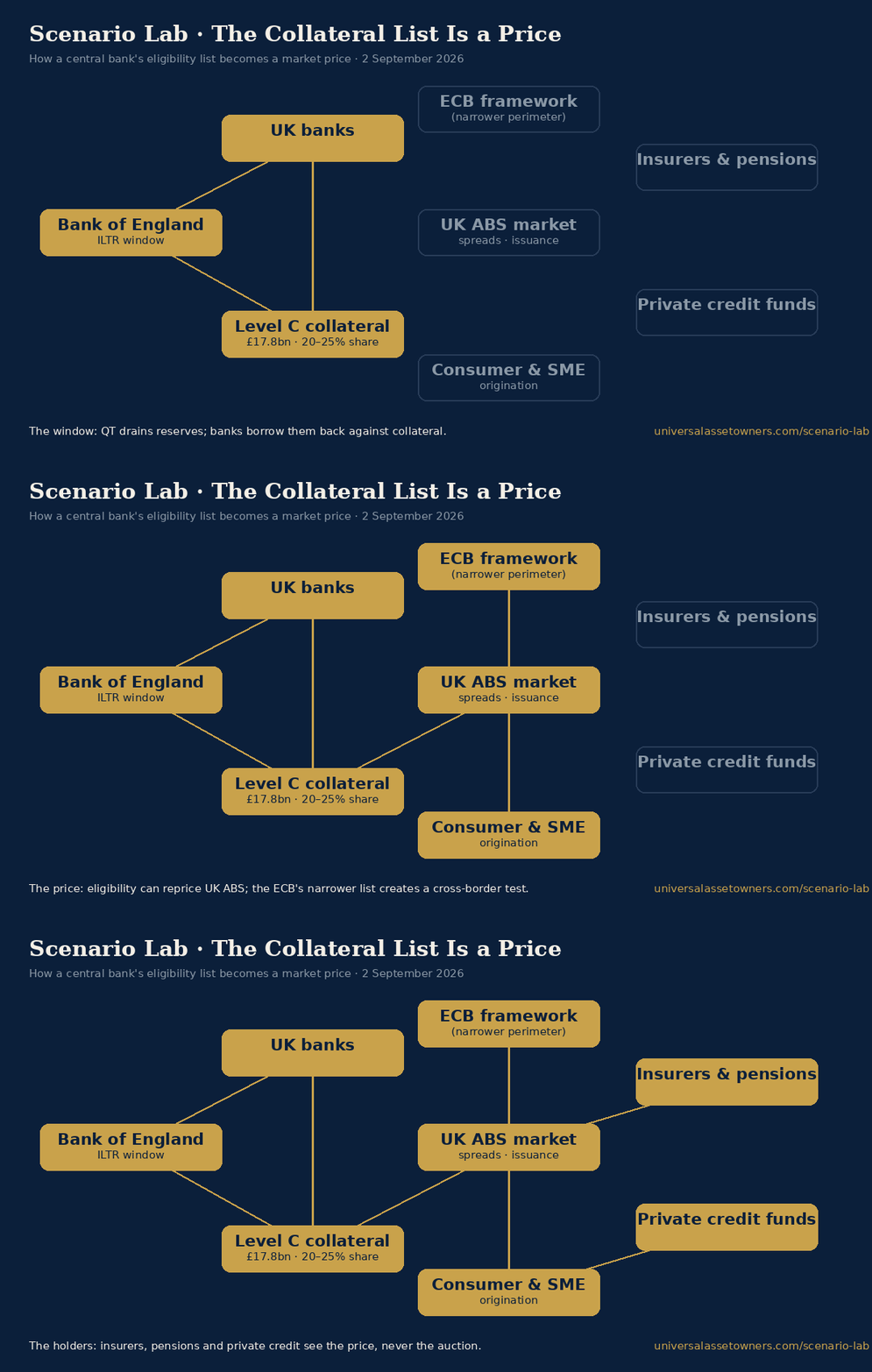 |
The Collateral List Is a Price · desk estimate 35% that a measurable eligibility premium between BoE-eligible and ineligible UK ABS is observable by mid-2027 · six voices, twelve questions. |
|
Advertisement  |
Week Ahead |
Thursday, 3 September — Japan’s 30-year JGB auction: the test of super-long-end demand after Tuesday’s ten-year cleared near 3 per cent. Week of 8 September — IAEA Board of Governors; the UN sanctions-panel renewal vote follows later in the month. 17–18 September — Bank of Japan policy meeting. |
|
The Back Page |
|
 |
Today’s editorial cartoon, and the Allocator’s monologue — “Three Questions for Friday.” The bottom line. A central bank’s list of what it will lend against is not a neutral document. It is a price — paid by every investor who holds the same paper and never sees the auction. Before the next credit-committee meeting, ask three things: what share of the UK securitised-credit book is BoE-eligible; whether UK ABS spreads or issuance are moving with ILTR usage; and whether the private-credit and securitised sleeves lend to the same borrowers. If nobody on the desk can answer the first one, that’s the work. |
Advertisement  |
| Universal Asset Owners · The publication for the world’s largest long-term investors. Written and edited by The Editorial Team. Every claim above is linked to its source in the section it appears in. Not investment advice. |
|