UniversalAssetOwners.com UAO Insider People, power, relationships and influence across the world's largest asset owners. Issue 11 · Saturday 5 September 2026 · Week of 29 August–4 September |
|
Norway asks to hold roughly US$80bn less in Treasuries and says the quiet part out loud: it never needed that many. Oregon, the plan that wrote KKR its first pension cheque, cuts private equity again. And the woman who built HOOPP's C$24bn private equity book turns up in Abu Dhabi — reporting to a CPP Investments alumnus.
|
The US$80bn Treasury Cut That Is Really a Liquidity Call
The world's largest sovereign fund has told its owner how much government paper it actually needs. The number is a lot smaller than what it holds.
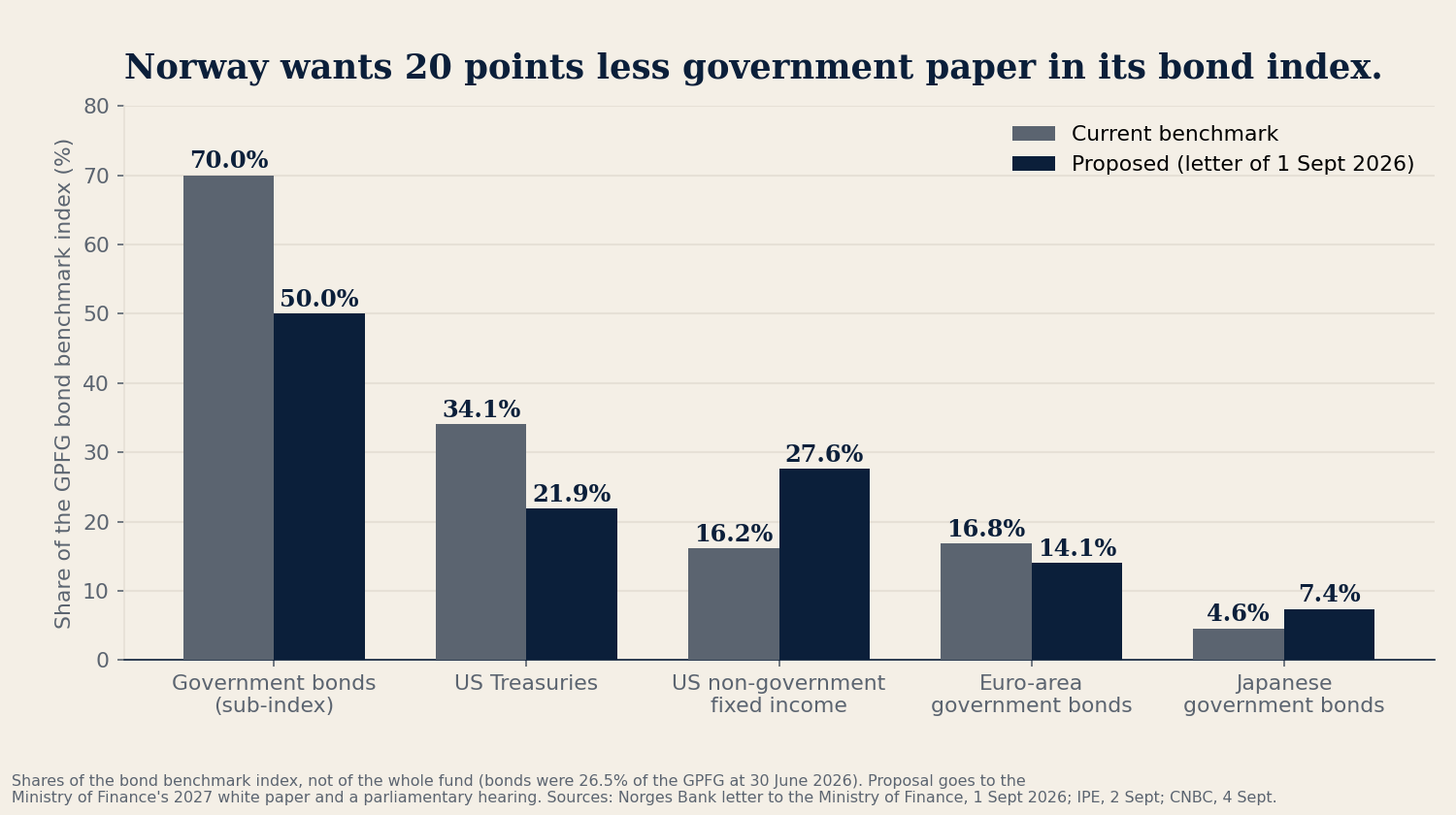
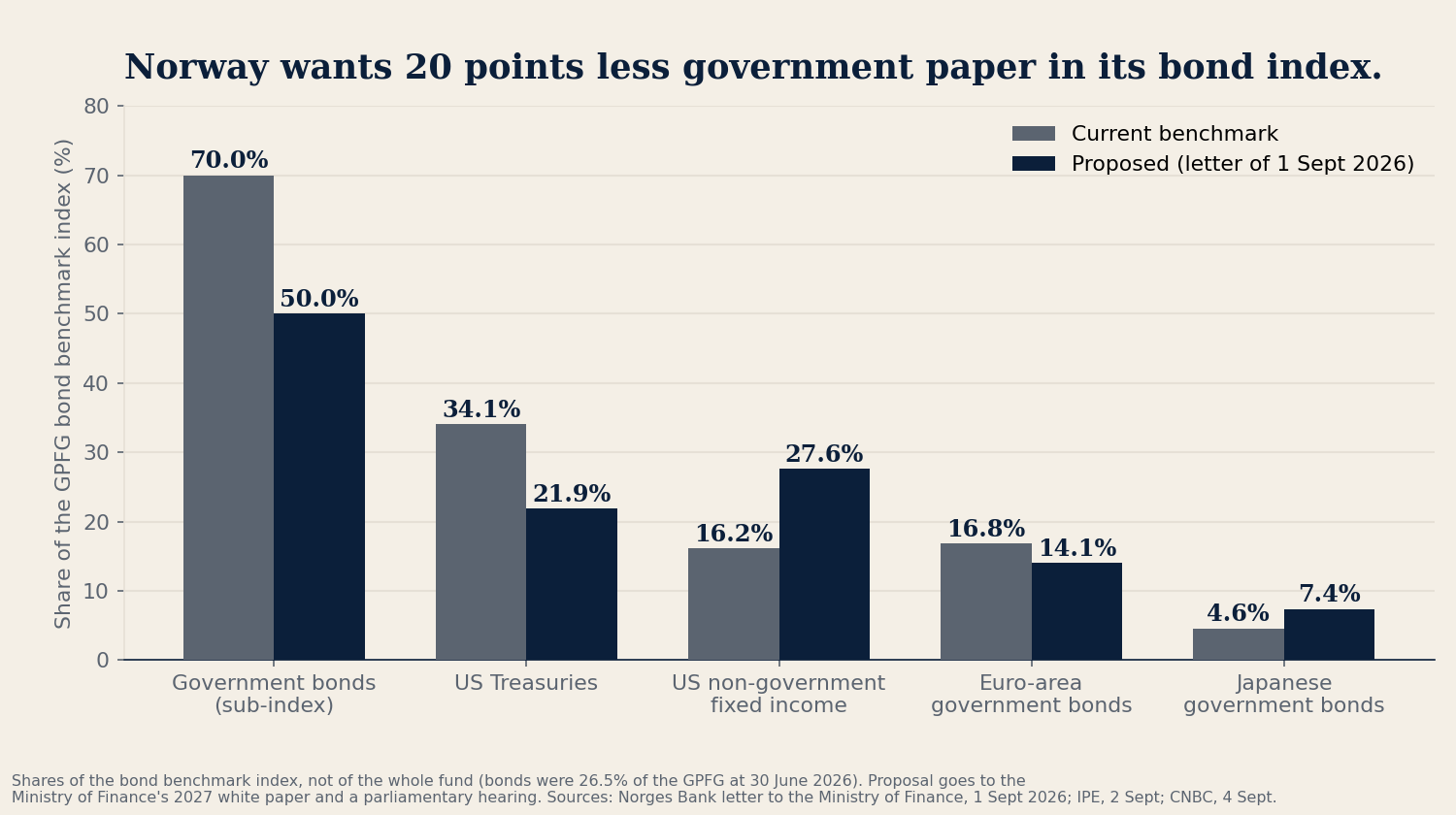
On 2 September Norges Bank published two letters to Norway's Ministry of Finance, both dated 1 September and both signed by governor Ida Wolden Bache and Norges Bank Investment Management chief executive Nicolai Tangen. The first recommends that the government sub-index of the Government Pension Fund Global's bond benchmark be cut from 70 to 50 percent, and that governments be weighted by market value rather than GDP, because high public debt is now a general feature of developed economies rather than a distinctive feature of a few. A 50 percent government share, the letter says, is sufficient to cover the fund's liquidity needs, including in periods of turbulence in financial markets.
Bonds were 26.5% of the fund at 30 June. IPE puts a 20-point shift on that book at roughly NOK1.22trn, about €100bn. Within the bond index the US Treasury share would fall from 34.1% to 21.9% and euro-area governments from 16.8% to 14.1%; Japanese governments would rise from 4.6% to 7.4%, and US non-government fixed income — corporates and, pointedly, mortgage-backed securities — from 16.2% to 27.6%. CNBC, which reported the letter on 4 September, put the Treasury reduction at close to US$80bn against holdings of about US$215bn at end-June. Nothing moves before the Ministry's white paper next spring and a parliamentary hearing.
The framing matters more than the number. The Ministry asked whether the three jobs of the bond book — damping the whole portfolio, providing liquidity, earning risk premia — are still the right jobs. Norges Bank answered that they are, but that liquidity has been over-provided for and premia under-collected. That is not a view on the US fiscal position. It is a statement that a government bond is a liquidity instrument first, and that the fund has been paying for more insurance than it uses. Most large asset owners have never written that sentence down. One of them just did, in public, with a number attached.
Shares of the bond benchmark index, not of the whole fund. Sources: Norges Bank letter to the Ministry of Finance, 1 September 2026; IPE, 2 September; CNBC, 4 September.
|
|
The week two benchmarks moved — in opposite directions on private markets
Strategic benchmarks are the slowest-moving objects in institutional investing. Two of the most-watched ones moved inside 48 hours this week, and they point different ways on the question every investment committee is arguing about.
Norway's second letter, on geopolitical and concentration risk in the equity index, concedes that concentration has risen, largely because of the performance and valuation of US companies and the weight of artificial-intelligence infrastructure, and that many of the largest constituents share exposure to the same three factors. It then rejects the obvious remedy. Norges Bank opposes market or sector caps. What it asks for instead is room for more unlisted assets, noting that comparable large funds held an average of around 37% in unlisted assets in 2023 against the oil fund's sliver. Fewer sovereign bonds, more private assets: the direction every large Canadian and Gulf pool took a decade ago, requested by the one fund that has resisted it longest.
Twenty-four hours later the Oregon Investment Council — the public plan that wrote Kohlberg Kravis Roberts its first institutional cheque in 1978 — adopted a new policy mix for the US$106.9bn Oregon Public Employees' Retirement Fund: 26% public equity, 20% fixed income, 19% private equity, 10% real estate, 10% real assets, 7.5% diversifying strategies and 7.5% credit, with credit carved out as a standalone asset class. The private equity target falls one point from 20%. The actual allocation in July was 23%. State Treasurer Elizabeth Steiner, who wrote last year that she agreed with reducing the overall allocation, said she supported the decision to dial back on private equity and target more of the fund toward fixed income and public equities. The council projects the new mix returns 7.3% against a 6.9% assumed rate, enough on its arithmetic to close the funding deficit within ten years.
So one universal owner wants into private markets and one of the earliest adopters wants less. These are not contradictory. Norway is at the bottom of the allocation curve arguing that a 72% listed-equity book concentrated in a dozen names is the bigger risk. Oregon is at the top, four points over a target it has just lowered, with a treasurer who has to defend the liquidity and the fees to voters. Both are answering the same question — how much of the total portfolio should be marked by someone other than the market — from opposite ends of the distribution, and both landed on 'less extreme than we are now'.
The people story runs through the middle of it. The week's largest private-equity appointment was not at a pension fund at all: the Abu Dhabi Investment Council, at US$160bn, hired the executive who ran HOOPP's C$24.2bn private equity book. Partners Group, the US$186bn manager that limited partners hired to do the marking for them, replaced its chief executive after performance fees fell 39%. Whichever end of the curve you sit on, the talent and the fee pool are moving toward whoever is still adding to private markets.
|
70% → 50% government share of Norway’s bond benchmark, as proposed | 34.1% → 21.9% US Treasuries’ share of that index under the proposal | 19% Oregon’s new private equity target; actual holding 23% | C$24.2bn HOOPP private equity under Lori Hall-Kimm, from ~C$20bn | −39% Partners Group performance fees, first half | US$2bn first close of NIIF’s second infrastructure fund |
|
|
Hires, promotions, departures, retirements and board appointments across the UAO ecosystem, 29 August to 4 September.
| Person | Move | New role / from | Source | Lori Hall-Kimm
Abu Dhabi Investment Council | New Hire | Chief Investment Officer, Private Equity
from Head of Global Private Equity, HOOPP; reports to Alain Carrier | Bloomberg
2 Sep 2026 | Roberto Cagnati & Juri Jenkner
Partners Group | Promotion | Co-Chief Executive Officers (from 1 January 2027)
both joined the firm in 2004 | finews
1 Sep 2026 | David Layton
Partners Group | Role change | Chief Investment Officer; Chairman, Global Investment Committee (from 2027)
from Chief Executive Officer; leaves the executive team | finews
1 Sep 2026 | Hans Georgeson
Royal London Asset Management | Departure | Stepped down as Chief Executive Officer
after five years in the role | Royal London
3 Sep 2026 | Daniel Cazeaux
Royal London Asset Management | Interim | Interim Chief Executive Officer, RLAM
remains Group Chief Financial Officer | Royal London
3 Sep 2026 | Jeremy Coller
Coller EQT / EQT AB | Role change | Head and CIO, Coller EQT; member of EQT Executive Committee
on completion of EQT’s combination with Coller Capital | EQT
31 Aug 2026 | Amy Johnston
Northern Trust Asset Management | New Hire | Head, Institutional Client Group
from State Street; reports to president Michael Hunstad | Chief Investment Officer
2 Sep 2026 | Natalie Herter
The Boston Foundation | New Hire | Chief Investment Officer (effective 2 September)
from Mount Holyoke College investment office; succeeds George Wilson | Chief Investment Officer
1 Sep 2026 | Naaman Atallah
ROSHN Group (PIF) | New Hire | Chief Executive Officer
from President, Real Estate, Al-Futtaim; first permanent CEO since early 2024 | Semafor
1 Sep 2026 | Sabah Barakat
New Murabba (PIF) | Interim | Acting Chief Executive Officer
PIF executive; replaces Michael Dyke; also acting group CEO of ROSHN | International Finance
2 Sep 2026 | Dan Thomas
Isio | New Hire | Group Chief Executive Officer
UK pensions, wealth and benefits consultancy; ~1,500 staff | Isio
1 Sep 2026 | Younghee Choi
H.I.G. Capital | New Hire | Head of Asia, Capital Formation Group (Hong Kong)
fundraising across private equity, credit and real assets | Hubbis
4 Sep 2026 |
|
|
Lori Hall-Kimm Chief Investment Officer, Private Equity · Abu Dhabi Investment Council
Bloomberg reported on 2 September, citing a statement from the council, that the US$160bn Abu Dhabi Investment Council has named Lori Hall-Kimm chief investment officer of its private equity business, reporting to Alain Carrier, executive director of private equity. Her career is a tour of the Canadian model: eleven years at Ontario Teachers', where she helped establish the London office and led European funds and co-investments; six years in CPP Investments' private equity group; and from 2022 the top private-equity seat at the Healthcare of Ontario Pension Plan, where net assets in the asset class grew to C$24.2bn from roughly C$20bn. She left HOOPP on 21 August; managing directors Mark Cormier and Roman Gula are acting co-heads.
Why she matters beyond the title: ADIC is assembling a bench from the world's most admired allocators. Carrier is himself a CPP Investments alumnus; the council's recent hires include Ben Samild, the Future Fund's former chief investment officer, and Edward Winter from Global Infrastructure Partners. For general partners, that is a buyer that underwrites like a Canadian pension and moves like a Gulf fund. For Canadian boards, it is the second senior private-markets departure to the Gulf in a summer that also saw CPP Investments confirm a run of senior exits. The trade in institutional talent now runs Toronto to Abu Dhabi, and it is not obviously reversible.
|
|
CPP Investments' senior ranks — C$220bn more, fewer people, and a run of exits
Benefits Canada reported on 3 September, citing Bloomberg, that CPP Investments has seen multiple departures from senior roles over the past month, across investment risk, credit, real assets and sustainable energies. Michel Leduc, senior managing director and global head of public affairs and communications, described the circumstances as a mix of voluntary and involuntary departures, all in line with business-as-usual retention rates and usual efficiency decisions due to evolving markets and strategies. The fund had 2,084 employees at its last fiscal year-end, down from 2,125, and chief executive John Graham noted in the annual report that it now manages about C$220bn more than at the end of fiscal 2023 with fewer staff. Net assets were C$863.6bn at 30 June.
Three things to watch. First, whether the exits cluster in the functions that mark private assets — risk, credit, real assets — at the moment the marking is contested. Second, where the alumni land: this week alone, one former CPP private-equity executive took the top PE seat in Abu Dhabi and reports to another. Third, whether 'more assets, fewer people' is copied. Every large plan is under the same cost scrutiny; CPP Investments is the one saying so in its annual report.
|
| What's Happening at the Firms |
Results, strategy shifts, reorganisations and platform news.
Partners Group replaces its chief executive as performance fees fall 39% Alongside first-half results on 1 September, the Zug-based manager said David Layton hands operational leadership on 1 January 2027 to Roberto Cagnati and Juri Jenkner as co-chief executives and becomes chief investment officer and chairman of the global investment committee. Profit fell 13% to CHF502m; revenue 7% to CHF1.12bn; performance fees 39% to CHF216m, or 19% of revenue against 20–25% guidance the firm had already cut from 25–40%. Client commitments were a record US$16bn and assets under management US$186bn. A manager that raises a record and still changes its chief executive is telling you fundraising and performance have decoupled.
EQT closes Coller; secondaries volume passed US$120bn in the first half EQT completed its combination with Coller Capital on 31 August. The business operates as Coller EQT under Jeremy Coller as head and chief investment officer, reporting to Per Franzén and sitting on EQT's executive committee, with independence over origination, underwriting and investment decisions. EQT's assets under management rise to €341bn. EQT cited record first-half secondaries volume above US$120bn. Limited partners selling fund stakes should assume the buyer now knows the general partner. Source: EQT · 31 Aug 2026 Royal London Asset Management loses its chief executive with no successor named Royal London said on 3 September that Hans Georgeson has stepped down after five years running RLAM. Group chief financial officer Daniel Cazeaux, a former KPMG partner who worked on the acquisition of infrastructure manager Dalmore Capital, is interim chief executive while Barry O'Dwyer searches for a permanent one. A mutual's asset-management chief leaving days after the group bought an infrastructure manager is a governance moment.
PIF resets two giga-project chief executives in one week ROSHN Group hired Naaman Atallah, president of real estate at Al-Futtaim, as its first full-time chief executive in more than two years, Semafor reported on 1 September; ROSHN confirmed it. On 2 September New Murabba, the US$50bn Riyadh development whose completion target has slipped from 2030 to 2040, replaced Michael Dyke with PIF executive Sabah Barakat as acting chief. Semafor counts removed chief executives at Alat, Lifera, Manara Minerals, Neo Space Group, King Abdullah Financial District, NEOM and New Murabba over two years. The fund is running its developers from the centre while it reprices their timelines.
Kuwait lets its government borrow from the Future Generations Fund Decree-Law No. 81 of 2026 amends the 1976 law on the Future Generations Reserve to permit borrowing by exception, with approval of the Council of Ministers and the Kuwait Investment Authority's board. Annual borrowing may not exceed the fund's average return over the previous five audited years; outstanding loans are capped at 10% of net asset value; loans have priority repayment from state revenues and cannot be written off except by law. The caps are strict. The precedent — a savings fund that can be drawn against — is the point.
Ontario DB plans reach a record 127% median solvency The Financial Services Regulatory Authority of Ontario reported on 3 September that the median solvency ratio of Ontario defined benefit plans rose five points to a record 127% in the second quarter. Surpluses of that size move the conversation from funding to risk transfer, and the annuity market is listening.
|
| Mandates & Money in Motion |
Searches, RFPs, awards and fundraising.
NIIF's second infrastructure fund: US$2bn first close, five universal owners in the room India's National Investment and Infrastructure Fund reached a first close of Infrastructure Fund II at Rs19,000 crore, about US$2bn, on 31 August — more than 60% of the Rs30,000 crore target. Commitments came from AustralianSuper, CPP Investments, a wholly owned subsidiary of the Abu Dhabi Investment Authority, Ontario Teachers' and Temasek, alongside ICICI Bank, HDFC Bank, Axis Bank, Kotak Life and HDFC Life. NIIF expects about US$950m of co-investment capital alongside the fund. The co-investment sleeve is where the real money will move.
LACERA hands Cheyne Capital up to US$750m in multi-asset credit The US$93.9bn Los Angeles County Employees Retirement Association approved up to US$750m in a multi-asset credit strategy run by Cheyne Capital through a dedicated managed account, disclosed in a Board of Investments report and reported 2 September. LACERA's credit target is 13% of the portfolio. Cheyne manages about US$15bn: a US$750m account is a concentration decision on both sides of the table.
Arizona doubles down on bank risk transfer: US$600m more to BNP Paribas AM Alts The Arizona State Retirement System awarded BNP Paribas Asset Management Alts a US$600m significant risk transfer mandate, on top of US$400m in April 2024, taking its commitment to US$1bn. Deputy chief investment officer Al Alaimo called the SRT market compelling on a risk-return basis; BNP says about 40 banks issued US$15bn of SRTs in the first half, over 70% from European banks. Bank capital relief is now a repeat line in a US public pension's private credit book.
APG gives MaxCap a third mandate: US$400m of Australian first-mortgage lending MaxCap secured a new US$400m discretionary mandate from APG, on behalf of its Dutch pension clients, for first-mortgage loans across Australian real estate with a living-sector focus, reported 1 September. Dutch pension money lending against Australian apartments is what a global real-estate credit book looks like when the home market is full.
Aegon AM's new environmental private debt fund hands Schroders Capital a second infrastructure-debt mandate Schroders Capital's infrastructure debt team will manage close to €50m within the Aegon Multi-Manager Environmental Private Debt Fund, launched this year for mid-sized Dutch institutions and targeting 80% impact investments across corporate, infrastructure and real estate debt, reported 31 August. Small ticket, telling structure: pooled private-debt access for mid-sized Dutch funds is the product consolidation keeps asking for.
|
|
Where the money is actually going.
Wren House nears €700m for GIC's 80% of the xScale European data-centre venture Reported talks — not a signed deal Wren House Infrastructure Management, the Kuwait Investment Authority's direct infrastructure arm, is nearing a deal to buy GIC's 80% of its European xScale hyperscale data-centre joint venture with Equinix for about €700m (US$810m), Bloomberg reported on 2 September, citing people familiar with the matter. Equinix would keep its 20%. Talks remain fluid and Wren House may not proceed. If it does, one sovereign selling European data centres to another at a price is the first clean mark on the asset class since the AI capital-spending debate began.
Alpha Dhabi doubles its stake in Mubadala Capital's private credit venture to US$1bn Alpha Dhabi Holding told the Abu Dhabi Securities Exchange on 31 August it has raised its shareholding in Micad Credit JV, managed by Mubadala Capital, from 20% to 40% and its capital commitment to US$1bn. Micad manages about US$1.7bn across 45 portfolio companies; the mandate widens beyond US and European direct lending to other Mubadala Capital private credit strategies. Abu Dhabi capital adding to private credit in the same fortnight Partners Group cut its performance-fee guidance is the two-sided market in one headline.
KKR sells USI to Aon for US$17bn in cash KKR said on 31 August it will sell USI Insurance Services to Aon in an all-cash US$17bn transaction, roughly six times its original equity investment and 3.4 times its total investment; USI chief Mike Sicard becomes president of Aon. A US$17bn cash exit is the distribution private-equity limited partners have waited three years for.
A 2009 SpaceX ticket is now 8.2% of the University of Colorado's endowment The University of Colorado Foundation reported a 20.34% return for fiscal 2026, driven by a SpaceX position first bought in 2009 for US$150,000 (total commitments US$4.2m) that had risen roughly 5,590% by 30 June after the June listing. The holding is worth US$289m, 8.2% of the US$3.5bn endowment. A concentration-policy question dressed as a triumph.
|
|
Shorter notes on the people moving around the industry.
Amy Johnston · Northern Trust Asset Management becomes head of the institutional client group, effective immediately, based in Chicago and reporting to president Michael Hunstad. She succeeds Lyenda Simpson Delp, who left for Franklin Templeton in December, and arrives after 14 years at State Street, most recently running Americas institutional distribution strategy. Northern Trust manages US$1.6trn, US$1.4trn of it institutional. Every asset-owner procurement team will hear from her this autumn.
Natalie Herter · The Boston Foundation is chief investment officer of the US$2.7bn foundation from 2 September, succeeding George Wilson after his 18 years in the seat. She comes from Mount Holyoke's investment office and more than a decade at Cambridge Associates, and was chosen from over 160 applicants in a Korn Ferry search. A 160-applicant field for a US$2.7bn seat is a data point on how crowded the endowment-CIO market is.
Jeremy Coller · Coller EQT is head and chief investment officer of the renamed secondaries platform and a member of EQT's executive committee from 31 August, reporting to Per Franzén, with independence over origination, underwriting and investment decisions preserved in the deal terms.
Dan Thomas · Isio formally took over as group chief executive on 1 September. The KPMG spin-out has grown to nearly 1,500 people across ten UK offices and expects revenue well above £200m this year on a five-year compound rate of 21%. Consultants sit between trustees and managers; a change at the top of one changes who recommends whom.
Younghee Choi · H.I.G. Capital joined on 1 September as head of Asia in the capital formation group, based in Hong Kong, raising across the US$75bn firm's private equity, credit and real assets platforms. A mid-market sponsor building an Asia fundraising seat is a read on where it expects the next re-ups to come from.
Alain Carrier · Abu Dhabi Investment Council is the executive director of private equity to whom Lori Hall-Kimm will report — himself a CPP Investments alumnus, per Bloomberg's account of the appointment. Two Canadian-model private-equity leaders now run the asset class at a US$160bn Gulf fund.
Al Alaimo · Arizona State Retirement System put his name to the plan's second significant risk transfer mandate, US$600m to BNP Paribas AM Alts, as deputy chief investment officer, and to the view that SRTs remain compelling on a risk-return basis. Deputy CIOs who sponsor a niche twice tend to own it.
|
|
Context, not news. Nothing here is dated inside this week's window.
HOOPP's private equity book is run by two acting heads When Lori Hall-Kimm's departure was announced on 19 August, HOOPP named managing directors Mark Cormier and Roman Gula acting co-heads of private equity, reporting to chief investment officer Michael Wissell, per an internal memo whose contents HOOPP confirmed to Bloomberg. Reported 20 August — outside the window, and the other half of this week's Abu Dhabi appointment. Where HOOPP goes for the permanent hire is the next move to watch.
The Future Fund's chief executive is leaving Raphael Arndt is stepping down after close to two decades at Australia's sovereign fund, six of them as chief executive, announced 26 August. Context for the ADIC item: the council's private equity bench already includes Ben Samild, the Future Fund's former chief investment officer.
Heinz Endowments filled its CIO seat from Kresge John Barker was named chief investment officer of The Heinz Endowments on 26 August after 19 years at the Kresge Foundation, the last four as CIO. With Boston this week, two endowment CIO seats filled in ten days, both from inside the endowment world: the pool is circulating, not widening.
|
|
Window: Saturday 29 August to Friday 4 September 2026. Every item above is drawn from a dated, public, professional source published inside that window, with the URL attached. Out-of-window developments appear only in Quiet Signals as labelled context, never dated as fresh. Two items originate with Bloomberg — the Abu Dhabi Investment Council appointment and the Wren House talks — and each is carried with a second, openly readable source; the Wren House item is a report of talks, not a signed deal, and is labelled as such. We do not print personal, private or unverified information about anyone. People moves are review-gated.
|
|
About UAO Insider is the weekly people-and-influence briefing from UniversalAssetOwners.com — the media, research and events platform for the world's largest asset owners. It tracks the people, organisations, relationships, appointments, gatherings, mandates and strategic developments shaping the world's largest pools of long-term capital. Every item is sourced from public, professional disclosures. We cover public role changes, appearances, partnerships and gatherings only — never personal, private or unverified information. Have a tip? info@universalassetowners.com. Sources this issue
|
|