|
A federal judge in Syracuse struck down New York’s $75 billion climate-superfund law on Monday. The same day Nvidia took $3.5 billion of MediaTek convertibles and, according to the Journal, held the lease under Anthropic’s $35 billion Lambda contract. One statute named a payer and lost. One company named three roles and kept them. The residual in both cases sits with whoever is left holding the real asset. |
Window: 31 Aug 01:49 ET → 1 Sep 01:49 ET. Event dates distinguished from article dates; post-cutoff developments are labelled.
The daily video briefing · 1 min 55 sec.
|
Read by allocators overseeing $50 trillion · 98% of the world’s largest sovereign wealth funds · 18 of 20 largest pension funds · 10 of 10 largest foundations · 85% of the largest family offices · 100+ billionaires. |
New York’s $75 billion climate law lost its payer. The adaptation work did not.
On Monday 31 August, Chief U.S. District Judge Brenda K. Sannes of the Northern District of New York granted summary judgment to the plaintiffs in West Virginia v. James, No. 1:25-cv-00168, consolidated with Chamber of Commerce v. James — the 63-page opinion (Dkt. 318, filed 08/31/26) has been obtained and read. The order prevents New York from enforcing the Climate Change Superfund Act, the 2024 law requiring companies responsible for more than one billion metric tons of CO2e from worldwide fossil-fuel extraction and refining over the statute’s 2000–2024 covered period (as amended; the as-introduced bill read 2000–2018) to pay $75 billion over 25 years into a state adaptation fund. (The widely quoted “$3 billion a year from 2028” is an average of that aggregate, not the statutory schedule: demands were due by 30 June 2028, payment by 31 December 2028, with up to 92% of a demand payable over the following 24 years — and no demand had yet been issued.) Plaintiffs include 22 state attorneys general and industry groups led by the U.S. Chamber of Commerce and the American Petroleum Institute. The court held the statute preempted by the Clean Air Act, and any cost-recovery demand against a foreign producer preempted by the foreign-affairs doctrine. The parties must file a status report by 14 September.
Governor Hochul’s office said it is reviewing the decision to determine next steps. That is not a notice of appeal. Vermont passed the first such law and is already in court. This is a separate case from the DOJ-led challenge in the Southern District of New York; do not conflate them.
Why universal owners should care. The law was a financing mechanism, not a climate forecast. Killing the mechanism does not kill the capex. Precision matters: invalidating a revenue statute does not transfer a defined $75 billion dollar-for-dollar onto any particular balance sheet. What owners inherit is a question, not a bill — which adaptation projects, budgets and financing plans assumed those receipts, and what replaces them. The candidates for the residual are the state general fund, local governments, public authorities, ratepayers and the insurers writing property and municipal books. And the disclosure is thin exactly where the exposure is largest: Ceres found 33% of sixty sampled bond offerings across twenty of the highest physical-risk US metros make no mention of climate or extreme-weather risk at all.
The underappreciated signal. Federal law spent Monday doing the same thing in two rooms. In Syracuse it pulled a state climate-finance statute back under the Clean Air Act. In Washington the SEC sent OIRA a draft proposal to rescind Rule 14a-8 and return shareholder-proposal mechanics to the states. One federal move concentrates climate liability onto public balance sheets. The other disperses stewardship tools into fifty corporate codes. Owners who have been running a single US governance playbook will need two.
What to watch. A filed notice of appeal. The 14 September status report. The first reasoned order in the Vermont case. Whether rating-committee language on New York State or MTA credits mentions the lost mechanism.
Nvidia is the supplier, the leaseholder and the bondholder
Two Monday prints, one pattern. First, the Wall Street Journal reported — with Reuters and AFP following; the companies had not publicly confirmed it by publication — that Anthropic has signed a $35 billion cloud contract with Lambda, that the campus is a Hut 8 development in Nueces County, Texas, and that Nvidia itself holds the lease. Lambda, an Nvidia-backed “neocloud,” would run Nvidia chips in a building Nvidia has rights over, selling the output to a model company Nvidia has also backed. Second, Nvidia took $3.5 billion — 89.7% — of MediaTek’s $3.9 billion overseas convertible-bond issue: 17,500 units on MediaTek’s own 31 August filing, conversion price NT$4,513.75 — 115% of Monday’s NT$3,925 close, a 15% premium — zero coupon, five years, scheduled issuance 8 September with SGX as the issuance and trading venue. Alphabet participated; its allocation is undisclosed. MediaTek will use Nvidia’s NVLink Fusion so customers can design custom accelerators inside Nvidia’s rack-scale fabric.
Jensen Huang told Bloomberg Television the ticket “is not circular because obviously they do their own business and we do our own business.” A useful statement of the official position — and these are genuinely separate companies with separate contracts. The portfolio question is narrower and harder: do those risks remain independent when demand, technology standards, power constraints or refinancing conditions turn at the same time? A universal owner long the semiconductor complex, the hyperscalers, the private-credit books that lease the campuses and the model companies that rent them is long one capital-expenditure cycle four ways, and calling it four risks.
The convertible is the tell. Straight equity would have been a stake. A zero-coupon five-year convertible at a 15% premium sits senior if MediaTek’s custom-silicon push stalls, and converts if it works. Nvidia has structured the custom-chip era so that a customer who leaves the GPU still pays for the fabric — and the design partner is partly financed by the fabric owner. Concentration is no longer a market-share chart. It is a capital stack.
The evidence and the countercase. A Federal Reserve Bank of Boston paper (Current Policy Perspectives 26-6, 5 August; ~890,000 loan-quarters across 168 BDCs) found payment-in-kind usage up roughly 67% since 2022 while lending spreads compressed about a full percentage point — rising stress, falling compensation, a pattern that should not hold and does. The ECB’s Monday blog runs the countercase: five hyperscalers may spend more than $1 trillion through 2028, their euro bonds are near 10% of gross new euro corporate issuance — and current spillovers “remain limited.” The right conclusion is not that AI concentration is a crisis; it is that the exposure map must extend beyond benchmark weights.
What to watch. Settlement 8 September. Any filing naming Alphabet’s ticket. Credit-committee language treating “Nvidia residual-value support” as a named covenant. The disconfirming print: a neocloud offtake announced without Nvidia on the lease, the equity, or the chip invoice.
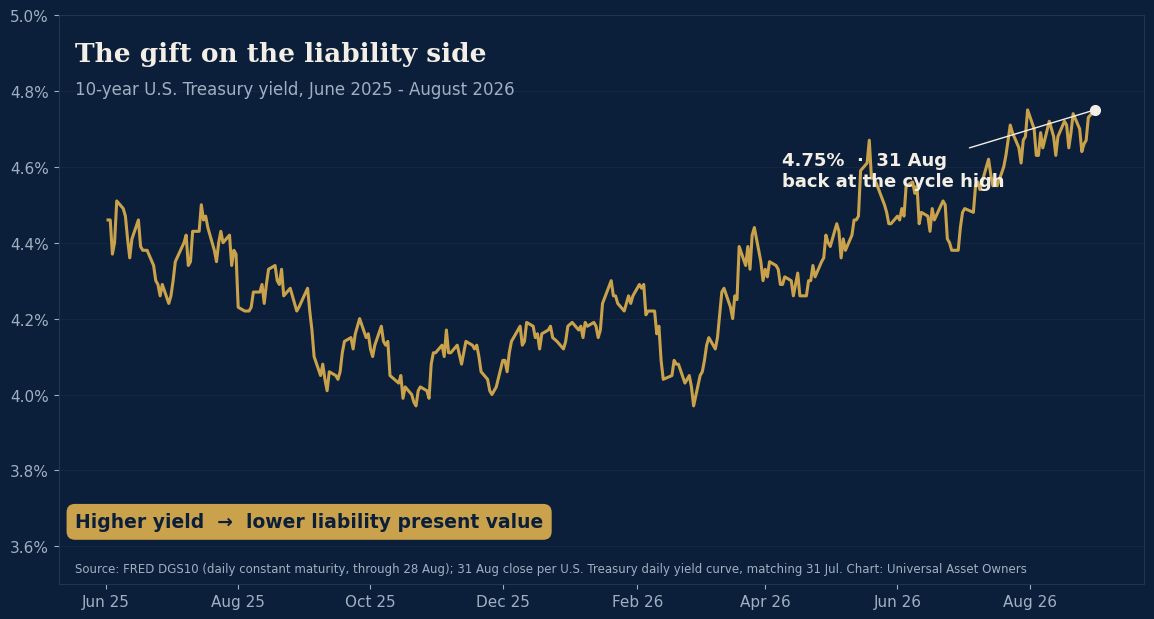
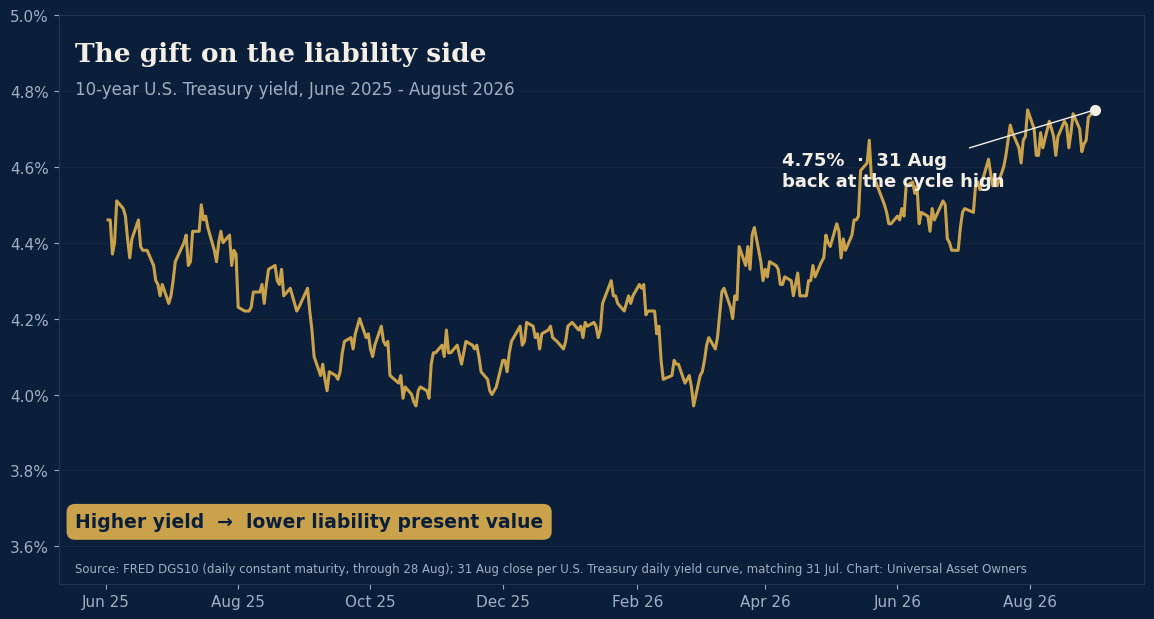
The 10-year printed 4.75%. That is a liability fact first.
Kevin Warsh, at Jackson Hole on Friday 28 August, said summer PCE and CPI readings “do not tell me that underlying trends have meaningfully improved,” and that if underlying inflation is not moving toward objective “clearly and at sufficient speed... we have work to do.” The 2-year rose 14 basis points that day; the 10-year closed at 4.73% Friday and 4.75% on Monday 31 August — matching the 31 July close for the highest level since January 2025 — amid a broader global bond selloff rather than a single-speech effect. September-hike odds on CME FedWatch reached about 66% by late Monday morning (11:40 a.m. ET), up from roughly a coin flip after Friday’s speech. The FOMC is 16 September.
On direction, because it is reported backwards elsewhere: a lower yield raises the present value of liabilities; a higher yield lowers it. Monday’s move is the second kind — a present-value gift wearing a growth-scare headline for rate-discounted DB books. But conditional, not universal: a public plan on an expected-return assumption, a duration-matched insurer, or an inflation-linked promise each experience the same Treasury move differently — and the same move marks down long-duration bonds and raises the cost of capital on every piece of infrastructure under construction. Baseline: the Milliman 100 Pension Funding Index stood at 112.1% at 31 July 2026, up from 109.5% a month earlier — plans were comfortably funded before this tailwind arrived.
Washington is trying to hand shareholder proposals back to the states
On Friday 28 August the SEC transmitted a draft proposed rule to OIRA, public on Monday: “Rescission of Rule 14a-8’s Federal Regulation of Shareholder Proposals and Amendments to Rule 14a-4” (RIN 3235-AN47), with a companion proxy-solicitation modernization file (RIN 3235-AN63) moving in parallel. A spokesman said Chair Atkins has “highlighted concerns that the SEC’s Rule 14a-8 on shareholder proposals exceeds the Commission’s authority and infringes upon state laws.” The Commission has not voted on or published either text — a proposal entering White House review, not an adopted restriction. Corp Fin separately said on 14 August it will no longer answer 14a-8 no-action requests.
The preview of the alternative bar already exists in Texas Business Organizations Code §21.373, in force since 1 September 2025 for Texas corporations that opt in: the lesser of $1 million or 3% of shares, held six months, plus solicitation of 67% of voting power. Rule 14a-8’s federal eligibility begins near $2,000 (held three years, with higher-value shorter-period paths). If the federal pipe is pulled up, the residual tools are withhold campaigns, exempt solicitations, bylaw routes and fifty different state codes. US public pensions would be operating on home political terrain; non-US universal owners on terrain they do not vote in. That is a coordination problem, not a culture-war headline — and the mechanics already worry the largest owners: Norges Bank Investment Management’s formal response to the EU’s Shareholder Rights Directive consultation says fragmented voting-chain mechanics undermine the reliability of its roughly 110,000 annual votes across 11,000-plus AGMs, in a market that is trying to harmonize.
Separately, 19 state attorneys general plus the District of Columbia, led by New York’s Letitia James, wrote SEC Chair Atkins on 27 August defending physical climate risk as a legitimate, fact-based credit-rating input — expressly taking no position on the agencies’ actual conduct. Ratings feed LDI, insurance capital and collateral haircuts; a politicized methodology fight is a data-quality risk for any book running one credit framework across US and non-US paper.
What to watch. The Commission’s actual proposing release and comment clock. The first Texas issuer leaning on §21.373 in the 2027 season. Whether ISS and Glass Lewis rewrite US policy for a no-federal-pipe world.
The Strategic Petroleum Reserve is now a receivable as well as a tank
The Department of Energy, via Reuters on Monday, put crude in the Strategic Petroleum Reserve at 286.6 million barrels last week — down 3.1 million, the lowest since November 1982, 40.1% of the 714-million-barrel authorized capacity — as part of the US contribution to the 172-million-barrel emergency release agreed after the Iran war opened in February. (The official EIA weekly series available today still ends 21 August near 290 million; Wednesday’s report is the reconciliation to watch.) Treat operational language about the Strait with care: transit and flow estimates vary sharply by tracker, vessel class and methodology, and vessels running dark are absent from visible counts entirely — a reliability problem, not a padlock, and not a single collapsing series.
Why it matters. A reserve is optionality; an exchange program is optionality already spent. Official language describes the operation as emergency exchanges rather than sales: the borrowed barrels must be returned, with premium barrels on top — a future call on the same thin physical market, with DOE’s nominal maximum drawdown at 4.4 million barrels a day and roughly 13 days from decision to delivery. Owners of energy equities, inflation-linked liabilities, shipping credit and Gulf fiscal paper sit on one side or the other of that unwind — not both in equal measure.
Capital in Motion
- CPP / Ares: Japan Logistics Development Partners V closed at its ¥612bn hard cap (~$4bn at Ares’ ¥155 conversion); CPP Investments cornerstone ¥150bn (~$968m, 24.5% of commitments). Stated investment capacity ¥1.7tn, ~¥450bn already committed. Development risk in Tokyo/Osaka/Nagoya — CPP has sat in every vintage since 2011.
- Aon / KKR: $17bn (incl. debt) USI acquisition signed, not closed; Q4 2026 target, approval pending. Aon’s 8-K: up to ~$1.11bn of transaction/integration/retention costs vs ~$395m run-rate net adjusted-EBITDA synergies; buybacks paused; shares fell ~10% on announcement.
- NIIF: $2bn first close for Infrastructure Fund II (>60% of the $3.2bn target) — AustralianSuper, CPP Investments, Ontario Teachers’, Temasek and a wholly owned ADIA subsidiary in one India infrastructure vehicle, with ~₹9,000cr (~$950m) of co-investment capital expected.
- Keppel DC REIT / Keppel: conditional agreements for 90% effective interests in Tokyo Data Centres 4 and 5 (Inzai City). ¥190bn is the 100%-asset headline; the REIT’s 88.62% consideration is ¥168.4bn; operator retains 10%; Q4 close target; concurrent fully underwritten placement of at least S$600m. Japan’s rental-income share rises from ~9% to ~23%.
- SLB / Kelvion: definitive agreement — $3.4bn cash plus ~$700m assumed debt ($4.1bn total transaction value), conditional, closing expected H1 2027. Kelvion guides $2.3–2.4bn 2026 revenue, over half from data centres. AI capex arriving in industrial cooling supply chains.
- EuroHPC / Bull: €387.8m signed contract for the LUMI-AI supercomputer in Kajaani, Finland — 50/50 EuroHPC and a six-country consortium; EuroHPC owns, CSC hosts; H2 2027. EuroHPC’s infrastructure head, Evangelos Floros, told Reuters some applications are already rejected because demand cannot be met.
- Nuveen Green Capital: CPACE Lending Fund IV first close above $1bn (25 August), insurer-led; series commitments over $3bn since 2023; Fund III closed July 2025 at $785m. Insurer-backed building-improvement and resilience private credit.
- TWG Global / Mubadala Capital: the proposed $10bn Mubadala-led syndicated raise — part of TWG’s $15bn equity raise, per Mubadala Capital’s own announcement — remains unclosed after 15 months (Bloomberg, 28–29 August, people familiar) amid a DOJ/SEC inquiry into Mark Walter’s insurance orbit; no cash has moved; both sides still expect a deal. Separately, TWG signed a definitive agreement (18 August, per AM Best) to exchange up to $6.5bn of Delaware Life’s affiliated investments for an equal amount of third-party assets — an asset-for-asset swap, not loans being cut. No charges have been filed against anyone. A sovereign co-investment delayed by an enforcement shadow — a supporting item, correctly dated to Friday.
- Turkey Wealth Fund / Turkcell / TOGG: a single-origin Reuters report of talks to acquire Vestel and Anadolu’s combined ~46% of the EV maker. Terms undisclosed; a negotiation, not a signed purchase.
The UAO Signal Ledger
Six statuses: EARLY OBSERVABLE · DEVELOPING · CONFIRMED · WEAKENED · DISPROVED · EXPIRED. Evidence strength and analytical conviction are separate axes. Nothing is dropped silently.
- Vermont’s parallel preemption challenge — NEW, EARLY OBSERVABLE. Vermont’s statute — the first of its kind — faces a pending challenge; no merits ruling has issued. A decision that follows Sannes would reprice the whole state-level polluter-pays architecture; a contrary district ruling would set up an intra-circuit conflict for the Second Circuit to resolve (both states sit in the Second Circuit — there is no circuit-split path between them).
- The alleged Hormuz mine payload — EARLY OBSERVABLE. The IRGC claims a supertanker was disabled by mines on 31 August; CENTCOM flatly denies (“no ships have hit mines”). Weak evidence on the payload claim; high conviction the risk premium is justified regardless — war-risk cover near 10% of hull value versus ~0.25% pre-war. Next catalyst: any UKMTO/CENTCOM statement.
- Bundibugyo Ebola, DRC — DEVELOPING, updated. Primary sitrep (INSP No. 108, through 30 Aug): 6,100 confirmed cases, 2,950 deaths, 60 of 151 health zones across six provinces, Ituri ~82% of cases, crude reported CFR 48.4%; imported cases treated in Germany and France. No licensed Bundibugyo-specific vaccine or therapeutic; candidate studies underway. WHO’s outbreak bulletin still carries July totals — cite the sitrep.
- UBS loss-absorbing mix — EARLY OBSERVABLE. A Council of States committee (10–2) backed at least half the capital against UBS’s foreign participations being CET1 with AT1 eligible for the balance, plus an ~11% CET1 distribution trigger. Committee text, not law; chamber votes ahead.
- AMOC tips on the rate of warming — DEVELOPING. Nature Climate Change (13 Aug): under fast CO2 ramps the model collapses near +2°C; current Mauna Loa growth ~+2.6 ppm/yr sits in the fast regime. A model experiment initialized from an already-weakened circulation state — not a forecast that the real AMOC collapses at +2°C. Confirm/weaken: RAPID array at 26.5°N.
- Global fertility possibly below replacement — EARLY OBSERVABLE. A circulating Penn/Northwestern working paper argues UN estimates overstate births relative to national civil registries (registered births in high-registration countries run well below UN projections — Colombia’s ~36% below), putting the world already below replacement; population peak near 9bn around 2056 vs the UN’s ~10.3bn around 2084. Not yet peer-reviewed or replicated. Confirm: 2026-27 registries in Mexico, Egypt, the Philippines and Colombia printing another down-year.
- Carried unchanged: the phantom US data-centre power queue (CONFIRMED — ~28% of 1,066 GW requested is served); Korea’s statutory CIO pool (DEVELOPING); Soitec’s unreconciled deposit statements (EARLY OBSERVABLE); the white-collar duration mismatch (EARLY OBSERVABLE — the weakest-evidenced entry, held to a higher bar by design).
- QBE’s NZAOA resignation — RESOLVED, EXPIRED. The open question in this entry was the announcement date; it is now confirmed as 21 March 2025 — eighteen-month-old news, not a current signal. Removed from the ledger with the resolution recorded rather than dropped silently.
Today’s scenario: The Orphaned Adaptation Bill
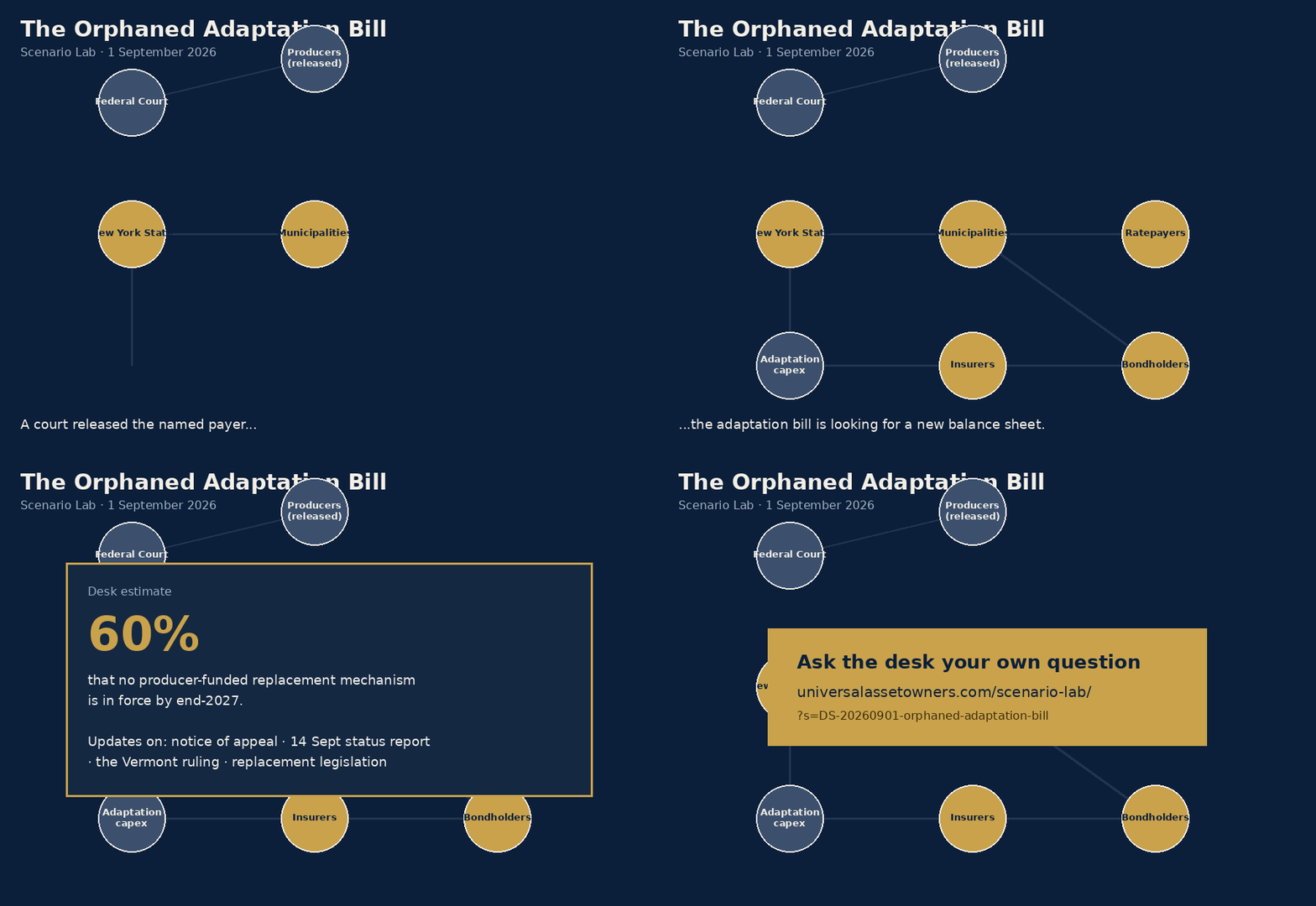
Who inherits New York’s $75 billion question if the ruling stands? Open the scenario, interrogate the relationship map, and put your own questions to six allocator perspectives — the desk’s estimate, method and update triggers are stated inside. Open today’s scenario →
Research and publications
- Indonesia’s land-use dilemma, now peer-reviewed — Squire, Lou et al., Nature Sustainability, 31 August (the peer-reviewed version of a 2025 preprint, making it current research). Scenarios: the B50 biodiesel target could require 4.85–8.55 million hectares of land conversion by 2030, rice self-sufficiency up to a further 2.3 million, with material overlap and conversion emissions modelled at 360–3,753 MtCO2e (oil palm) and 509–1,297 MtCO2e (rice). Model ranges, not forecasts.
- Coastal conflicts and Indigenous communities — Villasante, Verba, Relano et al., Communications Sustainability, 31 August: 401 documented conflicts across 72 countries involving at least 275 Indigenous ethnic groups; biodiversity loss the most frequent coded impact, in 44% of cases (44% of conflicts recorded it — not a 44% decline); energy projects 126 cases (~31%). A conflicts database, not a representative sample — and a live input to permitting and social-licence risk on coastal assets.
- FSB Chair’s letter to the G20 (August): frontier AI’s effect on cyber risk described as “the most immediate concern” for the financial system, alongside sovereign-debt fragility, private-credit vulnerabilities and stretched valuations; calls for globally coordinated model-release safeguards. A high-level policy warning — not a binding standard or a quantified stress test.
- Boston Fed, Current Policy Perspectives 26-6 (5 August): PIK usage up ~67% since 2022 while BDC lending spreads compressed ~1pt; and a one-standard-deviation decline in disclosed fair-value ratios predicts ~50bp lower abnormal equity returns the following quarter. Opaque internal marks leak real information before default headlines move.
People, careers and capability
- Australia’s Future Fund (announced 26 August): CEO Raphael Arndt steps down at end-2026 — funds under management grew from $205bn to $356bn across his tenure; FY2026 return 14.8%. No successor named.
- Kresge Foundation (effective today, 1 September): Jon D. Gentry becomes VP/CIO; Emily Bertsche promoted to deputy CIO; John A. Barker departs to become CIO of the $2.2bn Heinz Endowments.
- Background, June appointments (dated for the record, not new this week): the UK Pensions Regulator’s three board additions (Ben Gunnee; non-executives Tracey McDermott and Chris Hitchen; announced 15 June) ahead of the Pension Schemes Act 2026 build-out, and Schroders Capital’s newly created head of European asset-based finance and SRT investments (Bob Paterson, ex-Manulife CQS; June) — both part of the same capability-building pattern.
Signposts
2 Sep — EIA Weekly Petroleum Status Report (SPR reconciliation). 4 Sep — August payrolls. 8 Sep — MediaTek convertible issuance (SGX venue). 14 Sep — West Virginia v. James status report. 16 Sep — FOMC, with the Summary of Economic Projections. 17 Sep — Institutional Investor Allocators’ Choice Awards, New York. September, date unset — Swiss Council of States on UBS capital; the SEC’s 14a-8 proposed-rule text leaves OIRA, or does not. Any day — a New York notice of appeal; UKMTO/CENTCOM on the corridor; WHO on Bundibugyo. 13–15 Oct — PRI in Person, Amsterdam.
Deep dive: The counterparty behind the counterparty
Three stories this week — a frozen sovereign capital raise, a $35 billion compute deal, and a quiet piece of Boston Fed research — turn out to be the same story about who is actually standing behind the paper an allocator signs.
Start with the reported deal. Anthropic’s $35 billion, six-year agreement with Lambda — per the Journal, Reuters and AFP; unconfirmed by the companies at publication — puts Nvidia in view repeatedly: as the chip supplier inside the servers, as the leaseholder on the Texas facility Lambda would occupy (the Journal’s reporting), and — via separate, contingent residual-value guarantees cumulatively capped at $105 billion behind OpenAI’s leases at SB Energy’s Ohio campus, per Nvidia’s own SEC filing (a different project from the Texas campus) — as a backstop of the same buildout it supplies. None of this is illegal, or even unusual for a capital-constrained industry building faster than conventional project finance can move. And these are distinct legal entities with distinct contracts. But a portfolio holding what looks like three diversified exposures — a cloud contract, a real-estate lease, a project-finance facility — may in practice hold correlated claims on one capital-expenditure cycle.
Now the deal that has not closed. Mubadala Capital’s proposed $10 billion raise for Mark Walter’s TWG Global — announced roughly fifteen months ago, structured with a reciprocal 5% stake and $2.5 billion of cross-investments — remains unclosed while the DOJ and SEC examine more than $20 billion of loans on the balance sheets of Walter’s insurers that were not classified as affiliated-party transactions until this year. Two banks have paused distribution of Delaware Life products while the inquiry runs; no charges have been filed. The mechanism is the same one the AI capital stack raises in the abstract: when the same parties sit on multiple sides of a financing relationship, the classification of that relationship stops being a technicality and becomes the whole question.
And the research that explains why nobody catches it sooner: the Boston Fed’s loan-level BDC study — the only public window into an otherwise-opaque trillion-dollar private-credit market — found payment-in-kind usage up 67% since 2022 while spreads on the same loans compressed. Rising stress, falling compensation. Either lenders are quietly restructuring borrowers ahead of defaults, or too much capital has pushed pricing discipline out of the market. The paper does not resolve which. It does show that a fund’s own internal marks predict its subsequent returns — the information exists; it simply is not visible from outside until someone with loan-level data goes looking.
The investment-committee question: across every AI-infrastructure or private-credit commitment the portfolio has approved or is considering, how many genuinely independent sources of cash flow, financing and collateral sit behind the paper once every role is traced to its ultimate party — and would the commitment still clear the diversification test if that number is lower than the deal memo implies?
The Back Page
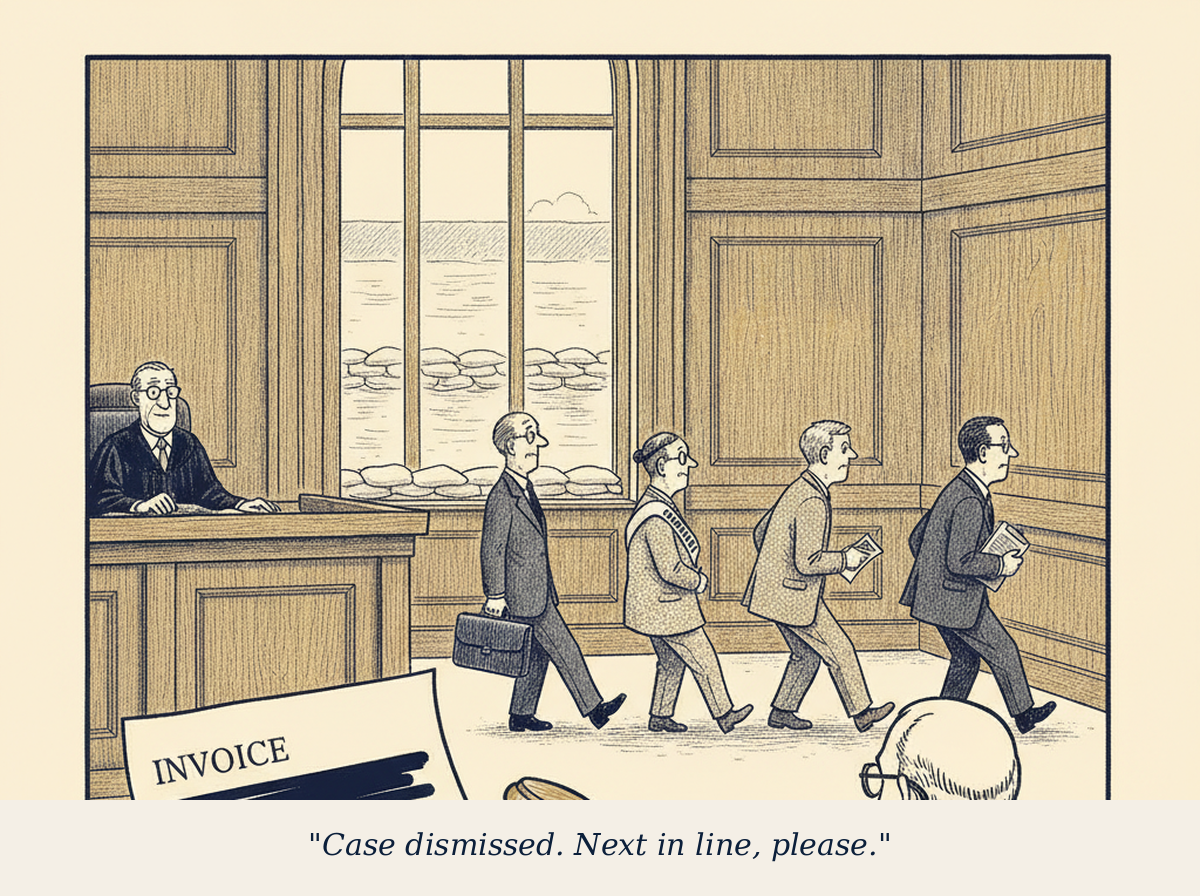
The Allocator · “Whose Name Goes on the Bill” · 51 sec
Source ledger
Every source below was opened before use. Primary documents marked ◆.
- ◆ West Virginia v. James, 1:25-cv-00168, Dkt. 318 — the 31 Aug opinion (63 pp., Chief Judge Sannes)
- ◆ DOJ ENRD release 26-1002, 31 Aug · Sabin Center case page · the statute
- ◆ Ceres, “Can Investors Price the Risk?” (19 Aug)
- Anthropic–Lambda $35bn (Bloomberg/WSJ via Investing.com, 31 Aug) · lease detail
- ◆ MediaTek 31 Aug filing via Digitimes · Nikkei Asia
- ◆ Boston Fed CPP 26-6 (5 Aug) · ◆ ECB Blog, “Big tech, big debt” (31 Aug)
- ◆ Warsh, Jackson Hole remarks (28 Aug) · 10-year at 4.75% (Bloomberg, 31 Aug) · Milliman 100 PFI
- ◆ OIRA record, RIN 3235-AN47 · TheCorporateCounsel.net · Cooley · Reuters · ◆ Texas BOC §21.373 · ◆ the AGs’ 27 Aug letter · ◆ NBIM consultation response
- SPR 286.6m (Reuters/DOE) · ◆ EIA weekly SPR series · Washington Examiner
- Ares JDP V close · ◆ Aon 8-K · Aon release · NIIF first close
- ◆ Keppel release (two data centres, 1 Sep) · SLB/Kelvion · EuroHPC/Bull (EuroHPC JU, primary) · Nuveen CPACE IV
- TWG/Mubadala (Bloomberg, 28 Aug) · TWG “no fraud” (CNBC) · TVF/TOGG (Reuters-originating) · UBS committee (Bloomberg)
- ◆ INSP (DRC) Situation Report 108 (30 Aug) · WHO DON614 (July totals)
- ◆ Nature Sustainability: Indonesia land-use (31 Aug) · ◆ Communications Sustainability: coastal conflicts (31 Aug) · ◆ FSB Chair’s G20 letter
- Signal Ledger carried sources: ◆ Nature Climate Change (AMOC) · “Terra Incognita” coverage · ◆ QBE newsroom · CENTCOM denial · war-risk rates
Correction, 1 September 2026: An earlier version of this article misstated the Climate Change Superfund Act’s covered period as 2000–2018; the statute as amended covers 2000–2024. It cited a year-stale Milliman 100 funded ratio of 105.7%; the correct 31 July 2026 figure is 112.1%. It described Monday’s 4.75% 10-year close as the highest since January 2025; that level matched the 31 July close. It described a reported $6.5 billion Delaware Life transaction as loans being cut; it is a definitive agreement to exchange affiliated investments for third-party assets. An unverifiable Hormuz flow figure was removed, a working paper’s registry-versus-UN comparison was corrected to state that UN estimates overstate births relative to registries, and two June appointments were relabelled as background.
Written and edited by The Editorial Team. Not investment advice.