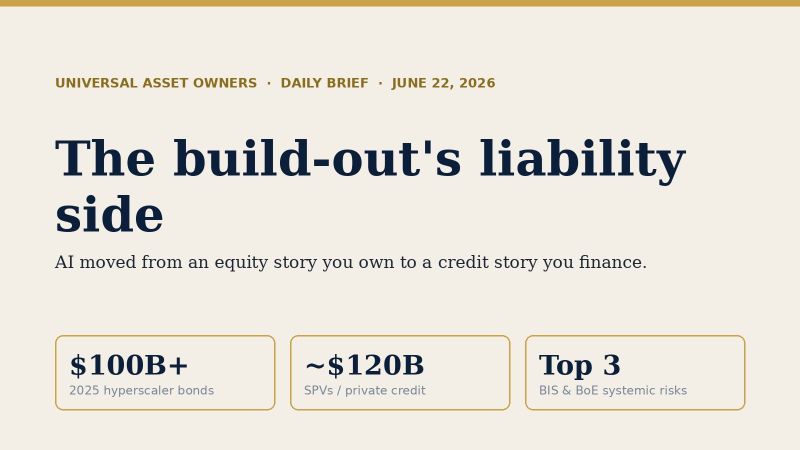
You own the AI build-out. Now you're lending to it.
For two years the AI build-out has been an equity story — a thing universal owners owned, through their Nvidia and hyperscaler
For two years the AI build-out has been an equity story — a thing universal owners owned, through their Nvidia and hyperscaler
The Universal Owner — “You own it. Now you’re lending to it.” Today’s ~7-minute audio briefing: the credit migration (Nvidia’

The UAO Daily Video Brief, read by our presenter: the AI build-out becomes a credit story, China’s new rare-earth
Research & Commercial Insight · June 22, 2026 · UAO Research There is a tidy story large allocators have told themselves about artificial intelligence:
Fiduciary duty forms the legal and ethical foundation of pension fund management. We examine statutory obligations, trustee responsibilities, and governance implications for long-term allocators.
Universal proxy consolidates shareholder proposals onto a single ballot, reshaping how institutional investors exercise voting rights and engage in stewardship. We examine the mechanics, adoption timeline, and governance implications for asset owners.
Say on Climate gives institutional investors a formal voice in corporate climate governance through non-binding shareholder votes. We explain how it works, adoption rates, and its role in fiduciary duty.
Duty of care requires institutional investors to act with competence and diligence when managing capital. We examine the legal framework, practical implementation, and how major asset owners structure governance to meet this obligation.
Active ownership has become central to how large institutional investors—pension funds, endowments, and sovereign wealth funds—exercise influence over portfolio companies. It extends beyond voting to include direct engagement on governance, risk, and strategic direction.
Proxy advisors research corporate governance issues and issue voting recommendations to asset owners managing trillions globally. Their influence over stewardship decisions has triggered regulatory scrutiny and asset owner backlash.
Pecuniary factors—monetary elements that influence investment decisions and fiduciary obligations—are central to institutional governance. Understanding their scope determines compliance with duty-of-care standards and allocation transparency.
A fiduciary standard legally binds advisers to prioritize client interests above profit. Understanding its scope and enforcement is critical for institutional investors evaluating adviser relationships and governance frameworks.