Libyan Investment Authority Explained
The LIA represents Libya's consolidated sovereign wealth apparatus post-civil conflict. We examine its governance structure, asset base, and institutional positioning within the MENA fund ecosystem.
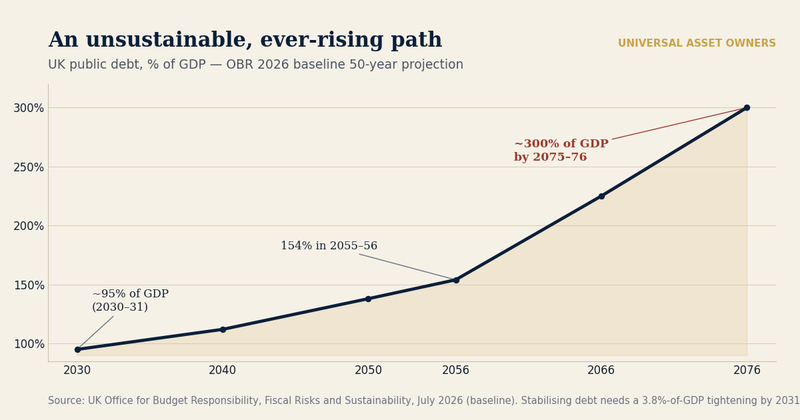
NATO's 5%-of-GDP defense-investment commitment and the OBR's unsustainable-debt warning converge with the Hormuz oil shock on one of a universal owner's least-diversifiable exposures: long-dated government debt.
The desk is tracking 10 structural risks at a combined radar load of 8.0/100. Chokepoint concentration leads at 53%.
The desk is tracking 10 structural risks at a combined radar load of 8.2/100. Chokepoint concentration remains the highest-priority exposure at 53%.
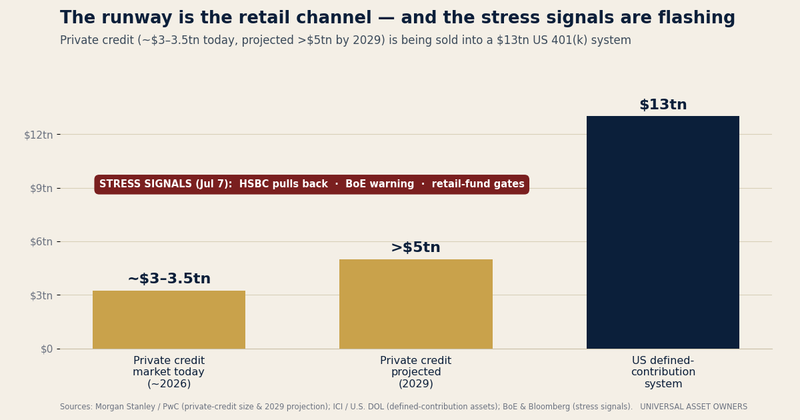
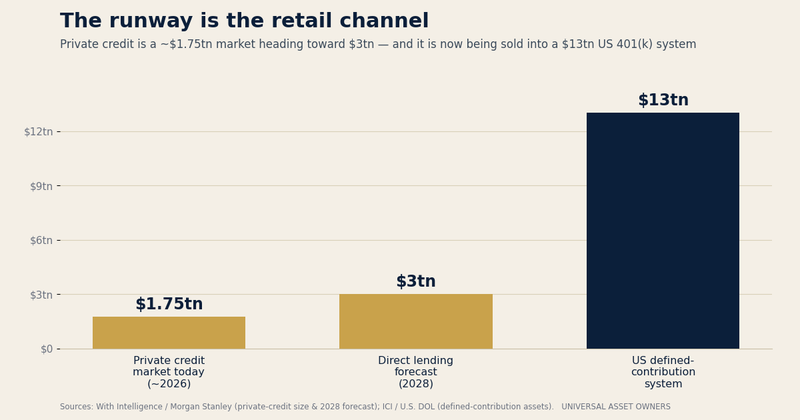
A single strait moves oil, LNG, inflation, rates, shipping and defense at once — and it's back. Plus private credit meets its stress test as it's sold into the 401(k), and Temasek maps the AI-and-income barbell.
Infrastructure equity and debt serve distinct roles in institutional portfolios. Equity provides growth exposure and inflation hedging; debt offers stable yields. Leading asset owners blend both for diversified infrastructure allocation.
Large asset owners increasingly face a structural choice between direct co-investments and traditional fund allocations. This analysis examines the governance, operational, and financial trade-offs defining institutional investment strategy.
Universal asset owners—pension funds, endowments, and sovereign wealth vehicles managing $100+ trillion—face mounting climate transition risk across equity, fixed income, and real assets. We examine how institutional allocators quantify and hedge this systemic exposure.
Private credit direct lending enables institutional investors to originate and hold loans directly to mid-market and large corporates. It has grown into a $1.5+ trillion asset class as pension funds and endowments seek higher yields and portfolio diversification.
Global power grid modernization demands $2–3 trillion by 2035. Asset owners access this opportunity through utility equities, infrastructure debt, and renewable energy integration vehicles.
AI infrastructure—data centres, semiconductor fabs, and compute networks—has emerged as a distinct capital allocation category for long-term asset owners. We map the institutional deployment landscape, governance structures, and portfolio implications for CIOs and investment committees.