|
Universal Asset Owners
Capital at the scale of the world
|
|
Evening Analysis · Complimentary Release of Subscriber Research
|
|
This evening, Universal Asset Owners is releasing a piece of original research that we ordinarily reserve for paying subscribers and institutional clients. We are making it available without charge because the distinction it examines — between a ceasefire and a commercially functioning Strait of Hormuz — has become consequential for global markets.
Our argument is deliberately narrower than saying insurers can make or prevent peace. They cannot. Governments and armed actors determine whether the fighting stops. But a ceasefire does not automatically restore commerce.
Shipping resumes only when a chain of private and public actors — shipowners, crews, charterers, lenders, P&I clubs, war-risk underwriters, reinsurers, and security authorities — concludes that a voyage is sufficiently safe, insurable, and financeable. Lloyd's of London is central to that process, but it is neither a single insurer nor the only source of marine capacity: it is a marketplace of independently managed syndicates whose pricing, exclusions, and available limits can help determine how rapidly political de-escalation becomes commercial normalization.
The implication for investors is significant: the shooting can stop while the Strait remains commercially constrained. The full analysis follows below — read it here, watch the video and audio briefings, or open either research document as an interactive flip book.
|
|
UAO Research · Deep Dive
The Second Chokepoint: Why an Iran Truce May Not Reopen Hormuz
The fighting can stop before shipowners, crews, lenders, and underwriters are willing to move.
UAO Editorial · Research & Commercial Insight · Tuesday, July 14, 2026
|
|
|
|
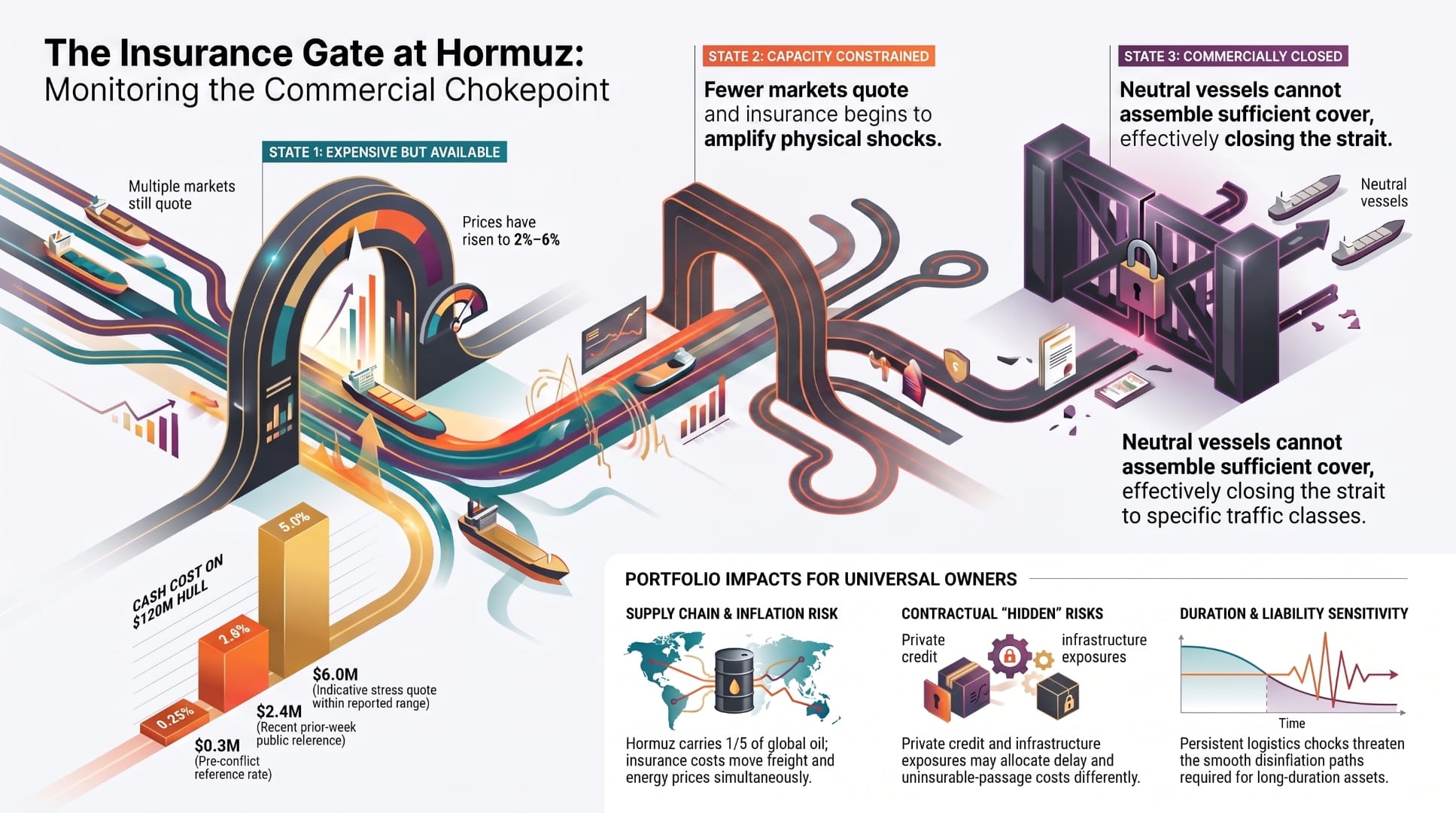
Video briefing — The Insurance Gate at Hormuz. Click to watch on the site.
|
|
|
|
|
The geography of the Strait of Hormuz is fixed; its commerce is not. The waterway remains legally open, but the commercial picture shifted sharply in mid-July. The UAE government reported that two UAE-flagged tankers were struck on July 13. Around the same window, confirmed crossings reportedly fell by roughly half week-over-week — a figure that should be read with care, since vessels running “dark” on their transponders may not be fully captured. With a renewed U.S. blockade now applied to traffic entering and leaving Iranian ports — not to all shipping through the Strait — the question for institutional investors is not only whether the missiles stop, but whether the commercial machinery that moves energy is willing to operate.
Two Gates, Two Clocks
The Strait is governed by two distinct constraints that move on different clocks. The first is navigational and kinetic: the physical ability of a hull to transit without seizure or destruction. The second is contractual: the ability of owners, lenders, and charterers to assemble a workable stack of hull, P&I, and cargo cover at terms that still make the voyage economic. History shows these gates rarely open or close in perfect synchrony. Naval escorts can restore a degree of physical security relatively quickly; insurance wordings, reinsurance treaties, and institutional risk appetite adjust more slowly. Conversely, insurers may keep quoting even as shipowners — citing crew safety or board-level risk appetite — withdraw their tonnage. For the universal owner, the financial gate can become one binding constraint among several: physical security, crew consent, sanctions, chartering, finance, and operational approval.
From “Expensive” to “Constrained”
War-risk cover for a route like this can be thought of in three states:
| 1. Expensive but available: multiple markets quote; terms reset, but volume persists. |
| 2. Capacity constrained: quotes dwindle, limits fall, and dedicated facilities become the main viable option. |
| 3. Commercially closed: neutral vessels cannot assemble sufficient cover on workable terms. |
The available evidence does not support declaring Hormuz universally uninsurable. Capacity remains available in portions of the market, but pricing, limits, and conditions vary significantly by vessel, ownership, flag, cargo, route, and timing. Recent reporting has placed additional war-risk premiums at several percentage points of hull value — far above peacetime levels. At those rates, insurance becomes a material component of voyage economics. The market has also begun to ring-fence exposure through dedicated facilities and consortia — a defensive repackaging of capacity rather than a sign of broad appetite. On the current evidence, the gate is tightening, not shut. Policy can shift the picture quickly in either direction: a proposed U.S. cargo charge floated earlier in the crisis was subsequently withdrawn — a reminder that the legal and policy layer is itself volatile.
The “Silent Withdrawal” Signal
Inquiry volume is often treated as a proxy for market activity. In a high-risk environment, a fall in inquiries can be a bearish leading indicator rather than a benign one. If shipowners are requesting fewer quotes for Hormuz transits, that may be a “silent withdrawal” — tonnage pulled before a price is even discussed — though it is a possible signal of owner behavior, not proof on its own. Where it does occur, it can be self-reinforcing: as owners step back, the premium pool that lets insurers spread risk thins, which can push the market toward the capacity-constrained state and raise rates for the vessels that remain.
The Illustrative $6 Million Passage
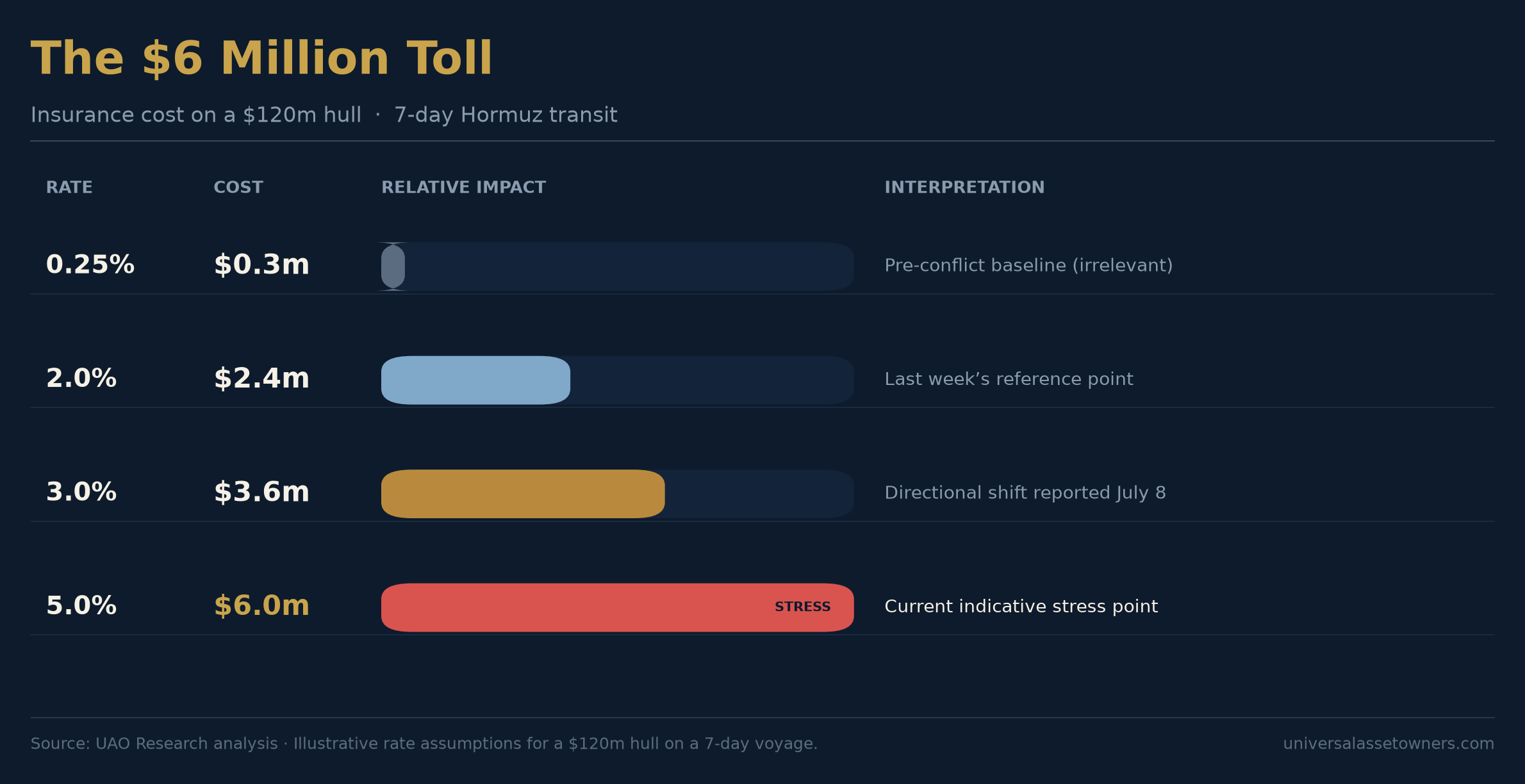
Consider a purely illustrative scenario: a 5% additional war-risk premium on a vessel with a $120 million insured hull value would equal $6 million for the relevant voyage or coverage period. That is scenario arithmetic — not a universal market quote — and it excludes cargo cover, P&I, deductibles, freight economics, and other contractual costs. Even so, it shows how quickly war-risk pricing can move from a negligible line item to a primary cost, and reshape the case for a transit.
|
|
|
Illustrative war-risk premium on a $120m hull across rate scenarios. Scenario arithmetic, not a market quote.
|
Solvency Is Not the Same as Capacity
The relevant question is not whether a handful of tanker losses would bankrupt Lloyd's. Lloyd's is a diversified marketplace supported by multiple syndicates and layers of capital. The more immediate question is whether individual syndicates, P&I providers, and reinsurers will offer sufficient limits on terms acceptable to shipowners, charterers, and lenders. A market can remain financially sound while declining to commit meaningful new capacity to a concentrated war-zone exposure. That distinction — between the ability to pay claims and the willingness to write new risk — is the real analytical issue.
What It Means for Asset Owners
Investment committees can move beyond monitoring oil futures to assessing exposure to these less-visible constraints:
| Sovereign wealth funds: separate the temporary upside of higher oil prices from the longer-term risk to export volumes and domestic liquidity. Strategic “bypass” infrastructure (such as the reported DP World discussions in Fujairah) should be assessed for actual return, not only strategic need. |
| Pension funds: stress-test inflation-linked liabilities and duration risk. If commercial cover tightens materially, a logistics shock could disturb the disinflationary path many long-duration assets rely upon. |
| Investment managers: identify who bears the cost if passage becomes commercially unviable — the owner, the charterer, or the end consumer. |
What to Watch
A ceasefire may be necessary for normalization, but it may not be sufficient. The pace of reopening will depend on whether attacks stop, whether navigational routes are credible, whether crews consent to transit, whether sanctions and blockades are clarified, and whether commercial actors can assemble an acceptable insurance and financing package.
That argues for watching more than the headline war-risk premium. The more revealing indicators are the number of underwriters quoting; the limits available; exclusions and cancellation provisions; reinsurance support; shipowner refusals — some owners have reportedly declined even military-guided transits; crew-consent requirements; and lender or charterer approvals.
Lloyd's will not decide whether there is peace. But decisions made by syndicates in London — and by insurers, reinsurers, and P&I clubs elsewhere — could help determine whether peace produces functioning trade. That is the second chokepoint: not the power to stop the war, but the power to influence how quickly commerce returns after it.
The peace agreement may be negotiated in capitals; the commercial reopening will be negotiated vessel by vessel.
|
|
|
Interactive Flip Book
The Insurance Gate at Hormuz — Slide Deck
The full argument in twenty-five slides. Click the cover to open the flip book.
|
|
|
Open the slide-deck flip book →
|
|
|
Special Briefing — Interactive Flip Book
Underwriting the Abyss
Our briefing on Lloyd's of London, war-risk insurance, and the capital bottleneck at Hormuz — the research we ordinarily reserve for paying subscribers and institutional clients. Click the cover to read the full flip book.
|
|
|
Read “Underwriting the Abyss” →
|
|
Prepared by the Universal Asset Owners editorial desk. This analysis is provided for informational purposes and does not constitute investment advice. You are welcome to share it with colleagues.
|
|
See the full page — video, audio, deck & briefing →
|
Universal Asset Owners — Institutional Membership
For investment teams that need a continuous research relationship: premium research, probability-weighted scenario analysis, weekly research calls, and board-ready briefings for sovereign funds, pensions, endowments, family offices, and institutional allocators.
View membership tiers →
|
|
Universal Asset Owners
Capital at the scale of the world.
Media, research & intelligence for long-horizon capital. Not investment advice.
© 2026 Universal Asset Owners. You're receiving this because you subscribe to the UAO Daily Brief.
Website · Unsubscribe
|
|