Weekend Edition. Saturday, May 23, 2026. One long read for the people who own the long horizon.
You already own the AI power bill.
When you own a slice of the entire economy, the AI question stops being whether to buy it. You already hold all of it — the hyperscaler equity, the investment-grade bonds now funding the capital expenditure, the data-centre real estate, the power and grid infrastructure, and the energy-transition book the same demand is straining. This weekend's one long read is the International Energy Agency's Electricity 2026 and Energy and AI analysis, and the reason to read it is that it prices the constraint the market keeps treating as someone else's problem.
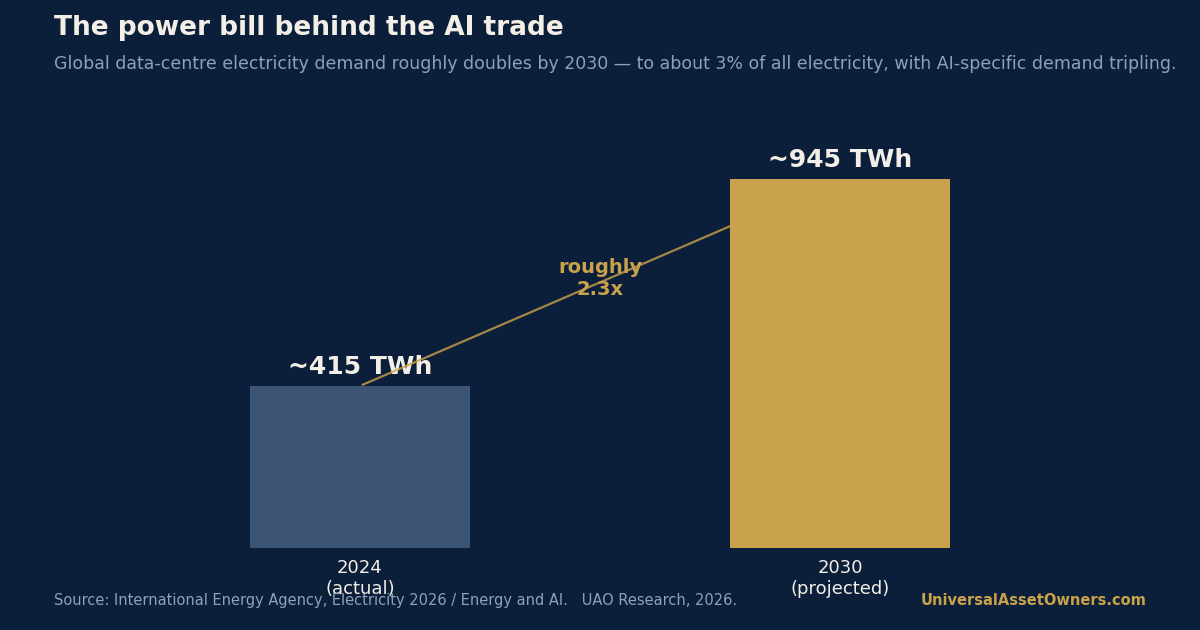
The binding limit on the AI build-out is no longer chips or money. It is electrons. Global data-centre electricity demand is set to roughly double, from about 415 terawatt-hours in 2024 to around 945 by 2030 — close to 3% of all electricity, with AI-specific demand tripling. The IEA estimates roughly a fifth of planned data-centre projects are at risk of delay because the grid cannot be built fast enough, and that meeting the load would require annual grid investment to rise about 50% from today's roughly $400 billion. Morgan Stanley puts a number on the same gap: a projected ~49 GW shortfall in US power access by 2028.
For a universal owner this collapses four supposedly separate positions into one. The AI trade, the credit trade, the infrastructure trade and the energy-transition trade are different desks looking at a single physical bottleneck. The largest sovereign owners have already acted on that logic — PIF's $40bn Humain, the roughly $100bn MGX, and the Kuwait fund joining the Microsoft–BlackRock AI Infrastructure Partnership — underwriting compute and power as strategic infrastructure rather than trading the theme.
The risk is not only physical. Data centres drove roughly half of US electricity-demand growth last year, and the public has begun asking who pays for the grid. The undiversifiable exposure is a grid that cannot scale in time, an AI-demand air-pocket that strands the assets, or a political reallocation of the power bill — and the universal owner sits on every side of each.
— Chart of the day —
Data-centre electricity demand roughly doubles by 2030.
— The Take —
"The cleanest way to mis-read the AI cycle is to run it on four separate desks. For an owner of the whole market it is one position with one gating item — power — and the edge is not picking the winning model but underwriting the electrons, the grid and the political settlement that lets the build-out finish."
— UAO Research.
— Three links worth your time —
- International Energy Agency — Electricity 2026, Executive summary. The primary numbers behind the whole story: demand trajectory, the share of projects at delay risk, and the grid-investment gap.
- Morgan Stanley — Energy Markets Race to Solve the AI Power Bottleneck. The clearest house-view framing of the gigawatt shortfall and the financing structures being built to close it.
- Belfer Center, Harvard — AI, Data Centers, and the U.S. Electric Grid: A Watershed Moment. The governance and grid-policy lens — who builds the power, and who pays.
The Saturday Edit is the weekend read from UAO Daily — one idea for the people who allocate long-horizon capital. The Daily Brief resumes Monday.
Become a Premium subscriber · Listen: The Universal Owner · Forward to a colleague · Manage preferences
UniversalAssetOwners.com. Capital at the scale of the world.
Continue the briefing. Read the daily brief · watch the daily video briefing · listen to The Universal Owner · view the chart of the day.
Produced with the UAO Content Engine. AI-assisted; editorially reviewed before release. Not investment advice.