Universal Asset Owners The Long Horizon The Weekly Digital Magazine · Issue No. 07 · Sunday, July 19, 2026 The Price of Passage Capital is abundant. Passage, power and the rules are the scarce assets — and the owners of the long horizon went on the record. 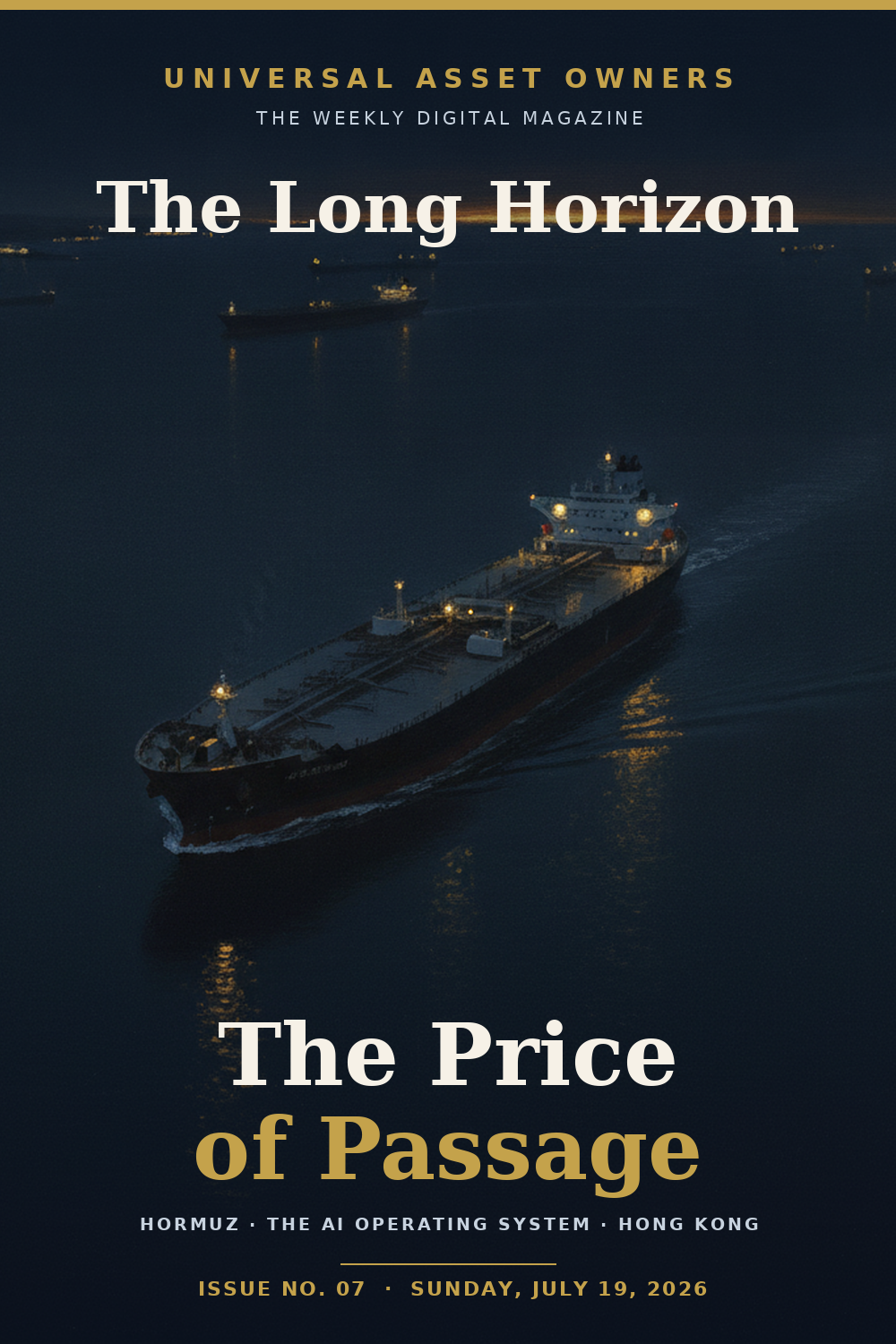 54 pages · a 10-minute executive scan, or ~45–60 minutes cover to cover. |
|
From the desk · The Week Beneath the Week For most of the post-crisis era, the binding constraint on the world’s largest owners was finding somewhere to put the money. This week inverted the problem. Money was everywhere. What was scarce was the right to move a barrel through a strait, the power to run a data centre, and the rules that decide who sets the toll.
Read the week in sequence and it tells one story. From Monday to Wednesday, the Strait of Hormuz was open on paper and closed in practice. From Thursday to Saturday, a semiconductor selloff reminded allocators that the artificial intelligence now woven through their portfolios runs on physical things — chips, grids, water, permits — that no balance sheet can conjure. And in between, three of the largest pools of permanent capital on earth chose this fortnight to go on the record with us. Their message was not comfort. It was doctrine. |
|
The cover essay · The Price of Passage On 17 June, the United States and Iran concluded a fourteen-point accord — the Islamabad Memorandum, brokered by Pakistan and Qatar and signed remotely after a planned in-person ceremony in Switzerland was called off. It opened a sixty-day window to turn a fragile ceasefire into a settlement. Within five days the U.S. Treasury issued a sweeping oil-sanctions waiver; within three weeks the waiver was revoked, three commercial vessels had been struck in the Strait of Hormuz, and President Trump, who signed the memorandum, had declared it ‘over.’
By the time this week began, Washington had floated a demand for ‘reimbursement’ equal to 20% of the value of all cargo transiting the strait — on the same day the International Maritime Organization’s Council reaffirmed that passage should remain free of tolls. Iran declared the waterway closed to unapproved traffic. Both claims cannot be fully true. That is precisely the point.
‘Open’ is not a binary state. A navigable strait can still be commercially closed if vessels lack recognised authorisation, war-risk cover, willing crews and sanctions-clean insurance. Kpler counted roughly fourteen transits one recent Sunday against thirty-seven a week earlier — a decline of about sixty per cent. The water did not move. The permission did.
The market spent the first half of the week charging for the war and the second half selling something else entirely — Brent up about 4.6%, but the S&P more than 1.5% lower on a semiconductor selloff, and the VIX up roughly 12%. Credit stayed calm. Put the two halves together and the through-line appears: the scarce asset is no longer capital. It is passage — through a strait, a permitting queue, a power interconnection — and the right to set its price. You already own the whole market. What you do not own is the chokepoint.
Which is why the most revealing signal of the week came not from the tape but from the allocators — three of the largest owners on earth, answering on the record how permanent capital should behave when the rules of passage are rewritten in real time. Their posture, over the pages that follow: control what you can — deployment, benchmarks, geography — and refuse to let the chokepoints set your horizon for you. |
|
On the Record · Exclusive What US$1.3 trillion of permanent capital told us Mubadala, CPP Investments and CalSTRS — three mandates, three continents — on counter-cyclical deployment, the benchmark debate, and deliberately light U.S. positioning. In statements to Universal Asset Owners, three of the world’s largest allocators converged on a single argument about how long-horizon capital should behave when others hesitate. “We may deliberately accept short-term benchmark headwinds if it strengthens the Fund over decades,” CPP’s Michel Leduc told us. Mubadala: “We look through short-term volatility.” CalSTRS: “A 30-year investment horizon… not short-term gains.” Two of the three run deliberately light U.S. positioning — on the record. |
|
This week in the Newsroom Strategic analysis · South & Central Asia The Hormuz Reversal By Obaid ur Rehman A sixty-day peace window, opened and shut in three weeks. How a strait gets closed without being closed — and why ‘open’ is not a binary state when vessels lack war-risk cover, clean insurance and recognised passage. Asia Hong Kong’s Family Office Moment By Syed Muhammad Fahad Wasim The scoreboard says Hong Kong is winning — US$2.95tn in cross-border wealth, narrowly ahead of Switzerland. The real contest, after Singapore’s 15 June rule change, is whether a booking centre can convert assets it holds into decisions it makes. |
|
Partner First Look · Sponsor  AssetOps Chicago · 11 August 2026 — the operations and technology forum for institutional asset owners. UAO readers register at the partner rate. Inclusion is not an endorsement or investment advice. |
|
The owner’s week in numbers | $88.10 | Brent crude settle Friday, up about 4.6% as strikes entered a sixth night | | −1.01% | S&P 500 close (7,457.69), and more than 1.5% lower on the week, on a semiconductor selloff | | 18.77 | VIX, up roughly 12% Friday — its highest in several weeks | | ~14 vs 37 | Hormuz transits one recent Sunday against a week earlier — about 60% fewer (Kpler) | | C$793.3bn | CPP Investments’ net assets at 31 March, on a 7.8% fiscal-2026 return | | $13–80tn | Sovereign funds today; all state-owned investors by 2030 on current trajectory |
|
|
Capital in Motion · this week ADIA → IndiaAmid a fresh slate of India–UAE agreements, the Abu Dhabi Investment Authority made a stated US$1bn commitment alongside India’s NIIF to infrastructure projects in India. (DD News, 18 Jul) KWAP under scrutinyMalaysia’s public-service pension confirmed a ~RM163.4m (~US$40m) stake, around 2.51%, in Indonesian agritech eFishery, which collapsed amid alleged fraud; Malaysia’s anti-corruption commission has opened an investigation. (SCMP, 19 Jul) EBRD → the corridors€230m committed to upgrade a 234-km stretch of Kazakhstan’s Trans-Caspian Corridor — the middle route between China and Europe. (EBRD, 17 Jul) Europe prices powerThe European Commission’s Electrification Action Plan set an indicative 46% electrification target for 2040, which it argues could cut the EU fossil-fuel import bill by ~€260bn. (European Commission, 17 Jul) |
|
The desk’s scenarios Hong Kong vs Singapore, to July 2028. Analytical judgments, not market-implied odds. 35%Durable Hong Kong leadBill enacted intact; inflows stay broad-based. The booking crown converts to local substance. 30%Two-hub equilibriumSingapore’s notification regime shortens set-up; both cities’ approvals flow. The modal outcome. 20%Shallow substanceFormation continues but reporting can’t show jobs or decisions behind the count. 15%Policy or market setbackMainland enforcement widens, custodians retrench, or the bill stalls. |
|
Listen & Watch · The Universal Owner  Listen — The Universal Owner. This week’s Big Read puts Mubadala, CPP and CalSTRS in their own words: the counter-cyclical case, the benchmark heresy, and the America question. New episodes weekly on Apple Podcasts and Spotify.
Watch. The week’s films — the Hormuz reversal and the decoupled tape — are collected in the video briefing. |
|
The Insider • GIC named Bryan Yeo as its next Group CIO and Boon Chin Hau as CIO for Infrastructure.
• CPP Investments returned 7.8% in fiscal 2026; net assets C$793.3bn, up from C$714.4bn.
• Scale check: sovereign funds ~US$13tn; all state-owned investors ~US$60tn today, a path to US$80tn by 2030; NBIM alone above US$2tn.
• Quiet signal: 60% of family offices plan to change their asset allocation — the most UBS has ever measured — and 65% expect the dollar’s reserve status to weaken. |
|
The week ahead Watch the second-reading progress of Hong Kong’s family-office tax bill; the sixty-day Islamabad window as it passes its halfway point; the breadth of the semiconductor selloff; and any widening of the Strait’s insurance and escort arrangements. |
|
The Allocator · the back page 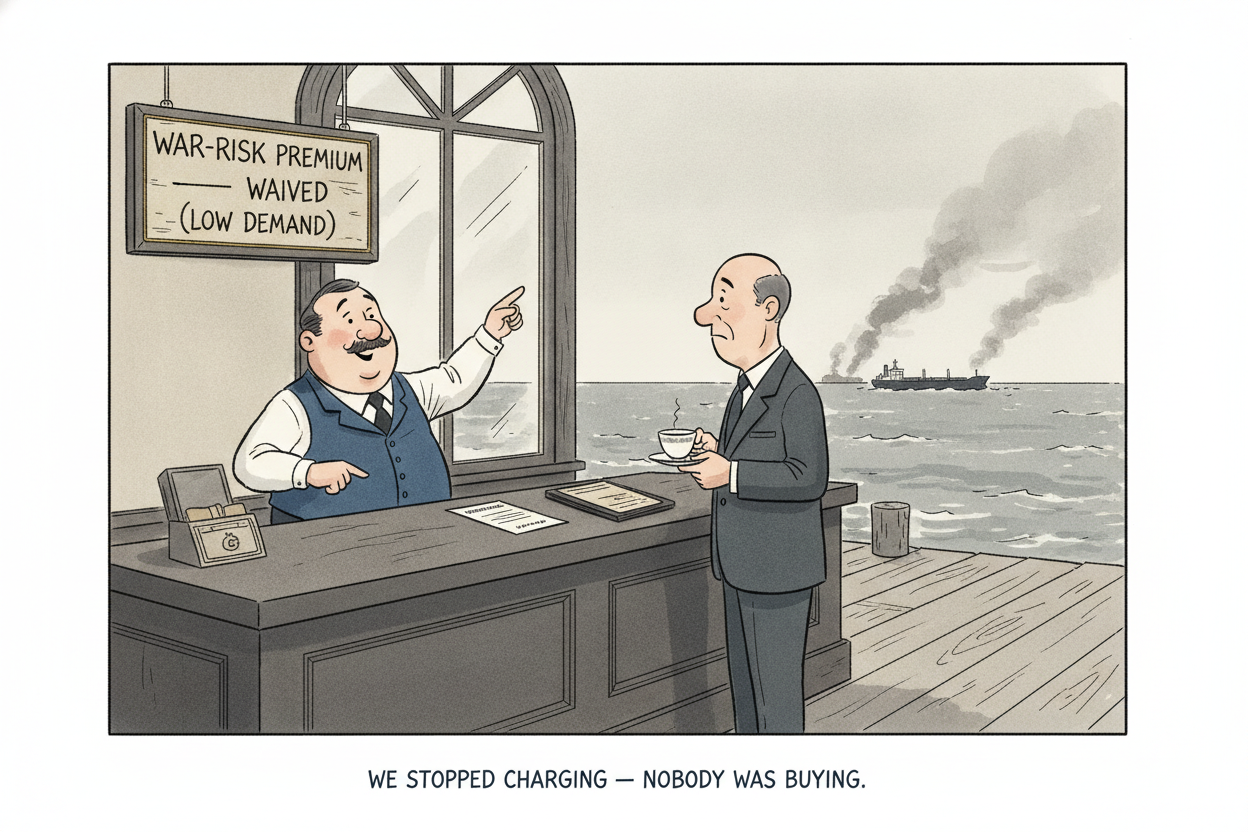 “We stopped charging — nobody was buying.” This week’s cartoon, “Low Demand” — a dockside war-risk counter at the strait, its premium waived for want of buyers, with The Allocator the only customer trying to buy the cover no one else wants. |
|
The Long Horizon · WeeklyMedia, research & intelligence for long-horizon capital. Membership · Read · ListenNot investment advice. © 2026 Universal Asset Owners. Unsubscribe |
|