OpenAI + Anthropic IPOs: $198bn that could hit housing.
Redfin says OpenAI and Anthropic staff could buy 29% of San Francisco's homes. Plus Aviva, Royal London and M&G move £538m — and the terms they disclosed.
UAO EditorialJuly 31, 20267 min read
Everyone is quoting the same yield this morning — 5.21%, the highest 30-year close since 2007. The number is right; the conclusion being hung on it is not, because the same move decomposed two different ways at two maturities, and what it does to your balance sheet depends on which curve, in which currency, actually prices your promises.
The briefing
Two minutes: an 11bp jump on decision day, a real yield that did not move for three sessions, and why the maturity is the whole story.
What happened
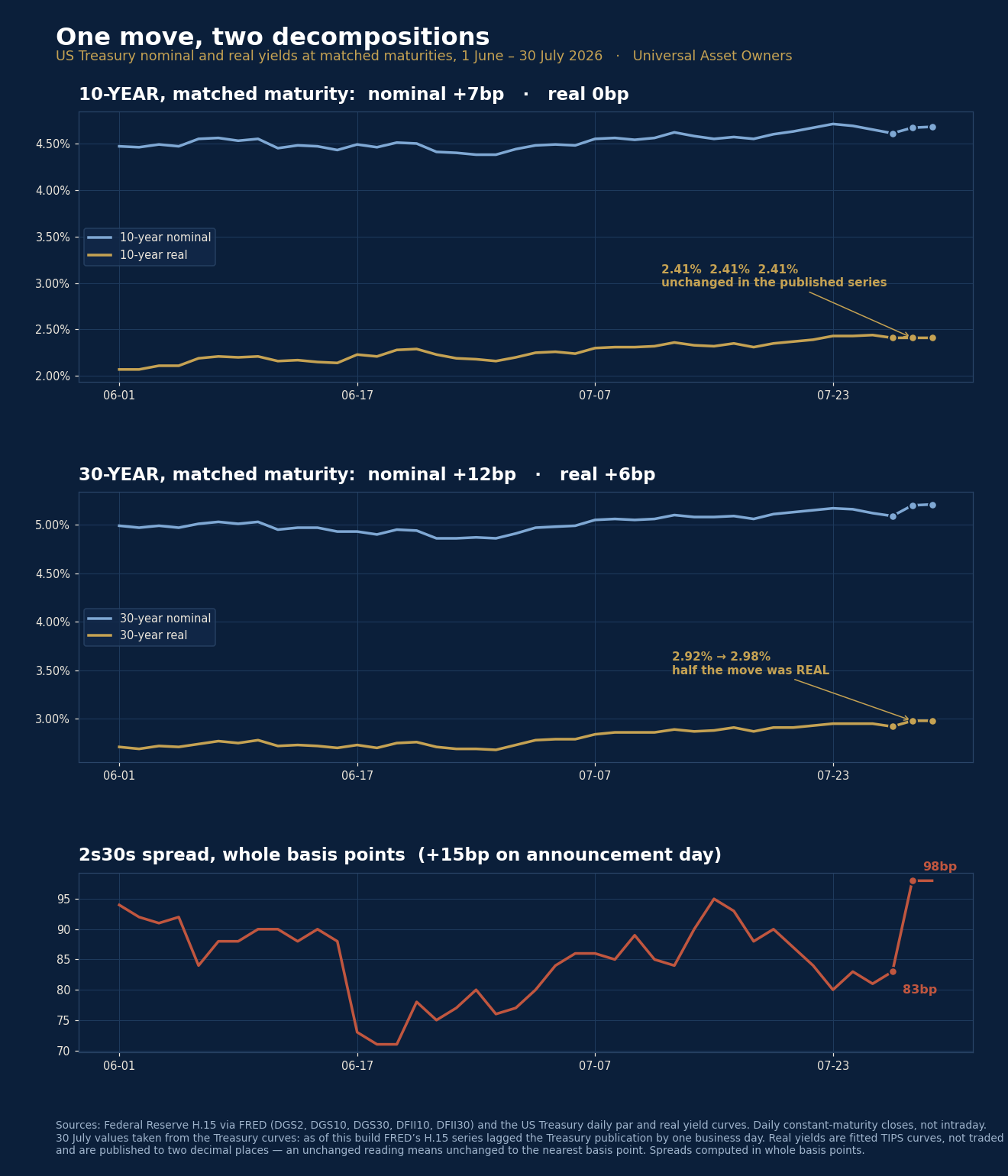
On Tuesday 28 July the two-year closed at 4.26% and the 30-year at 5.09% — a spread of 83bp. On Wednesday, when the Committee held the target range at 3½–3¾ percent on a 9–3 vote (Hammack, Kashkari and Logan preferring a quarter-point rise — FOMC statement), the two-year fell four basis points and the 30-year rose eleven, widening the spread to 98bp. It held there on Thursday, when the 30-year closed at 5.21% — its highest close since 12 July 2007 (Treasury par curve). Computing in whole basis points across the Fed’s H.15 history, a one-day 2s30s steepening of 15bp or more has happened 157 times in 12,357 day-to-day comparisons — 1.27% (DGS30, DGS2).
One move, two decompositions
At 10 years, the nominal yield rose 7bp (4.61% to 4.68%) while the published real yield read 2.41% on Tuesday, Wednesday and Thursday — unchanged in the published series to the nearest basis point (DFII10). The whole move was inflation compensation. At 30 years, the nominal yield rose 12bp while the real yield rose 6bp, 2.92% to 2.98% (DFII30) — roughly half the move was real. One steepening, two different answers, and a breakeven is compensation, not a forecast: it carries an inflation-risk premium and TIPS liquidity alongside expectations.
Capital moves
£538m of UK pension risk transfer announced over two days, with differing completion dates: Aviva’s £180m full buy-in with the Aston Martin Lagonda scheme; Royal London’s £208m bulk annuity with the Hickson scheme (adviser release); and M&G’s £150m “BPA Plus”, completed in June, offering the potential for with-profits participation. Graham Holdings disclosed a $113.9m premium against $124.3m of obligations removed on its own accounting measurement — a rare disclosed comparison, not a portable multiple (10-Q). Nesta Trust moved £120m of its £420m endowment from Northern Trust to Amundi, citing — its words — Northern Trust’s exit from two climate initiatives (Nesta). HSBC agreed to sell its A$36bn Australian loan book to Blackstone; signed, not closed (announcement). And the UK’s multi-employer collective money-purchase regime takes effect today.
The Universal Owner Risk Radar
Uto, Japan earthquake — USGS PAGER alert red. Mww 6.8; modelled impact, not observed loss: 1.2m people at modelled MMI ≥ VII. → USGS PAGER
Saumos, France wildfire — GDACS red alert. 47,895 ha, an automated alert estimate; Copernicus EMSR899. → GDACS
CVE-2026-16812 — Arista VeloCloud Orchestrator, severity 10.0, exploited. The 30 July remediation date binds US federal civilian agencies; the portfolio question is who runs it and who owns patching. → CISA KEV
Credit’s silence. High-yield spreads +19bp over five sessions to 2.87% while VIX rose 24% — three readings of that gap, each with a falsifier, in the edition. → BAMLH0A0HYM2
Commentary versus filed cash flow. Amazon’s release shows trailing free cash flow at −$7.6bn with AWS up 37%; the widely-quoted $220bn capex figure was earnings-call commentary and appears in no filing yet. Watch the 10-Q reconcile them (8-K exhibit).
Inventories versus prices. Crude ex-SPR at 404,508 kbbl (lowest since September 2018) and Cushing at 18,599 (lowest since August 2014), while Brent sits 12.8% below its 23 July peak at the last print, $91.82 on 27 July (DCOILBRENTEU). The 5 August EIA report at 10:30 ET is the next hard read.
Held with dissent. The Bank of England at 3.75% on a 6–3 vote, Greene, Mann and Pill for 4% (minutes); the Bank of Japan at ~1%, 8–1, Takata for 1.25% (BOJ); China’s manufacturing PMI at 49.2 (NBS).
What this is not
It is not a verdict on the Chair. Chair Warsh told the press conference that nominal and real yields were “materially higher across the Treasury curve” — and over the 42-day intermeeting window he was describing, he is right: the 10-year real yield rose 18bp and the 30-year real 25bp (transcript). The narrower point is that in the final three sessions of that move, the two real curves stopped agreeing.
Allocator Lens: which curve prices the promise
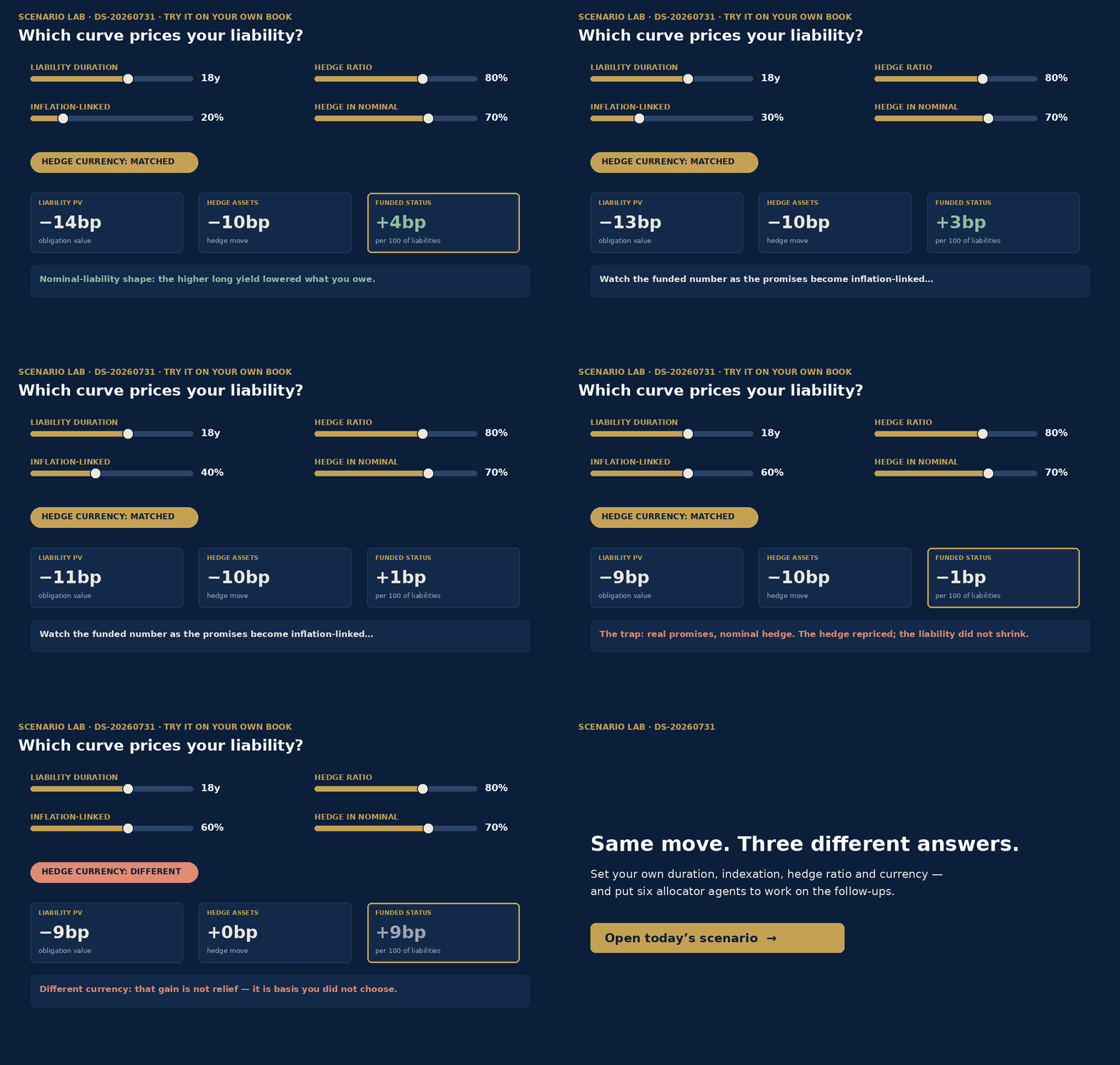
No institution values a liability off one point on one curve. A US corporate plan discounts against a high-quality corporate curve matched to its benefit payments — a Treasury move is evidence about Treasuries, not that curve. A UK scheme prices sterling promises off gilt and market-implied inflation curves; a US Treasury yield cannot tell you what happened to a sterling pension promise. For fixed nominal cash flows, present value generally falls when the matched same-currency nominal curve rises. For fully inflation-linked cash flows, present value is broadly unchanged when the matched real curve is unchanged. Everything past that is assets, collateral and hedge design — the full regime table is in today’s edition.
Three questions for the investment committee this month: which curve — currency, credit quality, maturity points — actually prices each section’s liabilities, and is the hedge on the same one? What fraction of the hedge book is nominal instruments against index-linked promises? And what does the collateral position do under a non-parallel shock — the kind that just happened?
Chart of the day
Nominal and real constant-maturity yields at matched maturities, with the 2s30s spread in whole basis points. 30 July values from the US Treasury daily curves; FRED’s H.15 series lagged the Treasury publication by one business day as of this build. Real yields are fitted TIPS curves published to two decimal places — an unchanged reading means unchanged to the nearest basis point. Sources: Federal Reserve H.15 via FRED; US Treasury.
Scenario · Which curve prices your liability?
Base case: the maturity divergence closes quietly — both real curves drift together and the funding question stays a basis question. Watch: a 10-year real close at or above 2.50% on two consecutive sessions; the 30-year at or above 5.30%; 2s30s at or above 110bp; a fourth dissent at the next meeting. No probability attached — the conditional base rate (57.1% of 42 episodes) sits 6.8 points above the unconditional 50.3%, inside its own confidence interval, so this scenario carries triggers instead of a forecast.
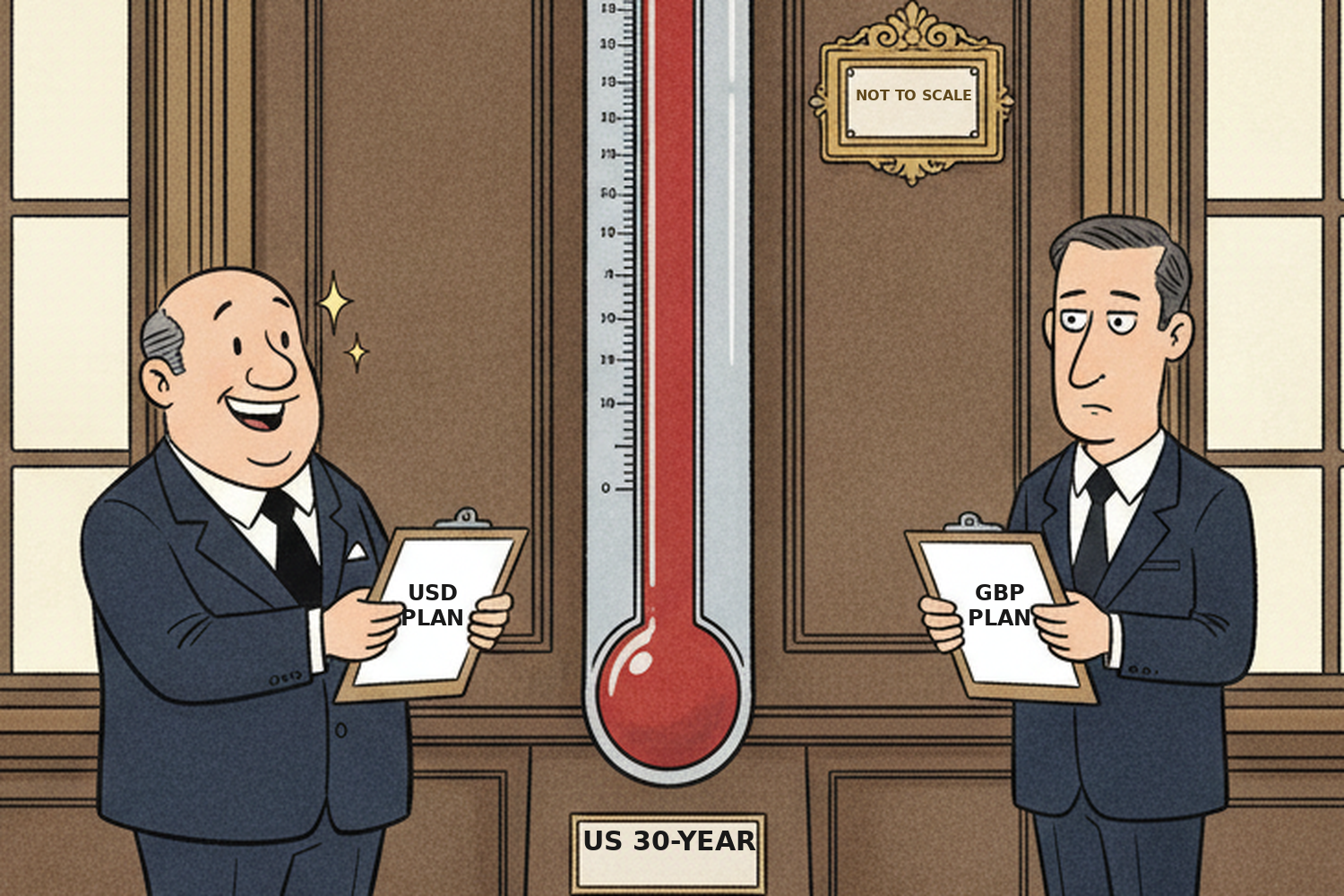
The Allocator is our resident universal owner: a composite chief investment officer who holds a slice of every listed company on earth, cannot sell his way out of a systemic problem, and takes the day’s contradiction personally. Today: two clipboards, one thermometer, and the question of whose gauge it is anyway.
TODAY’S EDITORIAL CARTOON
“It only measures one of us.” — Universal Asset Owners, 31 July 2026.
Verified on each employer’s own applicant system, 31 July 2026.
The measure, in one line
The 30-year printed a nineteen-year high and the ten-year real yield did not print a new number for three days — because the question was never what the headline yield did. It is which curve prices your promise, and in which currency.
The Daily Brief
The morning briefing for the people who allocate long-horizon capital.
Research, charts, video and podcast analysis for the institutions investing at the scale of the world.
Five minutes, five days a week. Complimentary — subscriptions are reviewed by our editorial desk, and you'll receive a notice once approved.
You’re on the list. Tomorrow’s brief will arrive in your inbox.