
Good morning {first_name},
The Rights You Actually Bought
98% of the world’s sovereign wealth funds |
18 of 20 of the world’s largest pension funds |
10 of 10 of the largest charitable foundations |
85% of the world’s largest family offices |
100+ billionaires, every morning |

Norway’s sovereign wealth fund told Reuters this week that shareholder rights are weakening across the United States, Britain, Europe and Hong Kong. Its own disclosures show what that looks like in a single line: 1.28% of NVIDIA owned and 1.28% voted, against 0.05% of a newly listed SpaceX owned and 0.01% voted. In the same seven days, GIC agreed to co-own a data-centre platform, six of the world’s largest managers signed memoranda to make computing power financeable, and three Canadian plans posted a 470-basis-point spread. In each case the economic exposure is disclosed. In almost none of them are the control rights.
What happened
In a joint interview with Reuters, datelined Arendal and published on 13 August, Carine Smith Ihenacho, chief governance and compliance officer of Norges Bank Investment Management, said: “We are concerned about shareholder rights generally. We are concerned because we’re seeing it’s been diminished in many markets, not just the U.S., but also in the UK, in Europe, in Hong Kong even.”
She named three mechanisms: dual-class share structures that hand founders voting power out of proportion to their capital; a drift of corporate reporting from mandatory toward voluntary frameworks; and narrowing routes for investors to sue boards. Chief executive Nicolai Tangen tied the trend to competition between exchanges for listings.
The fund held NOK 22,683bn — about $2.3 trillion — at 30 June, across roughly 7,100 companies, and states that “on average, the fund holds 1.5 percent of all listed companies.” Its half-year return, published on 12 August, was 9.4%, with equities up 13.0%.
The mechanics matter more than the sentiment. A fund that owns the market cannot express a view by leaving it: selling a badly governed company means buying the rest of the index, where the externality lands anyway. Influence substitutes for exit. When influence thins, the risk stays put with fewer levers attached.
What the disclosure actually shows
NBIM publishes economic ownership and voting power side by side, for free, for every holding. Almost nobody else does.
| Holding | Owned | Voted |
| NVIDIA | 1.28% | 1.28% |
| Apple | 1.24% | 1.24% |
| SpaceX | 0.05% | 0.01% |
Norges Bank Investment Management published holdings, as at 30 June 2026.
The gap is not a scandal and it is not a choice. SpaceX listed on 12 June with Class A shares carrying one vote and Class B carrying ten; Elon Musk holds 82.4% of the voting power after the offering, and the company qualifies as a controlled company, exempt from maintaining a majority-independent board. An index fund buys what the index contains. NBIM’s position arrived through the benchmark, not through a discretionary decision to accept diluted rights — as this publication noted on 12 August. NBIM officials declined to answer questions about SpaceX’s governance specifically.
That is precisely what makes it the right worked example. Dual-class dilution is not something a universal owner opts into. It is something the benchmark delivers, automatically, in proportion to how well the issuer performs. The better a controlled company does, the more of it you own, and the wider the gap between your capital and your say.
Where the disclosure runs out
The listed case is the transparent one. Consider what this week’s other transactions disclosed.
On 10 August, Anthropic, Macquarie Asset Management and GIC announced Theseus Infrastructure, a platform to develop, operate and lease data-centre capacity to Anthropic under long-term agreements, with Anthropic as anchor tenant and an initial US focus. Macquarie-managed funds will, with GIC, “own the platform and fund the majority of the equity for each project.” Anthropic will cover electricity price increases that consumers might otherwise face from these sites.
What was not disclosed: total capacity, dollar commitment, site count, the equity split, the capital-call schedule, and — the point here — the governance of the platform itself. Who appoints directors. What decisions require investor consent. What happens on tenant default. GIC is separately estimated by Global SWF to hold around $6.3bn of Anthropic equity, an estimate GIC has never confirmed and which post-dates the Theseus announcement by two days. Nothing suggests GIC sold or reduced anything; it added an exposure alongside one it has never quantified publicly.
The same day, NVIDIA signed memoranda of understanding with Apollo, BlackRock, Blackstone, Brookfield, Goldman Sachs and KKR to establish compute-financing platforms. The memoranda are signed; the definitive agreements are not. The figure attached is more than $500 billion, and NVIDIA has been careful about it: Jensen Huang wrote that it “represents aggregate third-party capital that these platforms are designed to mobilize over time — the capital is not NVIDIA revenue, a single fund or a commitment to a single customer.” In some cases NVIDIA may provide residual-value support “for up to 25% of an opportunity, assessed carefully on a project-by-project basis.” What the 25% is a percentage of is undefined.
On 13 August Databricks closed $5 billion at a $190 billion valuation, led by Coatue with Blackstone, MGX, accounts advised by T. Rowe Price and new investor Sixth Street Growth. The release names GIC, Ontario Teachers’ Pension Plan and Temasek among existing investors — it does not state that they participated in this round. Not disclosed: whether those owners hold board seats, consent rights, information rights or preferred protections. Investors of that size rarely go in without them. Nobody outside the cap table can verify what they are.
This is the finding. Move along the spectrum from a listed single-class share to a listed dual-class share to a private round to a platform equity stake to a credit tranche, and two things happen at once. The control rights become more negotiated, more concentrated and potentially stronger — a covenant with a step-in remedy can bind harder than a proxy vote ever will. And the public disclosure of those rights falls to essentially zero. A beneficiary can audit NBIM’s voting power in a spreadsheet. They cannot audit anything about Theseus.
Allocator Lens What this means for the portfolio Stop asking whether an instrument has a vote. Ask what it lets you compel. For every material exposure: what rights are obtained — voting, board seats, reserved matters, consent, information, covenants, security, termination, step-in? Who enforces them? At what trigger do remedies become available? Do the tenors align across legal maturity, debt tenor, hardware life, tenant demand and residual value? What control premium are you paying, or foregoing, against the listed alternative? And can a beneficiary verify any of it? Report voting power as its own line beside economic exposure. NBIM does it for free. If your reporting cannot produce that comparison, benchmark drift is invisible to you. Extend the same discipline to private and platform holdings internally: require managers to report the rights obtained, the enforcement path and the trigger points, in a standard format, for every position above a threshold. |
Capital Flows
Stage language is load-bearing. A memorandum is not a commitment. An announcement is not a close. Being named as an existing investor is not participation in this round.
| Institution | Action | Amount | Stage | Date |
| GIC + Macquarie AM + Anthropic | Theseus Infrastructure — Macquarie funds and GIC “own the platform and fund the majority of the equity for each project”; Anthropic anchor tenant | Not disclosed | Announced | 10 Aug |
| NVIDIA + Apollo, BlackRock, Blackstone, Brookfield, Goldman Sachs, KKR | Compute-financing platforms; possible residual-value support up to 25% of an opportunity | >$500bn mobilisation target over time | MoUs signed | 10 Aug |
| Databricks | Round led by Coatue with Blackstone, MGX, T. Rowe Price accounts, Sixth Street Growth. GIC, Ontario Teachers’ and Temasek named as existing investors | $5bn at $190bn | Closed | 13 Aug |
| Ontario Teachers’ | H1 results; Venture Growth raised to 9% of asset mix from 6% | C$303.2bn net assets · 9.5% | Reported | 10 Aug |
| OMERS | H1 results; Private Equities 1.1% against Public Equities 12.2% | C$151.6bn · 4.8% | Reported | 11 Aug |
| La Caisse | Mid-year; Private Equity −4.3% against an 8.0% benchmark | C$552bn · 5.1% vs 7.5% index | Reported | 13 Aug |
| NYC five pension systems | Fiscal year to 30 June — not a calendar half-year | US$326.3bn · 13% | Reported | 12 Aug |
| Norges Bank Investment Management | H1; equities 13.0%, fixed income 0.9%, renewables −0.2% | NOK 22,683bn (~$2.3tn) · 9.4% | Reported | 12 Aug |
| Almanac Realty Investors (via Australian Retirement Trust’s US$1bn Horizon mandate) | Growth capital to AmCap Ventures, US necessity retail; rebrands to ACX at closing | US$250m — inaugural Horizon commitment | Committed | 12 Aug |
The spread. Three large Canadian plans reported inside four days: 9.5%, 5.1% and 4.8%. Private-market performance is a conspicuous contributor — La Caisse’s private equity returned −4.3% against a benchmark expecting 8.0%, OMERS’s private equities 1.1% against public equities at 12.2% — but the releases do not by themselves establish a full return attribution, and Ontario Teachers’ credits Venture Growth, public equities and inflation-sensitive assets together. Ontario Teachers’ describes SpaceX as one significant contributor and attaches no figure; the widely quoted US$8.7bn mark is the Financial Post’s reading of an SEC filing, not the plan’s disclosure.
The physical layer
An El Niño with a record-strength tail. NOAA’s Climate Prediction Center issued its monthly diagnostic discussion on 13 August under an El Niño Advisory: a greater than 90% chance of a very strong event in the Northern Hemisphere autumn and winter of 2026–27. July index values were +1.4°C in Niño-3.4, +1.7°C in Niño-3 and +2.9°C in Niño-1+2, with subsurface anomalies reaching +10.0°C at depth. For October–December, the Center puts a 69% chance on an event exceeding the strength of every El Niño back to 1950 — a three-month Relative Oceanic Niño Index value of +2.5°C or more. NOAA’s own caution belongs in the same breath: at that magnitude El Niño-consistent impacts are more likely, “but they are not guaranteed,” and the discussion does not identify which regions take drought, flood or crop loss. Record-strength index values are not record impacts. Next discussion: 10 September.
Grain, at the same time. Ukraine’s grain and pulse exports reached 348,000 tonnes in the first two weeks of August, down about 70% from 1.15m tonnes a year earlier, per State Customs Service data published by the agriculture ministry on 14 August. Separately, grain railed for export fell 76% year-on-year as of 12 August, to 201,700 tonnes, per Ukrzaliznytsia. Season-to-date exports remain up 9.8% — the collapse is confined to August. Two grain terminals at Novorossiysk halted work on 12 August and a third on 13 August, attributed to industry sources. In attacks along the Krasnodar coast overnight into 12 August, three people were killed, including an eight-year-old boy, and at least 24 injured, according to regional governor Veniamin Kondratyev.
One chokepoint traded for one counterparty. Three trade-source datasets disagree on India’s July Russian crude imports, on both level and monthly direction. Kpler estimates about 2.8m barrels a day, roughly 55% of imports, up on June. CREA reports a 2.1% monthly increase and €5.5bn of purchases. Reuters, citing trade sources, reports 2.47m b/d, 50.83%, and a 4.8% decline from June. They agree Russia supplied about half or more of India’s crude; they do not agree on volume or direction. Russia supplied under 100,000 b/d in 2021. On 7 August the US Senate passed the Sanctioning Russia and Iran Act 86–11, which would authorise tariffs of up to 100% on major purchasers — discretionary authority, with a carve-out for countries importing less than 15% of Russia’s gas exports and a presidential waiver. The House has not passed it.
Decisions due · the week ahead
Capex commentary. Whether any of the six NVIDIA memoranda converts to a definitive agreement, and what the first one discloses: senior/junior split, advance rate, tenor against hardware life, and the legal form of the residual mechanism. The gap between memorandum and first close is where the risk transfer becomes visible.
Oil, volatility and credit. The seam between India’s July composition — on whichever dataset — and the US House’s handling of the Senate-passed bill. A record share is a fact about July; the tariff exposure is discretionary authority that does not yet exist in law.
Insurance advisories. Black Sea war-risk terms after the Novorossiysk halts and the Turkish moratorium call. Publish rates as a level and name the house; multiples of a pre-crisis baseline have repeatedly proven unsourceable.
Dated: NOAA ENSO discussion 10 September · USDA WASDE 11 September · Ofwat final water determination December.
The Universal Owner Risk Radar
| Signal | Observation | Exposure |
| Record-strength El Niño tail NOAA CPC, 13 Aug 2026 › | >90% very strong autumn–winter; 69% chance an Oct–Dec RONI exceeds everything since 1950; subsurface to +10.0°C | Farmland, hydropower, water utilities, cat reinsurance, food-importing sovereigns |
| Rights disclosure gap NBIM holdings, 30 Jun 2026 › | NBIM publishes economic and voting ownership per holding; Theseus, the NVIDIA platforms and the Databricks round disclose no governance terms | Stewardship budgets, manager oversight, beneficiary reporting |
| Dual-class dilution via benchmark SEC Form 424(b)(4) › | SpaceX Class A 1 vote / Class B 10 votes; Musk 82.4% post-IPO; controlled-company status | Index mandates, governance risk premia |
| Black Sea export capacity Ukraine agriculture ministry / State Customs Service, 14 Aug › | Two Novorossiysk grain terminals halted 12 Aug, a third 13 Aug; Ukrainian August exports −70% y/y though season-to-date +9.8% | Wheat and oilseeds, freight, marine insurance, importing sovereigns |
| Say-on-pay as a non-binding instrument Semler Brossy Vol. 4, 25 Jun 2026 › | 90.6% S&P 500 support YTD — not a record (91.4% in 2017) — alongside a 21% rise in average pay to $22.8m | Compensation committees, proxy mandates |
| Proposal franchise narrowing The Conference Board / ESGAUGE, 11 Aug 2026 › | Filings −20% YoY; E/S/HC support 9%→6%; governance +19% but ~70% from one proponent | Engagement calendars, escalation strategy |
| Energy counterparty concentration CREA / Kpler / Reuters; Senate 86–11, 7 Aug › | Russia ~50.8–55% of India’s July crude depending on tracker; Senate bill authorises up to 100% tariffs, House has not acted | Indian refiners, INR, sanctions exposure |
ESG & Governance Watch
GPIF: the managers who cannot sell care most about the rights of owners who cannot sell
Japan’s Government Pension Investment Fund published its 2026 survey of external managers’ material ESG issues on 12 August (Japanese only). Among domestic-equity managers, all six passive firms flagged climate change, biodiversity, human rights and local communities, capital efficiency, minority-shareholder protection, supply chain, diversity and disclosure. The fifteen active managers sat lower on several: minority-shareholder protection 67%, disclosure 60%, human rights 47%, supply chain 40%. Six is a small denominator and the survey makes no year-on-year comparison — but the split itself is the signal: universal exposure produces the stewardship preference, not the other way round.
The fiduciary definition is being contested from both directions
Democratic state finance officials representing more than $3 trillion of pension assets have written to major managers reaffirming climate and governance as core to long-horizon fiduciary duty — a direct counter to the earlier Republican state officers’ letter. NBIM, AP7 and CalPERS have separately opposed outright rescission of the SEC climate-disclosure rule, whose fate remains pending. For global owners with heavy US equity exposure, a weaker US baseline against holding EU and Asian standards is not a policy abstraction: it is a data-cost line, because what regulation stops publishing, engagement teams must privately collect.
MassPRIM operationalises climate competence in manager selection
Massachusetts PRIM (its own performance summary puts the PRIT Fund at $129.5bn at 30 June) has completed a review of how its active equity managers assess climate-transition risk in high emitters, with findings feeding manager-quality evaluations and new selections — as characterised by the Sierra Club’s 12 August statement; the fund itself has not yet published the review. If the characterisation holds, expect climate-transition competence clauses to start appearing in RFPs.
Early signals — labelled, not confirmed
EARLY SIGNAL · NOT YET CONFIRMED. A Black Sea civilian-shipping truce may be forming. On 13 August an unnamed source told Reuters that Kyiv transmitted, through a third party, a proposal to halt attacks on civilian Black Sea targets; Russian deputy foreign minister Alexander Grushko said earlier that day that Moscow had received no formal proposals — which, on the timing, is not a direct contradiction. Turkey’s foreign minister Hakan Fidan conveyed a call for a moratorium on 9 August after strikes hit Turkish-linked vessels. Confirmation triggers: formal Russian acknowledgment, independently verified cessation of attacks, Novorossiysk terminals reopening, vessel calls normalising. Disconfirmation: rejection, further strikes, additional terminal closures.
Watchlist, pending primary confirmation: Mubadala reported to be weighing up to ~$6.3bn (¥1tn) in a 500 MW Japan AI data-centre project at Akita — no commitment, structure or timeline announced. Vantage Data Centers reported to be exploring an IPO or sale at a valuation near $100bn — preliminary discussions, no formal process. Silver Lake reported in talks over Workday — no offer, no agreement. SEBI has proposed wider overseas accredited-investor access to higher-risk products — a proposal, not a rule. Each of these moves to the main file only on a primary document.
Careers · the asset-owner job board
Confirmed moves
Iowa Public Employees’ Retirement System (~$47bn, >424,000 members) — Governor Kim Reynolds appointed Martin Noven chief executive, effective 24 August, for the remainder of a term running to 30 April 2028. Noven ran the Maryland State Retirement and Pension System (~$75bn) from 2021 to 2025 and before that the State Universities Retirement System of Illinois. He succeeds Greg Samorajski, who resigned 1 May. (Governor’s office release, 7 August.)
Norfund (~NOK 45bn / ~$4.7bn) — Mark Davis appointed the institution’s first chief investment officer, promoted from EVP renewable energy after nearly two decades; Bjørnar Baugerud succeeds him. A development-finance vehicle creating a CIO seat for the first time is professionalisation in one line. (As reported 11 August.)
Kresge Foundation (~$4.2bn) — Jon Gentry, a 21-year veteran, named CIO succeeding John Barker; Emily Bertsche named deputy CIO, effective ~1 September pending board approval. (As reported ~5 August.)
Nevada PERS (~$79bn) — Lauren Larson confirmed permanent CIO as Steve Edmundson moves to executive officer; continuity for one of the most-watched passive strategies in US public pensions. (As reported.)
Open searches
Manitoba Civil Service Superannuation Board (~$13bn) — CIO, on the incumbent’s retirement; full oversight of a ~16-person team. Dallas Employees’ Retirement Fund — deputy CIO. New Jersey Division of Investment — senior portfolio managers in private markets and fixed income. Concurrent senior searches in private markets are themselves a signal: allocators are still building internal capability.
The pattern
Stabilisation hires after disruption (IPERS, Nevada) favour experienced multi-state public-pension operators and internal continuity. Professionalising vehicles (Norfund) are creating first-time CIO seats. Managers should expect relationship resets and mandate reviews at funds under new leadership — and note that talent keeps flowing from Canadian pensions toward sovereign platforms.
Watch · the next 72 hours
• Any of the six NVIDIA memoranda converting to a definitive agreement — the first one prices the whole class.
• Formal Russian response to the Black Sea proposal; Novorossiysk terminal status.
• US House scheduling on the Senate-passed Russia bill (passed 86–11 on 7 August; authorises, does not impose, tariffs to 100%).
• IPERS under Noven from 24 August — manager and allocation reviews typically follow within a quarter.
• Ofwat’s provisional £3.4bn water determination moving toward its December final — £477m of it tied to housebuilding and data-centre demand.
Chart of the day
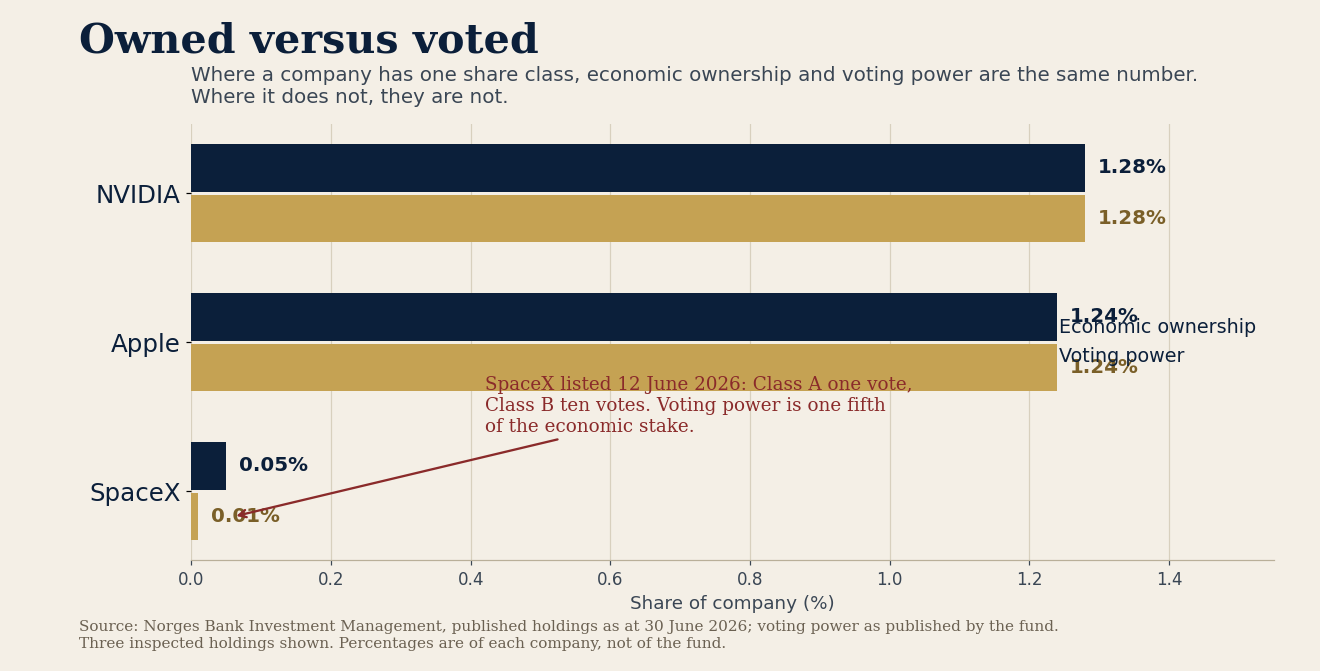
Norges Bank Investment Management published holdings, as at 30 June 2026. Three inspected holdings shown; percentages are of each company, not of the fund.
Scenario · The rights disclosure gap
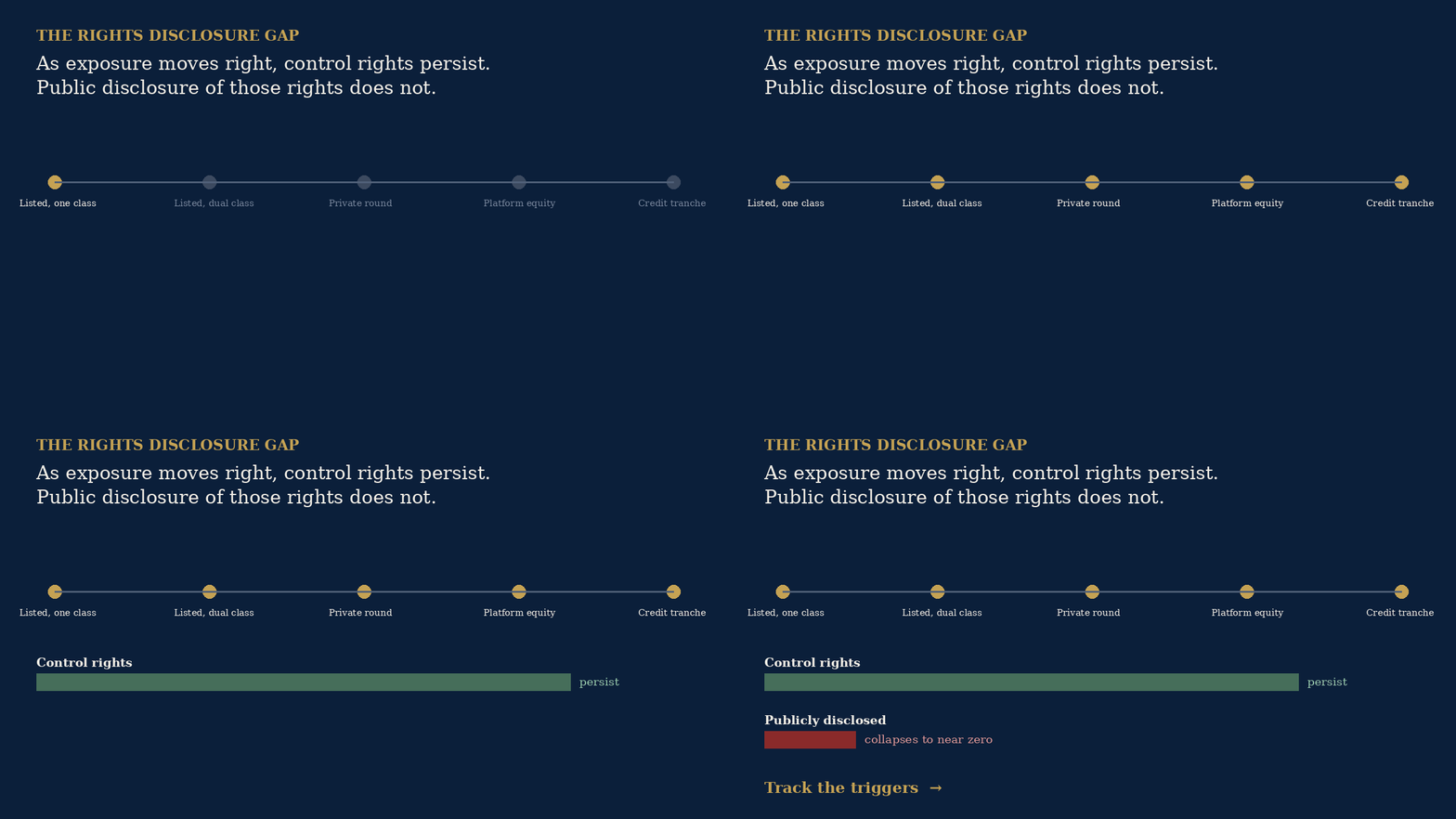
Base case: control rights persist as exposure moves private; public disclosure of them does not. Trigger-based — no probability is attached, because no method, timestamp or update rule exists for this question. Track the triggers ›
The vote that no longer bites
The AFL-CIO published its 2026 Executive Paywatch on 13 August. Excluding Elon Musk’s Tesla award, average S&P 500 chief-executive pay rose 21% to $22.8 million in 2025 from $18.9 million, and the average pay ratio moved from 285:1 to 312:1. Median pay was $17.3 million against a median ratio of 198:1. Including the Tesla grant, the average is $340.1 million and the ratio 5,387:1.
Semler Brossy’s fourth 2026 volume, published 25 June, puts average S&P 500 say-on-pay support at 90.6% year-to-date, with four S&P 500 failures. That is not a record — support was 91.4% in 2017 and 90.8% in 2016 — and it is a figure to 25 June, with late-season votes historically pulling the average down. What can be said is narrower: approval has sat near nine-tenths for a decade, through a period in which average pay rose substantially. High approval is consistent with restraint working, and equally consistent with an advisory instrument that does not bind. The data cannot distinguish the two — which is itself the reason not to treat the approval rate as evidence of control.
The Conference Board’s proxy-season review, released 11 August, shows the ballot narrowing. Against 2025: human-capital proposals down 37%, social down 33%, environmental down 32%. Total filings down 20%; proposals passed down 45%. Governance proposals rose 19% and now make up nearly half of all filings — but roughly 70% of them came from a single proponent. A rising count is not a broadening franchise.
Podcast · The Universal Owner

| Apple Podcasts | Spotify | Podbean |
Seven minutes on why “does it carry a vote?” is the wrong question.
The Back Page


Sources
- “Mighty Norway wealth fund warns of erosion in shareholder rights” — Reuters, 13 Aug 2026
- “Record high krone return in the first half of the year” — Norges Bank Investment Management, 12 Aug 2026
- “All investments” — NBIM published holdings, as at 30 June 2026
- “Space Exploration Technologies Corp. — Form 424(b)(4)” — US Securities and Exchange Commission
- “Anthropic, Macquarie Asset Management, and GIC announce strategic partnership to develop dedicated data center infrastructure at scale” — Macquarie Asset Management, 10 Aug 2026
- “NVIDIA AI Factory Compute Is Becoming an Investable Asset Class” — NVIDIA, 11 Aug 2026
- “Databricks Grows >80% YoY, Surpasses $7B Revenue Run-Rate” — Databricks, 13 Aug 2026
- “Executive Paywatch — 2026” — AFL-CIO, 13 Aug 2026
- “2026 Say on Pay Reports” (Vol. 4) — Semler Brossy, 25 Jun 2026
- “2026 Proxy Season: Human Capital, Environmental, and Social Proposals Decline by Over 30%” — The Conference Board, 11 Aug 2026
- “El Niño/Southern Oscillation (ENSO) Diagnostic Discussion” — NOAA Climate Prediction Center, 13 Aug 2026
- “Експорт з України зернових” — Ukraine Ministry of Agrarian Policy / State Customs Service, 14 Aug 2026
- “July 2026 — Monthly analysis of Russian fossil fuel exports and sanctions” — Centre for Research on Energy and Clean Air
- “Senate Approves Sweeping Russia Sanctions Bill” — Office of Senator Kevin Cramer, 7 Aug 2026
- “3 Killed, 2 Grain Terminals Halt Work in Novorossiysk” — The Moscow Times, 12 Aug 2026
- “SWFs Bolster AI: GIC Extends Anthropic Bet Into Claude Data Centres” — Global SWF, 12 Aug 2026 (estimate only)
Universal Asset Owners · The Editorial Team
Email extra · vertical cut |
One table, if you keep nothing else
SpaceX listed on 12 June with ten-vote founder shares; the position arrived through the benchmark, not a decision. Every source, with article titles and dates: the full ledger on the web edition › — The Editorial Team |