$250bn announced. $1.9bn signed. $500bn still an MoU.
BofA, NVIDIA, Goldman, GIC — six announcements this week, two of them transactions.
UAO EditorialAugust 13, 202626 min read
Who reads this
Before the market opens, this brief is read at the desks that direct more than $50 trillion in permanent capital.
98%
of the world’s sovereign wealth funds
18 of 20
of the world’s largest pension funds
10 of 10
of the largest charitable foundations
85%
of the world’s largest family offices
100+
billionaires, every morning
Circulation is narrow by design. The capital behind it is not.
The Daily Brief of the Universal Owner
Written for the desks that steward the world’s long-horizon capital — sovereign wealth funds, public pensions, endowments, insurers and family offices, an institutional class managing more than $40 trillion. One edition a day. Every claim carried to its source. The second-order read the headlines don’t give you.
If this was forwarded to you, you are reading what the largest allocators read before the market opens.
Bank of America announced a $250 billion infrastructure initiative yesterday morning, and its own methodology counts advisory transactions toward the total. Hours later it signed a definitive agreement to put approximately $1.9 billion into an Indian lender. On the same day, the international compensation fund that exists to pay for oil spills said it would not be involved in paying for one, the Rhine fell to twelve centimetres of navigable depth, and an artificial-intelligence company agreed to absorb a cost that could otherwise land on households. Four of the day’s biggest numbers describe money that has not moved — and the firmest of them is a signed agreement that still awaits approvals and closing.
What happened
At six o’clock on Wednesday morning, Bank of America launched a $250 billion Critical Infrastructure Finance Initiative covering digital infrastructure, energy and power, and what it calls core infrastructure — transport, water, semiconductors, critical minerals.1 It runs from 1 January 2026 to 4 July 2027, and a large share of that measurement window is already behind it.
The number is real. So is the sentence underneath it, which is the part worth reading:
“Progress for this initiative will be measured solely based on eligible activity in primary market lending, investing, capital markets and advisory transactions, consistent with Bank of America’s methodology for its $1.5 trillion ten-year sustainable finance goal.”
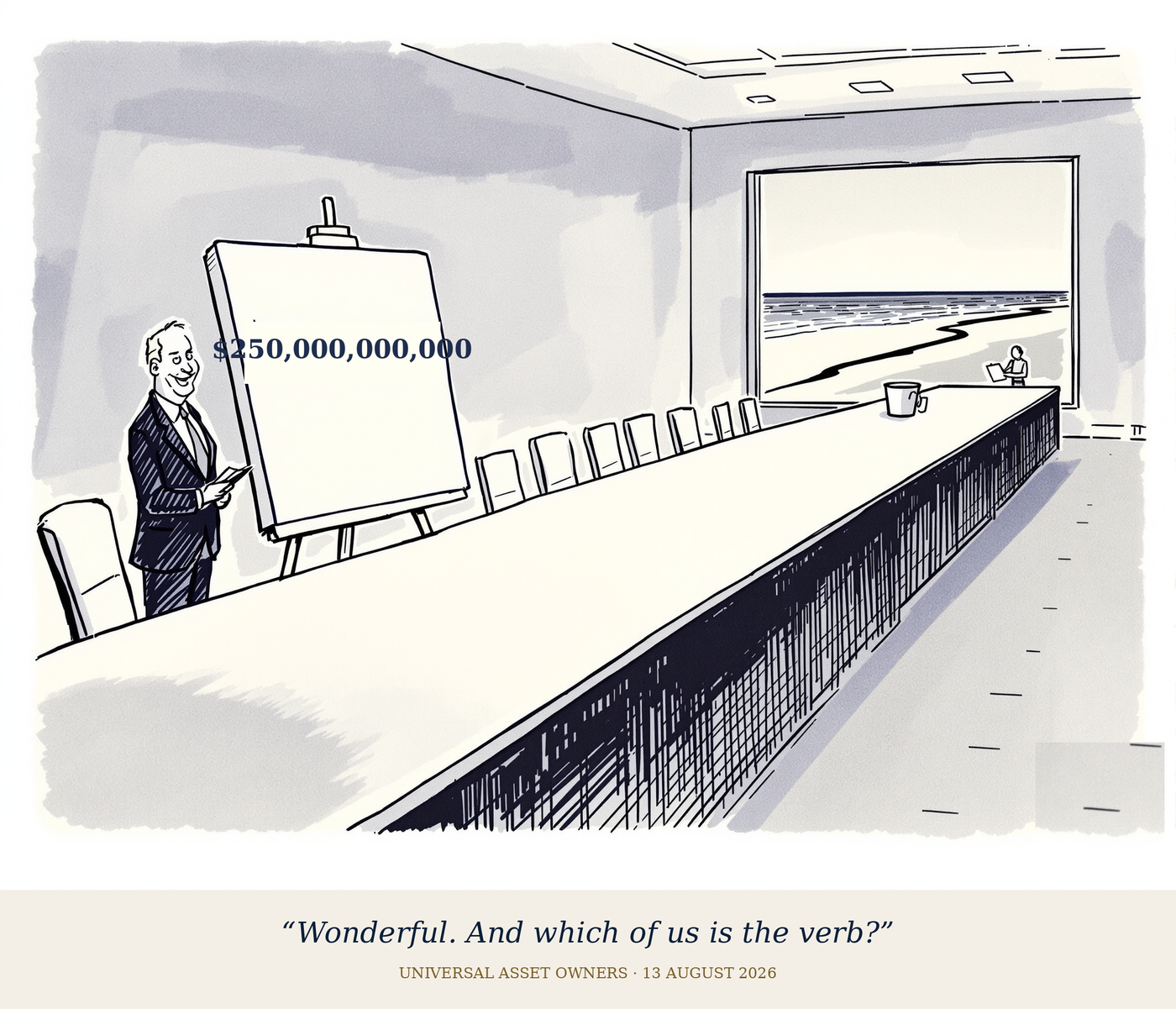
Four categories. Only the first two — lending and investing — necessarily put the bank’s own balance sheet at risk; how much retained exposure sits inside the capital-markets and advisory categories depends on the transaction, and the release does not disclose the mix. A transaction the bank advises somebody else on counts toward the $250 billion. So does an underwriting it distributes in full. The verb in the headline is “mobilize and deploy,” and the first word is doing most of the work.
None of that is concealed. It is in the release, in the same paragraph as the number, and it is the identical methodology the bank has applied to its sustainable-finance goal for five years. The problem is not disclosure. The problem is that the number travels and the sentence does not.
Then, later the same day, Bank of America did something categorically different.
It entered a definitive agreement with Jio Financial Services to invest ₹18,268.22 crore — approximately $1.9 billion in the bank’s own words — in Jio Credit.2 The structure is specific to the share: up to 42.9 million equity shares at ₹10 face value, ₹66.1 billion, taking 26.5 per cent of post-issue paid-up capital; plus up to 75.7 million warrants, ₹116.6 billion, convertible one-for-one within eighteen months at 25 per cent upfront and 75 per cent on conversion. Fully converted, that is 49.9 per cent. The agreement is subject to regulatory approval and closing conditions — a signed commitment of the bank’s own capital, not yet funded cash.
You can reconstruct the second number from its stated share and warrant terms. The first cannot be assessed until the bank publishes its composition.
Four headline figures, four different stages
Wednesday was not an outlier. Look at what else carried a headline figure this week.
Announcement
Headline
What it actually is
Bank of America infrastructure initiative
$250bn
Activity target; counts advisory and capital-markets work
NVIDIA + six managers
>$500bn
Non-binding MoUs, “subject to execution of the final agreements”
EQT for Cleanaway
A$9.4bn
“Conditional, non-binding indicative proposal”
Colombia reconstruction
—
Fund named Fondo Milagro; no amount disclosed
Bank of America into Jio Credit
~$1.9bn
Definitive agreement, share count stated
Goldman Sachs for NEOS
up to $2.25bn
Agreed; the ceiling is contingent on performance and service commitments
NVIDIA’s platform announcement on 10 August is the largest of them. It signed memorandums of understanding with Apollo, BlackRock, Blackstone, Brookfield, Goldman Sachs and KKR to “mobilize over $500 billion of third-party capital … over time.”5 The release states plainly that the partnerships “remain subject to execution of the final agreements.” Third-party capital, over an unspecified period, under agreements that do not yet exist.
We should say what is not in that release, because it has been widely reported that it is. There is no “DSX reference design” underwriting hardware obsolescence — “DSX” appears once, inside a chief executive’s quote about building “DSX AI factories.” And there is no residual-value support of any kind, anywhere in the document. The suspicion that somebody must be absorbing GPU depreciation risk for this debt to be financeable is a reasonable one. It is not, on this evidence, a claim about NVIDIA.
EQT’s approach to Cleanaway is the cleanest example of the genre because the company itself is scrupulous about it. The ASX release calls it a “conditional, non-binding indicative proposal” at A$3.13 cash per share less dividends, an enterprise value of about A$9.4 billion, a 32.1 per cent premium to Wednesday’s A$2.37 close and 34.2 per cent to the one-month VWAP, implying roughly 20 times FY26 EBIT.6 Cleanaway has granted up to nine weeks of exclusive diligence. It follows an earlier unsolicited proposal at A$3.00. There is a detail in the deed that has not been reported: a ticking fee of 0.02 cents per share per day after 31 March 2027 — a contingent incentive that bites only if the process runs past that date.
An allocator reading the tape sees A$9.4 billion. An allocator reading the deed sees a price, a diligence window, a walk-away and an interest clock.
The three that were not negotiable
Now the other column.
The International Oil Pollution Compensation Funds say they will not pay for the spill reaching Oman. The Caroline Bezengi — a 25-year-old tanker carrying an estimated 800,000 barrels of sanctioned Russian crude, and we should be exact that this is cargo aboard, not volume spilled — grounded on 30 June after a blast off Yemen on 8 June. Oil has now reached Oman’s coastline. The IOPC Funds, the body that exists precisely to allocate marine pollution costs, told a news agency this week that they will not be involved in clean-up costs because the incident is being treated as an act of war.23 No published Fund decision has been located. The vessel is reported to carry no recognised Western insurer.
The spill’s size is genuinely contested and we are not going to pick a number. Oman’s own estimate on 10 August was about 400 square kilometres. SkyTruth’s John Amos, reviewing imagery obtained by a news agency, put it above 2,000 square kilometres.24 Greenpeace has published a rising series of 45, then 150, then 600 square kilometres. Agencies say the oil could affect roughly 40 kilometres of coast near Ras Madraka and Masirah Island. Who ultimately pays has not been established: the shipowner and any insurer ordinarily form the first tier of the compensation architecture, subject to statutory defences, and the Funds sit above them. What this week’s statement raises is the possibility that sanctions exposure, non-standard insurance and a war-risk characterisation together leave the residual with a government that neither owned the vessel nor bought the oil.
The Rhine stopped taking indicative proposals. Navigable depth at Kaub fell to 12 centimetres on Wednesday, from 15 the day before.26 That figure needs its label: it is navigable depth (Fahrrinnentiefe), not the gauge, and the river itself runs about a metre deeper than that measurement implies. The gauge is on its own record — 24 centimetres on 3 August, beating a mark set in October 2018. A commodity trader described most north–south commercial traffic through the chokepoint as effectively halted — the waterways authority has not said that, there has been no formal closure, and lightly loaded barges can still pass — and rail substitution has begun. Kaub connects chemicals, steel, fuels, power generation and agriculture. A portfolio can hold all five and believe it is diversified.
And Anthropic agreed to pay for something it did not have to. On 10 August, Macquarie Asset Management and GIC announced a platform to “develop, operate and lease data center infrastructure at scale to Anthropic under long-term agreements.”4 Macquarie-managed funds and GIC own the platform and fund the majority of the equity for each project; Anthropic is the anchor tenant; the initial focus is the United States. No dollar size was disclosed. No megawatt figure was disclosed. Both should be treated as unknown until somebody publishes them.
The sentence that matters is this one: “Anthropic will cover electricity price increases that consumers otherwise may face from these sites” — which the release says is in line with commitments Anthropic announced earlier this year.
That is a private company contracting to absorb a cost that data-centre build-outs can otherwise shift to retail ratepayers, depending on jurisdiction and tariff design. The commitment itself is not new — the deal applies one Anthropic had already announced — but this is the first disclosed financing structure in which we have seen it written into the deal rather than promised in a policy statement, and we have not identified a comparable disclosed provision in another hyperscale platform. That is a disclosure observation, not a claim of a market first. It got a fraction of the coverage the $500 billion MoU got. It is worth more to a universal owner, because it converts an argued-about externality into an assigned, contractable liability — even though no price, formula, cap or enforcement mechanism has been disclosed.
Allocator Lens: what this means for the portfolio
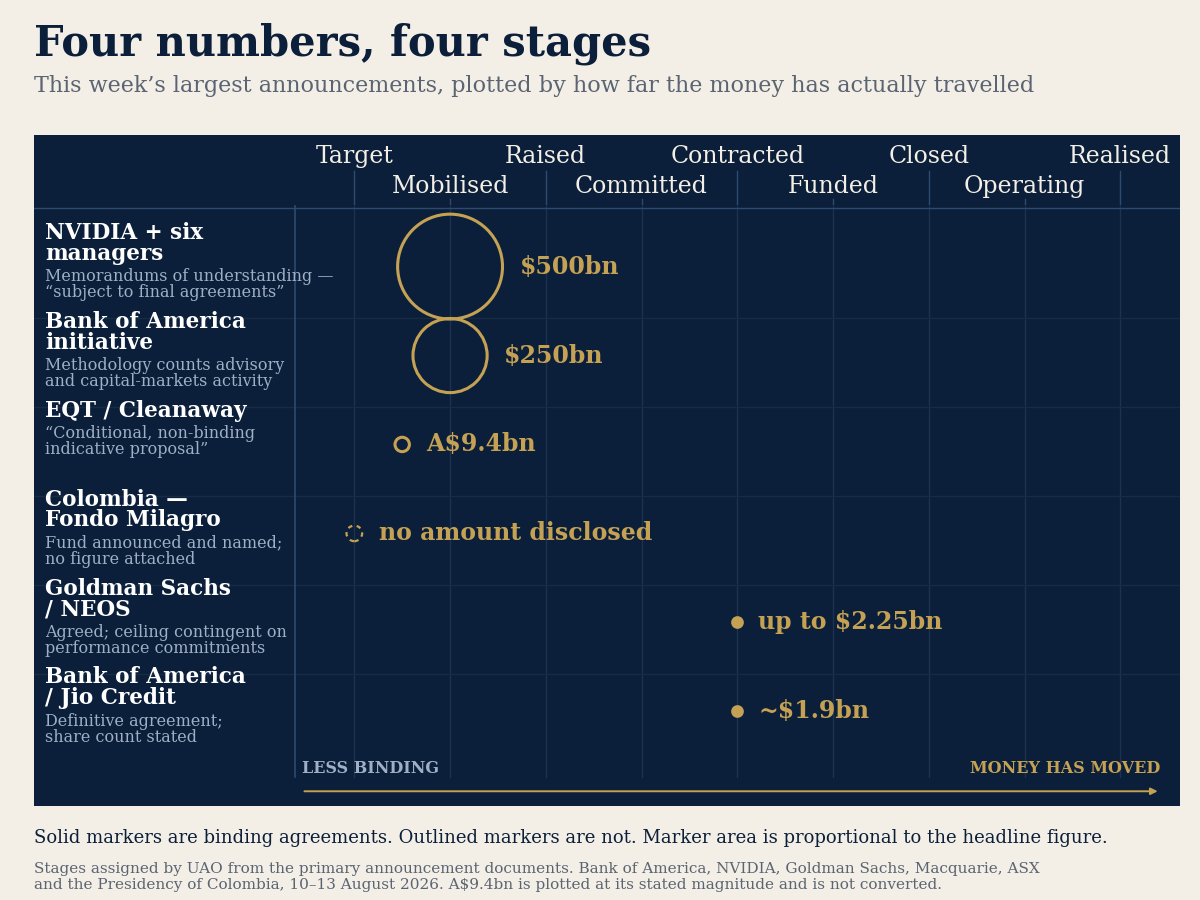
Stop putting announcements in one column. The single most useful piece of internal plumbing an investment office can build this quarter costs nothing: a stage field on every capital announcement it tracks. Target · Mobilised or facilitated · Raised · Committed · Contracted · Funded · Closed · Operating · Realised. Bank of America’s $250 billion and its $1.9 billion sit four stages apart and were reported identically. So do NVIDIA’s $500 billion and Goldman’s NEOS agreement. A pipeline that cannot distinguish them is not a pipeline.
The test to run this month. Take every infrastructure or AI “commitment” above $10 billion your team has logged since January. For each one, answer three questions from the primary document, not the coverage: Whose balance sheet? What triggers the obligation? What happens if nothing is signed? Our expectation, and it is only that, is that fewer than a third survive with a named obligor and a binding trigger.
The mirror discipline is the one nobody runs. Do the same exercise on liabilities. For every physical exposure in the book — a port, a river-dependent industrial, a coastal insurer, a sanctioned-trade counterparty — ask who pays if the compensation mechanism declines. Oman is the live worked example: the P&I and IOPC architecture is designed to answer that question, and this week it answered not us. An “act of war” exclusion is not exotic. It is in most of your contracts.
⚠ Embedded exposure flag. Any AI-infrastructure allocation made this quarter carries a power liability that its label does not disclose. The Anthropic clause is the first such assignment we have identified in a disclosed financing structure — the commitment itself was announced by Anthropic earlier this year. Until this week the honest answer to “who pays for the grid impact of the compute build-out” was nobody has said in a deal document. One structure now says. Ask whether your other data-centre exposures carry anything comparable; none we have reviewed discloses one.
Capital flows
Goldman Sachs Asset Management agreed on 12 August to acquire NEOS Investments for consideration of up to $2.25 billion in cash and equity, with the ceiling “subject to the achievement of certain performance and/or service commitments.”3 NEOS manages $30 billion across 19 options-based income ETFs as of 30 June. The deal is expected to close in the first quarter of 2027, subject to regulatory approval, and, on Goldman’s own figures, would make it the eighth-largest active ETF manager, with roughly $80 billion of active and $130 billion of total ETF assets.
For asset owners the interesting part is not the consolidation, which is continuous, but the product. Nineteen funds, all options-based income. That is a distribution channel selling volatility-harvesting to buyers who want yield without duration — which is to say, it is a bet that the retirement-income problem gets solved in the ETF wrapper rather than in the annuity. If you run a defined-contribution plan, that is a competitor for your members’ decumulation decision.
Bank of America into Jio Credit is the more consequential structure. A global bank taking up to half of an Indian non-bank lender that reached its scale in roughly two years, alongside Jio Financial’s existing arrangements with BlackRock in asset management and Allianz in insurance, is not a foreign-bank branch expansion. It is local digital distribution attached to foreign balance sheet and underwriting. Watch the funding mix and the asset-quality disclosures, not the stake.
EQT and Cleanaway is worth watching as a category rather than a transaction. Waste and recycling carries what long-duration capital says it wants — essential-service demand, municipal and industrial contracts, regulatory barriers to entry — and 20 times FY26 EBIT is an infrastructure multiple, not a buyout multiple. If it completes, it will become a reference point in environmental-services processes for years.
And a note on what is not here. There is no major new sovereign-fund or public-pension purchase in the window strong enough to print. NBIM’s half-year and Ontario Teachers’ venture book were our lead on 12 August and are not repeated. We would rather say the window was thin than recycle Wednesday’s edition.
The macro that actually moved
Three official releases on Wednesday, and they do not tell the same story.
US CPI for July came in soft and the composition did not. Headline rose 0.1 per cent on the month and 3.4 per cent on the year; core rose 0.2 per cent and 2.5 per cent.7 Underneath, energy is still 14.7 per cent higher than a year ago and gasoline 24.6 per cent higher, even after both fell on the month. A headline that decelerates while its most volatile major component sits a quarter higher than last year is not an all-clear for an inflation-linked liability.
The Treasury’s July statement is the more interesting document. The monthly deficit was $432 billion, a July record, 48 per cent larger than a year earlier and the biggest monthly gap since March 2021.8 Adjust for the $99 billion of benefit payments shifted into the month and it is $333 billion, still 18 per cent up. Fiscal-year-to-date, the deficit is $1.799 trillion — already larger than the whole of FY2025 with two months left to run.
The mechanism is the part that has not been priced. Customs receipts were negative for a third consecutive month: $33.38 billion of tariff refunds against collections produced a net outflow of $8.55 billion. This is the Supreme Court’s 20 February ruling working through the cash accounts — six to three, Roberts writing, that IEEPA does not authorise tariffs; collection halted on 24 February; roughly $166 billion eligible for refund, of which about $100 billion has gone out since May.9 Replacement duties may restore future revenue. They cannot offset the financing requirement until collections exceed the refunds still being paid, and that has not happened yet.
Oil is adjusting through a combined shock — supply loss and demand destruction at once. The IEA cut its 2026 supply forecast to minus 4.3 million barrels a day from minus 3.7, put the third-quarter deficit at 1.8 million b/d, and counted 410 million barrels of cumulative stock draws since the Iran war began — inventories now below 7.9 billion barrels, the lowest since April 2025.11 Global refinery throughput is 80.9 million b/d, nearly 5 million below a year ago. And the agency now expects 2026 demand to contract by 1.6 million b/d.
OPEC, publishing the same week, still expects demand to grow by 580,000 b/d — its fourth consecutive downward revision, but growth.12 The two agencies are 2.18 million barrels a day apart on the direction of global oil demand, which is not a forecasting disagreement so much as a statement that nobody can currently see the physical market. Meanwhile US commercial crude built 17.4 million barrels in a single week — the largest since January 2023 — on collapsed exports.10
For a universal owner the useful distinction is this: demand falling because consumers are comfortable is a soft landing. Demand falling because fuel is unavailable or unaffordable is a supply shock wearing a soft landing’s clothes. The IEA’s own composition — record margins, throughput five million barrels below last year — points at the second.
Decisions due and the week ahead
Bank of America’s first composition disclosure. The $250 billion has no meaning until the bank publishes the split between principal lending, principal investment, underwriting and advisory, and states how much is genuinely incremental after 1 January. That is the single highest-value follow-up in this edition and we have filed for it.
Cleanaway’s Scheme Implementation Deed, or its absence. Up to nine weeks from 13 August. The proposal becomes a transaction only on signature.
The next Bank of Japan read. July CGPI at 7.2 per cent with import prices 29.1 per cent higher year-on-year is a producer-price shock that consumer subsidies are currently masking.13 The pass-through question is a 2027 duration question for anyone holding JGBs.
Also this week: India’s July CPI at 4.45 per cent with food at 5.52 per cent — the constraint is food, not the headline.14 Swiss Re’s H1 catastrophe data landed on 11 August.15 In France, a ministerial estimate of €10–15 billion in heat costs was attributed to INSEE — which says it is not the source and holds no such estimate; a caution on how quickly climate-cost figures outrun their evidence.27 And Colombia’s earthquake toll stood at 265 dead, 3,494 injured and 496 missing on Wednesday’s official bulletin; the reconstruction fund it prompted, Fondo Milagro, still has no amount attached.28
The Universal Owner Risk Radar
Every item carries a dated, reproducible observation and links to the issuing authority.
Signal
Observation
As of
Authority
Chokepoint sea-state — Hormuz
Wind 29.1 km/h, gusts 40.3, wave 0.64 m — elevated
⚠ Read the chokepoint rows correctly. Open-Meteo measures weather and sea-state only. An “elevated” reading means wind or waves could slow transits today. It says nothing about the political and military constraints on Hormuz, which are a standing condition and not a meteorological one. A calm sea at a constrained strait is still a constrained strait. We flag this because an event-driven feed will never re-report a state.
⚠ The space-weather item is deliberately de-escalated, as it was on 12 August. A cancelled watch below the minor-storm threshold is background, not a tail risk.
Coverage note: there is no media-buzz or pre-consensus row today. We would rather leave the row out than infer one.
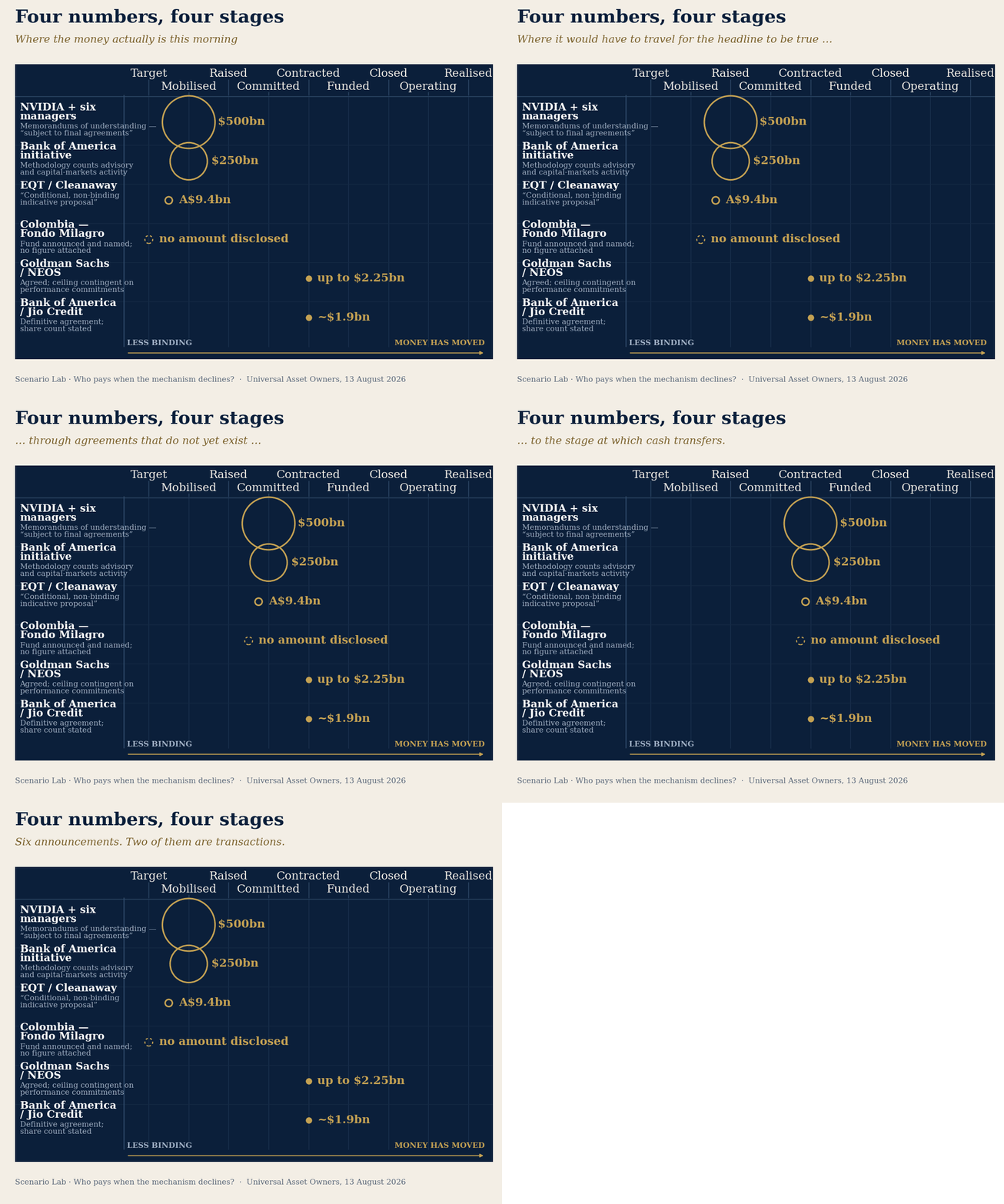
Six announcements across the stage ledger. Stages assigned by UAO from the primary announcement documents — Bank of America, NVIDIA, Goldman Sachs, Cleanaway (via ASX) and the Presidency of Colombia, 10–13 August 2026. Marker area is proportional to the headline figure; solid markers are binding agreements; Colombia’s fund, announced without an amount, is the empty dashed marker. A$9.4bn is plotted at its stated magnitude and is not converted to US dollars.
Scenario · Who pays when the mechanism declines?
A trigger-based scenario — what would have to happen, not a guessed probability.
Scenario Lab · Who pays when the mechanism declines? Five states, from where the money is to where the headline says it is.
Three observable triggers, each with a named authority and a portfolio consequence. This is a monitoring frame, not a forecast.
If this is observed
Then the reading changes to
Watch here
Bank of America publishes the composition split and principal lending plus principal investment exceeds half the $250bn
Mobilisation language is conservative, not inflationary; the stage-discipline argument weakens materially and we will say so
BofA quarterly disclosure
A second data-centre transaction copies the Anthropic consumer-power clause
The power externality has become a market standard rather than a one-off negotiation; underwriting and covenants follow within four quarters
Deal announcements, PPA filings
Oman appropriates public money for the Caroline Bezengi clean-up with no recovery secured
The act-of-war exclusion is functionally load-bearing, not theoretical; re-read the same exclusions across marine, political-risk and terrorism cover in your own book
Omani budget documents, IOPC Funds
NVIDIA’s first definitive agreement is signed and the first securitisation is rated
The $500bn moves from stage two to stage five and becomes an analysable credit; until then it is a pipeline, not an asset class
Rating-agency new-issue reports
Kaub navigable depth recovers above 40 cm for ten consecutive days
The Rhine constraint is seasonal rather than structural for 2026; industrial inventory drawdown reverses
German waterways authority daily gauge
Disconfirming evidence we would accept. If the majority of this week’s headline figures convert to funded exposure within twelve months at the stated sizes, the “stage inflation” reading is wrong and the correct one is simply that the AI capital cycle is very large. We would rather find that out from the disclosure than assume it either way.
No probability is published with this scenario. It is deliberately trigger-based: what would have to happen, and where you would see it first.
The tape
Close, Wed 12 Aug 2026
Change
S&P 500
7,748.50
+0.3%
Nasdaq Composite
26,588.49
+0.5%
Dow Jones Industrial
53,770.27
−0.04%
US 10-year (Treasury par yield)
4.68%
from 4.70%
US 2-year (Treasury par yield)
4.20%
from 4.22%
10y–2y spread
+48 bp
VIX
14.55
from 15.28
Brent, front month
$88.98
+$0.07
WTI, front month
$83.27
+$0.07
US high-yield OAS
2.72%
as of 11 Aug
Treasury yields are the official par yield curve. Brent and WTI are wire settlements, not exchange settlement files. The VIX close is derived from FRED’s 11 August observation of 15.28 and two independent same-day market snapshots that reconcile to −0.73. The high-yield OAS is the ICE BofA series via FRED and is an 11 August figure; 12 August had not published at press time. COMEX gold and the dollar index are omitted: sources disagreed by more than $60 on gold and we will not print a number we cannot source to a close.
Note the spot–futures gap. EIA’s Brent spot price was $93.26 on 11 August against a front-month future near $89.10 That is consistent with the backwardation the IEA described, and the two figures are not interchangeable.
What we left out today, and why
No media-buzz or pre-consensus row. The Risk Radar is built entirely from the primary authorities today; we would rather leave a row out than infer one.
Gold and the dollar index are out of the tape. Sources disagreed by more than $60 on the gold close. We do not print a number we cannot carry to a settlement.
The high-yield OAS is an 11 August figure, labelled as such. The 12 August observation had not published at press time.
The Macquarie–GIC platform is unnamed here because no primary document names it.
The deep dive · The Capital Stage Ledger
The long read, carried here in full.
Nine words describe where a dollar actually is — target, mobilised, raised, committed, contracted, funded, closed, operating, realised. The industry uses one column for all of them, and the gap between the first and the seventh is where investment committees are currently being misled, mostly by accident.
The problem is not dishonesty
Start by dismissing the cynical reading, because it is wrong and it will make you miss the actual risk.
Bank of America published its methodology in the same release as its number.1 NVIDIA wrote “memorandums of understanding” and “subject to execution of the final agreements” into its own announcement.5 Cleanaway’s ASX filing says “conditional, non-binding indicative proposal” in the first line and repeats it.6 Goldman Sachs wrote “up to” and disclosed that the ceiling depends on performance and service commitments.3 Macquarie and GIC disclosed no size at all, which is the most honest thing any of them did.4
Every one of these institutions told the truth in the primary document. The distortion happens entirely downstream, in the aggregation — in the tracker, the pipeline, the board pack and the market-sizing slide, where a $250 billion activity target, a $500 billion non-binding MoU and a $1.9 billion definitive agreement all become rows in the same table with the same header.
That is a data-architecture failure, not an ethics failure. Which is good news, because data-architecture failures are fixable in a quarter.
Nine stages, and why the middle four are where the damage is
Stage
What it means
Can you audit it?
Target
An aspiration, usually with a horizon
No
Mobilised / facilitated
May include third-party capital, underwriting, advisory
Only against a disclosed methodology
Raised
Legally committed to a fund or vehicle
Yes — fund documents
Committed
Allocated to an investment, not necessarily funded
Yes — LPA / IC minutes
Contracted
Binding commercial agreement signed
Yes — the deed
Funded / deployed
Cash has transferred
Yes — the bank statement
Closed
Transaction legally complete
Yes — completion notice
Operating
The asset produces economic output
Yes — the meter
Realised
Capital returned
Yes
Stages one and two are the ones that generate press releases. Stages six through nine are the ones that generate cash flows. The middle four — raised, committed, contracted, funded — are where most institutional analysis actually lives and where almost no public reporting is precise.
Run this week’s file through it and the picture reorganises immediately. NVIDIA’s $500 billion is stage two, and explicitly conditional on documents that do not exist. Bank of America’s $250 billion is stage two by its own methodology. EQT’s A$9.4 billion is pre-stage-five: a proposal with a diligence window and a ticking fee that prices delay to March 2027. Colombia’s Fondo Milagro is stage one with the number left blank. Goldman’s NEOS acquisition is stage five with a contingent ceiling. Bank of America’s Jio Credit investment is stage five with a stated share count, and moves toward funding only as approvals and closing conditions are met.
Six announcements. Two of them are transactions.
The number that should worry a chief risk officer is not the big one
Here is the part that turns a taxonomy lesson into a risk question.
Suppose the mobilisation totals now circulating are broadly accurate as activity forecasts. NVIDIA’s six counterparties are the six largest alternative managers on earth, and the limited partners in their infrastructure and private-credit funds are pension plans, sovereign funds and life insurers. Bank of America’s initiative, Morgan Stanley’s and JPMorgan’s each carry multi-hundred-billion or trillion-dollar labels. These are not separate pools of capital chasing separate assets. They are substantially the same balance sheets, arranged through different intermediaries, pointed at the same shortlist of hyperscale data-centre projects, the same transformer order books and the same interconnection queues.
Concentration risk in this build-out will not show up as a large exposure to any one manager. It will show up as the same three projects appearing, under different names, in the underlying holdings of four funds an allocator believes are diversifying one another. You cannot see that from the headline totals. You can only see it from funded exposure and project counterparties, which is precisely the disclosure nobody currently provides.
That is the follow-up we have filed with Bank of America, and it is the one we would encourage any LP to file with its general partners: not how much have you committed, but to which assets has cash actually gone, and who else is on the capital stack.
The mirror: liabilities do not have stages
Now run the discipline backwards, because this is where it earns its keep.
Capital announcements have nine stages. Liabilities have one. They exist or they do not, and when they crystallise they do so at full size, immediately, with no diligence period.
The Caroline Bezengi is the worked example of the year. A tanker with no recognised Western insurer, carrying sanctioned cargo, grounds off Oman. The International Oil Pollution Compensation Funds — an intergovernmental architecture built across five decades for exactly this event — has told a news agency it will not be involved in clean-up costs, because the incident is being treated as an act of war.23 No published Fund decision has been located, and the shipowner and any insurer ordinarily form the first tier of that architecture, subject to defences. But there is no indicative stage on a beach: if no tier of the mechanism responds, the bill defaults to whoever owns the coastline.
The transmission for an institutional portfolio is not the tanker. It is the precedent: an act-of-war exclusion in a compensation regime is not exotic drafting. Variants of it appear in marine, aviation, political-risk, terrorism and cyber policies across many institutional books — the only way to know your own exposure is to pull the wording. What this week established is that the exclusion can be invoked in an incident that looks, to a non-lawyer, like an ordinary maritime casualty. If sanctioned-trade activity keeps expanding — and the shadow fleet is now a structural feature of seaborne crude, not a temporary one — the population of casualties that fall outside the compensation architecture expands with it.
The Rhine makes the same point without any legal complexity at all. Twelve centimetres of navigable depth at Kaub does not negotiate, cannot be refinanced, and does not care which stage anybody’s capital is at.26
The one deal this week that priced a liability instead of announcing capital
Which brings us to the most interesting document of the week, which carried the smallest headline.
In the GIC–Macquarie–Anthropic data-centre platform, Macquarie-managed funds and GIC own the platform and fund the majority of the equity in each project. Anthropic is the anchor tenant under long-term agreements. No size disclosed, no capacity disclosed, initial focus the United States.4
And: “Anthropic will cover electricity price increases that consumers otherwise may face from these sites.”
Read that as a risk-allocation document rather than a press release. For three years the argument about hyperscale compute and retail power prices has mostly run on assertions in regulatory filings. Here, a tenant has agreed contractually to absorb a cost that disclosed structures have to date left with ratepayers — which implies the parties negotiated who bears it, and found it material enough to write into the deal. No price, formula, cap or enforcement mechanism has been disclosed, and the commitment itself carries forward one Anthropic had announced earlier this year.
For an owner of the whole market, that is worth more than the $500 billion figure. The $500 billion tells you how much capital might come. The Anthropic clause tells you that the power externality is now an assigned, contractable liability — which is the precondition for it becoming a covenant, an underwriting input and eventually a regulatory requirement.
If you hold utilities, grid infrastructure, data-centre private credit or the equity of any hyperscaler, that single sentence is the beginning of a repricing.
What a serious allocator does with this by Friday
One. Add a stage field to every capital announcement your team tracks. Nine values. No dollar figure enters a board pack or a market-sizing exercise without one. This is an afternoon of work.
Two. Re-stage the last six months of logged commitments above $10 billion, sourced from the primary document. Expect the aggregate to fall sharply. That fall is not a loss; it is the removal of an error you were already carrying.
Three. For every private-credit and infrastructure fund in the book with AI-adjacent exposure, request funded exposure by project and the identity of co-lenders. Not commitments. Funded, by project. If a GP declines, that is itself information.
Four. Have your insurance and legal teams pull the act-of-war and sanctions exclusions from your own marine, political-risk and terrorism cover, and map which counterparties in the book rely on the same architecture the IOPC Funds just declined to apply.
Five. Add one line to your data-centre and utility underwriting: who bears the retail power impact, and is it written down? As of this week there is one disclosed deal we have identified where the answer is “the tenant, in the contract.” Use it as the benchmark question.
The uncomfortable conclusion
The institutional capital industry has spent a decade getting better at announcing and no better at staging. The result is an information environment in which the largest numbers are the least binding, the most binding numbers are unannounced, and the liabilities that will actually move a funding ratio arrive with no announcement at all.
None of that requires anybody to have lied. It only requires everybody to have used one column.
Allocator Lens: the one-line version for an investment committee
We will no longer record a capital announcement without recording its stage, and we will apply the same discipline to liabilities by asking, for each physical and counterparty exposure, who pays when the compensation mechanism declines.
The measurable output: a re-staged pipeline by 30 September, and a funded-exposure request to every GP with AI-infrastructure exposure in the same cycle.
The thing to watch for confirmation: Bank of America’s first composition disclosure, and whether any second data-centre transaction copies the Anthropic power clause. One instance is a negotiation. Two is a market standard forming.
GIC — roles across public and private markets, Singapore and global offices — the fund on the other side of this edition’s Anthropic data-centre platform
Universal Asset Owners · The Editorial Team Sources checked through 13 August 2026. Material claims are linked to named sources; primary or first-party sources are used throughout.