
This week the risk the Bank of England has spent a year warning about stopped being a forecast. On June 22, Prime Minister Keir Starmer resigned, opening a Labour leadership contest — and the UK government-bond market repriced in real time. Thirty-year gilt yields sit near 5.5% and the ten-year near 4.84%, already the highest in the G7, while sterling has slipped about 3% since February to roughly $1.32. For a universal owner this is not Westminster theatre. It is a live demonstration that a developed-market sovereign curve can be repriced by domestic politics — the exposure you carry in every duration sleeve and cannot diversify away.

▶ Watch today's 2-minute video brief · 🎧 Listen: Podbean · Apple · Spotify
1. The UK just repriced a G7 curve on politics.
Starmer's resignation on June 22 — the UK's sixth prime minister in seven years — triggered a Labour leadership race, with nominations opening July 9 and a successor due before Parliament returns in September. Andy Burnham, fresh from a Makerfield by-election win, is the frontrunner. Gilts had already been signalling stress: the 10-year near 4.84% sits sharply above international peers, the 30-year near 5.5%, and sterling is down ~3% since February. The Bank of England's Financial Policy Committee names sovereign debt among its top-three stability risks. Read the full story →
2. Stewardship goes on trial — in London, today.
The PRI convenes roughly 100 senior investors for its Investor Day at London Climate Action Week today, under Chatham House Rule, to argue system-level stewardship as fiduciary risk management — engagement reframed not as values investing but as managing a portfolio you cannot diversify out of. It lands on a widening trans-Atlantic fault line: the UK's FRC Stewardship Code 2026 builds stewardship into fiduciary duty, while 2026 US Department of Labor guidance narrows ESG-driven latitude for ERISA plans. See the agenda →
3. The largest owner's ethics tool is switched off.
Even as stewardship goes on trial, Norway's $2 trillion Government Pension Fund Global — the world's largest single owner of listed equities — has its primary stewardship lever paused. Under temporary Ministry of Finance guidelines, Norges Bank may revoke but not make new observation or exclusion decisions, pending a government framework review due October 15. The Council on Ethics keeps monitoring, but its recommendations are no longer public. How NBIM exclusions work →
Stewardship & Duty Watch — one duty, two incompatible legal readings
The universal owner operates on both sides of the Atlantic — and now has to discharge a single fiduciary duty under two opposite definitions of what that duty is. In the UK, the FRC Code makes stewardship part of fiduciary duty; in the US, DOL guidance treats ESG-motivated voting as suspect inside ERISA plans. Whether pressing a portfolio company to disclose refinancing or supply-chain risk counts as prudent stewardship or off-limits politics now depends on which jurisdiction's lawyer is in the room.
Asset-Owner Moves — long-horizon owners buy the grid
- APG, GIC and NBIM agreed to invest up to €9.5bn for a 46% stake in TenneT Germany (valuing it ~€40bn), as Germany's KfW sells a 25.1% slice for ~€3.3bn — pension and sovereign capital anchoring core grid infrastructure. Details →
- The deal is the template in miniature: the energy transition needs trillions of long-duration equity, and the owners who can hold it for thirty years are becoming the backstop bidders for regulated infrastructure.
The Probability Desk — a live model, not a chart
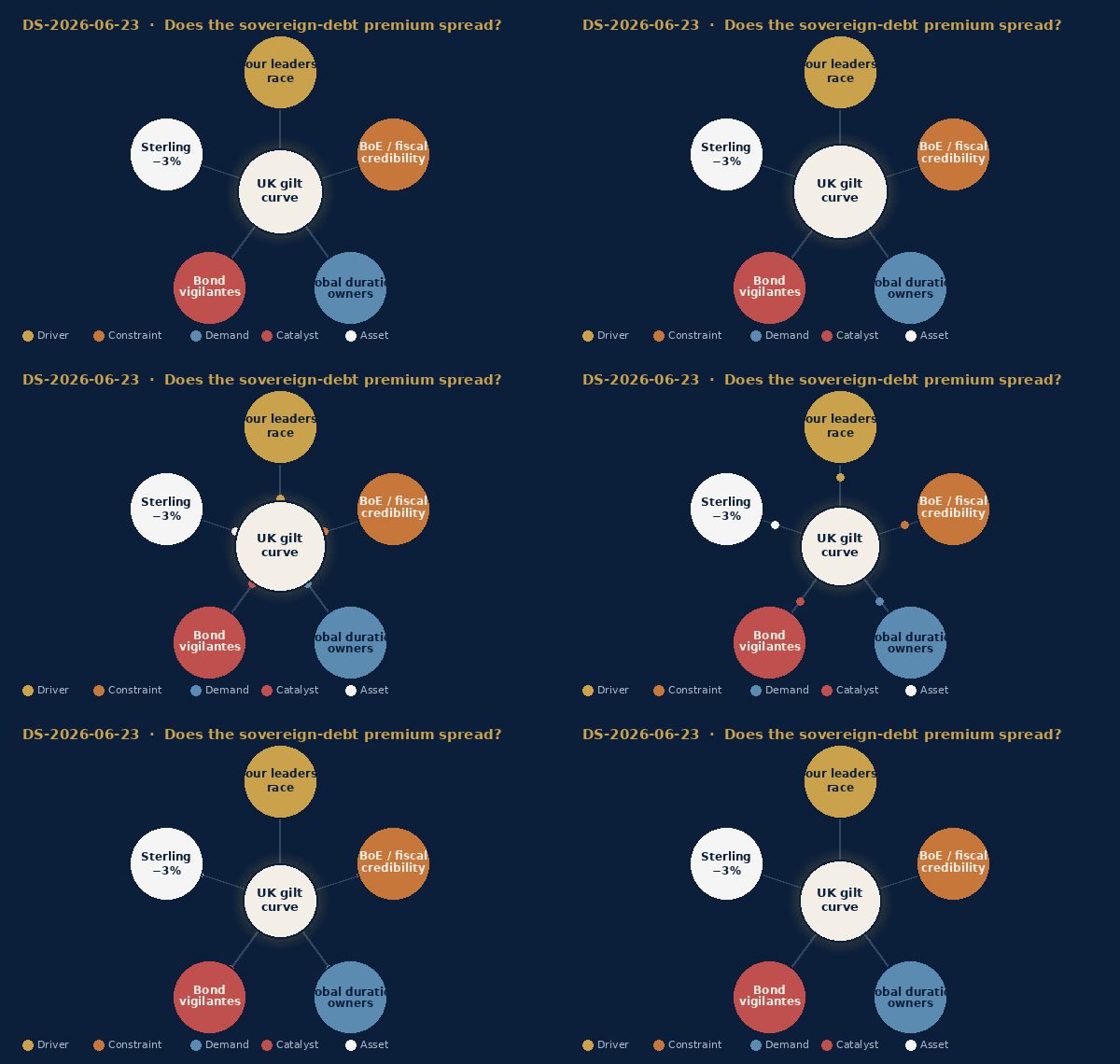
Does the sovereign-debt premium spread? Today's model maps what keeps the UK repricing contained — and what makes it jump to other G7 curves. Open it, click any player — a global duration owner, the BoE, the bond vigilantes — and ask the desk what they do next. Open the live scenario →
Chart of the day
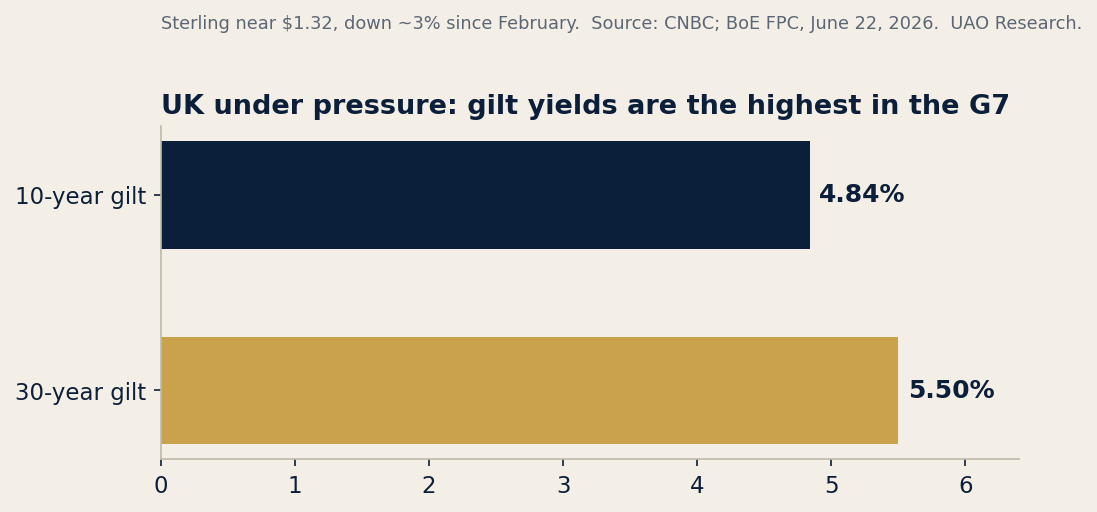
The highest sovereign yields in the G7 — repriced on politics. Source: CNBC; BoE FPC, June 22, 2026. UAO Research.
Free tool — the Policy-Risk Radar
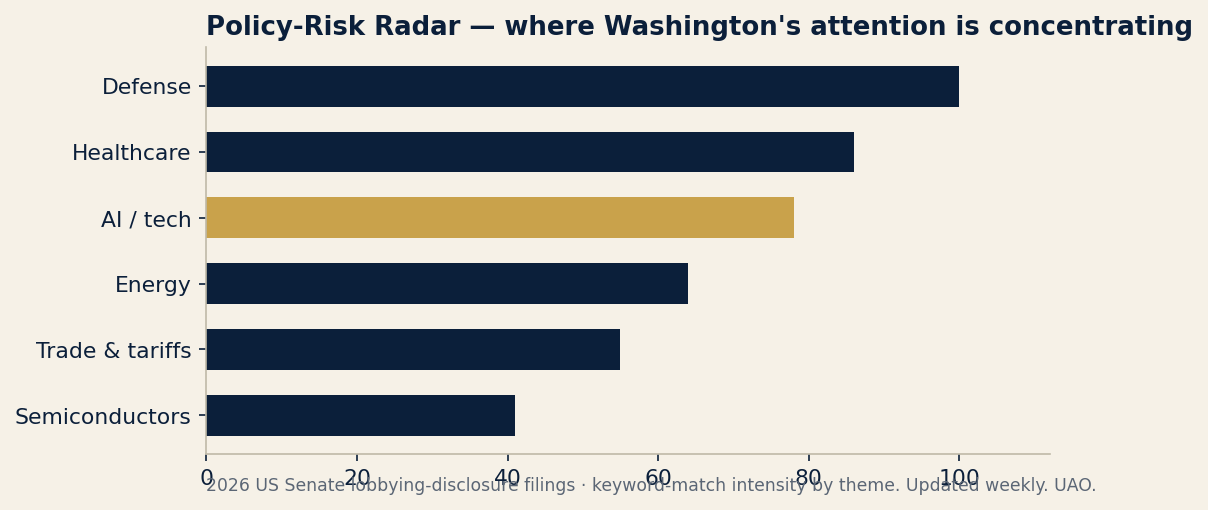
Lobbying is a leading indicator: capital hires representation where it expects policy to move. Our radar reads US Senate lobbying-disclosure filings to rank the sectors drawing the most policy attention in 2026 — then maps each to where a universal owner actually holds the exposure. Open the Policy-Risk Radar →
Take of the day. When a developed-market curve can be repriced by a leadership contest, "risk-free" is a courtesy title. The universal owner doesn't get to opt out of sovereign duration — so the discipline is to price political credibility as a real input, not a tail you wave away. — UAO Research
What to watch
Labour leadership nominations (open July 9) and whether a contested race runs to September · the next UK fiscal signal and the Chancellor's standing · PRI Investor Day read-outs on whether collective climate stewardship survives as a fiduciary discipline · NBIM's ethics-framework review (October 15).