
98% of the world’s sovereign wealth funds |
18 of 20 of the world’s largest pension funds |
10 of 10 of the largest charitable foundations |
85% of the world’s largest family offices |
100+ billionaires, every morning |
Beijing added solvency headroom across eight state banks and insurers, and the market marked it down. Tokyo spent a record $98.7bn holding the yen up. Seoul stopped hedging. Canberra’s opposition wants future contributions to pay the rent. The money, the mandate and the meeting are not the same thing.
The thesis — The Assignment
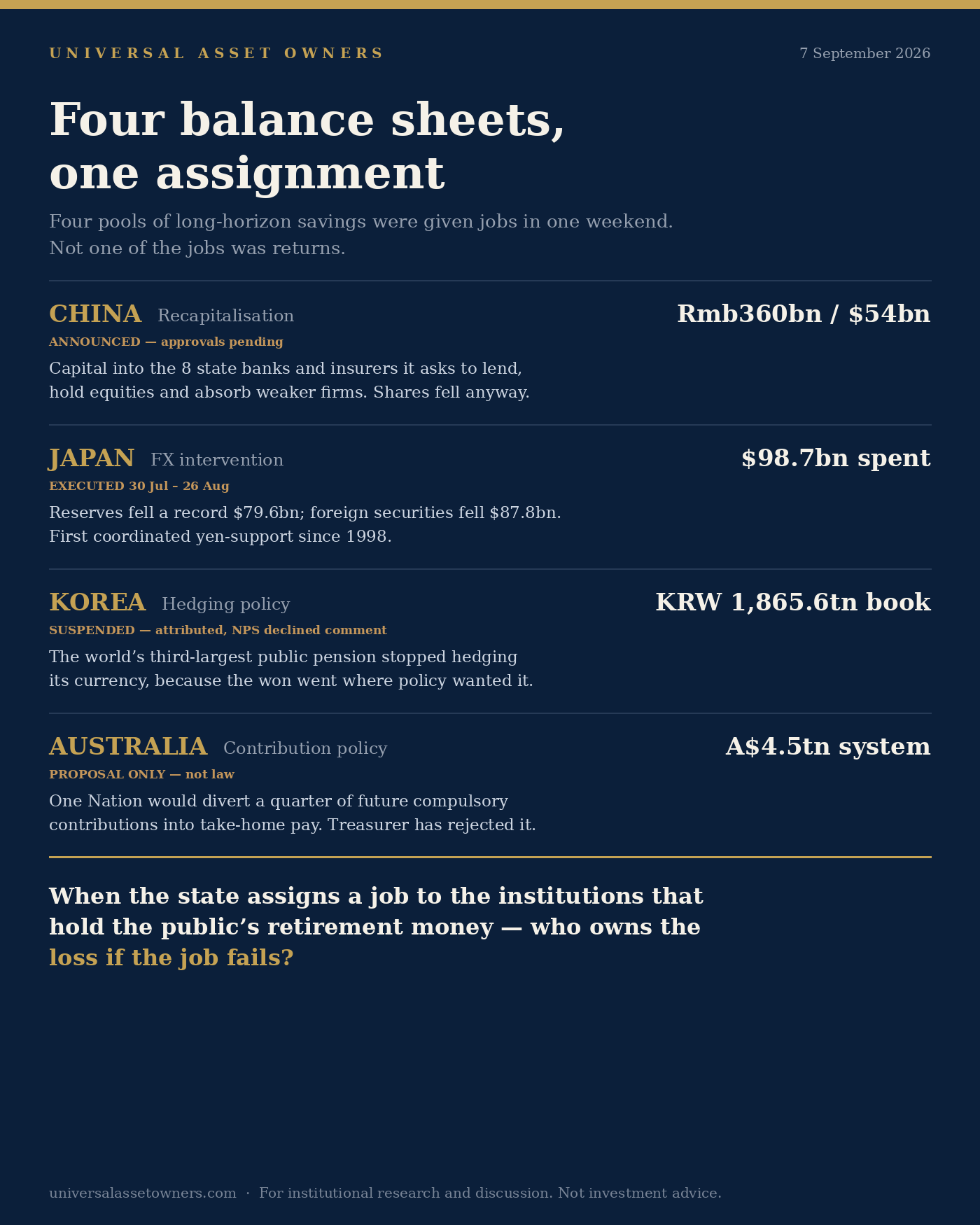
Four pools of long-horizon savings were given jobs this weekend, and not one of the jobs was returns.
China added Rmb360bn of capital to the eight institutions it asks to lend, to hold equities and to absorb weaker insurers. Japan spent ¥15.4tn — and a record $79.6bn of its reserves — to hold its currency up. Korea’s National Pension Service, the world’s third-largest public pension, stopped hedging its currency exposure. And Australia’s rising opposition proposed that a quarter of future compulsory pension contributions do household cash-flow work instead.
Recapitalisation, intervention, hedging policy and contribution policy are four different instruments. This weekend they were all pointed at the same thing: using the balance sheets of long-term savers to hold a short-term outcome in place.
One distinction must not be flattened to make the pattern tidier. China, Japan and Korea are official acts — capital announced by the state, money spent by a finance ministry, a hedging programme switched off at the world’s third-largest public pension. Australia is a proposal, from an opposition party polling near 30% on the primary vote, which the Treasurer has rejected and which would need an election expected in 2028 to go anywhere. Three governments did something. One party suggested something. The pattern is real; the fourth item is the weakest leg in it, and saying so is the difference between an argument and a montage.
For a universal owner this is not four national stories. It is one question asked four times — when the state assigns a job to the institutions that hold the public’s retirement money, who owns the loss if the job fails?
The lead — Capital is being given a job
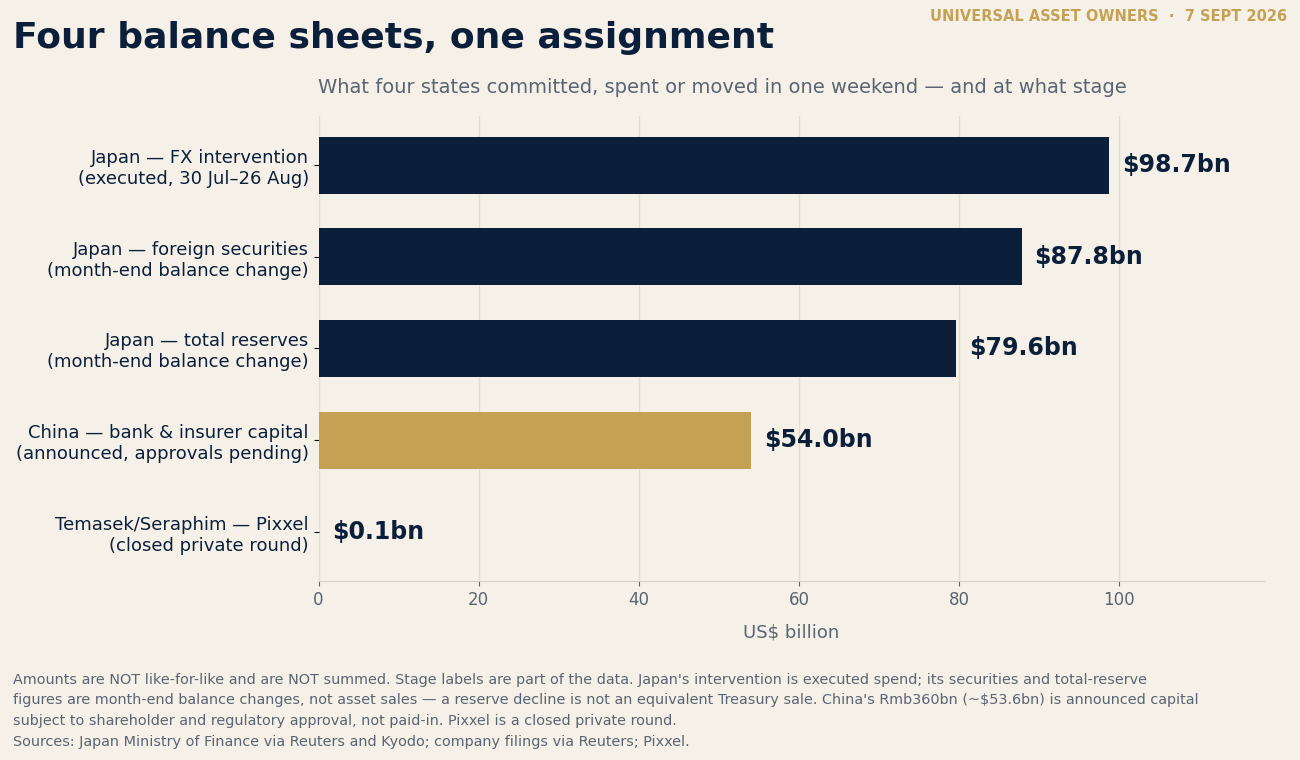
On Sunday, eight Chinese state financial institutions announced capital actions summing to Rmb360 billion — about US$54 billion. Three banks account for Rmb290bn: Agricultural Bank of China plans a private A-share placement of up to Rmb160bn, ICBC up to Rmb100bn, and the Export-Import Bank of China takes an Rmb30bn injection. Five insurers account for Rmb70bn: China Life Rmb35bn, PICC up to Rmb15bn, Sinosure Rmb10bn, China Taiping Rmb7bn and China Re Rmb3bn. The bank proceeds are designated for core Tier 1 capital.
Named subscribers on the two large bank placements are the finance ministry and China National Tobacco entities. Reuters corrected its initial framing: the ministry leads the package; it is not committing every yuan. These are announced placements and injections subject to shareholder and regulatory approval — not closed transactions, and not paid-in capital.
The arithmetic holds: 160 + 100 + 30 = 290 for banks; 35 + 15 + 10 + 7 + 3 = 70 for insurers; 290 + 70 = 360. At 6.7108 to the dollar, Rmb360bn is about US$53.6bn.
What is new here is the insurers. This is the first time Beijing has extended recapitalisation to them. Insurer capital does three jobs at once: it repairs solvency that low rates have eroded, it enlarges the balance sheet that can hold long-duration equities, and it creates headroom to absorb weaker insurers. Beijing can add an equity bid and a resolution tool on the same weekend, from the same cheque.
And the market did not take it as good news. On Monday in Hong Kong, Agricultural Bank fell 2.7%, ICBC 2.3% and China Taiping almost 4%, against a Hang Seng down less than 1% — the recapitalised names underperformed the index they sit in.
The reason is scale, and Citi named it: the insurers’ recapitalisation is “significantly smaller than the 200 billion yuan the market had expected earlier.” Citi read the shortfall as reassurance rather than stinginess — “This downsized package underscores the healthier capital positions of Chinese insurers, indicating an overall lower urgency for aggressive capital replenishment” — which inverts the alarm. A state that has to bring in its tobacco monopoly to help fund a bank placement is telling you something about fiscal space; a state that puts in less than the market demanded may be telling you the patient is less sick than assumed. Both readings are live.
The honest limit on the thesis: new capital changes what these institutions can hold. It does not change what households want to borrow, what projects earn, or who owns the loss if directed assets underperform. Capacity is not transmission.
Universal-owner question. When a state recapitalises the institutions that allocate national savings, which assets absorb the new risk capacity — and what return, liquidity and policy constraints come attached?
Sources: Reuters, “China to pump $54 bln into state banks, insurers”, 6 Sep · South China Morning Post · CNBC, “China pulls in Big Tobacco…”, 7 Sep · Agricultural Bank of China board filing, HKEXnews · ICBC A-share issuance plan
Deep dive — Tokyo, Seoul and the price of holding a currency
Japan spent a record amount, and probably sold Treasuries to do it
Japan’s Ministry of Finance reported that official reserves fell to $1,207.5 billion at the end of August, down $79.6 billion, or 6.18%, from $1,287.1 billion a month earlier. It is the largest monthly fall on record.
The cause is disclosed: Japan spent ¥15.4 trillion — about $98.7 billion — on yen-buying intervention between 30 July and 26 August, the largest single-month operation on record. It lifted the yen off 40-year lows near 164 per dollar to as strong as 155.20 by 3 August.
Part of the operation was conducted jointly with the United States, and the precedent needs stating carefully, because two different operations are usually collapsed into one. This is the first coordinated intervention involving Japan since 2011 — but March 2011 was the G7 acting together to sell yen, after the earthquake and Fukushima drove the currency to a postwar high on expected repatriation flows. The objective then was a weaker yen. The last coordinated US–Japan operation to buy yen — the same direction as this one — was 1998, during the Asian financial crisis. So: first coordinated intervention of any kind since 2011; first coordinated yen-support since 1998.
The composition, and the official dual attribution. A Ministry of Finance official told Kyodo the fall reflects both mark-to-market moves on bonds and the intervention itself — not one or the other.
| Component | Move | Note |
| Total official reserve assets | −$79.6bn to $1,207.5bn | largest monthly fall on record |
| Foreign securities | −$87.8bn to $839.6bn | mostly US Treasuries; largest single driver |
| Gold | +$14.6bn | ounces unchanged — a price effect, not a purchase |
Read the first two lines together, because this is the part that gets misreported: securities fell by more than total reserves did. An $87.8bn decline in securities against a $79.6bn decline in the total means other components moved the other way — gold’s price gain alone offsets $14.6bn of it, with the balance in deposits and other reserve assets. Anyone quoting the $79.6bn headline as the size of the securities move is understating it; anyone quoting it as a Treasury sale is overstating what is known.
The caveat the desk will not drop: a fall in reported reserves is not an equivalent outright sale of US Treasuries. Valuation changes, deposits, repo and central-bank liquidity facilities all move the reported level and its composition, and the ministry does not publish the transaction-level split. The Japan Times reported Japan likely sold Treasuries to fund the operation, and the $87.8bn securities decline is consistent with that. Consistent is not confirmed. The direction is established; the instrument mix is inferred.
Seoul stopped hedging because the won finally went the right way
On the same morning, Reuters reported that the National Pension Service — the world’s third-largest public pension — has suspended its foreign-exchange hedging operations as the won reached a near two-year high. NPS declined to comment; the report rests on market sources.
The mechanism is a trigger system: NPS raised its hedging limit in 2026 specifically to help policymakers lean against won weakness, and with the won strengthening the requirement effectively lapsed. Scale is what makes this a universal-owner story rather than a Korean one. NPS held KRW 1,865.6 trillion at the end of June, with 54.1% in global assets — the currency exposure being hedged, or not hedged, is one of the largest single FX books any pension runs.
Read the two together. Japan sold reserve assets to strengthen its currency. Korea used a pension fund’s hedging programme as a currency instrument and has now switched it off because it worked. In both cases the balance sheet of a long-term saver was the tool.
Triple exposure. A universal owner is on three sides of this at once. As a holder of US duration, you are on the other side of Japan’s securities sales — the largest foreign official holder liquidating into your market to fund a currency defence. As a holder of Japanese and Korean assets and the yen and won themselves, you own the outcome of the intervention that the selling paid for. And as a peer institution, you are watching two governments establish that a long-term savings pool is an acceptable instrument of short-term currency policy — a precedent that does not stay in Asia.
Practical tilt. The testable question is not “will Japan sell more Treasuries.” It is which leg of your book is short the correlation between reserve-manager selling and your own duration book. Ask fixed income for the foreign-official share of your benchmark’s marginal buyer over the last four quarters, not the last four years. Then ask the FX team whether your hedging policy could be read, by anyone, as a policy instrument — because Korea’s now is.
Embedded exposure flag. Any climate or listed-infrastructure mandate leaning on Japanese or Korean utilities carries embedded gas exposure here twice over: once through the fuel bill the yen defence is partly about, and once through the marine-fuel bottleneck in the Risk Radar below. A “low-carbon Asia infrastructure” sleeve is not currency-neutral or fuel-neutral this month.
Sources: Reuters, “Japan reserves plunge record $79.6 billion after massive yen intervention” · The Japan Times, “Japan likely sold Treasurys to fund record yen intervention”, 7 Sep · Reuters, “South Korea pension fund suspends FX hedging…”, 7 Sep
Australia puts future contributions on the ballot
One Nation proposed that workers paying rent or a mortgage be allowed to redirect one-quarter of future compulsory superannuation contributions into take-home pay for up to three years. Employers still pay the full 12%; the worker elects to take 3 percentage points as wages, taxed at the concessional 15% superannuation rate rather than the marginal personal rate, with the remaining 9% preserved. One Nation’s published figure is about A$2,300 more a year after tax for a median worker on A$90,500.
Treasurer Jim Chalmers called it “a full-frontal attack” on workers’ retirement savings and “a recipe to make Australian workers tens of thousands of dollars worse off in retirement”, saying the next election — expected in 2028 — would be a referendum on the A$4.5 trillion system. He argued lost compounding outweighs the short-run cash. (Chalmers quotes carried by Reuters and ABC News; the A$2,300 figure is One Nation’s own estimate, not an independent calculation.)
This is not a raid on existing balances, and it is not law. It is the diversion of future flows, proposed by a party polling around 30% on the primary vote. For a fund, contribution predictability is an asset — it is the input to every liquidity and compounding model the trustee runs. The debate has moved from early access to existing savings toward the purpose of compulsory capital formation itself.
Sources: ABC News, “One Nation pushes for early super access”, 7 Sep · Reuters, “One Nation proposes pension shake-up”, 6 Sep
A lithium tonne that cannot be mined is not a reserve
A Brazilian judge suspended the environmental licences and mining activity at Sigma Lithium’s Grota do Cirilo complex in Minas Gerais — the company’s only producing asset, with nameplate capacity of 330,000 tonnes a year of lithium concentrate.
The civil action was brought by the Federation of Quilombola Communities of Minas Gerais. Quilombolas are traditional communities descended from people who escaped slavery; their territories carry state protection and a heavier licensing burden for projects that may affect them. The judge found sufficient preliminary evidence that the Bau community sits inside the project’s area of influence — studies cited place it about 2.7 km from the directly affected area, within an 8 km consultation threshold — and ordered an independent georeferencing review. The order also bars Minas Gerais from issuing new licences and sets a fine if operations continue. Sigma argues the mine lies outside the impact zone. The order is dated 4 September and became public on 6 September. It is interim, not a judgment on the merits.
Watch the sequence, because it is the lesson. Sigma was under a July embargo; it reached a state-level conduct agreement in August that restored operations; and on Friday 4 September a federal judge suspended the licences anyway. A project can be administratively settled at state level and judicially halted at federal level in the same quarter. Permit finality is not a single gate — it is a stack of them, and clearing the visible one does not clear the stack. Consultation compliance belongs inside reserve and capacity estimates: a tonne that is geologically present but not legally operable should not carry the same weight in a resource model as a permitted, consulted and financeable one.
Sources: Reuters, “Brazilian court suspends licenses for Sigma Lithium mine”, 6 Sep · Bloomberg, “Brazilian Court Suspends Permits, Halts Sigma Lithium’s Mine”

Wildfire smoke leaves the burn scar — and the models undercount it
The WMO’s sixth Air Quality and Climate Bulletin, published 7 September, finds that fire-derived PM2.5 and heat-driven ozone are making WHO air-quality guidelines harder to meet even where industrial and transport emissions are falling. 2025 PM2.5 ran above long-term averages in northern Canada, parts of Russia, west-central Africa and north-western Spain.
The most decision-relevant number: conventional risk models based on total PM2.5 concentration may underestimate wildfire-attributable mortality by up to 93%. Smoke is more toxic per microgram than the ambient pollution those models were calibrated on.
Attribute that number precisely, because it is easy to over-claim. It comes from Alari et al., led by ISGlobal and published in The Lancet Planetary Health — a short-term mortality study covering 654 contiguous regions across 32 European countries, a population of 541 million, using the EARLY-ADAPT dataset. Applying a generic all-PM2.5 risk value produced an estimate of 38 deaths a year; using fire-specific risk showed actual mortality close to 14 times higher, hence the 93% gap. It is an epidemiological finding for Europe, not a global catastrophe-model result and not a 2025 death count.
Separately, the bulletin cites different work — Chowdhury et al. — finding extreme fire-smoke events have tripled since the 1990s and may have contributed to nearly 100,000 additional deaths a year during 2010–2018. An earlier period, a different study, and by the bulletin’s own account possibly an underestimate. The two findings are not the same research and should not be merged.
For owners: catastrophe models price the burned footprint. Smoke crosses borders and produces mortality, morbidity, business interruption, worker absence, crop and aviation losses far outside that perimeter. Downwind exposure is a separate hazard layer, and geographic diversification does not help when the plume travels.
Sources: WMO, “WMO bulletin shows air quality and climate interlinkages”, 7 Sep · Alari et al., “Quantifying the short-term mortality effects of wildfire smoke in Europe”, The Lancet Planetary Health · France 24
Temasek’s closed cheque is in Earth intelligence
Pixxel closed a $100 million Series C co-led by Temasek and Seraphim Space, with 360 ONE Asset and IMM Investment joining as new investors and Radical Ventures and growX returning. Total disclosed funding reaches $195 million — the largest space-technology round raised in India. Valuation was not disclosed, and neither was Temasek’s individual ticket.
Proceeds go to the Honeybee hyperspectral constellation, high-resolution optical satellites, the Aurora software platform, sovereign Earth-observation systems and manufacturing in India and Los Angeles. This is the window’s only verified, closed transaction by a mature sovereign investor. The industrial point is the stack: sovereign capital is buying sensor-to-decision infrastructure that agriculture, insurers, commodity traders and governments will rent. A record round establishes financing scale, not demand, backlog or unit economics.
Sources: Pixxel, “Pixxel raises $100 million in Series C funding”, 7 Sep · Business Standard
Capital flows
- China — announced, not closed. Rmb360bn across eight state banks and insurers; the finance ministry leads, tobacco entities subscribe part of the two large bank placements.
- Japan — executed. ¥15.4tn of intervention; reserves down $79.6bn to $1,207.5bn, foreign securities down $87.8bn.
- Temasek — closed. Co-lead of Pixxel’s $100m Series C.
- British Business Bank — earmark, not new money. £150m of already-allocated funding directed to northern firms in £5m–£15m tickets.
- China rural finance — architecture, not capital. Six agencies published a plan combining budgets, bank credit, agricultural insurance, guarantees, local-government bonds, listings, infrastructure REITs and private funds around food security by 2030. No aggregate amount was committed.
- Direct finding: no newly closed large acquisition by a mature sovereign wealth fund or public pension survived verification inside the strict primary window, other than Temasek’s Pixxel participation.
Risk Radar
- China transmission. New capital can produce assets without returns. Trigger: faster balance-sheet growth alongside weaker margins. Company filings via Reuters
- Japanese reserve drawdown. A record monthly fall, foreign securities down $87.8bn. Trigger: a second consecutive monthly decline, or a rise in the deposit/repo share of reserves. Japan MOF via Reuters
- Hormuz transit collapse. The 10-day moving average of commodity-ship transits fell to 10 a day on Sunday, from more than 15 on Friday and nearly 13 on Saturday — the lowest since May. Two vessels transited Saturday, six Sunday. UKMTO has logged 27 projectile-strike incidents since 6 July. The strait is not closed. UKMTO incident count, via Reuters · Reuters/Kpler
- Marine-fuel bottleneck. Energy Aspects forecasts a Q3 fuel-oil deficit of 218,000 bpd against 6,000 bpd in Q3 2025; Rystad separately expects supply to stay critically tight. Singapore VLSFO printed just under $825/tonne on 1 September on the Reuters/ZeroNorth screen, up 76% since the war began against a 40% rise in Brent; Ship & Bunker’s close the same day was $838 — bunker screens differ, so name the screen. Hub stocks about 30% below three-year seasonal averages. The deficit is a forecast, not a measured balance. Reuters analysis
- OPEC+ held October steady. Seven members kept October targets unchanged on 6 September, having completed the phase-out of the 1.65m bpd voluntary cut. Broader cuts run to end-2026; 2027 baselines await a capacity review. Next meeting 4 October. Holding targets is not holding supply when export capacity is impaired. CNBC
- Liquid Network. About 4,000 of 4,200 BTC (~$320m) left the federation wallet on 6 September through SideSwap’s authorised peg-out path. Liquid says no key was compromised; reporting points to a protocol bug, with the federation signing validly. Bridge nodes disabled, sidechain paused. Not a confirmed theft, and not a confirmed recovery. Liquid Network statement via Cryptopolitan
- Anak Krakatau. Eight Indonesian airports closed including Soekarno-Hatta; about 170,000 passengers stranded and 1,558 flights delayed. Ash to 50,000 ft on the Sumatra side. Authorities reported no imminent tsunami risk. Al Jazeera · ABC News
- Sigma single-asset interruption. Interim order; independent survey pending. Reuters via Mining.com
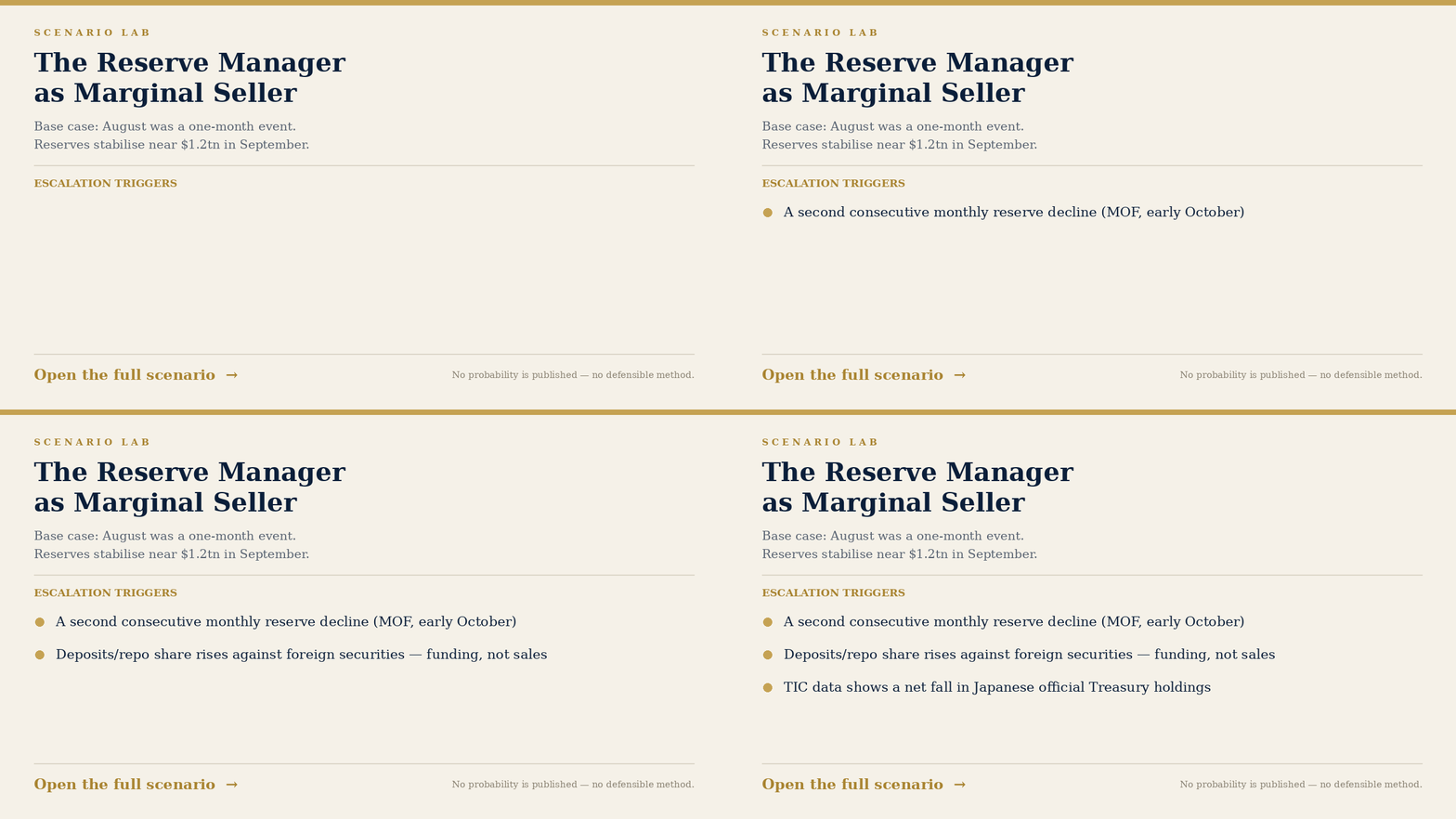
Base case. August was a one-month event. Reserves stabilise near $1.2tn in September, foreign-official Treasury holdings resume their prior trend, and the correlation between reserve-manager activity and long-end US yields stays inside its two-year range.
Escalation triggers — each observable, each dated
- A second consecutive monthly reserve decline in the MOF’s early-October release.
- A rise in the deposit/repo share of reserves against the foreign-securities share — funding rather than sales.
- TIC data showing a net decline in Japanese official holdings of US Treasuries for the same reference month.
- A second joint US–Japan operation. The 1998 precedent was not repeated for 28 years; twice in one quarter would be a regime change.
- Korea’s NPS reactivating its hedging programme, indicating the won has turned back.
De-escalation triggers
Yen sustained stronger than 150 without intervention; the MOF reporting no August-style operation in September; reserves recovering above $1.25tn.
Update rule: re-scored on the MOF monthly reserve release and the TIC release, not on daily FX moves. No probability is published for this scenario — the desk has no defensible method for one, and a number without a method is decoration. Open the scenario page →
Editorial watchlist — named, unsized, not promoted
- EU / Greenland package — “substantial”, no amount, no project list at cutoff.
- Reported US–South Korea Texas gas plant — ~$22.3bn, 6.3 GW at Encinal, sourced to Edaily via unidentified officials; Seoul’s Industry Ministry could not confirm. No named sponsor, ERCOT interconnection filing, permit or offtaker.
- China battery-storage approval pause — reported by Cailianshe; no ministry notice or affected-project list. Do not say factories were cancelled or that a national moratorium is confirmed.
- Germany’s anti-sabotage / counter-drone package — interior ministry planning confirmed; not enacted law.
- iBRICS Delhi, 12–13 September — the meeting is real; the “~$1tn AUM in the room” is an organiser claim.
- Waterland / Gamma Communications — a bid being prepared, not submitted.
Week ahead — the high-signal three
- Capex commentary tied to power, not chips. Watch whether AI-campus announcements start disclosing firm-power contracts and interconnection positions rather than megawatt ambitions. The deliverability gap is where the capital risk sits.
- Oil / volatility / credit divergence. Hormuz transits are at a four-month low and marine fuel is up 76%, while crude is up 40% and equity volatility stays subdued. Watch whether the refined-product squeeze finally moves credit spreads for shipping and EM importers.
- Insurance advisories. The decisive Hormuz confirmation is not another transit count — it is a named insurer or P&I club changing terms after the weekend’s tanker strikes, and the first verified outbound VLCC.
Also dated: OECD PISA 2025 (8 Sep), OECD lithium/nickel traceability work (9 Sep), USDA WASDE (11 Sep), OPEC+ (4 Oct).
Meet The Allocator

Universal Asset Owners · 7 September 2026 · For institutional research and discussion. Not investment advice.