UniversalAssetOwners.com UAO Insider People, power, relationships and influence across the world's largest asset owners. Issue 10 · Saturday 15 August 2026 · Week of 8–14 August |
|
Norway books the biggest half in its history and immediately warns you off it. The Caisse beats its equity index and still misses its benchmark by 2.4 points. And at IMCO, a chief investment officer resigns — and the job resigns with her.
|
The $184bn Half That Nobody Should Bank On
Four of the world's largest asset owners reported the same six months this week. The spread between them is not skill. It is what they own.
Norges Bank Investment Management reported on 12 August that the Government Pension Fund Global returned 9.4% in the first half of 2026 — a profit of 1.75 trillion kroner, roughly US$184bn, and the largest six-month gain in the fund's history. It beat the previous first-half record of 1.5 trillion kroner, set in 2023. Equities returned 13.0%. The fund closed June at 22,683 billion kroner, about US$2.34 trillion, and beat its benchmark index by 0.22 percentage points. In the same disclosure it revealed a 0.05% holding in SpaceX worth US$1.22bn at 30 June — its first.
Chief executive Nicolai Tangen spent the briefing talking the number down. Do not read that as modesty. Read it as guidance.
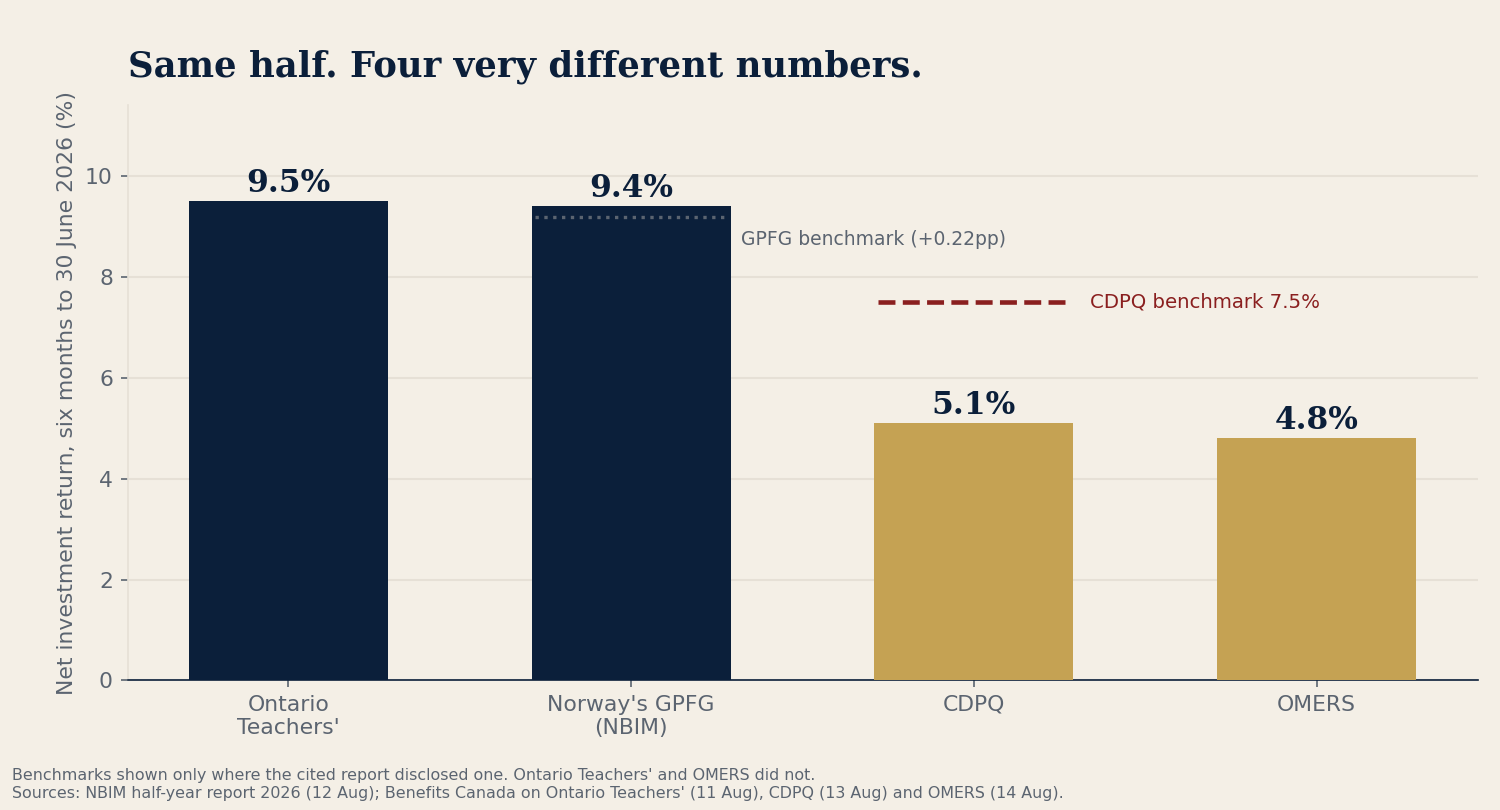
Net investment return, six months to 30 June 2026. Benchmarks are shown only where the cited report disclosed one. Sources: NBIM half-year report 2026; Benefits Canada on Ontario Teachers', CDPQ and OMERS.
|
|
The private-markets bill came due in the same week the public book paid out
Set the four prints side by side. Ontario Teachers' returned 9.5%. Norway returned 9.4%. The Caisse de dépôt et placement du Québec returned 5.1%. OMERS returned 4.8%. That is a 470 basis point spread across six months between four institutions that all describe themselves as long-horizon, diversified owners of the global economy.
The Caisse is the instructive case, because it published enough detail to show the mechanism. Its equity portfolio returned 14.6% against a 13.6% benchmark — by the fund's own account the best combination of return and value added in a half-year in twenty years. And the fund still finished 5.1% against a 7.5% benchmark, 2.4 points behind. Private equity returned negative 4.3%. Infrastructure returned 7.2% against a 12.7% benchmark. Real estate returned 2.7% against 3.2%. Only fixed income, at 1.7% against 1.1%, quietly did its job.
Nothing in that sequence is a failure of judgment. It is arithmetic. When a benchmark is part listed and part private, and listed markets sprint for six months, the private book cannot mark up fast enough to keep pace — and the shortfall shows up as underperformance in a period where the manager did nothing wrong. Chief executive Charles Emond named the two forces honestly: persistent enthusiasm for artificial intelligence, and the conflict in the Middle East.
OMERS, at 4.8% and C$151.6bn of net assets, sits in the same place for the same reason. Ontario Teachers' at 9.5% and Norway at 9.4% sit at the other end — and the comparison there is more uncomfortable than it looks. Teachers' runs one of the most heavily internalised, most direct portfolios in the world. Norway holds the market. Over this half, the active book and the index book landed within a tenth of a point of each other.
The question for investment committees this autumn is not which of these funds had a good half. It is whether the private-markets gap is a lag that reverses when listed markets pause, or a revaluation that resolves downward. Every allocator has an answer. Very few have evidence. And the market is voting the other way in the meantime: manager searches are running about 60% above last year, with private markets accounting for 56% of the pipeline.
That is the tension worth carrying into September. Allocators are writing private books down and shopping for private managers in the same quarter.
|
9.4% Norway's GPFG, six months to 30 June | US$184bn its half-year profit — a record | 5.1% vs 7.5% CDPQ's return against its benchmark | −4.3% CDPQ private equity, first half | 0.192 sovereign concentration index, from 0.110 in 2021 | C$552bn CDPQ net assets |
|
|
Hires, promotions, departures, retirements and board appointments across the UAO ecosystem.
| Person | Move | New role / from | Source | Rossitsa Stoyanova
Investment Management Corporation of Ontario | Departure | Special advisor (from January 2027)
from Chief Investment Officer, IMCO | Benefits Canada
10 Aug 2026 | Nick Chamie
Investment Management Corporation of Ontario | Promotion | Executive Managing Director, Total Portfolio
reporting to CEO Bert Clark | Benefits Canada
10 Aug 2026 | Craig Ferguson
Investment Management Corporation of Ontario | Promotion | Executive Managing Director, Private Markets
reporting to CEO Bert Clark | Benefits Canada
10 Aug 2026 | Angus Botterell
Investment Management Corporation of Ontario | Promotion | Executive Managing Director, Public Equities
reporting to CEO Bert Clark | Benefits Canada
10 Aug 2026 | Adam Buzanis
OMERS | New Hire | Managing Director and Head of Funds (effective 3 August 2026)
reporting to Michael Block, head of private capital | Benefits Canada
10 Aug 2026 | Mark Sack
CIBC Global Asset Management | New Hire | Vice-President, Institutional Business Development | Benefits Canada
10 Aug 2026 | Kate Tollis
Dalriada | New Hire | Senior Pensions Manager
30+ years across pensions and governance | Professional Pensions
12 Aug 2026 |
|
|
Nick Chamie Executive Managing Director, Total Portfolio · Investment Management Corporation of Ontario
When IMCO announced on 10 August that Rossitsa Stoyanova would leave as chief investment officer, it also announced that it would not replace her. The role is being widened into an investment leadership function and split three ways. Chamie — who at IMCO has been senior managing director, head of total portfolio and capital markets — takes total portfolio. Craig Ferguson takes private markets. Angus Botterell takes public equities. All three join the senior executive team and report to president and chief executive officer Bert Clark.
Why Chamie is the name on this list rather than the other two: in a structure with no chief investment officer, whoever owns the total portfolio owns the only seat with a view of the whole thing. Asset-class heads optimise their own book. The total-portfolio head is the one who has to say no to them. That is the closest thing IMCO will have to a CIO, whatever the title says.
|
|
IMCO's investment office — the one without a chief investment officer
IMCO said the changes reflect the growing scale and complexity of its investment platform. That is the polite version. The sharper version is that the single-CIO model concentrates judgment, accountability and succession risk in one person, and IMCO has decided the platform has outgrown the seat.
Three things to watch over the next two quarters. First, whether the total-portfolio function is given real authority over asset-class allocation or merely reporting responsibility for it — the difference decides whether this is a governance upgrade or a committee. Second, whether other mid-sized Canadian platforms copy it; this is the second Ontario plan in six weeks to flatten its investment reporting lines into the chief executive, after OMERS did the same in July. Third, whether the transition period costs IMCO anything commercially — it is still winning consolidation mandates, having been selected in early August to manage roughly C$300m of legacy pension assets for the City of Hamilton.
|
| What's Happening at the Firms |
Results, strategy shifts, reorganisations and platform news.
Ontario Teachers' returns 9.5% for the first half The plan reported a net investment return of 9.5% for the six months to 30 June 2026. It is the highest of the four large half-year prints published this week, from one of the most heavily internalised portfolios in the business — which means the active, directly-managed book landed within a tenth of a point of what the index gave away for free.
The Caisse makes 5.1% and misses its benchmark by 2.4 points CDPQ reported 5.1% for the first half against a 7.5% benchmark, with net assets rising to C$552bn. Equities returned 14.6% against 13.6%; private equity returned negative 4.3%; infrastructure 7.2% against 12.7%; fixed income 1.7% against 1.1%; real estate 2.7% against 3.2%. Over five and ten years the fund annualised 6.4% and 7.5% against benchmarks of 6.8% and 7.6%.
OMERS posts 4.8% and C$151.6bn at the half OMERS reported a net investment return of 4.8% as at 30 June 2026, with net assets of C$151.6bn. The lowest of this week's four prints, and from a plan with one of the heaviest private-asset weights — the same signature as the Caisse, arriving from a different direction.
Nova Scotia's plans grow to C$15.2bn Nova Scotia Pension Services Corporation, which administers the investment assets of the Public Service Superannuation Plan and the Teachers' Pension Plan, reported assets of C$15.2bn. Mid-sized plans are where the build-or-rent decision is still genuinely open, and every year of asset growth moves the arithmetic.
|
|
Where the money is actually going.
Sovereign capital is concentrating geographically — and there is now a number for it The International Forum of Sovereign Wealth Funds' annual review, reported on 12 August, found geographic concentration of sovereign wealth fund investment rose to 0.192 on the Herfindahl-Hirschman index in 2025, from 0.110 in 2021 — the highest the forum has recorded. The effective number of destination countries fell from roughly nine in 2021 to just over five in 2025. The United States commanded a geographic share of between 27% and 41%; Canada ranked 14th, up from 17th in 2024. By sector, infrastructure overtook real estate as the leading destination by money invested at a share of 18% to 26%, with real estate falling to fourth behind financials and technology and telecommunications. The forum tested deal count as well as deal size, to confirm the narrowing was not the artefact of a handful of large transactions. Chief executive Duncan Bonfield said the main structural shift is happening in geography, while sovereign capital remains broadly diversified across sectors.
Geographic diversification has been the universal owner's cheapest defence for thirty years. This is the first hard measurement that the largest state-backed pools are giving it up — trading correlation risk for jurisdictional legibility. Most board-level risk models do not price that swap.
|
| Mandates & Money in Motion |
Searches, RFPs, awards and fundraising.
San Luis Obispo County closes a search on the last day of the window The San Luis Obispo County Pension Trust, a California county plan of roughly US$2.06bn, set a proposal deadline of 5:00 p.m. PDT on 14 August 2026, with finalist interviews anticipated between 5 and 30 October and an award anticipated on 7 December. Four months from close to award is the real sales cycle at this end of the market — and it tells consultants where the autumn interview load lands.
Hamilton awards C$300m to IMCO Out of window — context Reported 5 August — just outside this issue's window and carried as context. The City of Hamilton selected IMCO to manage roughly C$300m in legacy pension assets. Worth reading against the leadership item above: the platform is still winning consolidation mandates while it rewires its investment office.
|
|
Shorter notes on the people moving around the industry.
Adam Buzanis · OMERS becomes managing director and head of funds, effective 3 August, reporting to Michael Block, head of private capital. His remit is explicit: lead the development of the external private equity funds strategy, oversee a growing global portfolio and advance co-investment. That is a plan telling you it intends to keep buying external manager exposure at scale rather than internalise it — the name to know if you are raising private equity from Canadian plans.
Mark Sack · CIBC Global Asset Management joins as vice-president, institutional business development. Distribution hires are the leading indicator nobody reads: a bank-owned manager adding senior institutional coverage expects the plan-sponsor market to be contestable.
Kate Tollis · Dalriada joins the professional trustee firm as a senior pensions manager on 12 August, bringing more than 30 years across pensions and governance. UK professional trusteeship keeps absorbing decision rights that used to sit with lay boards.
Also on the move · UK pensions Professional Pensions' week-ending-14-August roundup carries further appointments across EQ Retirement Solutions, Zedra, First Actuarial and the Railways Pension Schemes. We have not restated the individual roles here because the full roundup sits behind the publisher's paywall and we do not print a title we have not read.
|
|
Context, not news. Nothing here is dated inside this week's window.
Manager searches are running about 60% above last year Dakota reports institutional manager searches up 60% in 2026, with private markets at 56% of the pipeline and public plans dominating it. Undated within our window; carried as context. It is the counterweight to this week's results: allocators are marking private books down and shopping for private managers at the same time.
OMERS flattened its investment reporting lines in July Michael Hill was appointed global head of infrastructure and private equity and Scott McIntosh global head of equities and multi-asset strategies, with Kenton Bradbury, Kal Patel and Eric Plesman continuing to lead total portfolio management, global credit and Oxford Properties. All five now report directly to chief executive Blake Hutcheson. Reported 8 July — outside the window, and the direct precedent for IMCO's move this week.
|
|
Window: Saturday 8 August to Friday 14 August 2026. Every item above is drawn from a real, dated, public source published inside that window, with the URL attached. Items dated outside the window appear only in Quiet Signals or are explicitly labelled as context — never presented as fresh.
Two candidate stories were dropped in verification and it is worth saying why. A South Korean recruitment drive for 30 fund-management specialists was put to us as a 14 August announcement; the trail leads to a report from November 2025, and it is not this week's news. A Canadian governance story surfaced the same way dates to February and March 2026. A third correction was proposed to Norway's closing fund value; we checked it against the fund's own half-year report and the figure in this issue stands.
What we could not find this week is also information: no in-window deal or capital-commitment announcement from a Gulf or Asia-Pacific institution cleared verification with a primary source and an in-window date, so there is no regional item here rather than a thin one. Public professional facts only. People moves are review-gated.
|
|
About UAO Insider is the weekly people-and-influence briefing from UniversalAssetOwners.com — the media, research and events platform for the world's largest asset owners. It tracks the people, organisations, relationships, appointments, gatherings, mandates and strategic developments shaping the world's largest pools of long-term capital. Every item is sourced from public, professional disclosures. We cover public role changes, appearances, partnerships and gatherings only — never personal, private or unverified information. Have a tip? info@universalassetowners.com. Sources this issue
|
|