
UAO Fiduciary — When the Data Goes Private
Week to Wednesday, 22 July 2026 · The weekly briefing on fiduciary duty, governance, stewardship and system-level risk for the world’s largest owners.
Sources checked through 22 July 2026. Not legal, investment, or voting advice.
THE 90-SECOND BOARD VIEW
- What changed: investor groups, including the IIGCC, responded to the FCA's consultation on replacing standardised public product-level climate reports (CP26/17, closed 13 July) — broadly backing simplification while warning that losing comparable public data could weaken investment analysis and the flow of information along the investment chain.
- What did not change: UK pension trustees' fiduciary duties. On 23 March 2026 the House of Lords voted down the government's own enabling Amendment 156 (225–202), so the statutory "have regard" mechanism did not enter the Pension Schemes Act 2026; DWP is developing separate guidance within trustees' existing duties.
- The board question: if public product-level climate reports disappear, do our manager contracts and data rights still deliver the comparable information we need for manager selection, monitoring, reporting and beneficiary communication?
FROM THE DESK — When the data goes private
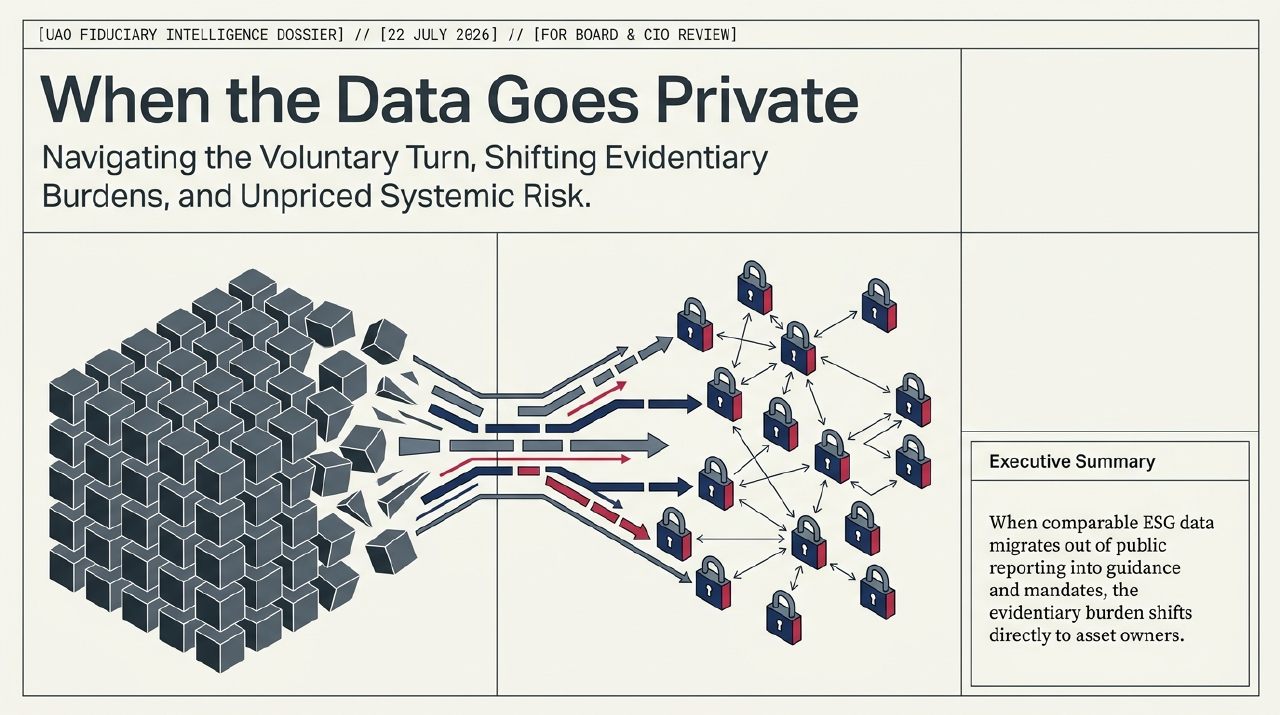
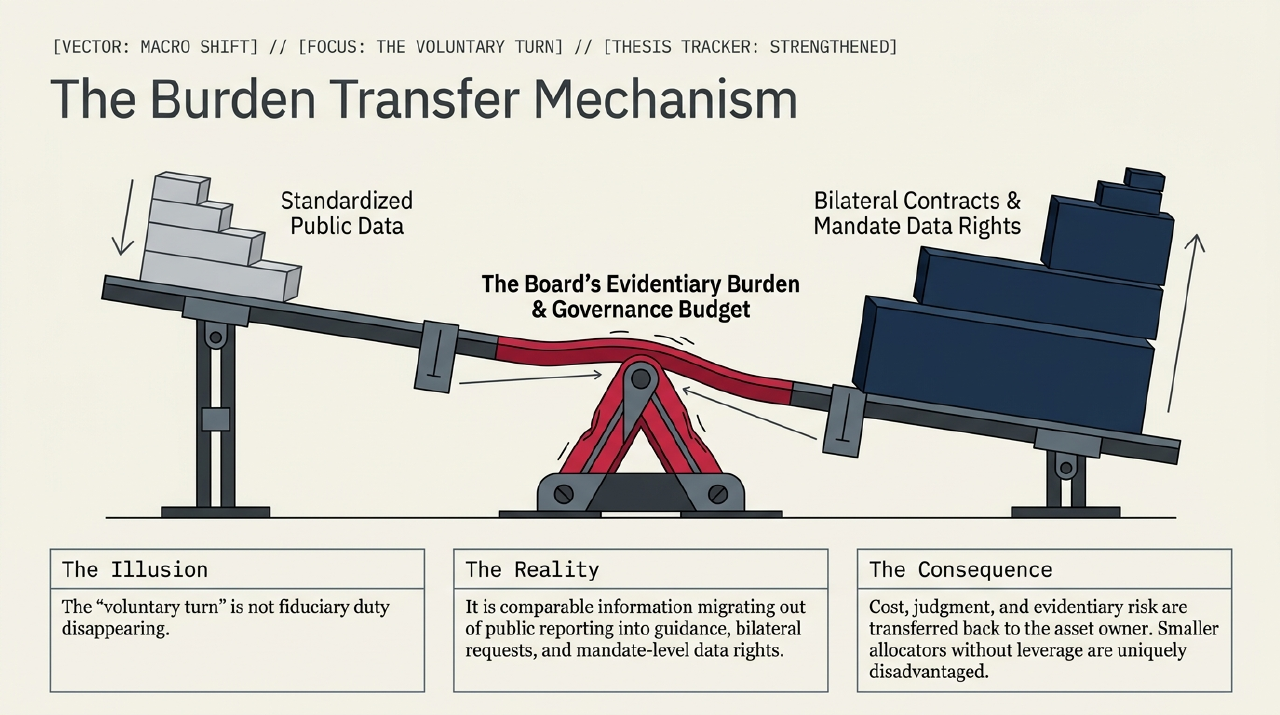
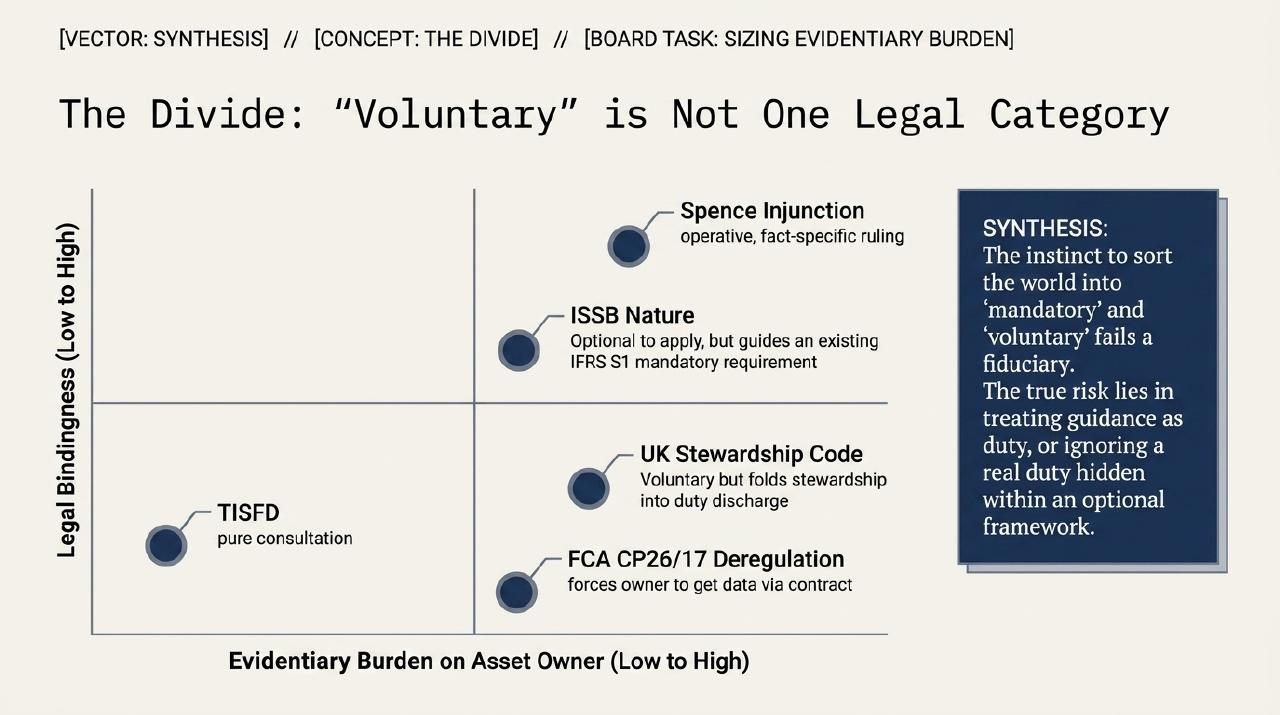
The consequential voluntary turn is not fiduciary duty disappearing. It is comparable information migrating out of public reporting and into guidance, bilateral requests and mandate-level data rights. TISFD remains consultative; the ISSB's proposed nature Practice Statement would be optional to apply, though IFRS S1 already requires material nature-related disclosure from entities claiming compliance; UK fiduciary guidance sits outside the Act, still under development; and the FCA now proposes to thin standardised public climate reports. Spence, by contrast, is an operative but fact-specific ERISA injunction. Each instrument transfers cost, judgement and evidentiary risk back toward the asset owner — precisely where a board needs a documented process. The task this quarter is to map every instrument by jurisdiction, legal status, asset pool and decision owner before treating any of it as a duty.
Listen — The Fiduciary Special (podcast)
A ~10-minute audio edition narrated in our Probability Desk voice: the FCA data story, Spence, the underinsured balance sheet and the two signals. Subscribe, or press play.
The Debate — a two-host deep dive
A longer, conversational deep dive (about 25 minutes): two hosts talk through why comparable ESG data is migrating out of public reporting — and what that means for a board.
Watch — The Spence Misconception
A short film on the most misread ruling in fiduciary circles: what Spence v. American Airlines actually held, and the conflicts-and-monitoring lesson for anyone who delegates voting.

Watch — Why the ESG “Data Blackout” Is a Trap
Ninety seconds on the core idea: when comparable public climate data thins out, it does not vanish — it moves behind private contracts, and the burden of proof lands on owners.

The Chart — the voluntary ESG data turn
The week’s thesis in one image.

The Intelligence Dossier — flip through the deck
Our 15-page briefing deck. Swipe, or use the buttons to turn the pages; download the PDF or slides below.
WHAT CHANGED SINCE LAST WEDNESDAY
| Development | Event date | Legal / policy status | The delta for owners |
|---|---|---|---|
| Investor responses to FCA CP26/17 (public climate-report simplification) | Consultation closed 13 Jul 2026 | Proposed (deregulatory) | Comparable public product data may thin; owners must secure it via mandates |
| ISSB nature — staff papers seek balloting for a consultation | July 2026 board papers | Proposed Practice Statement (guides existing IFRS S1 requirement) | Moves from idea toward a formal, time-boxed consultation |
| Pension Schemes Act 2026 — status of fiduciary-duty guidance | Royal Assent (2026) | Statutory "have regard" mechanism omitted; guidance under development | UK duties unchanged for now; watch the DWP guidance track |
Older material below (Spence, TSP5, the protection gap, proxy season) is carried as context, not as this week's news, and is labelled where it matters.
THE FIDUCIARY DELTA — the public-data question
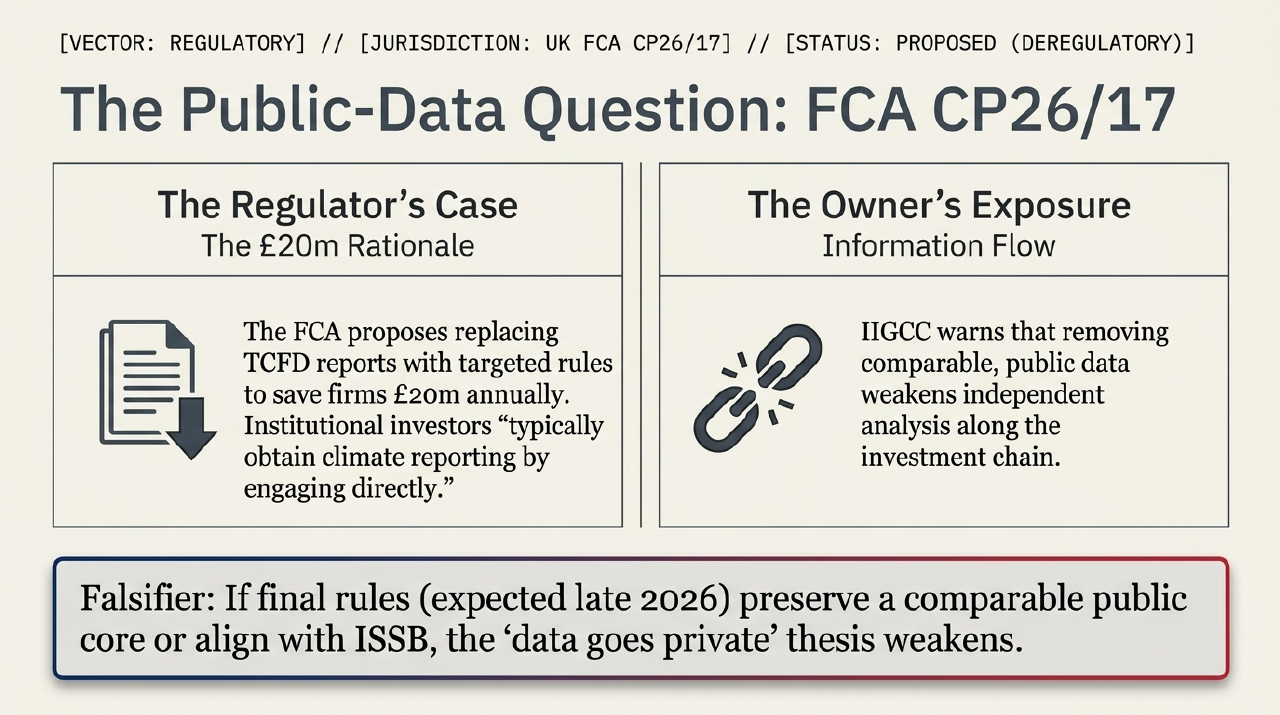
Development. The FCA's consultation to replace standardised, public, product-level TCFD climate reports with "fewer, more targeted, outcomes-based" rules (CP26/17) closed on 13 July. The regulator's own rationale is telling: it judges the public product reports "too long and complicated" for retail investors, and notes that institutional investors "typically obtain climate reporting by engaging directly with firms rather than via the public reports." Investor bodies including the IIGCC responded — broadly supporting simplification while warning that removing comparable, public data could impair independent analysis and weaken information flow along the investment chain.
Mechanism & transmission. If standardised public reports thin out, the comparable data an owner needs for manager selection, monitoring, consolidated reporting and beneficiary communication does not vanish — it moves behind bilateral engagement and contractual data rights. That shifts cost and evidentiary burden onto the owner and its oversight team, and it disadvantages smaller allocators without the leverage to demand bespoke data. The exposure lands on governance process and mandate design, not on any single holding.
Counter-case. The FCA's case is real: retail-facing TCFD product reports were long, little-read, and costly (the regulator estimates simpler rules could save firms roughly £20m a year), and sophisticated institutions already engage directly. Losing a document few used is not the same as losing the information.
Falsifier. The final rules preserve a comparable public core, or the data migrates into an equally comparable ISSB-aligned regime — in which case the "data goes private" thesis weakens.
What to watch. The FCA's final rules, expected later in 2026, and whether they retain any standardised, comparable public baseline.
Sources: FCA — simpler climate reporting could save firms £20m · IIGCC — response to the FCA consultation · Herbert Smith Freehills Kramer — CP26/17 explainer.
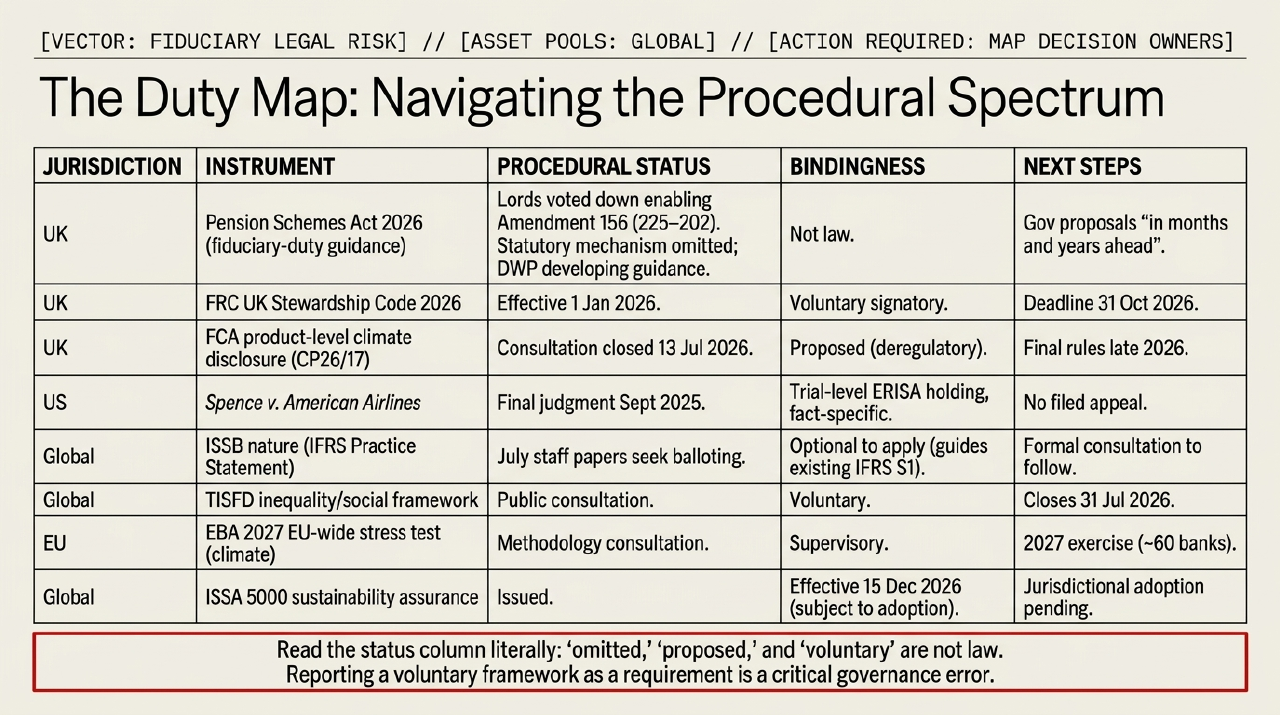
THE DUTY MAP — what is binding, what is guidance, what is merely proposed
| Jurisdiction | Instrument | Procedural status | Bindingness | Next step |
|---|---|---|---|---|
| UK | Pension Schemes Act 2026 — fiduciary-duty guidance | Lords voted down enabling Amendment 156 (225–202) on 23 Mar 2026; statutory mechanism omitted; DWP developing guidance within existing duties | Not law; guidance under development | Government has said it will bring proposals "in the months and years ahead" |
| UK | FRC UK Stewardship Code 2026 | Published 3 June 2025; effective 1 January 2026 | Voluntary / signatory | Application deadline 31 October 2026 |
| UK | FCA product-level climate disclosure (CP26/17) | Consultation closed 13 July 2026; now in feedback review | Proposed (deregulatory) | Final rules expected later in 2026 |
| US | Spence v. American Airlines (N.D. Tex.) | Final judgment Sept 2025; reconsideration denied Feb 2026 | Trial-level ERISA holding, fact-specific | No filed appeal on record |
| Global | ISSB nature — proposed IFRS Practice Statement | July staff papers seek balloting for a consultation | Optional to apply; guides the existing IFRS S1 material-disclosure requirement | Formal consultation to follow |
| Global | TISFD inequality/social framework | Public consultation | Voluntary | Closes 31 July 2026; final framework expected late 2027 |
| EU | EBA 2027 EU-wide stress test — climate module | Methodology consultation | Supervisory | 2027 exercise (~60 banks, ~75% of EU banking assets) |
| Global | ISSA 5000 sustainability assurance | Issued | Effective for periods beginning on or after 15 December 2026, subject to jurisdictional adoption | Jurisdictional adoption pending |
Read the status column literally: "omitted," "proposed," "consultation" and "voluntary" are not law. Reporting a voluntary framework as a requirement is the single most common error in this field.
GOVERNANCE & ACCOUNTABILITY — the conflict Spence actually flagged
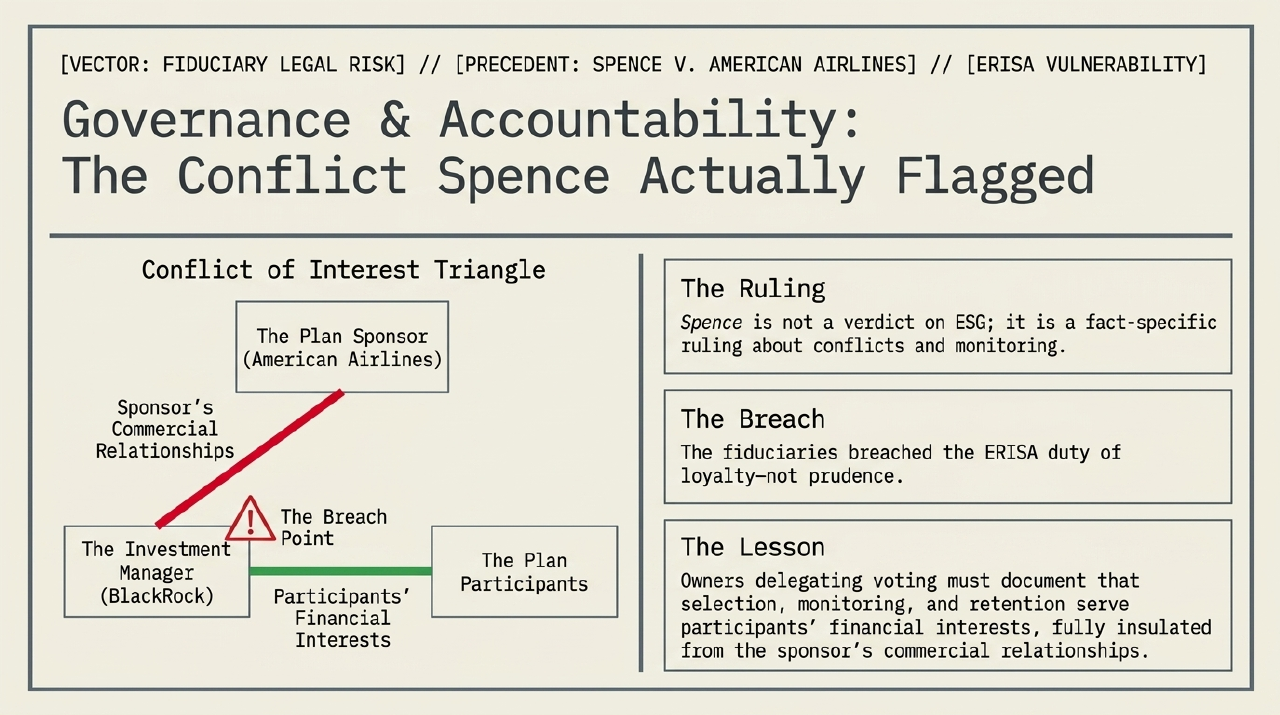
Spence v. American Airlines is not a verdict on ESG; it is a fact-specific ruling about conflicts and monitoring in two American Airlines 401(k) plans. The court found the fiduciaries breached the ERISA duty of loyalty — not prudence — and awarded no monetary damages; its analysis turned substantially on American Airlines' own corporate relationship with its investment manager, BlackRock, and whether that relationship, rather than participants' financial interests, shaped delegated stewardship. For any owner that delegates voting — nearly all of them — the durable lesson is documented oversight: a voting policy the owner sets, evidence the manager followed it, and a record that the manager's and the sponsor's other relationships did not drive outcomes. Counter-case: critics warn the ruling chills ordinary stewardship and nudges owners toward passive, do-nothing voting to dodge litigation — itself a governance failure. Board test: can the fiduciary committee document that selection, monitoring and retention of a manager exercising delegated votes served participants' financial interests and were insulated from the sponsor's commercial relationships? Sources: Willkie — Spence · Ropes & Gray — practical takeaways.
THE STEWARDSHIP OUTCOMES LEDGER — action vs outcome vs attribution
| Ask | Owner's lever | Observable result | Causality confidence |
|---|---|---|---|
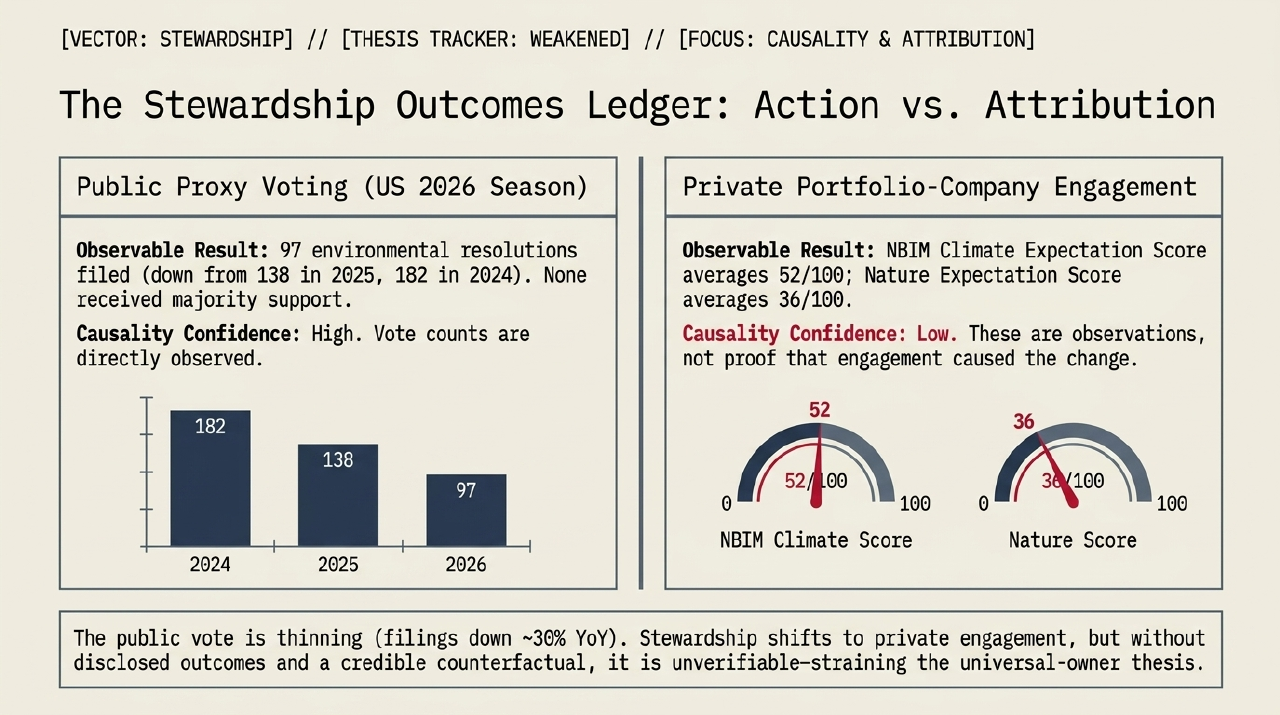
| Environmental resolutions, 2026 US season | Public proxy vote | 97 filed (vs 138 in 2025, 182 in 2024); none of the environmental proposals voted on in 2025 or 2026 to date received majority support | High (vote counts are observed) |
| Portfolio-company climate/nature progress | NBIM Climate Expectation Score / Nature Expectation Score | Companies average 52/100 climate, 36/100 nature | Low — these are observations, not proof that NBIM's engagement caused the change |
Reading: environmental filings fell about 30% year on year (97 vs 138); all shareholder proposals fell roughly 17%. The public vote is thinning, and stewardship leads argue the real channel is now private engagement — but engagement without disclosed outcomes and a credible counterfactual is unverifiable, which strains the universal-owner thesis exactly where it needs a working lever. What to watch: disclosure of engagement outcomes with attribution, not vote tallies. Source: Mayer Brown, via the Harvard Law School Forum.
THE UNDERINSURED BALANCE SHEET — the gap that keeps growing
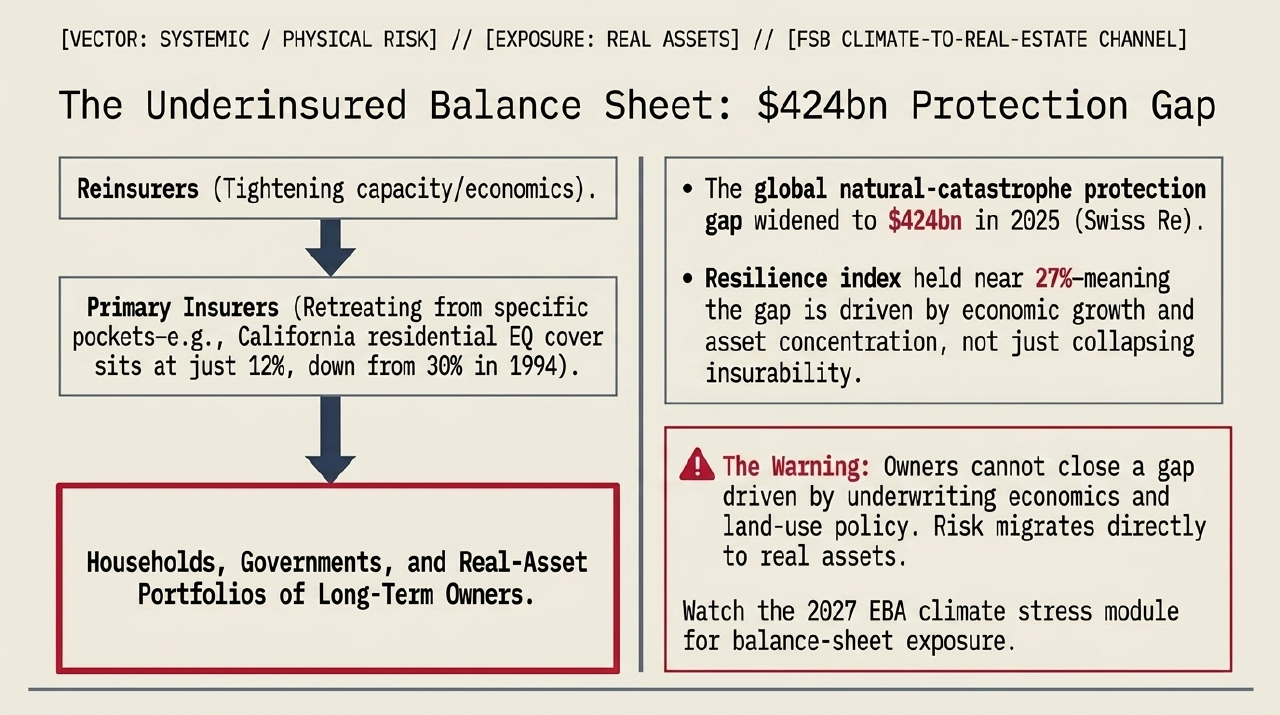
The global natural-catastrophe protection gap widened to $424bn in 2025 (from $395bn), per Swiss Re. Coverage broadly kept pace with exposure — the resilience index held near 27% — so most of the widening reflects economic growth and asset concentration in exposed places, not a collapse in insurability; even so, in absolute terms there is simply more uninsured value each year, and pockets are thinly covered (California residential earthquake cover sits near 12% of policies, versus 30% in 1994). Where cover lags, risk migrates toward households, governments and the real-asset portfolios of long-term owners — the FSB's "severe yet plausible" climate-to-real-estate channel. Counter-case: this is an underinsurance and exposure-growth story more than an "insurers retreating" one; an owner can price it but cannot close a gap driven by underwriting economics and land-use policy. What to watch: 2027 reinsurance renewals and whether the EBA's climate stress module surfaces the exposure on bank balance sheets. Sources: Swiss Re via Insurance Business · FSB climate roadmap.
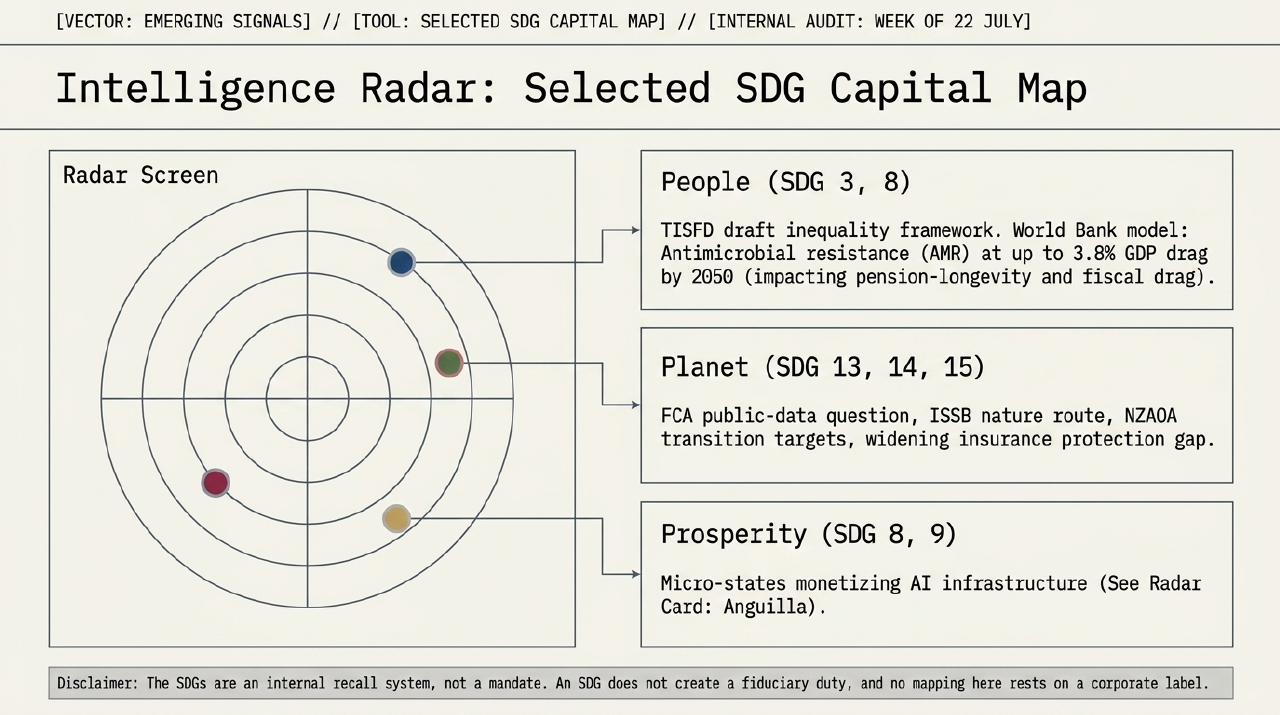
SELECTED SDG CAPITAL MAP — material signals this week
This is a selected map, not a complete 17-goal publication. Internal audit this week: material signals on SDG 3, 7, 8, 9, 13, 14, 15, 16; no qualifying in-window development logged for SDG 1, 2, 4, 5, 6, 10, 11, 12, 17.
- People (SDG 3, 8): TISFD's draft inequality/social framework (consultation to 31 July) aims to make labour and human-capital risk comparable. Foundational context, not a weekly development: the World Bank's high-impact scenario puts antimicrobial resistance at up to 3.8% of GDP a year by 2050 — a modelled figure whose fiduciary relevance runs through several distinct channels (pension-longevity assumptions, insurer mortality/morbidity, and broader macro-fiscal drag), which should not be collapsed into one number.
- Planet (SDG 13, 14, 15): the FCA public-data question (13); ISSB's nature route guiding IFRS S1 (13–15); NZAOA transition targets (7, 13); the widening protection gap (13 adaptation).
- Prosperity (SDG 8, 9): Anguilla's `.ai` domain as a concentrated sovereign revenue stream (see Signals).
- Peace / Partnership (SDG 16, 17): no qualifying in-window development logged this week.
The SDGs are an internal recall system, not a mandate: an SDG does not create a fiduciary duty, and no mapping here rests on a keyword or a corporate label.
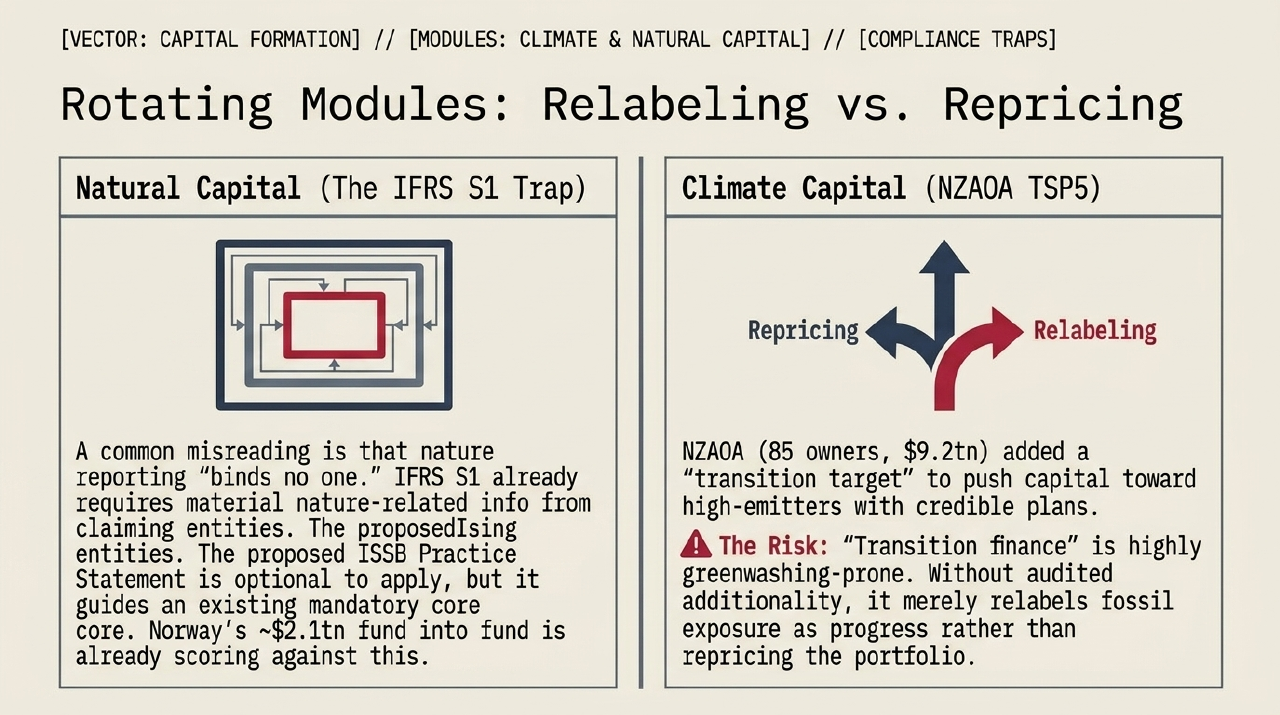
CLIMATE CAPITAL — "transition finance": repricing or relabelling?
NZAOA's fifth Target-Setting Protocol (TSP5, March 2026) added a "transition target" to push capital toward high-emitters with credible plans — the only lever that reprices a whole-market portfolio. The Alliance currently reports 85 asset owners and about $9.2 trillion (79 signatories, $9.4tn, have set Paris-aligned 2025 targets); it launched larger and has shed members under antitrust and political pressure. Counter-case: "transition finance" is the most greenwashing-prone label in the market; without audited additionality it relabels fossil exposure as progress. Watch: whether transition targets ship with audited additionality criteria. Sources: ESG Today — NZAOA transition targets · UNEP FI — NZAOA.
NATURAL CAPITAL — nature disclosure is already partly here
A common misreading is that nature reporting "binds no one." In fact IFRS S1 already requires material nature-related information from companies claiming ISSB-compliance; the ISSB's proposed Practice Statement would guide that existing requirement and would be optional to apply. July staff papers ask the board to authorise balloting for a formal consultation — moving nature from an idea toward a time-boxed process. Norway's ~$2.1tn fund already scores companies against consolidated nature expectations. Counter-case/trap: the Practice Statement itself is proposed and optional — do not report it as a new mandatory standard; but equally, do not tell readers nature disclosure is wholly voluntary when IFRS S1 materiality already reaches it. Watch: the balloting decision and any jurisdiction hard-wiring it. Sources: IFRS/ISSB — nature way forward · ESG Today — ISSB non-mandatory route.
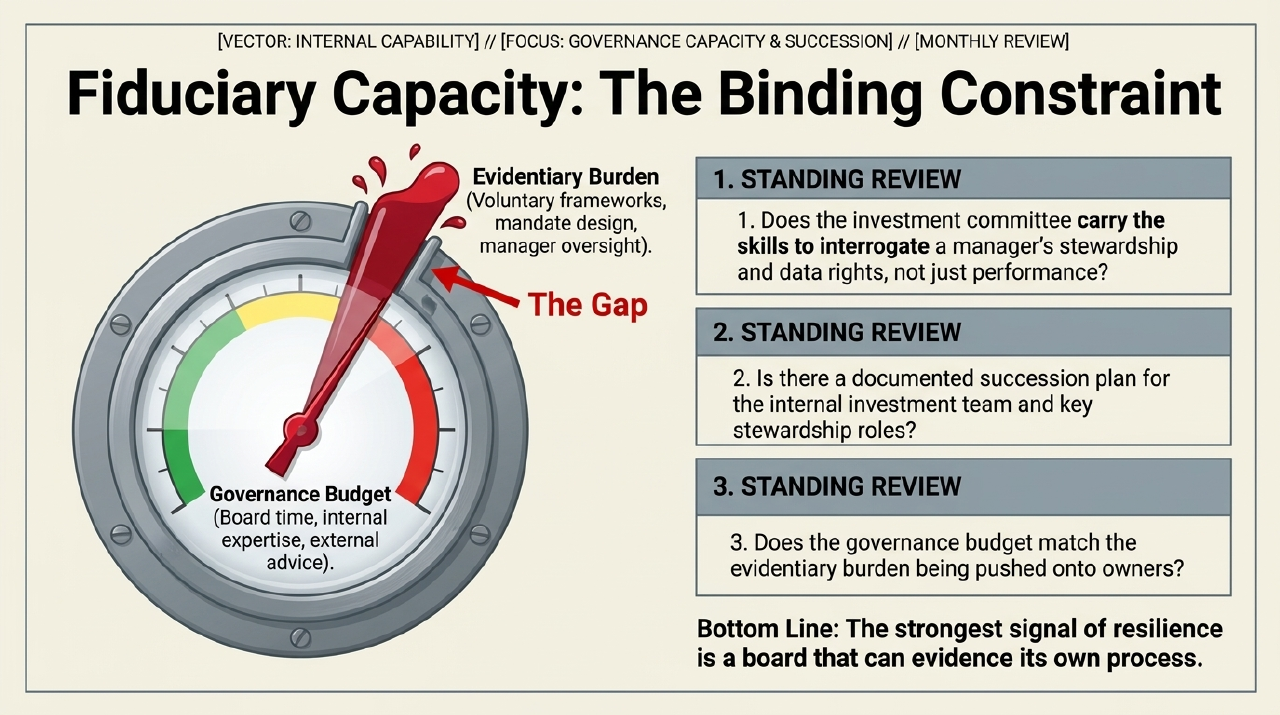
FIDUCIARY CAPACITY & SUCCESSION
As duty migrates from public disclosure into judgement, mandate design and manager oversight, the binding constraint becomes the board's own capacity. Three questions worth a standing review: does the investment committee carry the skills to interrogate a manager's stewardship and data rights (not just performance)? Is there a documented succession plan for the internal investment team and key stewardship roles? And does the governance budget — time, expertise, external advice — match the evidentiary burden that voluntary frameworks now push onto owners? This is a governance-capacity prompt, not advice; the strongest signal of resilience is a board that can evidence its own process.
ON THE RECORD — three allocators on the duty to the long horizon
In statements to UAO, three of the world's largest allocators — Abu Dhabi's Mubadala, Canada's CPP Investments and CalSTRS, managing more than US$1.3 trillion between them — set out how permanent capital should behave when others hesitate. The through-line is a fiduciary one. CPP's Michel Leduc put the benchmark debate in duty terms: "A genuine Total Portfolio Approach is about optimizing the entire Fund… we may deliberately accept short-term benchmark headwinds if it strengthens the Fund over decades… our ultimate test is whether we're improving long-term outcomes for contributors and beneficiaries, not whether we outperform a market index in any given year." Mubadala framed its 17% asset growth and US$39bn of 2025 deployment as conviction through the cycle: its "long-term horizon… allows us to look through short-term volatility." And on the concentration question every universal owner faces, both are, in Leduc's words, underweight America "by design" — CPP roughly 48% US ("well below its share of global public markets"), Mubadala 44% North America.
Why it matters here. The same intergenerational mandate that lets these funds tolerate benchmark pain is exactly what the voluntary turn tests: when duty migrates from public rules into judgement, the owners who can articulate a beneficiary-first standard — not an index — are the ones who can defend their decisions. Read the full exchange: Mubadala, CPP Investments and CalSTRS — On the Record.
SIGNALS BEFORE CONSENSUS — early, sourced, with triggers
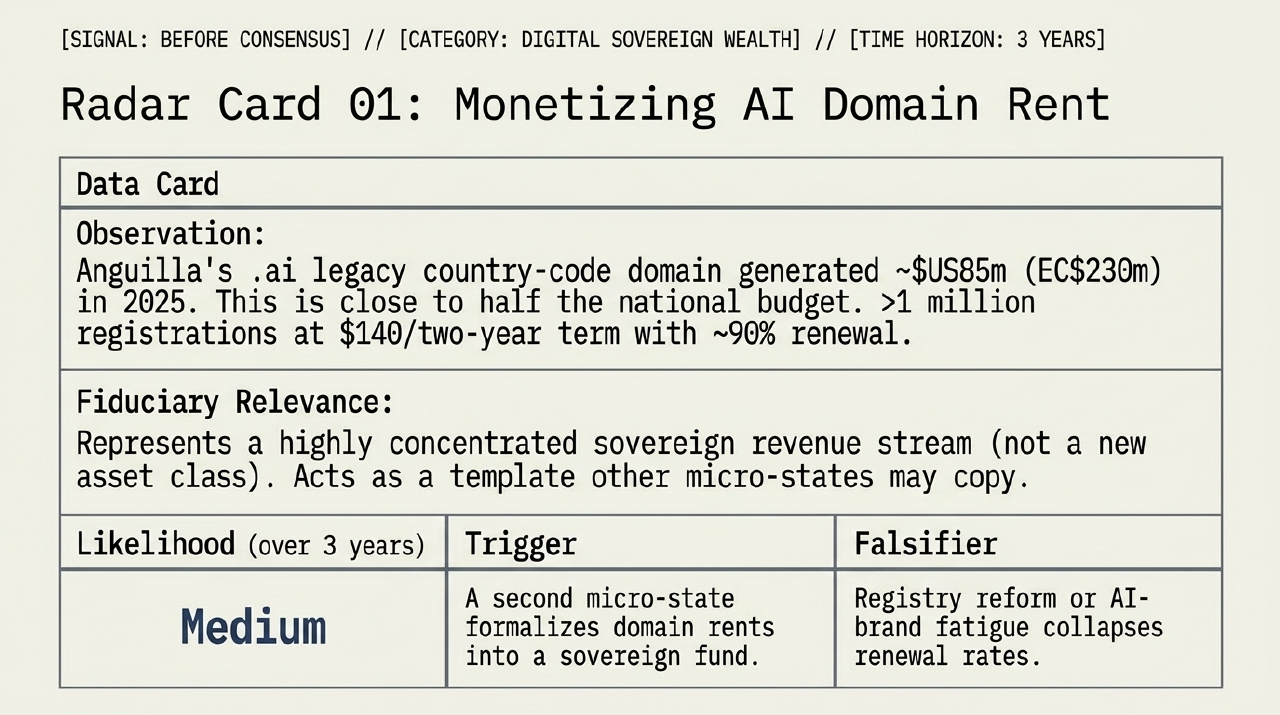
"Digital sovereign wealth": micro-states monetising AI via legacy country-code domains. Anguilla's `.ai` domain generated about US$85 million (EC$230 million) in 2025 — close to half the national budget — with registrations past one million at $140 per two-year term and roughly 90% renewal; independent analysis (Sherwood) corroborates domain-related revenue well above $70 million. Fiduciary relevance: a highly concentrated sovereign revenue stream (not a new asset class) and a template other micro-states with valuable legacy domains may copy. Likelihood the category persists over the next three years: medium. Trigger: a second micro-state formalises domain rents into a fund. Falsifier: registry reform or AI-brand fatigue collapses renewals. Sources: Anguilla Focus — EC$230m .ai windfall, 2025 · Sherwood — >1m .ai sites · IMF — Anguilla's AI-powered revenue.
RARE BUT RUINOUS — a tail hypothesis, not a forecast
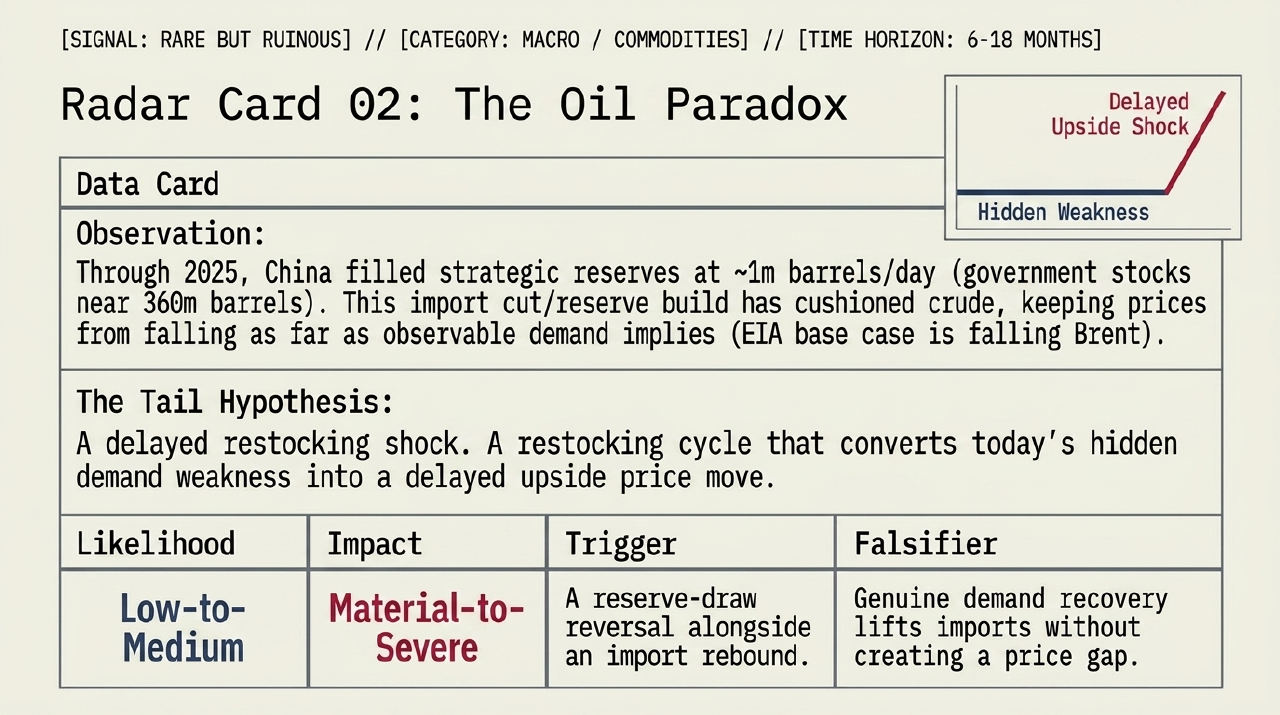
The oil paradox: a delayed restocking shock. Through 2025, China filled strategic reserves at roughly one million barrels a day (government stocks estimated near 360 million barrels), and its import cuts plus reserve builds have cushioned crude — helping keep prices from falling as far as weak observable demand implies. The EIA's July base case is for falling Brent, with reserve rebuilding merely attenuating the decline. The tail hypothesis owners may not be pricing: a restocking cycle that converts today's hidden demand weakness into a delayed upside price move. This is a scenario to stress, not an established signal, and the base case runs the other way. Likelihood: low-to-medium over the next 6–18 months; impact: material-to-severe. Trigger: a reserve-draw reversal alongside an import rebound. Falsifier: genuine demand recovery lifts imports without a price gap. Sources: EIA — Short-Term Energy Outlook, global oil · CNBC — China's cushioning "won't last".
THE DIVIDE — "voluntary" is not one legal category
The instinct to sort the world into "mandatory" and "voluntary" fails a fiduciary. This quarter alone: an ISSB Practice Statement that is optional to apply but guides an existing IFRS S1 requirement; a TISFD framework in pure consultation; a UK stewardship code that is voluntary yet folds stewardship into how duty is discharged; UK fiduciary guidance under development outside statute; an FCA proposal to remove a public requirement; and, against all of it, a US trial-court injunction that is narrow, fact-specific and fully operative. The board task is not to ask "is this binding?" but to map each instrument by jurisdiction, legal status, asset pool and decision owner — and to size the evidentiary burden each one quietly transfers.
THESIS TRACKER
| Prior UAO signal | Evidence received this week | Status | Next falsifier |
|---|---|---|---|
| "The voluntary turn" — obligations attached to ESG language are being made optional | FCA moves to thin public climate reports; UK duty mechanism omitted from the Act; ISSB nature still proposed | Strengthened (but reframed: it is comparable data, not duty, going private) | A jurisdiction hard-wires ISSB nature, or the FCA retains a comparable public baseline |
| Universal-owner stewardship needs a working lever | Public proxy support near zero; NBIM scores are observations, not attributed outcomes | Weakened | Owners publish attributed engagement outcomes with counterfactuals |
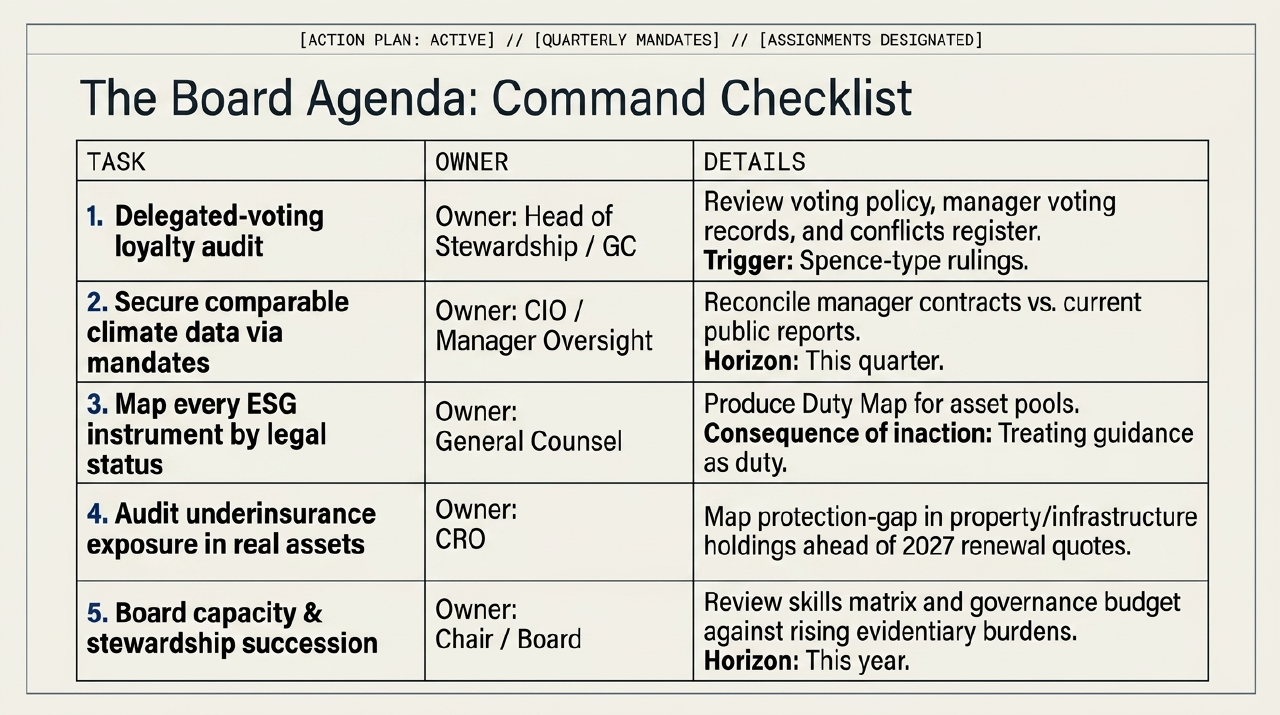
THE BOARD AGENDA
1 · Delegated-voting loyalty audit — Owner: Head of Stewardship / GC · Horizon: next meeting · Evidence: voting policy + manager voting records + conflicts register · Trigger: any Spence-type ruling in your jurisdiction · If ignored: duty-of-loyalty and litigation exposure.
2 · Secure comparable climate data via mandates and data rights — Owner: CIO / Manager Oversight · Horizon: this quarter · Evidence: manager contracts + data-rights schedule vs current public reports · Trigger: FCA final rules · If ignored: loss of comparable data for selection, monitoring and reporting.
3 · Map every ESG instrument by legal status — Owner: GC · Horizon: this quarter · Evidence: a Duty Map for your asset pools + counsel note · Trigger: a new consultation or code deadline · If ignored: treating guidance as duty, or ignoring a real one.
4 · Insurance-retreat / underinsurance exposure in real assets — Owner: CRO · Horizon: this quarter · Evidence: protection-gap mapping of property and infrastructure holdings · Trigger: 2027 renewal quotes · If ignored: unpriced, correlated real-asset risk.
5 · Board capacity and stewardship-role succession — Owner: Chair / Board · Horizon: this year · Evidence: skills matrix + succession plan + governance budget · Trigger: a key-person departure · If ignored: the evidentiary burden outruns board capacity.
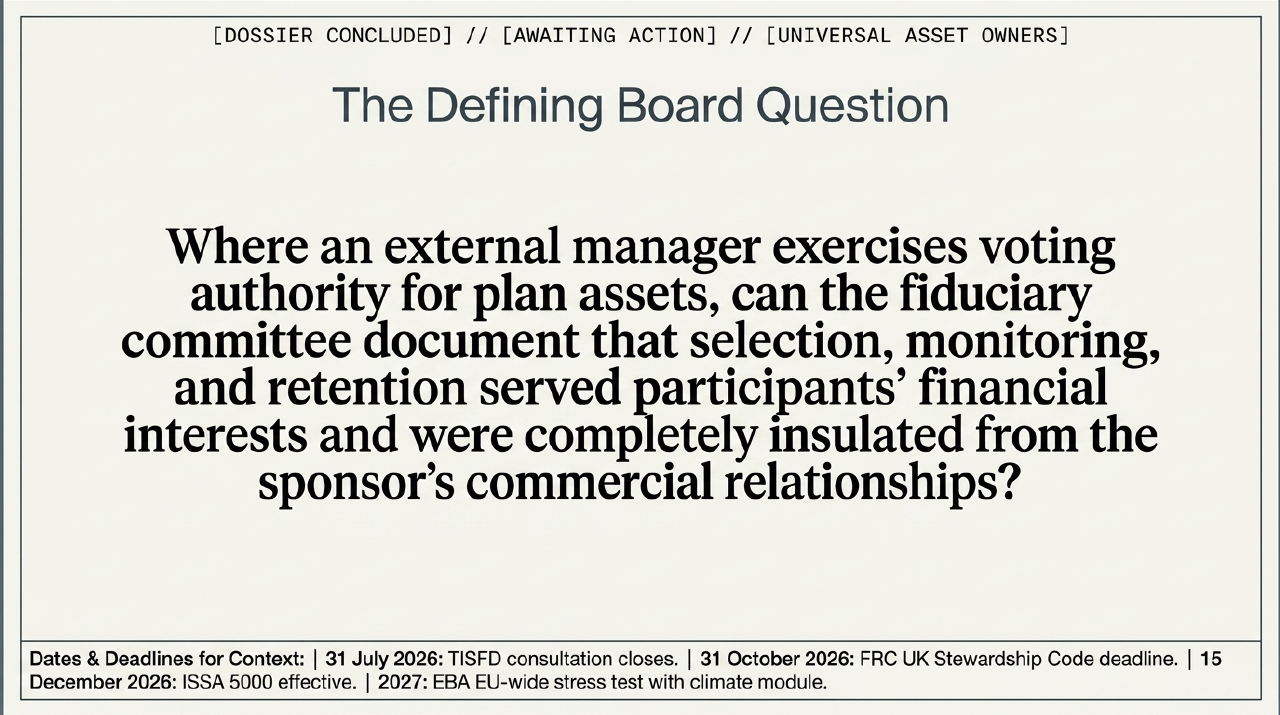
THE BOARD QUESTION
Where an external manager exercises voting authority for plan assets, can the fiduciary committee document that selection, monitoring and retention served participants' financial interests and were insulated from the sponsor's commercial relationships?
DATES & DEADLINES
- 31 July 2026 — TISFD consultation closes.
- 31 October 2026 — FRC UK Stewardship Code 2026 application deadline.
- Later in 2026 — FCA final rules on product-level climate disclosure expected.
- 15 December 2026 — ISSA 5000 effective for periods beginning on or after this date, subject to jurisdictional adoption.
- 2027 — EBA EU-wide stress test with climate module; TISFD final framework expected.
- Expected across 2026–27 — DWP fiduciary-duty guidance (consultation then publication); the government has said it will bring proposals forward "in the months and years ahead."
BY THE NUMBERS
- $424bn — 2025 nat-cat protection gap, up from $395bn (Swiss Re, June 2026); resilience index ~27%.
- 97 / 138 / 182 — environmental proxy proposals filed in 2026 / 2025 / 2024; none voted on in 2025–26 won majority support (Mayer Brown, via Harvard Law School Forum).
- ~US$85m (EC$230m) — Anguilla's `.ai` domain revenue in 2025, close to half the national budget (Anguilla Focus; corroborated by Sherwood).
- 52 / 36 — average NBIM portfolio-company Climate / Nature Expectation Scores, 2025 (observations, not attributed outcomes).
FOUNDATIONAL CONTEXT & FURTHER READING
- FSB — "Vulnerabilities in Private Credit" (6 May 2026) — foundational systemic-risk context.
- Mayer Brown, via Harvard Law School Forum — 2026 proxy-season trends (11 June 2026).
- For the other side — "BlackRock refocuses its 2026 voting stance" (IR Impact) — the pecuniary-materiality case in its own words.
- This week: the FCA product-level climate-disclosure consultation and investor responses (see the Fiduciary Delta).
SOURCES — this issue
Primary and first-party where available; confirmed claims are cited inline above and consolidated here. Sources checked through 12:00 ET, 22 July 2026.
- Fiduciary Delta / FCA: FCA press release · IIGCC response · HSF Kramer — CP26/17
- UK duty / Act: Pensions Expert — statutory-guidance amendment defeated · FRC — UK Stewardship Code 2026
- Spence: Willkie · Ropes & Gray — practical takeaways · Ropes & Gray — final judgment
- Stewardship & proxy: Mayer Brown / Harvard Law School Forum · Trellis — NBIM
- Systemic risk & insurance: Swiss Re via Insurance Business · FSB climate roadmap
- Climate & nature: ESG Today — NZAOA · UNEP FI — NZAOA · IFRS/ISSB — nature · ESG Today — ISSB route
- Just transition & health: ESG Today — TISFD · World Bank — AMR (foundational)
- Signals: Anguilla Focus — EC$230m .ai windfall · Sherwood — Anguilla .ai · IMF — Anguilla · EIA — STEO · CNBC — China oil
Methodology note: sources checked through 12:00 ET (16:00 UTC), 22 July 2026; material claims are linked to named sources, primary or first-party where available. Older developments are labelled as context, not presented as in-window news. Likelihood ranges are calibrated qualitative judgements, not forecasts or model outputs. UAO Fiduciary is editorial analysis — not legal, investment, or voting advice.