Trump said deal. Tehran said no talks. Brent fell 5% anyway.
UAO EditorialAugust 3, 20268 min read
The FT put €3.1bn on restoring the land burnt in Europe’s record fire season — a restoration-cost floor, not the loss. What still does not exist is a map of who bears that loss. The ECB, it turns out, already has one instrument for it: a collateral haircut on climate-vulnerable debt, live for bonds since June, extended to loans on 24 July. Meanwhile Brent fell 5% on talks Tehran says do not exist, and Hungary’s biggest power plant shut down for the first time in 44 years — because a river got too low.
Watch · Today’s briefing.
If you read nothing else
1. Europe got a fire number today — the restoration bill, not the loss. The Financial Times, using the European Commission’s methodology, estimates €3.1bn to restore land burnt in the season’s first two months across France, Spain, Portugal, Greece and Romania — already above the Commission’s ~€2.5bn annual EU average, and, by the FT’s own account, likely well below the full economic toll. EFFIS: 434,976 ha to 29 July, 2.53× the twenty-year average; Spain’s ministry counts 173,651 ha, about six times last year. A consolidated total-loss estimate, and its allocation, is still nowhere we could find.
2. The ECB already has an instrument — extended ten days ago. A 24 July decision extends the Eurosystem’s collateral “climate factor” — live for corporate bonds since 15 June — to corporate loans pledged as collateral: graduated haircuts up to 5% on transition-vulnerable debt, effective at the earliest by end-2027. Frank Elderson told the Guardian the bank also plans research this year on how ecosystem degradation becomes credit loss dynamics. The haircut is policy; the research is intent; neither is a capital requirement.
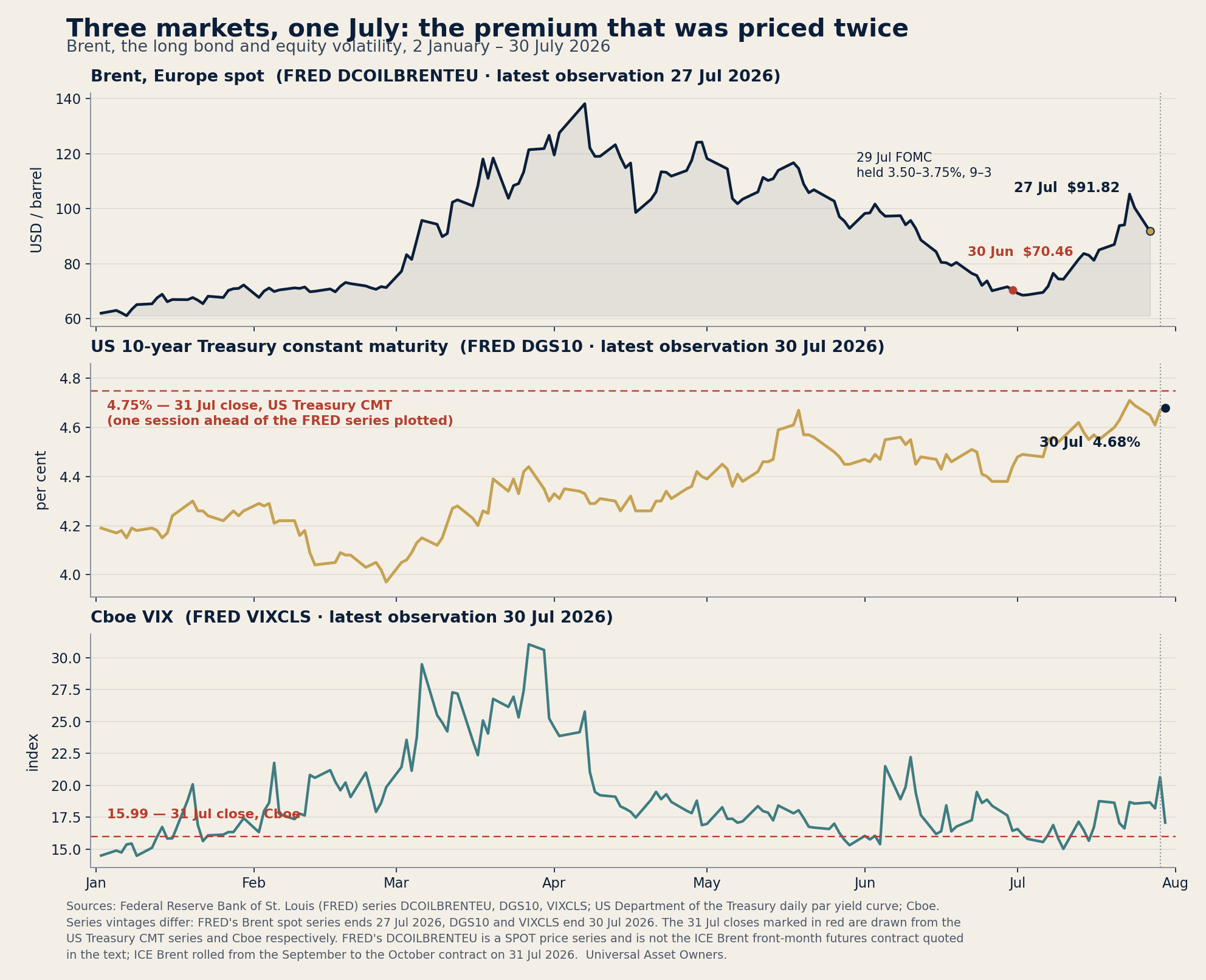
3. The oil premium came out on an intention. Brent’s new October front month fell 4.7% from Friday’s $87.93 settlement to about $83.77 (10:21 UTC), after President Trump said on Sunday he had cancelled planned strikes on Iran “subject to being able to rapidly make a DEAL.” By Monday morning Iran’s foreign ministry had said twice on the record that no US–Iran negotiations exist and “the strait remains closed.” (September’s expiring contract gained 23.5% in July to $90.12; the contract rolled 31 July — different contracts, not directly comparable.)
4. Hungary’s biggest power plant is off — first time in 44 years. Paks completed a full shutdown on 2 August after the Danube fell 28 cm below its 2018 record low, beneath the plant’s cooling intakes. A low-carbon asset with no fuel-price risk, stopped by hydrology — and one river correlating nuclear, hydro, freight, industry and municipal water across mandates that report separately.
5. Washington sold euros to buy yen. The first coordinated US yen-buying operation since 1998, executed Friday via the New York Fed — and, per FT reporting, funded by selling euros, not dollars. Bessent indicated the Fed’s FIMA repo facility supported it and proposed enlarging it; the Fed has not agreed. Collateralised public-sector liquidity in place of outright Treasury sales — intervention that stays on public balance sheets.
Chart of the day. Sources: FRED (DCOILBRENTEU, DGS10, VIXCLS); US Treasury daily par yield curve; Cboe. Series vintages differ; the 31 Jul closes in red come from Treasury CMT and Cboe. DCOILBRENTEU is a spot series, not the ICE front-month contract; ICE Brent rolled September→October on 31 Jul.
The restoration bill is in. The loss map isn’t.
This morning’s €3.1bn is a floor with a good methodology — the cost of returning burnt land to its pre-fire condition. It is not the destroyed private wealth, the interrupted businesses, the impaired collateral, or the fiscal cost of response and rebuilding. The FT itself says the final toll is likely considerably higher. What remains unpublished, from every modeller and authority we checked: a consolidated estimate of the total economic loss, and of who bears it.
The structure explains the blank. Forest fire is excluded from France’s CatNat regime and from Spain’s Consorcio — which does not mean burnt houses were uninsured (standard policies can cover fire), but does mean no state-backed pool stands ready to publish the consolidated figure CatNat produces for floods. Trees, plantations and undeveloped land are largely uninsured, so the economic loss will materially exceed the insured loss — by a multiple that the modellers and authorities we checked have not yet published. An uninsured loss distributes: households, farmers, lenders, municipalities — and a portion, not all, migrates to the sovereigns you hold.
The quietest link now has hard evidence. Banco de España researchers (Working Paper 2406, 2024) found lending to firms within 10 km of a wildfire contracts about 6% — big “outsider” banks pull back sharply; local banks, trading on soft information, cut far less. That is the fire entering the credit market: a quiet contraction in who can borrow.
The exposure map, not a number. Three channels, and they compound:
Underwriting — test DBRS’s “earnings event” read against your carriers’ southern-European concentration; ask about property-cat capacity intentions for 1 January.
Credit — request the share of your banks’ books lent to ecosystem-dependent borrowers (the ECB’s op380 measure), and — after 24 July — the share of pledged collateral that would attract the climate factor. The Banco de España result adds a third: how much of your bank exposure behaves like an “outsider” lender in a fire zone?
Sovereign — a portion of the uninsured loss reaches the sovereigns you hold; which portion is a fiscal-policy outcome. Watch supplementary budget lines, not fire maps.
The practical ask. When insured-loss estimates arrive, ask the second question: what is the estimated total economic loss, and how does the difference distribute? Answerable in ranges — few are asking.
The tape
Instrument
Level
As of
ICE Brent, Oct front month (settle)
$87.93 +1.21%
31 Jul close
ICE Brent, Sep (expiring, settle)
$90.12 +1.2%
31 Jul, final session
Brent, quoted (not a settlement)
$83.50 −5.0%
3 Aug 11:45 UTC — intraday
NYMEX WTI, quoted
$79.61 −6.0%
3 Aug 11:45 UTC — intraday
US 10-year Treasury (CMT)
4.75% +6bp wk +31bp mth
31 Jul close
US 2-year Treasury (CMT)
4.28% −5bp wk
31 Jul close
USD/JPY
156.79 (o/n 155.24–157.88)
3 Aug 11:56 UTC — intraday
S&P 500
7,489.72 +0.70%
31 Jul close
Nasdaq Composite
25,373.85 +1.00%
31 Jul close
Dow Jones Industrial Average
52,485.03 +0.53%
31 Jul close
VIX (Cboe)
15.99 −6.44%
31 Jul close
ICE BofA US High Yield OAS
284bp
30 Jul — 31 Jul print not yet published
Brent rolled September→October on 31 July; weekend moves are quoted on the October contract only. Europe mid-session (10:13–10:15 UTC): Stoxx 600 +0.42%; DAX +1.44% (intraday 52-week high); CAC 40 +1.31%; FTSE 100 −0.07%, having opened higher. Asia closes: Nikkei −0.94%; KOSPI −5.13%.
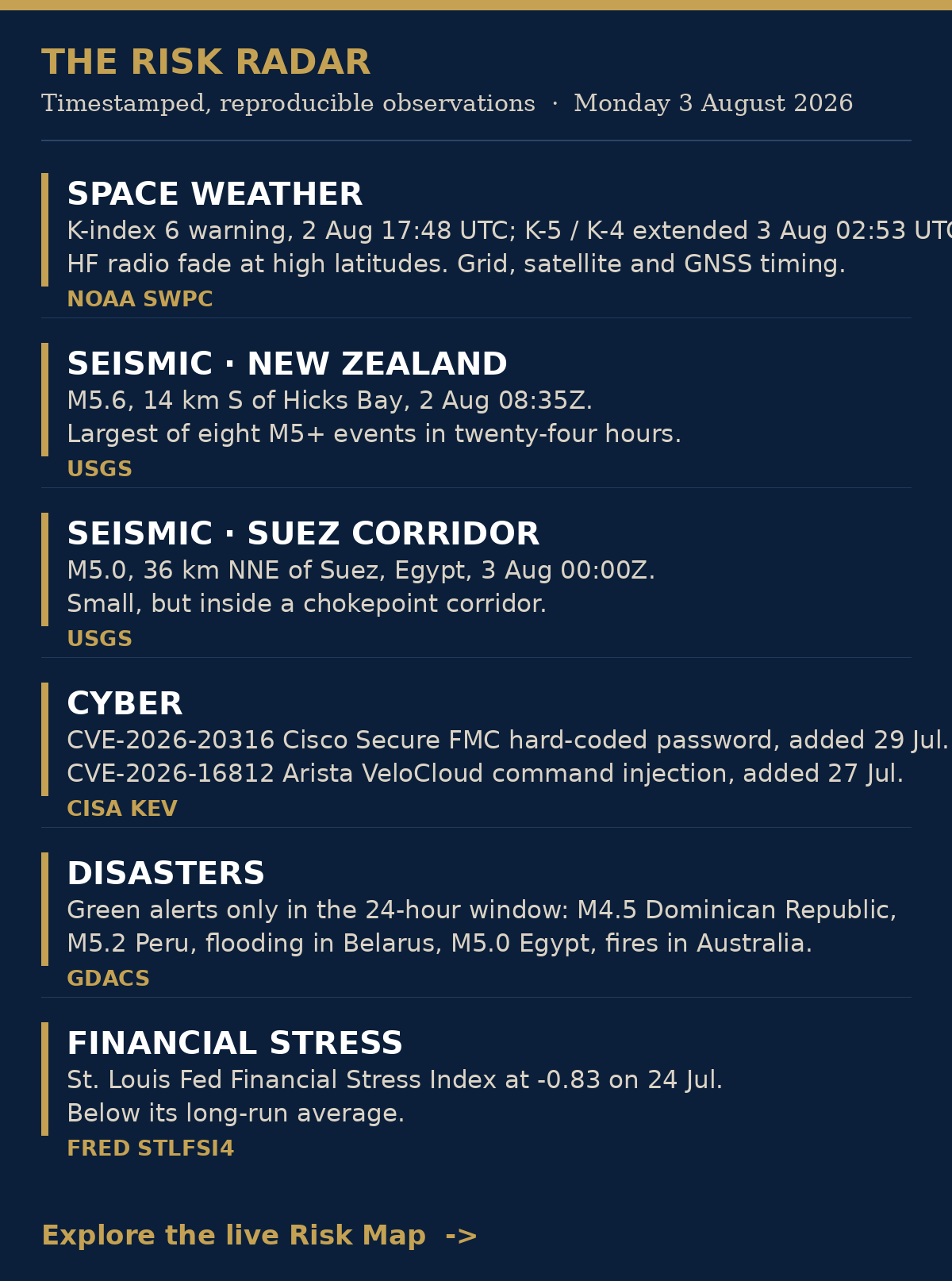
Space weather. K-index 6 warning 17:48 UTC 2 Aug; K-5/K-4 extended 02:53 UTC 3 Aug. → NOAA SWPC Seismic. M5.6 Hicks Bay, NZ, 2 Aug 08:35Z → USGS · M5.0 Suez corridor, 3 Aug 00:00Z → USGS Cyber. CVE-2026-20316 (Cisco FMC) and CVE-2026-16812 (Arista VeloCloud) added to KEV. → CISA Disasters. Green alerts only. → GDACS Financial stress. STLFSI4 −0.83 (24 Jul). → FRED
Early signals — reported, not yet confirmed
Items below our normal evidence bar: reported observations we have not confirmed to a primary source, listed because the trajectory matters more than the confirmation lag.
Spokane, WA: ~60,000 ordered to evacuate, ~600 buildings destroyed, three uncontained fires, FEMA assistance requested; no casualties at the Sunday briefing. Not established: insured loss, final counts. A second record fire event, second continent, no loss total. Hormuz physical: two UKMTO incidents Saturday (one projectile strike; one nearby explosion, no damage); the LNG carrier GasLog Shanghai’s manager confirmed a strike and extinguished fire — likely the same vessel as the first report. “Three attacks since Saturday” conflates stale items. Not established: attribution, transit volumes. OPEC+: +188,000 b/d September quota approved; production runs far below targets on blocked routes. A quota is not a delivered barrel. FIMA: Bessent proposed enlarging the facility; the Fed has not agreed. Also: Australia’s first H5N1 mass wildlife mortality (no farm incursion; human risk low) · India’s CERC draft waiver for grid-stranded renewables · Cuba’s fourth national blackout and first foreign-backed fuel venture.
Base case: Elderson’s analysis publishes in 2026 and informs supervisory dialogue; the loan collateral factor lands on its stated timetable (earliest end-2027); no Pillar 1 change in 2027. Triggers: quantified credit-loss pathways; SREP/Pillar 2 references; an EBA consultation; a second supervisor or a raised haircut ceiling.
No probability attached. A collateral haircut exists; a capital requirement does not, anywhere we checked — no reference class, so we publish the triggers.
Podcast · The Universal Owner
Many prices, no total — 10 min.
Supported by Corinium’s AssetOps Chicago — where the buy-side operating community meets.
The Back Page · with The Allocator
Many prices. No total.“Many prices. No total.” — Universal Asset Owners, 3 August 2026.
Verified on each employer’s own applicant system, 3 August 2026.
The measure, in one line
A traded risk repriced in minutes on talks Tehran says do not exist. An untraded one set records on two continents and, as of this morning, has a restoration floor — and still no loss map. Not knowing the total has never been the same as not being exposed to it.
See you tomorrow, The Editorial Team Universal Asset Owners
The Daily Brief
The morning briefing for the people who allocate long-horizon capital.
Research, charts, video and podcast analysis for the institutions investing at the scale of the world.
Five minutes, five days a week. Complimentary — subscriptions are reviewed by our editorial desk, and you'll receive a notice once approved.
You’re on the list. Tomorrow’s brief will arrive in your inbox.