
Universal Asset Owners · Daily Brief · Monday 3 August 2026
The Restoration Bill Is In. The Loss Map Isn’t.
The Financial Times put €3.1bn on restoring the land burnt in the first two months of Europe’s record fire season — a restoration-cost estimate, and by the FT’s own account well short of the full economic loss. What still does not exist is a map of who ultimately bears that loss. The ECB, it turns out, has already started building one instrument for it: a collateral haircut on climate-vulnerable corporate debt, live for bonds since June and extended to loans on 24 July. Meanwhile Brent fell 5% on talks Tehran says do not exist, and Hungary’s largest power plant shut down completely for the first time in its 44-year history — because a river got too low.
1. Europe got a fire number today — the restoration bill, not the loss. The Financial Times, using the European Commission’s methodology, estimates €3.1bn to restore land burnt in the season’s first two months across France, Spain, Portugal, Greece and Romania — already above the Commission’s ~€2.5bn annual EU average, and, as the FT itself notes, likely well below the full economic toll. EFFIS has mapped 434,976 hectares across the EU to 29 July — 2.53× the 2006–2025 average — and Spain’s environment ministry puts its national figure at 173,651 hectares to 28 July, roughly six times last year. A consolidated estimate of the total economic loss, and of how it distributes, is still nowhere we could find.
2. The ECB already has an instrument — and extended it ten days ago. A 24 July ECB decision extends the Eurosystem’s collateral “climate factor” — live for corporate bonds since 15 June — to corporate loans pledged as collateral, with graduated valuation haircuts of up to 5% on transition-vulnerable debt, effective at the earliest by end-2027. Frank Elderson told the Guardian on Saturday the bank also plans research this year on how “ecosystem degradation pathways” become credit loss dynamics. The haircut is policy; the research is intent; neither is yet a capital requirement.
3. The oil premium came out on an intention. ICE Brent’s new October front month fell 4.7% from Friday’s $87.93 settlement to about $83.77 by mid-morning (10:21 UTC), after President Trump said on Sunday he had cancelled planned strikes on Iran “subject to being able to rapidly make a DEAL.” By Monday morning Iran’s foreign ministry had said twice on the record that no US–Iran negotiations exist and that “the strait remains closed.” (Brent’s expiring September contract gained 23.5% in July to a $90.12 settlement; the contract rolled on 31 July, so the two moves are measured on different contracts and are not directly comparable.)
4. Hungary’s biggest power plant is off — for the first time in 44 years. The Paks nuclear plant completed a full shutdown on 2 August after the Danube fell 28 cm below its 2018 record low and its cooling-water intakes could no longer reach the river. A low-carbon asset with no fuel-price risk, stopped by hydrology — and one river correlating nuclear cooling, hydro, freight, industry and municipal water across mandates that report separately.
5. Washington and Tokyo bought yen — and, per the FT, Washington sold euros to do it. The first coordinated US yen-buying operation since 1998, executed Friday through the New York Fed, confirmed by both governments this weekend. Treasury Secretary Bessent indicated the Fed’s FIMA repo facility supported it and proposed enlarging it. Collateralised public-sector liquidity in place of outright Treasury sales — intervention that stays on public-sector balance sheets.
01 · The Briefing
Today in two minutes
The day, delivered.
02 · Chart of the Day
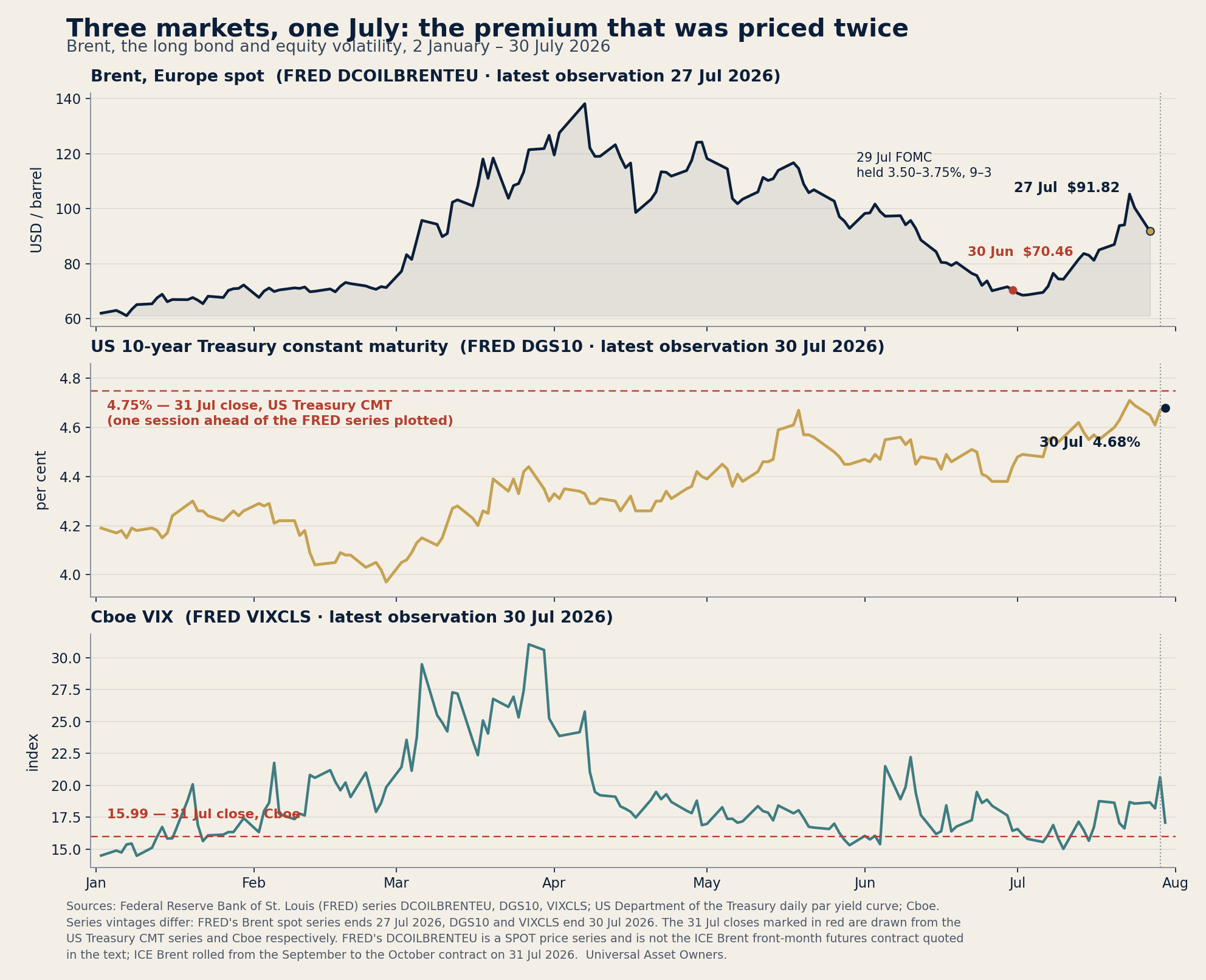
Three markets, one July
03 · The Lead
The restoration bill is in. The loss map isn’t.
At nine o’clock this morning, UTC, Europe’s record fire season finally got a headline number. The Financial Times, applying the European Commission’s methodology and aligning with French government calculations, put the cost of restoring the land burnt in the season’s first two months — across France, Spain, Portugal, Greece and Romania — at €3.1 billion. That is already above the Commission’s roughly €2.5 billion average for an entire year of EU fire damage.
Read the fine print, though, because the noun matters. €3.1bn is a restoration-cost estimate — what it would take to return the burnt land to its pre-fire condition. It is the FT’s own analysis, not an official finding, and by the FT’s own account the final toll “is likely to be considerably higher,” because restoration is only one slice of the loss. It is not the destroyed private wealth, the interrupted businesses, the impaired collateral, the foregone tourism seasons or the fiscal cost of response and rebuilding. This morning’s number is a floor with a good methodology — and it is the first entry on a page that is otherwise still blank: a consolidated map of the total economic loss, and of who ultimately bears it, which we could not find from any of the modellers or authorities we checked.
The scale it is a floor under keeps growing. EFFIS — the Commission’s Copernicus fire-mapping service — recorded 434,976 hectares burnt across the EU to 29 July: 25.4% above the same date in 2025 and 2.53 times the 2006–2025 average, with 17.98 million tonnes of CO₂ emitted against a twenty-year average of 10.26 million. (EFFIS’s mapped-area series primarily captures fires of roughly 30 hectares and larger, and can differ from national administrative totals, which is why country figures below come from the national authorities’ own series.)
Spain is now the worst-burnt country in the Union by area. The environment ministry’s provisional national figure reached 173,651 hectares to 28 July — roughly six times the same period of 2025, with 35 large fires against seven last year, and the Sierra Oeste complex the largest single fire in the national record. France set the highest figure in its own series: 116,085 hectares across 13,566 ignitions to 27 July, against 72,000 in all of 2022, the previous worst year in that series. The Saumos fire alone burnt 42,000 hectares with 240 kilometres of fire edge; the Gironde prefecture recorded 224,000 people preventively evacuated at the peak, and two districts of Le Porge remain closed while unexploded shells are cleared — the difference between land that has stopped burning and land that can be used, insured or lent against again.
Contrast all of that with the other risk that moved this weekend — the one with a futures curve. Brent’s expiring September contract rose 23.5% through July to a $90.12 settlement on its final trading day. The US 10-year added 31 basis points over the month to close at 4.75%; the 2-year closed at 4.28%; 2s10s widened eleven to 47 basis points — a bear steepening consistent with higher inflation expectations, term premium, fiscal-supply concerns, or some mix of the three. Then, over a weekend, part of it came out. President Trump said on Sunday he had cancelled planned strikes on Iran, subject to a deal that would include opening the strait. By mid-morning Monday the new October front month was down 4.7% from Friday’s settlement, near $83.77. (The contract rolled on 31 July; July’s rally and the weekend’s fall are different contracts, and not directly comparable.)
And what had not happened: nothing was signed — and by Monday morning Tehran had rejected the premise twice. At 07:32 UTC, foreign ministry spokesman Esmaeil Baghaei said the understanding under discussion with Oman “does not mean the reopening of the Strait of Hormuz — the strait remains closed,” calling an Oman lane deal “a necessary condition, but not a sufficient one.” At 09:17 UTC: “We do not have any negotiations with the United States at the moment.” The talks that exist are Iran–Oman, about safe passage on a shipping lane. The talks the market repriced against are the ones Tehran says do not exist. A traded risk has a curve, daily settlements, and people paid to change their minds quickly — sometimes faster than the facts.
The fire season’s losses have no such machinery. They have the FT’s restoration floor, insured claims being adjusted, firefighting budgets spent, reinsurance programmes that reprice in January — many prices. What they do not have is a total, or an allocation. Swiss Re’s head of catastrophe perils said on 28 July it was too early to estimate losses. Morningstar DBRS called it an earnings event rather than a credit event for large diversified carriers, without a figure. France Assureurs extended the claims deadline to 31 August and published no aggregate. Two structural facts sit alongside that silence: forest fire is excluded from France’s CatNat regime, and Spain’s insurers’ association states plainly that fire is not among the Consorcio’s extraordinary risks. Neither exclusion means a burnt house was uninsured — standard property policies can and do cover fire — but for this peril, no state-backed pool stands ready to publish the kind of consolidated figure CatNat produces for floods. And DBRS adds the fact that sets the gap’s direction: trees, plantations and undeveloped land are largely uninsured, so the economic loss will materially exceed the insured loss — by a multiple that the modellers and authorities we checked have not yet published.
An uninsured loss does not disappear, and it does not automatically become the state’s either. It distributes: some stays with households and landowners as destroyed private wealth; some with farmers and forestry operators as lost income; some reaches lenders as impaired collateral and weaker borrower cash flow; some reaches municipalities and utilities; and a portion migrates to sovereign balance sheets through emergency response, reconstruction, income support and lower tax receipts. The insured-loss estimate, when it arrives, will be the most visible number in that chain — and for a universal owner it may matter least, because it measures only the slice that entered insurance contracts.
04 · The Second Story
The ECB’s haircut is already real — the fires just gave it a test case
Ten days before the Gironde burned at its peak, the ECB quietly did something our weekend coverage of Frank Elderson’s interview understated: it extended an existing climate instrument. On 24 July the Governing Council decided to apply the Eurosystem’s collateral “climate factor” — in force for corporate bonds since 15 June — to corporate credit claims: the loans banks pledge to the central bank for funding. Transition-vulnerable debt will carry a graduated valuation reduction of up to 5%, scaled by an asset-level uncertainty score built from the Eurosystem’s climate stress test, the borrower’s transition exposure and residual maturity, with implementation at the earliest by end-2027.
That reframes Saturday’s interview. Elderson told the Guardian the bank plans to publish analysis this year on how “ecosystem degradation pathways” could translate into credit loss dynamics for euro-area banks — “These services are not stable but they are in rapid decline… knowing that dependency, and knowing those exposures by the banks, we come to the conclusion that this is relevant.” Keep the categories distinct. Policy that exists: a live climate haircut on bonds and an announced extension to loans — the central bank’s liquidity plumbing, already discounting climate-vulnerable debt. Research that exists: Occasional Paper 380 (2024), placing ~72% of euro-area non-financial corporates as critically dependent on at least one ecosystem service, with roughly 75% of corporate bank lending sitting with those firms. Intent, as reported: the ecosystem-to-credit-loss analysis Elderson described, with no press release and no timetable. Not established: any capital requirement — a collateral haircut changes what a loan is worth at the central bank’s window, not how much capital a bank must hold against it.
He framed the stakes himself: “This is not some kind of a flower-power, tree-hugging exercise. This is core economics. This is core financial stability, core price stability.”
The counterclaim, stated at its strongest
The haircut maxes at 5%, applies to collateral valuation rather than capital, and does not bite loans before end-2027. Research is not regulation; prior ECB nature work has moved no risk weight. The Elderson interview predates the current fires — a running work programme, not a supervisory reaction. And the political weather is hostile: the US withdrew from the NGFS last year, a body Elderson co-founded and which now spans 114 central banks and supervisors.
All fair — and none of it changes the accounting question, because that question does not depend on the ECB. The losses from a record fire season are already distributing across household, corporate, bank and public balance sheets. The ECB’s instruments and research would only tell you more precisely where. Not knowing the total has never been the same as not being exposed to it.
05 · The Third Story
Washington sold euros to buy yen
Japan’s Ministry of Finance confirmed that Tokyo and Washington bought yen together on Friday 31 July — the first coordinated US yen-buying operation since 1998 (the 2011 joint action went the other way). Treasury Secretary Scott Bessent confirmed US participation: “Friday’s coordinated foreign exchange actions countered disorderly yen movements… [we] will not hesitate to participate in further joint intervention.” The yen touched a nearly three-month high of 155.20 per dollar, from a near-40-year low of 163.99 in late July, and traded near 156.90 by mid-morning. Japan’s 2-year yield rose to 1.54%, its highest since May 1995; the 5-year set a record 2.050%.
Two disclosures matter more than the currency move. First, the Financial Times reported that the US side sold euros rather than dollars — executed by the New York Fed on the Treasury’s behalf. (Analysts read the choice as protecting the dollar during an inflation fight and note the ESF and SOMA both hold euro reserves; that funding detail is analyst assessment, not an official statement.) Second, Bessent indicated the Fed’s FIMA repo facility — which lets approved foreign official institutions borrow dollars against Treasuries held at the New York Fed, up to $60bn per counterparty — supported the operation, and proposed enlarging it “in the coming months.” The Fed has not agreed; no amounts are disclosed; Japan’s monthly intervention data land at the end of August.
The pattern for an owner: collateralised public-sector liquidity replacing outright Treasury sales — intervention that reduces market disruption while remaining on public-sector balance sheets. Japan held $1.14trn of Treasuries at end-May; defending the yen by selling them would have pressured the very market Japan also holds. For unhedged Japanese equity, the currency leg is now a policy trade rather than a rate-differential trade, with a different half-life and tail.
06 · The Fourth Story
The river turned off the reactor
On Sunday, Hungary’s 2 GW Paks nuclear plant — which its operator says supplies close to half the country’s electricity generation — completed a full shutdown, the first total halt in its 44-year history. Not for lack of fuel, and not for a fault: the Danube fell 28 cm below its 2018 record low, beneath the reach of the plant’s cooling-water intakes. Output stepped down through the week — roughly 2,000 MW to 240 MW to zero — while households and more than 300 companies, MOL, Samsung SDI, Audi and Denso among them, cut about 400 MW of demand voluntarily; the measures in force are appeals and load-shifting, not compulsory industrial curtailment. The government says the outage could last weeks; a circulating $315–630m import-cost estimate comes from a party official, not the plant or grid operator, and we treat it accordingly.
The same drought has Serbia’s largest hydro plant at 20% of capacity, per its energy minister, and Romania’s Cernavodă reactors curtailed. For an owner the point is structural: a low-carbon asset can carry no fuel-price risk and still fail on hydrology — and one river correlates nuclear cooling, hydropower, industrial water, freight and municipal supply across holdings that sit in different mandates, with different managers, reporting to different committees. The river holds them together.
07 · Deep Dive
Who carries the fire?
Follow one burnt hectare and the loss distributes across at least four balance sheets — and there is now hard evidence for the quietest link in the chain.
The household and the firm carry the first share. Insured buildings claim on their policies — in the Gironde, the prefecture counted 252 buildings over 20 m² destroyed of 2,725 in the fire zone, with zero civilian deaths across an event that displaced 224,000 people. Remarkable civil protection. But uninsured private wealth — the woodlot, the uninsured outbuilding, the lost season — stays where it fell, as destroyed savings and forgone income, and does not appear in insured-loss estimates.
The insurer carries the second share, briefly and measurably. DBRS’s read — an earnings event, not a credit event, for large diversified carriers — is a statement about diversification, not size. The pass-through happens at the renewal: what burned in August is priced in January. Watch next year’s property-cat rate change in southern Europe, and whether capacity withdraws from the peril rather than repricing it. Withdrawal shifts future losses onto everyone else in this chain.
The lender carries the third share — and this is no longer conjecture. Banco de España researchers (Working Paper 2406: Álvarez-Román, Mayordomo, Vergara-Alert and Vives, Climate Risk, Soft Information and Credit Supply, 2024) studied Spanish wildfires and found that lending to firms within 10 km of a fire contracts by around 6% relative to unaffected firms — and that the cut is not uniform. Large, diversified “outsider” banks, seeing a burn map without local knowledge, pull back sharply; local banks, using what the authors call soft information, cut far less and keep lending to viable but opaque firms — a private cushion under the regional economy. Affected firms’ turnover falls by roughly seven percentage points of assets. That is the fire entering the credit market: not as a headline loss, but as a quiet contraction in who can borrow, priced bank by bank according to how well each one knows the borrower. It is also precisely the transmission — physical event to collateral and cash-flow impairment to credit — that the ECB’s collateral haircut discounts and Elderson’s planned research would map.
A portion — not all — migrates to the sovereign. Emergency response, reconstruction, income support, replanting, foregone tax receipts. With forest fire outside both CatNat and the Consorcio, no pooled mechanism pre-assigns this share, so it arrives unbudgeted. Holders of OATs and Bonos own that arrival without having underwritten it. But the state is one carrier among several, not the residual owner of everything — which share it ends up carrying is a political choice made after the fact, and that is one reason a consolidated total is so hard to publish.
▣ The Allocator Lens
The exposure map, not a number. You are exposed to this event through at least three channels, and they compound:
- Underwriting — test DBRS’s “earnings event” read against your own carriers’ southern-European concentration, and ask about property-cat capacity intentions for 1 January.
- Credit — two metrics worth requesting: the share of your banks’ corporate books lent to ecosystem-dependent borrowers (the ECB’s op380 measure), and — after the 24 July decision — the share of their pledged collateral that would attract the climate factor. The Banco de España result suggests a third question: how much of your bank exposure behaves like an “outsider” lender in a fire zone?
- Sovereign — a portion of the uninsured loss reaches the sovereigns you hold; which portion is a fiscal-policy outcome. Watch the supplementary budget lines, not the fire maps.
The practical ask. The restoration estimate exists as of this morning; insured-loss estimates will follow. When they arrive, ask your managers the second question: what is the estimated total economic loss, and how does the difference distribute? It is answerable in ranges, and few are asking it.
One check worth running — some climate and listed-infrastructure sleeves carry midstream gas assets whose economics improve when the oil-and-gas premium returns. Whether yours do is a holdings question, not a headline one: worth asking the manager directly, so the committee hears it from you first.
08 · The Fed
Three dissents, and one of their inputs just got cheaper
The FOMC held at 3.50%–3.75% on 29 July, 9–3 — the fifth consecutive hold, against inflation above target for more than five years. Three dissents in one direction is the most since September 2016; Chair Kevin Warsh said he “asked for a good family fight and I got one.” On 31 July all three dissenters published written statements: Beth Hammack (Cleveland) — “Inflation has been too high for too long…”; Neel Kashkari (Minneapolis) — preferred a 25bp increase; Lorie Logan (Dallas) — “Every month of above-target inflation compounds the strain…”
Their case, as written, is about persistent, broad inflation — not about oil. The weekend’s 4.7% oil reversal weakens one visible source of near-term inflation pressure; it does not dispose of their broader argument. Futures implied a September increase was more likely than not as of the weekend, though implied probabilities moved materially across the week and differ by framing — the cumulative “higher by September” measure runs well above the “25bp at the meeting” measure. 15–16 September is the date.
09 · Capital Flow Watch
The tape
| Instrument | Level | As of |
|---|---|---|
| ICE Brent, October front month (settle) | $87.93 +1.21% | 31 Jul close |
| ICE Brent, September (expiring, settle) | $90.12 +1.2% | 31 Jul, final session |
| NYMEX WTI September (settle) | $84.67 +1.3% | 31 Jul close |
| Brent, quoted (not a settlement) | $83.50 −5.0% | 3 Aug 11:45 UTC — intraday |
| NYMEX WTI, quoted (not a settlement) | $79.61 −6.0% | 3 Aug 11:45 UTC — intraday |
| US 10-year Treasury (CMT) | 4.75% +6bp wk +31bp mth | 31 Jul close |
| US 2-year Treasury (CMT) | 4.28% −5bp wk | 31 Jul close |
| USD/JPY | 156.79 (o/n range 155.24–157.88) | 3 Aug 11:56 UTC — intraday |
| S&P 500 | 7,489.72 +0.70% | 31 Jul close |
| Nasdaq Composite | 25,373.85 +1.00% | 31 Jul close |
| Dow Jones Industrial Average | 52,485.03 +0.53% | 31 Jul close |
| Russell 2000 | 2,931.34 −0.50% | 31 Jul close |
| VIX (Cboe) | 15.99 −6.44% | 31 Jul close |
| ICE BofA US High Yield OAS | 284bp | 30 Jul — 31 Jul print not yet published |
Brent rolled from the September to the October contract on 31 July; weekend moves are quoted on the October contract only. For July as a whole: S&P 500 −0.13%, Nasdaq Composite −3.20%, Dow +0.32%. Asia closed today with the Nikkei 225 at 63,754.90 (−0.94%), TOPIX 3,960.03 (−1.08%), KOSPI 6,257.45 (−5.13%), ASX 200 9,019.30 (+0.47%), Shanghai Composite 3,809.66 (−0.59%). Europe mid-session (10:13–10:15 UTC, trading to 15:30 UTC): Stoxx 600 651.91 (+0.42%), DAX 25,999.08 (+1.44%; intraday 26,027.58, a 52-week high), CAC 40 8,621.38 (+1.31%), FTSE 100 10,860.09 (−0.07% — opened higher, turned negative). China’s RatingDog manufacturing PMI printed 50.9 for July, down from 51.7 and below the 51.5 consensus; the official NBS reading was 49.2.
10 · The Risk Map
The risk radar
Each item is a timestamped, reproducible observation from the issuing authority.
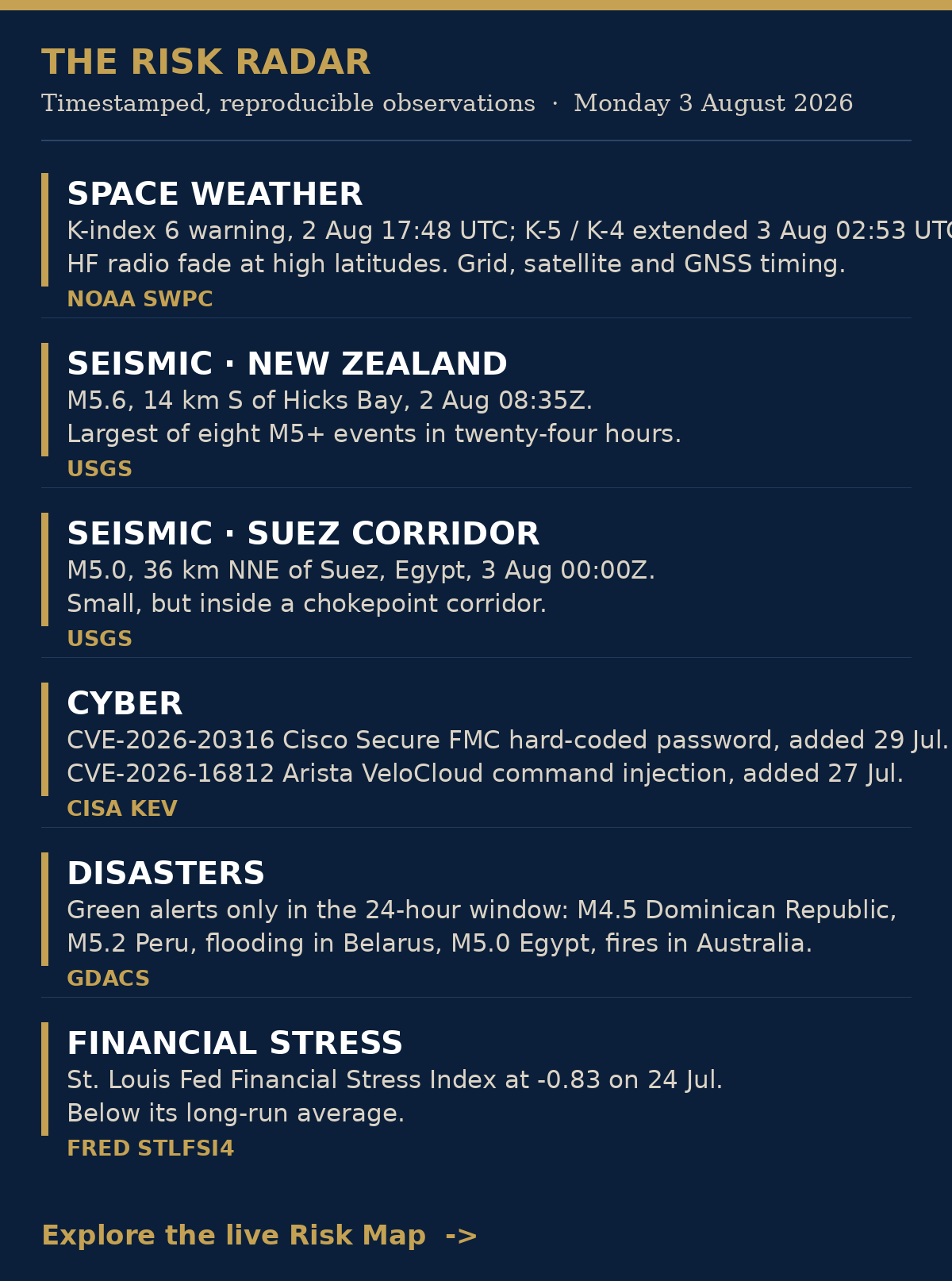
- Space weather. K-index 6 warning issued 17:48 UTC 2 August; K-5 and K-4 extended warnings 02:53 UTC 3 August; HF propagation fade at higher latitudes. → NOAA SWPC
- Seismic — New Zealand. M5.6, 14 km S of Hicks Bay, 2 August 08:35Z — the largest of the eight M5.0+ events on the USGS 24-hour feed. → USGS
- Seismic — Suez corridor. M5.0, 36 km NNE of Suez, 3 August 00:00Z. → USGS
- Cyber. CVE-2026-20316 (Cisco Secure FMC, hard-coded password, added 29 Jul) and CVE-2026-16812 (Arista VeloCloud, command injection, added 27 Jul). → CISA KEV
- Disasters. Green alerts only in the 24-hour window. → GDACS
- Financial stress. St. Louis Fed Financial Stress Index −0.83 (−0.8263) on 24 July. → FRED STLFSI4
11 · Early Signals
Reported, not yet confirmed
Items below our normal evidence bar — reported observations we have not confirmed to a primary source, listed because the trajectory matters more than the confirmation lag. We state what is established and what is not.
- Spokane, Washington. Officials report ~60,000 residents ordered to evacuate and ~600 buildings destroyed across three uncontained fires; FEMA assistance requested; no casualties reported at the Sunday briefing. Not established: insured loss, infrastructure damage, final counts. A second record fire event, on a second continent, with no loss total attached.
- Hormuz, the physical picture. UKMTO logged two incidents on Saturday — one tanker struck by an unknown projectile off Oman; one reported explosion in close proximity, no damage — and the manager of the LNG carrier GasLog Shanghai confirmed a projectile strike causing a blackout and an extinguished fire; the struck tanker and the GasLog vessel are likely the same ship. Reports of “three attacks since Saturday” conflate stale March and June items. Not established: attribution, damage assessments, current transit volumes. The physical route has not yet earned the de-escalation the futures curve has priced.
- OPEC+ approved a 188,000 b/d September quota increase (seven members, completing the 1.65m b/d rollback of the 2023 voluntary cuts; next meeting 6 September). Production has run far below collective targets — blocked export routes, not indiscipline. A quota is not a delivered barrel.
- FIMA expansion — Bessent has proposed enlarging the Fed’s foreign-official repo facility. The Fed has not agreed. If it does, an emergency backstop becomes standing intervention infrastructure. Watch the FOMC, not the Treasury.
- Australia’s first H5N1 mass wildlife mortality (49 dead terns at Cape Jaffa; 74 wildlife cases across four states; no farm incursion; human risk assessed low). India’s CERC has proposed — draft only — restoring transmission-charge waivers for renewables stranded by grid delays. Cuba recorded its fourth national blackout in recent weeks and authorised its first foreign-backed fuel-import venture.
12 · Watch
The week ahead
1. Capex commentary, and how it is funded. July’s Nasdaq fell 3.20% while AI spending guidance rose. Watch whether August guidance is funded from cash flow or issuance — the second is a credit story in equity clothing.
2. The oil / volatility / credit spread of opinion. Brent −5% on the October contract; VIX 15.99 Friday; HY OAS 284bp on 30 July. Three markets hold different views of how much geopolitical risk remains priced; Tehran’s Monday statements are the first test of which view survives the week.
3. From restoration cost to loss allocation. The FT’s €3.1bn is the first consolidated figure of the season. The next numbers to watch: the first named catastrophe-modeller insured-loss estimate, and the ratio between it, the restoration floor and the eventual economic-loss estimates — that ratio, not any single figure, is the signal.
13 · Today’s Scenario
Does nature risk enter bank supervision?

Base case. The ecosystem-degradation analysis Elderson described is published in 2026 and informs supervisory dialogue; the collateral climate factor extends to loans on its stated timetable (earliest end-2027); no Pillar 1 change in 2027.
Escalation triggers:
- The published analysis carries quantified credit-loss pathways, not methodology alone.
- SREP or Pillar 2 guidance references ecosystem dependency explicitly.
- The EBA opens a consultation touching nature-related credit risk.
- A second supervisor replicates the work, or the collateral climate factor’s scope or ceiling is raised.
De-escalation triggers: the analysis lands without a supervisory hook; the sustainability-reporting rollback extends to prudential work; the loan-collateral timetable slips.
14 · Podcast
The Universal Owner
The restoration bill and the loss map — today’s edition.
Supported by Corinium’s AssetOps Chicago — where the buy-side operating community meets.
15 · The Back Page
Meet The Allocator
The Allocator owns a small piece of nearly everything, is rarely surprised, and is often disappointed by the footnotes. Each day he closes the brief with the argument underneath the argument.

Source ledger
Fire season and losses. Financial Times restoration-cost analysis (3 August 2026, via syndication; the FT notes the figure uses European Commission methodology and understates the full toll) · European Commission JRC / EFFIS (data to 29 July 2026) · MITECO, Spain, provisional national statistics to 28 July 2026 · Ministère de l’Intérieur, France (27 July 2026) · Préfecture de la Gironde communiqués (26 July–2 August 2026) · Préfecture des Landes (24, 31 July 2026) · Boletín Oficial del Estado, Órdenes INT/748/2026 and INT/788/2026 · Swiss Re (28 July 2026) · Morningstar DBRS (27 July 2026) · France Assureurs (27 July, 2 August 2026) · UNESPA, FAQ Incendios (July 2026) · Banco de España Working Paper 2406 (2024).
Central banks and markets. ECB press release, 24 July 2026 (climate factor extension to corporate credit claims) · ECB Occasional Paper 380 (2024) · The Guardian interview with Frank Elderson (1 August 2026) · Federal Reserve FOMC statement (29 July 2026) and Cleveland / Minneapolis / Dallas dissent statements (31 July 2026) · Japan Ministry of Finance and US Treasury Secretary Bessent statements (2–3 August 2026) · Financial Times reporting on the euro-funded intervention (2–3 August 2026, via syndication; ESF/SOMA funding detail is analyst assessment, MUFG Research) · US Treasury daily par yield curve (31 July 2026) · Cboe (31 July 2026) · FRED series DGS10, DCOILBRENTEU, VIXCLS, BAMLH0A0HYM2, STLFSI4 · Associated Press index closes (31 July 2026) · Bloomberg ICE/NYMEX settlement wire (31 July 2026) · CNBC/Yahoo intraday quotes (3 August 2026, timestamped in the text).
Energy and geopolitics. MVM Paksi Atomerőmű operator statements (30–31 July 2026) and Reuters wire coverage of the Paks shutdown (2 August 2026) · Serbian energy ministry via AFP (2 August 2026) · Press TV/IRIB and ANI carrying Iran FM spokesman Baghaei (3 August 2026, 07:32 and 09:17 UTC) · Fortune/AP (1 August 2026) · UKMTO advisories via AFP and GasLog manager statement via Bloomberg (1 August 2026) · OPEC+ decision coverage, Reuters (2 August 2026) · CNBC on China PMI (31 July 2026).
Where a figure comes from a first-party institution we say so and link it. Where a figure is an outlet’s own analysis (the FT’s €3.1bn) or an analyst’s assessment (the ESF/SOMA funding detail), we label it as such. Reuters content was read as full wire text on licensed mirrors. Claims we could not trace to an issuing institution — including several circulating Hormuz incident counts and a $315–630m Hungarian import-cost estimate — are either excluded or attributed to exactly who said them.
Universal Asset Owners publishes analysis for institutional investors. Nothing here is investment advice.