Sovereign Wealth Funds
Saudi Arabia's Public Investment Fund (PIF), Explained
From a domestic holding company to one of the world's most consequential investors: how PIF works, what it owns, and what its 2026-2030 strategy signals.
From a domestic holding company to one of the world's most consequential investors: how PIF works, what it owns, and what its 2026-2030 strategy signals.
The market for second-hand private equity stakes set another record in 2025. How secondaries work, who sells, who buys, and why the market has become core institutional infrastructure.
Why every private equity fund looks like a loser in year two — and why disciplined allocators don't care.
Why falling public markets can leave pension funds and endowments 'overallocated' to private equity without buying a single new asset — and what allocators actually do about it.
How institutions delegate their portfolios to an outsourced CIO, why the model grew into a multi-trillion-dollar market, and what they give up in return.
When one family builds its own office and when several share one — the cost, control, privacy and scale trade-offs that decide it.
How non-bank lending became a multi-trillion-dollar asset class, why pensions and sovereign funds keep allocating to it, and where the risks sit.
Who bears the investment risk, how each model invests, and why the decades-long shift from DB to DC quietly rewired the world's pension capital.
A practical explainer for institutional allocators: how endowments and foundations turn permanent capital into a spending engine — and why the rest of
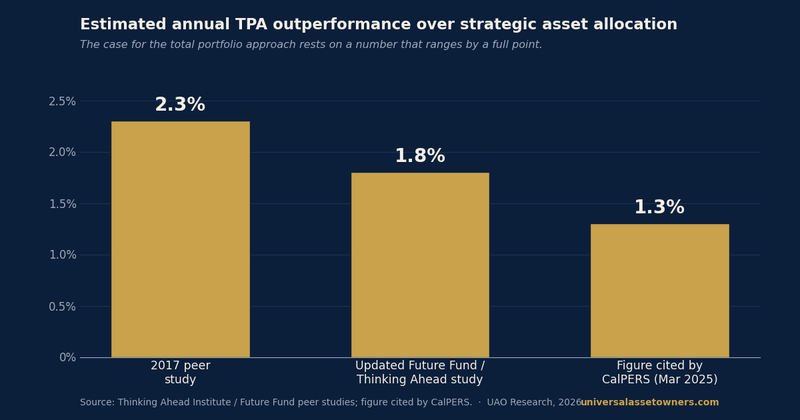
CalPERS retires asset-allocation targets July 1, rewires staff pay next week, and the private-credit split widens — plus one chart.

CalPERS retires asset-allocation targets July 1, rewires staff pay next week, and the private-credit split widens — plus one chart.

CalPERS retires strategic asset allocation on July 1 — the first US pension to adopt the total portfolio approach. We cover the switch, the staff-pay vote that decides whether it works, the private-credit split it's meant to settle, and the contested outperformance number behind it all. (1) CalPERS