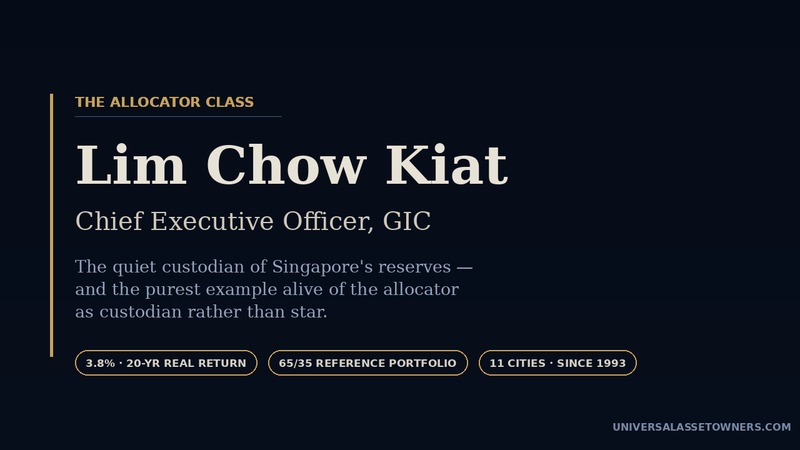
Lim Chow Kiat: The Quiet Custodian of GIC
A Universal Asset Owners profile of Lim Chow Kiat, CEO of GIC — the manager of Singapore's foreign reserves — and one of the most disciplined long-term investors in the world.
A Universal Asset Owners profile of Lim Chow Kiat, CEO of GIC — the manager of Singapore's foreign reserves — and one of the most disciplined long-term investors in the world.
The desk is tracking 10 structural risks at a combined radar load of 8.2/100 — a flat board day-over-day. Chokepoint concentration remains the highest-priority exposure at 53%.
A clear guide to the North Dakota Legacy Fund: its roughly US$13 billion in oil-tax savings, the constitutional 30% deposit rule, the 8% earnings payout, and who manages it.
A clear guide to the New Mexico State Investment Council: the roughly US$70 billion Land Grant and Severance Tax permanent funds, how oil royalties feed them, and how payouts fund public schools.
A clear guide to Trinidad and Tobago's Heritage and Stabilisation Fund: its dual mandate, its roughly US$6 billion size, how deposits and withdrawals are triggered, and who runs it.
A clear guide to the Timor-Leste Petroleum Fund: its size, the 3% sustainable-income rule, its Norway-style governance, and why overspending threatens to exhaust it by the mid-2030s.
A clear guide to the Brunei Investment Agency: the size of its reserves, how it is funded, and why it is one of the least transparent sovereign wealth funds in the world.

Private markets promised long-horizon investors an illiquidity premium. They did not promise that capital calls, redemptions, collateral, distributions, and sponsor demands would remain separate events.
The world's sovereigns and central banks are not just changing asset classes — they are changing what "safe" means. Grids, gold, the AI stack and simpler operating models.
Say on pay allows shareholders to vote on executive compensation packages. This non-binding mechanism has become a critical governance tool for institutional investors to express views on pay alignment with company performance.
Shareholder rights form the foundation of corporate governance, granting investors voting authority and information access. Institutional holders increasingly exercise these rights through proxy engagement and stewardship initiatives.
Shareholder resolutions are formal proposals that institutional investors—pension funds, asset managers, and endowments—submit to corporations for voting at annual shareholder meetings. They serve as a mechanism for long-term capital owners to address governance gaps, sustainability practices, and s