|
|
Committed to a discipline, not a decision.
|
Who reads this
Before the market opens, this brief is read at the desks that direct more than $50 trillion in permanent capital.
Circulation is narrow by design. The capital behind it is not.
|
Chairman Kevin Warsh, marking his 100th day as Chairman, told the Kansas City Fed symposium in Jackson Hole that he stands “committed to a discipline, not to a decision.” The official Board remarks, titled In Our Time, are posted at the Board speech page.
He said he is “not waiting to introduce innovations at the Fed” and set out to change “the form and function of the Fed Chairman’s so-called forward guidance.” “In normal times, the role of forward guidance should be limited and circumscribed.”
The 12-month change in the PCE price index “stands at 3.7 percent, while the six-month change is 4.1 percent.” “Inflation is running above our 2 percent target. So the Fed’s predominant focus right now should be on prices.” The jobless rate is 4.1 percent. “I believe the labor markets are consistent with full employment.”
“On balance, I would be hard pressed to describe broad financial conditions as restrictive.” “The responsibility for 65 months of sustained, elevated inflation sits squarely with the central bank.” “We must be confident that underlying inflation is moving to our objective, clearly and at sufficient speed. Otherwise, we have work to do.” The remarks print no rate path.
The United States sold $44 billion of seven-year notes on Thursday. The high yield was 4.512 percent. The notes will pay a 4.5 percent coupon. Investors bid $2.50 for every dollar Treasury offered. The sale closed at 1 p.m. Eastern. Results posted two minutes later.
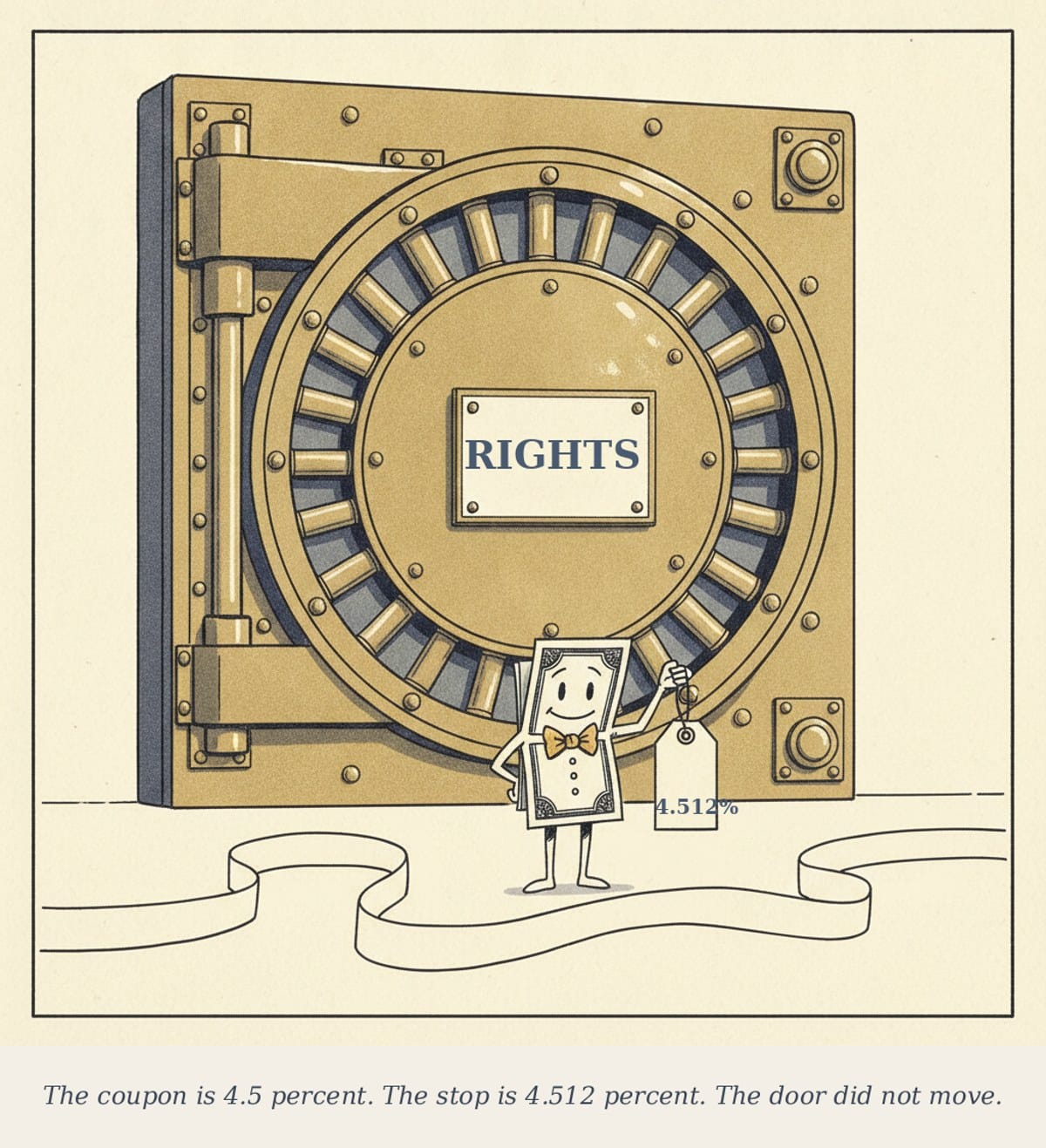
That is a price on seven years of government debt. It is not a change in anyone’s rights. A pension, a sovereign fund, and an insurer that already own the Treasury market did not gain a vote, lose a covenant, or rewrite a mandate because this coupon printed.
Investors put in $110.2 billion of bids for the $44 billion on offer. Almost every winning bid was filled at that 4.512 percent yield. Retail accounts took a sliver, about $21 million. The rest was an institutional book.
Of the $43.89 billion awarded to competitive bidders, Wall Street’s primary dealers kept 12.3 percent, or $5.38 billion, after putting in $59.5 billion of bids. Direct bidders, mostly domestic accounts that bid in their own name, took 27 percent, or $11.83 billion. Indirect bidders took 60.8 percent, or $26.68 billion. Indirect is Treasury’s label for bids that arrive through a dealer. It is not a count of foreign central banks.
The sale did not fail. Dealers did not get stuck with the issue. Real-money accounts took the bulk of the notes. That is a demand story.
Bills sold the same morning were quieter. The four-week stopped at 3.650 percent. The eight-week stopped at 3.670 percent. Those are short cash rates. The seven-year is the one a long book lives with until August 2033. The first coupon is due 28 February 2027. Each $1,000 of notes pays $22.50 twice a year at the 4.5 percent rate. Because the stop sat a sliver above the coupon, the notes priced at 99.928654.
The two-year yield on Wednesday’s official curve was 4.19 percent. The ten-year was 4.66 percent. The gap between them was 0.47 percentage points on Thursday. The new seven-year sits in the middle of that curve at 4.512 percent.
Reserve balances at the Fed were $2.92 trillion in the week through Wednesday. The Treasury’s cash balance at the Fed was $959 billion, up $23 billion on the week, while reserves fell $14 billion. That is Wednesday’s print. It is not Thursday’s auction talking.
What the book means
A universal owner already holds Treasuries as the risk-free spine of the portfolio. Thursday set the coupon and the yield on the next seven-year issue. The mandate did not move. Voting rights at companies did not move.
What moved is the price of duration. At 4.512 percent, Treasury paid a hair more than the 4.5 percent coupon to place the paper. Buyers who needed the notes paid up. Buyers who wanted a concession got very little of one.
Primary dealers bid the most and were awarded the least. That is normal when the rest of the market wants the bonds. Direct and indirect accounts took 87.7 percent of the competitive awards combined. The security is CUSIP 91282CRJ2.
|
|
Dispatch

|
Pakistan
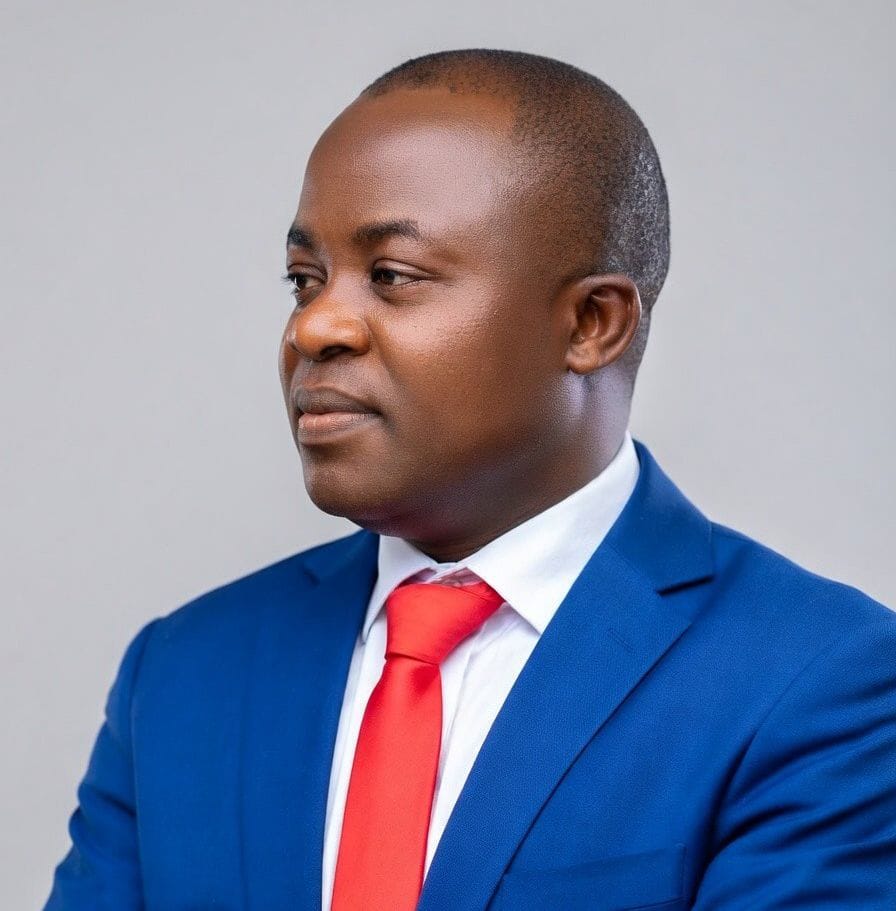
Naveed Iqbal
Pakistan is waiting on a U.S. answer to a $10 billion facility that would backstop the rupee, not a conventional loan. Talks are still open. Oil and Gas Development Company meets on 4 September to review the year. The books close from today through that meeting. |
|
Nigeria
Dan Agbo
Niger State said the mosque abductors have made no contact nearly a week on. Local officials count just over 60 taken and close to 30 killed; an earlier figure of about 600 was not verified, and there has been no ransom contact. Tinubu swore in Abel Enitan as Head of the Civil Service. The anti-corruption commission named three civil servants in the fictitious PFIPC budget-agency case. The exchange rose 0.20 percent to 239,156, snapping an 11-session slide. Surveyed petrol was about ₦1,212 a litre as Brent slipped. Still to watch: MTN’s planned $900 million to $1.1 billion sale of a 30 percent stake in IHS Nigeria. |
Chart of the day
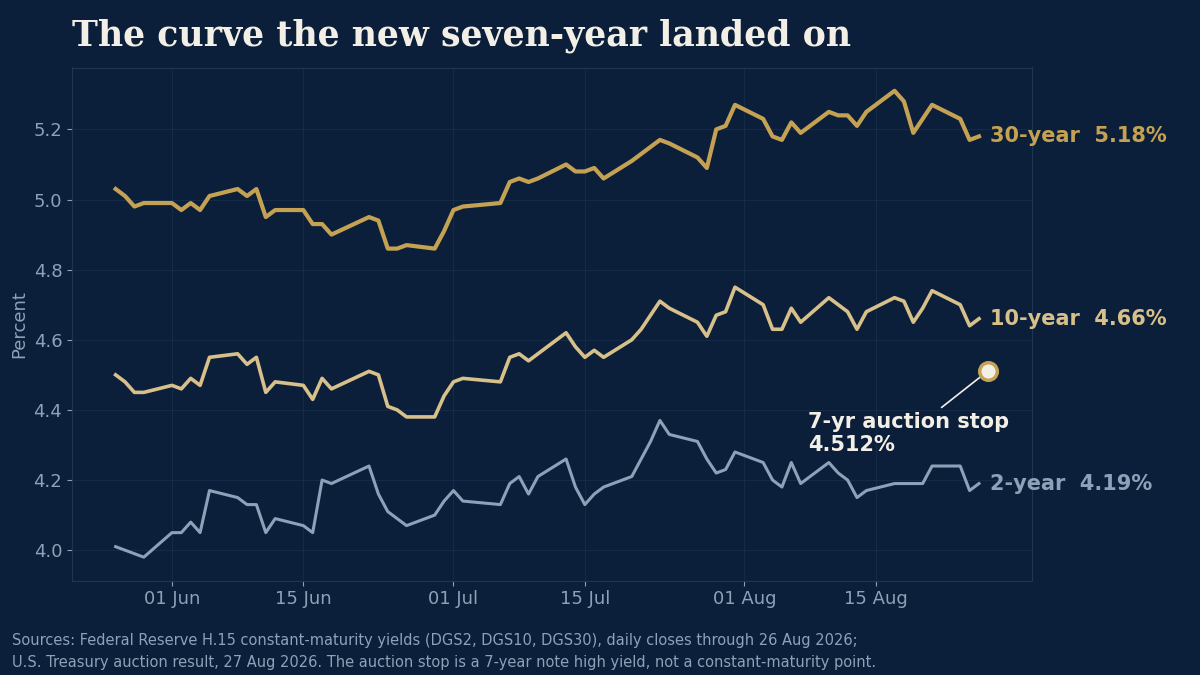
Thursday’s seven-year high yield, 4.512 percent, against the four-week bill at 3.650 percent and the eight-week bill at 3.670 percent. One is a coupon on a note. The other two are discount rates on bills.
Listen

Elsewhere
Tungsten West posted two London notices this morning: Baker Steel’s stake was reported at 7.82 percent, and the company said it had repaid its short-term loan in full, with the National Wealth Fund debt facility now effective.
Workday’s board authorized $4.0 billion of share purchases. Authorization is not a close. Arrive Logistics said Mubadala Capital would take a majority stake, with no price on the announcement. Diodes bought ElevATE Semiconductor for $250 million in cash.
Signals — not yet confirmed
HUMAIN × Microsoft. PIF-owned HUMAIN and Microsoft announced a “long-term strategic collaboration” in a wire release dated 26 August. The language is collaboration and intent, not a signed capacity contract, and PIF’s own newsroom could not be opened to confirm. Treat as a signal until a first-party document prints.
MTN × IHS Nigeria. Our Lagos desk flags MTN’s planned sale of a 30 percent stake in IHS Nigeria, reported at $900 million to $1.1 billion. Correspondent-sourced; no definitive agreement has printed.
The Vector — where the cash actually moves
The auction is one flow inside a much larger financing picture. Treasury’s 3 August borrowing estimate projects $739 billion of privately held net marketable borrowing this quarter and $628 billion next — estimates, not issuance already done. The quarterly refunding statement holds the seven-year at $44 billion through October, with bills as the first line of adjustment.
The plumbing sits underneath. On Wednesday’s H.4.1, the Treasury General Account rose $23 billion to $959 billion while reserve balances fell $14 billion to $2.92 trillion. When cash moves from banks into Treasury’s account at the Fed, it drains reserves all else equal — and “all else equal” is doing work in that sentence: reverse repos, currency and other lines move too. The junction to watch is Monday’s settlement of this note against the next Wednesday column.
From 9 September, Treasury also doubles its long-end liquidity-support buybacks to at least $4 billion per operation. That supports tradability of old bonds. It does not reduce net borrowing — new issuance replaces what is bought back.
The Long Horizon — one auction is not a regime
A single sale, even at a cycle-high stop, is a data point. The series is what matters: repeated tails, weakening cover, rising dealer take across successive auctions would be a funding story. Thursday showed none of those — cover held and real money took the notes.
The slower question belongs to liability owners. The stop on seven-year money has moved while most liability models are re-struck quarterly, some annually. A funded ratio reported today is being discounted at a rate the market may have stopped charging. That is not an error; it is a lag. The useful exercise this week is knowing its size — re-run assets and liabilities on the same curve before somebody else does it for you.
The Engine Room — systemic risk analytics
Three calculations, each running only on Thursday’s published prints. No probability is printed here that was not computed from a stated method.
1. The belly anomaly. Interpolating linearly between the official 2-year (4.19%) and 10-year (4.66%) constant-maturity yields puts a synthetic 7-year point at 4.484%. The auction cleared at 4.512%.
= 4.512 − 4.484 = +2.8 bps
The node printed about three basis points cheap to the straight line through its neighbours. That is the concession Treasury paid — visible in the 99.928654 price — to clear $44 billion without bending the rest of the curve.
2. The net liquidity impulse. Define the weekly impulse as the change in bank reserves net of the change in Treasury’s account at the Fed, from the H.4.1:
Reserves stand at $2.917 trillion. A widely watched structural comfort zone sits near $2.90 trillion — about $17 billion below Wednesday’s print, less than one week of TGA building at the current pace. No probability is attached to the crossing; the distance and the pace are the watch level.
3. Dealer absorption capacity. Dealers kept 12.3% of Thursday’s competitive awards. The arithmetic of the constraint: if combined direct-plus-indirect demand fell below 75% of an auction, dealer take would mechanically breach 25% — the zone where warehoused supply has historically pressured secondary yields. Thursday’s combined real-money take was 87.7%, a wide margin above that line.
| Regime | Trigger levels | Positioning logic |
| Orderly absorption current state | Cover 2.45–2.55 · belly anomaly near +3 bps · dealer take under 18% | Benchmark duration; roll maturities into the 7-year node. |
| Liquidity friction | Reserves through $2.90T · TGA through $975B · repo volatility | Lean on ultra-short cash (4-week at 3.650%, 8-week at 3.670%); build liquidity buffers. |
| Auction stress | Dealer take over 22% · cover under 2.25 · 2s10s widening hard | Deploy dry powder into concessions; hedge the belly. |
Scenario · Seven years at 4.512
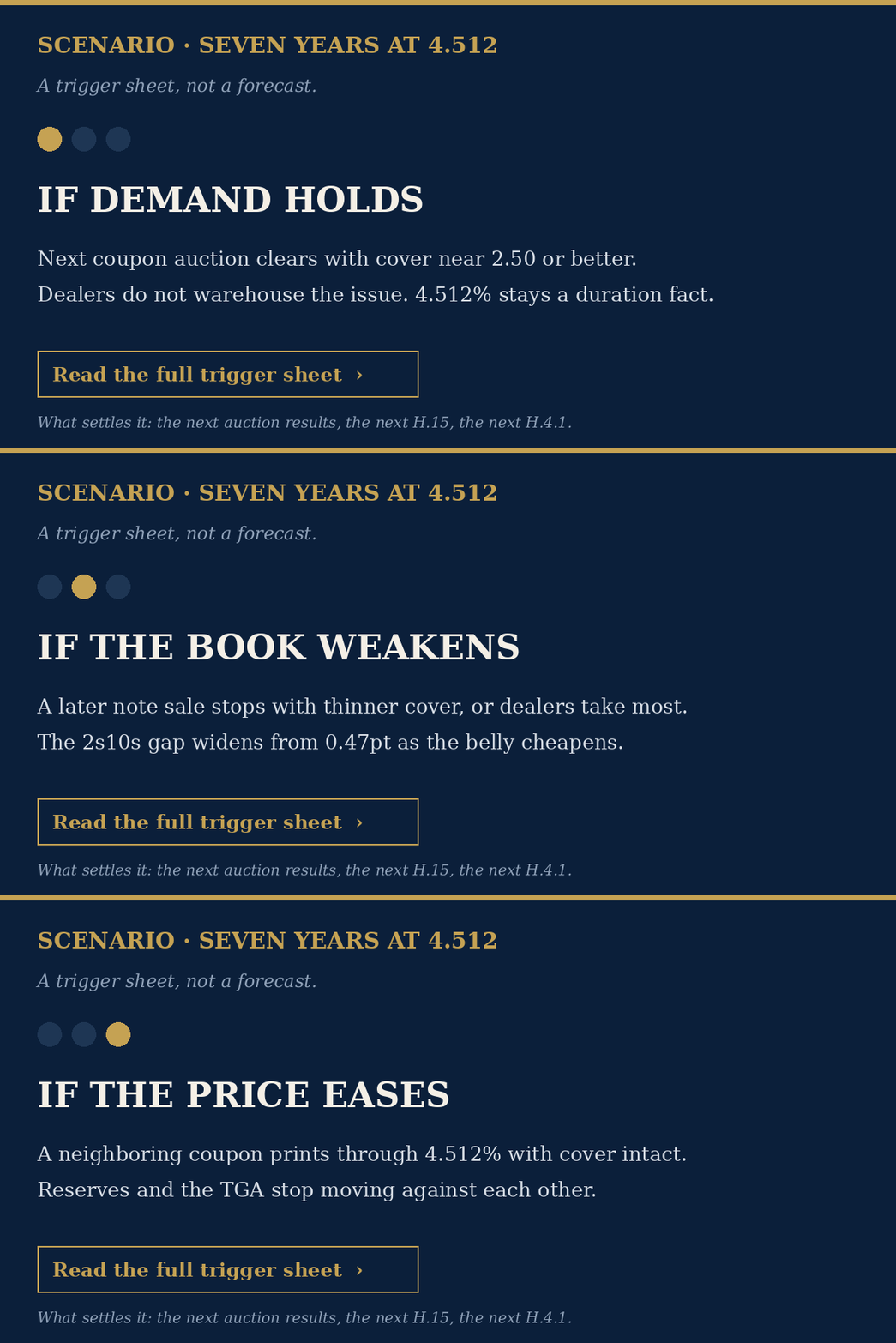
This is a trigger sheet, not a forecast. The 7-year sold. The next prints will say whether Thursday was a clean funding day or the start of a harder roll.
If demand holds
The next coupon-bearing auction clears with cover near 2.50 or better. Primary dealers do not take the bulk of the competitive awards. The notes that priced at 99.93 stay a duration fact, not a warehouse.
If the book weakens
A later note sale stops with a thinner cover, or dealers are awarded most of the issue. The two-year to ten-year gap widens from Thursday’s 0.47 percentage point as the belly cheapens. That would be a funding story, still not a change in anyone’s rights.
If the price eases
A subsequent 7-year or a neighboring coupon prints through 4.512 percent with cover still intact. The Wednesday reserve and Treasury-cash prints stop moving against each other in the same week.
What would settle it: the next official auction results, the next H.15 curve, the next H.4.1 Wednesday column. No probability is printed. None has been computed for this sheet.
Decisions due
| 10:00 ET today | Official Board remarks by Chairman Kevin Warsh, In Our Time, posted at the Board speech page. |
| 31 August | The new seven-year settles. Watch repo, dealer balance sheets and the next H.4.1 column. |
| 9 September | Treasury’s enlarged long-end buybacks begin. Better liquidity is not lower net borrowing. |
| Next TUN filing | Look for a total-voting-rights or admission statement. An offtake, when it comes, is a separate milestone. |
| Fourth quarter | Mubadala–Arrive expected close. A definitive agreement is not deployed capital. |
| This week | Add independent checks of registration status, address, phone and auditor to manager onboarding — the SEC’s 38 false-filing charges are the reason. |
The Universal Owner Risk Radar
| ORANGE | M5.0 earthquake near a population belt in China, 05:13 UTC today — 15.8 million people within 100 km. GDACS event page |
| GREEN | M6.0 earthquake, Yemen, 21:07 UTC Thursday — low exposure. GDACS event page |
| WATCH | Three Category-1 tropical cyclones active in the eastern Pacific (Lowell, Karina, Dolly) — no major population centres in current tracks. GDACS |
| ALERT | NOAA continued alert for elevated electron flux; geomagnetic watch issued 26 August — satellite-operations relevance, no grid impact stated. NOAA SWPC |
On the record — CISA, to our readers
After CISA added three exploited vulnerabilities to its Known Exploited Vulnerabilities catalog on 11 August — affecting Cisco ASA/FTD firewalls, the Windows AFD.sys driver and the Metabase analytics platform — this publication contacted the agency’s press office seeking an interview on what the catalog means for the owners of diversified balance sheets, rather than for the security teams it is usually written for.
We put three questions to the agency: what a large diversified owner should take from a KEV addition that a corporate security team would not; how the catalog should be read as a signal of systemic rather than firm-level exposure; and what the most common misuse of the catalog is among non-technical audiences.
In response to our inquiry, the agency provided the following statement, attributed to Jay Gazlay, its Acting Associate Director for Vulnerability Management:
“While it’s important to note when a CVE is listed on the KEV catalog, owners should focus on the speed and effectiveness of their response to such vulnerabilities. Unlike a corporate security team, which may focus on immediate, technical fixes, a diversified owner should consider the broader implications across multiple business units and systems. This means not only addressing the specific CVE but also evaluating whether their organization is set up to rapidly mitigate risk across its entire portfolio.
“Furthermore, large owners should encourage software makers and vendors to embrace Secure by Design principles, advocating for systemic improvements that reduce or eliminate classes of vulnerabilities represented by KEV entries, rather than just addressing individual issues. CISA’s BOD 26-04 can help clarify the intended use and importance of the KEV catalog.”
Numbers to know
| 3.7% / 4.1% | PCE 12-month / six-month, official Board remarks |
| 4.1% | unemployment; labor markets “consistent with full employment” |
| 4.512% | seven-year auction high yield; coupon 4.500%; price 99.928654 |
| 2.50 | bid-to-cover on $110.2bn of bids for $44bn offered |
| 60.8 / 27.0 / 12.3 | indirect / direct / primary-dealer shares of competitive awards, in percent |
| $22.50 | semi-annual coupon per $1,000 of notes, first due 28 February 2027 |
| 0.47pt | ten-year minus two-year on Thursday’s official curve |
| $959bn / $2.92tn | Treasury cash at the Fed / reserve balances, week through Wednesday |
|
|
|
|
|
|
|
|
|
|
|
Careers
Where the allocator seats are posted.
| CPP Investments Canada’s national pension investor · Toronto | Open roles › |
| Norges Bank Investment Management Manager of Norway’s Government Pension Fund Global · Oslo | Open roles › |
| CalPERS The largest U.S. public pension plan · Sacramento | Open roles › |
| CalSTRS California’s educator pension · West Sacramento | Open roles › |
| Ontario Teachers’ Pension plan for Ontario’s teachers · Toronto | Open roles › |
| GIC Singapore’s sovereign wealth manager | Open roles › |
| Temasek Singapore’s state investment company | Open roles › |
| Mubadala Abu Dhabi’s sovereign investor | Open roles › |
| USS The UK’s largest private pension scheme · London | Open roles › |
| Future Fund Australia’s sovereign wealth fund · Melbourne | Open roles › |
The Back Page

The Allocator · Friday 28 August — one question for your next investment committee. Tap to watch.
Also on Universal Asset Owners
Sources
Treasury auction results (TreasuryDirect) · FiscalData — CUSIP 91282CRJ2 · Federal Reserve H.15 · Federal Reserve H.4.1 · Kansas City Fed — Jackson Hole · Tungsten West — Baker Steel TR-1 · Tungsten West — loan repayment · Workday 8-K · Arrive Logistics announcement · Diodes 8-K