404.5m barrels. 23.3 days. Thinner cover than September 2018.
Refineries ran harder into a falling stock level - and three Reserve Bank presidents voted to tighten.
UAO EditorialJuly 30, 20266 min read
Everyone is quoting the same barrel number this morning. The level is right; the measure is wrong, and it is wrong in the direction that matters. And what the week’s two facts — a 9–3 hold and the thinnest crude cover since 2018 — do to your balance sheet depends on a discounting convention that differs across every institution reading this.
The briefing
A hundred seconds: the 9–3 hold, the three who wanted a hike, and why days of cover — not the stock level — is the measure that matters this week.
What happened
The Committee held the target range at 3½–3¾ percent on a 9–3 vote on 29 July. Beth M. Hammack, Neel Kashkari and Lorie K. Logan each “preferred to raise the target range for the federal funds rate by 1/4 percentage point at this meeting” (FOMC statement). The statement says inflation “remains elevated,” in part reflecting “supply shocks that have driven price increases in certain sectors, including energy.” Operational settings are in the Implementation Note.
Cover, not the level
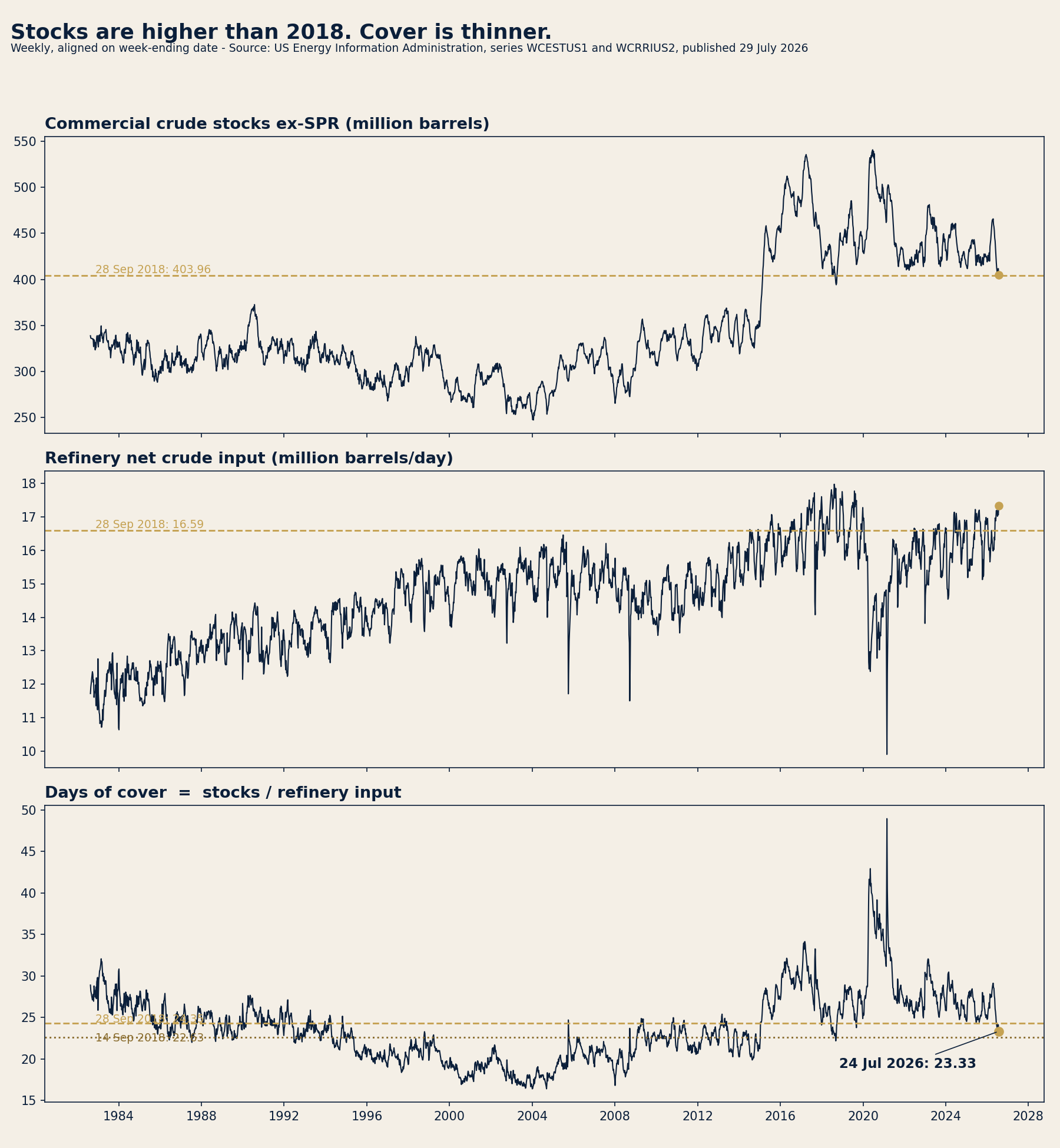
Commercial crude ex-SPR fell 7,167 thousand barrels to 404,508 for the week ended 24 July — reported everywhere as the lowest since September 2018 (EIA, WCESTUS1). But refineries took 17,336 thousand barrels a day, against 16,591 in that 2018 week (WCRRIUS2). Stocks are 544 thousand barrels higher than the comparison week; cover is a full day thinner: 23.33 days against 24.35. Across the full weekly series back to August 1982, that is the thinnest cover since 14 September 2018.
At Cushing — the WTI delivery point — stocks fell 771 thousand barrels to 18,599, the lowest since 8 August 2014 (W_EPC0_SAX_YCUOK_MBBL).
What this is not
The statement did not cite these series, and nothing ties the dissents to them — two things are true in the same week, and we are keeping them separate. Nor is “energy exposure” one position: thin cover and firm crude are a cost to refiners buying 17.3 million barrels a day of feedstock, a realisation tailwind to producers, and largely neutral to contracted midstream.
Allocator Lens: the sign most briefings get backwards
A lower discount rate raises the present value of future benefits — it increases the reported liability. A falling long yield is pressure on funded status, not good news for it. And the regime decides how much of that pressure lands: a GASB public plan discounts on expected asset returns to crossover (muted); an ERISA single-employer plan on smoothed corporate segment rates (damped, lagged); an IAS 19 sponsor on corporate yields, currency- and term-matched (direct — it lands in the accounts); an insurer on regulatory curves; a sovereign fund or endowment frequently has no contractual liability at all. Same numbers, five answers, some pointing opposite ways. The full archetype table is in today’s edition.
Three questions for the investment committee this month: which way does a 25bp fall in long rates move our reported funded status under our regime, and by how much after smoothing? What is our net exposure to firm crude once refiners, producers and midstream are separated? What is our hedge ratio against the inflation component specifically, as distinct from the nominal rate?
The week ahead — the high-signal three
Capex commentary. The statement calls capital investment strong; watch whether that survives the next round of guidance, and whether spending stays on balance sheet.
Oil dispersion. EIA Brent spot ran $85.01 → $105.32 → $91.82 across 17–27 July (DCOILBRENTEU); WTI $83.43 → $93.08 → $84.25 (DCOILWTICO). Spot series, not futures settles. Watch whether credit spreads price the energy input separately from the rate path.
A reporting assignment we are carrying, not asserting. Whether tight crude cover is met with low-carbon capacity or new gas-fired generation decides whether “infrastructure” mandates are accumulating financed emissions their labels do not disclose. That needs fuel-mix, interconnection and holdings data — we are reporting it out rather than inferring it from a crude draw.
The Universal Owner Risk Radar
Crude cover at a multi-year low. 23.33 days, thinnest since 14 September 2018; reproducible from WCESTUS1 ÷ WCRRIUS2. → EIA Weekly Petroleum Status Report
Cushing at an eleven-year low. 18,599 thousand barrels. → EIA
Policy divergence inside the FOMC. Three votes for a 25bp rise. → FOMC statement
Days of cover = weekly commercial crude stocks ex-SPR ÷ weekly refinery net crude input, both for the week ended 24 July 2026, published 29 July. Cover is 23.33 days against 24.35 in the week ended 28 September 2018 — the week usually cited for the comparable stock level. Computed across the full weekly series from August 1982. Source: US Energy Information Administration.
The Film
Sixty-five seconds: the week’s finding, measured as the market actually consumes it.
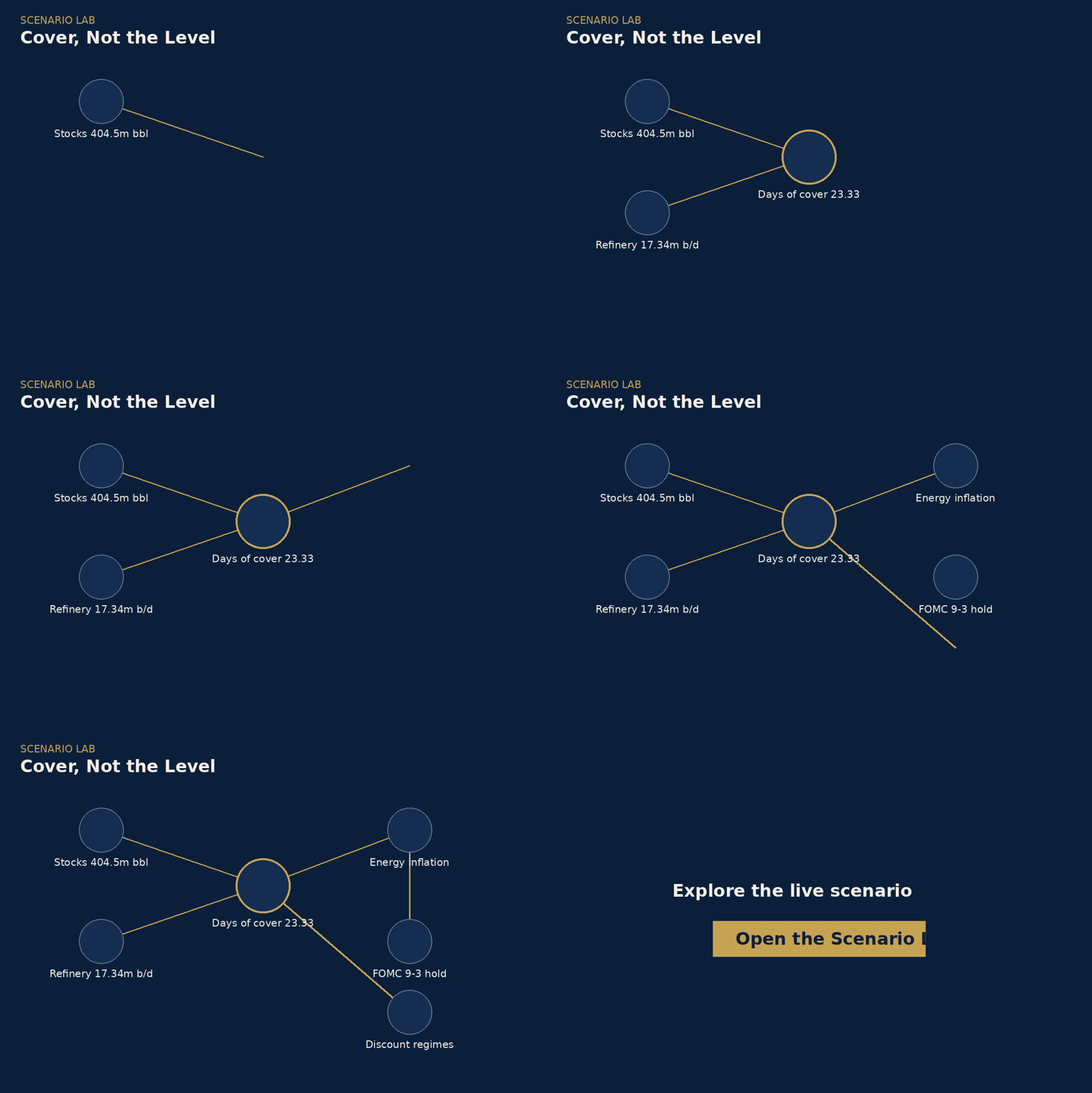
Scenario · Cover, not the level
Base case: throughput eases off seasonal highs, stocks stabilise, cover recovers toward 24 days. Watch: a print below 22.63 — the 14 September 2018 reading — on any weekly release; two consecutive weeks of input above 17,300 kbbl/d with stocks drawing; Cushing under 18,400; a fourth dissent at the next meeting.
The Allocator is our resident universal owner: a composite chief investment officer who holds a slice of every listed company on earth, cannot sell his way out of a systemic problem, and takes the day’s contradiction personally. Today: bath levels, open drains, and saying the direction out loud.
TODAY’S EDITORIAL CARTOON
“The level’s exactly where it was in 2018.” — “Yes. Different drain.” — Universal Asset Owners, 30 July 2026.
The measure, in one line
Stocks are half a million barrels above the 2018 week everyone is citing, and the market is a full day thinner — because the question was never how much is in the tank. It is how fast the tank is being drawn.
Sources checked through 30 July 2026. Material claims are linked to named sources; primary or first-party sources are used where available.
Universal Asset Owners · The Editorial Team Sources checked through 30 July 2026. Material claims are linked to named sources; primary or first-party sources are used where available.
The Daily Brief
The morning briefing for the people who allocate long-horizon capital.
Research, charts, video and podcast analysis for the institutions investing at the scale of the world.
Five minutes, five days a week. Complimentary — subscriptions are reviewed by our editorial desk, and you'll receive a notice once approved.
You’re on the list. Tomorrow’s brief will arrive in your inbox.