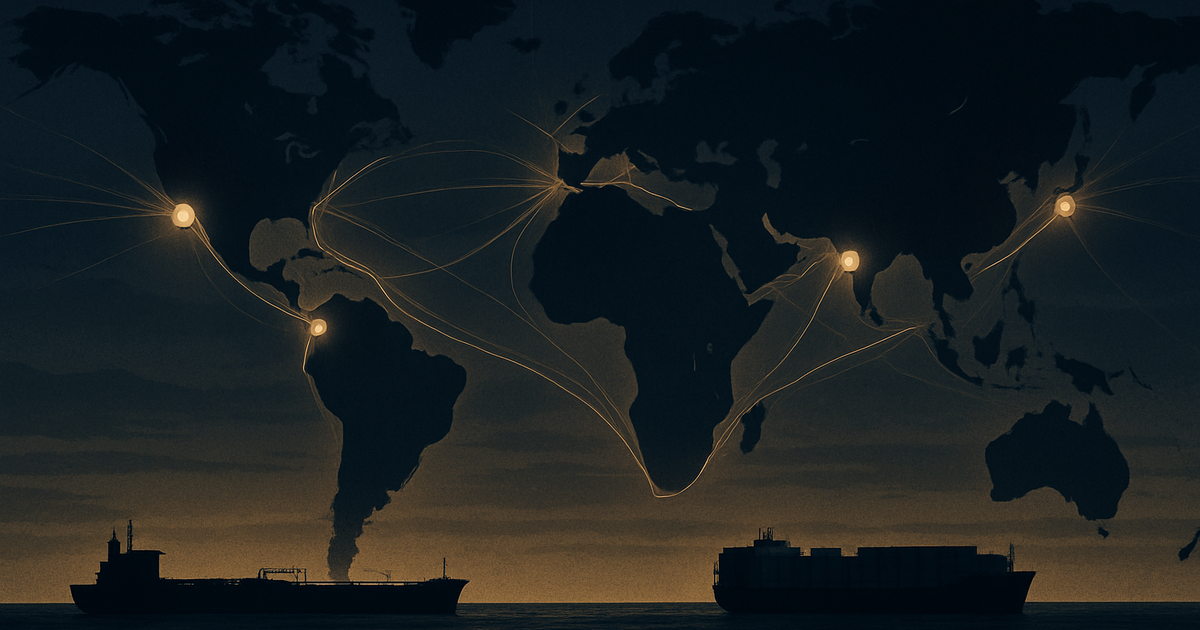
The Probability Desk runs a standing scenario on chokepoint concentration — the idea that Hormuz, the Taiwan Strait, Malacca, and the Panama Canal should be treated not as four independent flashpoints but as a single, correlated exposure that sits permanently inside a long-duration portfolio. Our published estimate on that scenario is driven by measured signals: prediction-market pricing, freight and energy data, sanctions activity, and a sourced base rate.
This note is about a different input. Alongside the measured signals, the Desk now runs a multi-agent discourse simulation of the scenario — a synthetic environment of roughly fifty actors (sovereign and pension allocators, corporates, governments, analysts, and media) who react to the scenario over dozens of rounds and argue with each other about what to do. We do not use that simulation to set a probability. We use it to do one thing well: surface the transmission channels and second-order reactions our analysts might otherwise under-weight. It is a blind-spot instrument, and it is governed accordingly — its output is labelled, capped, and held to zero weight on the published number until it has a calibration track record.
Here is what the first full run produced, and why three of its findings are worth an allocator's attention.
What the model was given, and what it returned
The simulation was seeded only with the scenario's own framing — the four straits, the live market signals as of the run, and the instruction to map first- through fifth-order consequences for long-duration capital and to surface contrarian objections and tripwires. It was not told what to conclude.
It anchored itself correctly to the live tape, picking up the prediction-market reading (a ~59% implied probability that Hormuz traffic normalizes by late August), the prevailing Brent level, and the rule-of-thumb that a serious Hormuz disruption removes on the order of a fifth of seaborne oil flow. From there the agents diverged into three behaviours that are more useful than the headline.
Three findings worth an allocator's attention
1. Insurance as a distinct inflation channel — not a footnote to the oil price. The agents repeatedly separated insurance and freight cost-push from the energy-price shock itself. War-risk premia on hulls, re-routing, and longer voyage times show up as a price-level effect that persists even in scenarios where the oil price round-trips. For an owner stress-testing inflation against a chokepoint event, the lesson is that the transmission is not one channel (energy) but at least three (energy, freight, insurance), and the latter two are stickier. That is a CMA input most allocators model loosely, if at all.
2. Friend-shoring as a slow erosion of the globalization dividend. The most strategically interesting thread was not about a blockade at all. The agents kept returning to friend-shoring — the steady re-routing of supply chains along political lines — as a structural drag on the globalization dividend embedded in long-horizon return assumptions. This is the opposite of a tail event: it is a low-volatility, high-duration repricing of the return premium that diversified owners have quietly banked for thirty years. A chokepoint scenario surfaced it because chokepoints are where friend-shoring becomes visible. It belongs in the strategic-asset-allocation conversation, not the crisis playbook.
3. Reflexive actors who profit from the volatility and amplify it. The simulation generated a class of agents who do not hedge the disruption but trade it — capitalizing on panic for short-term gain and, in doing so, deepening the instability the long-duration owners are trying to ride out. This reflexive feedback loop — stabilizing capital and destabilizing capital occupying the same market — is the kind of second-order dynamic that linear scenario analysis misses, because it treats the market as a single representative agent rather than a population with opposing incentives.
None of the three is a forecast. Each is a question the Desk is now obligated to investigate with measured data: how large is the insurance cost-push historically; how much globalization dividend is actually embedded in our return assumptions; how reflexive was the order book in prior chokepoint episodes. That is precisely the job we want this instrument to do.
How it sits in the published estimate
Discipline matters here, and we want to be explicit about it. The simulation does not move the published probability on the chokepoint scenario. Its contribution is held at zero until it has earned a calibration record against realized outcomes, and even then it is capped at a small fraction of any final number. It is directional and qualitative; it generated this run in summary form, not as audited evidence. We treat it as an idea-generation and blind-spot layer that feeds the analyst, not as a signal that feeds the math.
What it changes is the quality of the questions. An owner who only watches the oil price will see a chokepoint event as an energy shock. The simulation is a structured way of remembering that it is also an insurance shock, a globalization-dividend story, and a reflexivity problem — and of being reminded of that before the event, not after.
The Probability Desk publishes probability-weighted scenarios for long-duration capital owners. Estimates are driven by measured signals and sourced base rates; simulation output informs which risks we investigate, not what we conclude.