
Tuesday, June 9, 2026 — the daily brief for the world's long-duration owners of capital.
One labour-market number has done what a year of Fed commentary could not: it has taken rate cuts off the table and put a rate hike back on it. May payrolls landed Friday at +172,000 — more than double the roughly 80,000 economists expected — with unemployment holding at 4.3% and the prior two months revised up a combined +93,000. For a universal owner, the interesting part is not the print itself but how cleanly it travelled: in a single session it repriced equities, the curve, gold and the dollar at once. When one variable moves everything, diversification is doing less work than the policy portfolio assumes.
The regime flip
Futures now price better than a 70% chance of a Fed hike by December, up from roughly 45% a week earlier, and forecasters including Goldman Sachs have shifted to no cuts in 2026. The June 16–17 FOMC meeting is still almost universally expected to hold the funds rate at 3.50–3.75%; the live question is whether the Committee drops its easing bias altogether. The signal for long-horizon allocators is that the "higher-for-longer" rate path many capital-market assumptions had begun to discount away is reasserting itself — with direct consequences for discount rates, the cost of leverage in private books, and the marginal value of the bond hedge.
What it did to markets
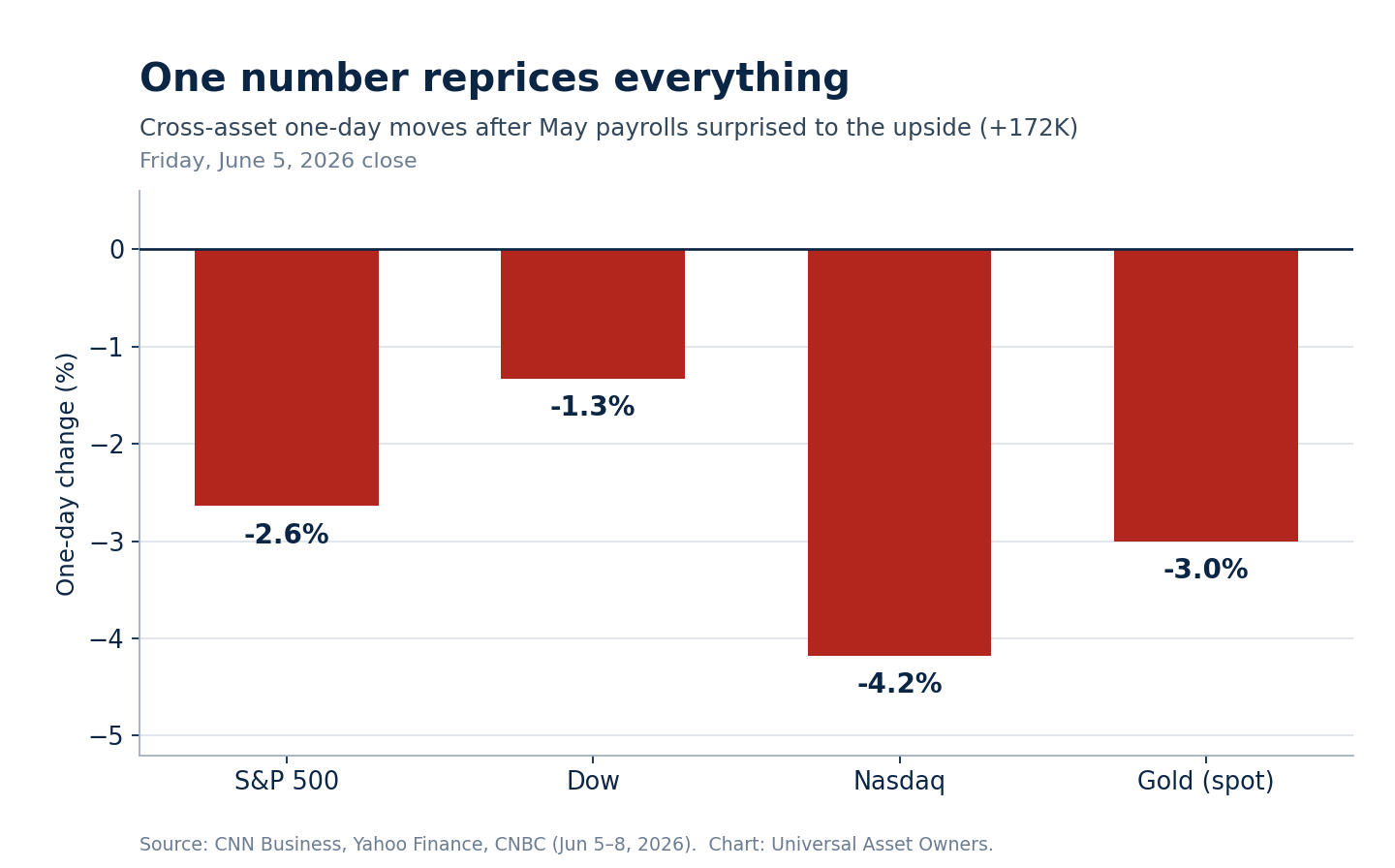
Friday delivered the worst equity session since October. The S&P 500 fell 2.6% to 7,383.74, the Nasdaq dropped 4.2% as a soft AI-chip outlook from Broadcom hit the semiconductor complex, and the Dow shed 1.3%. The selloff paired a yield jump with stretched AI valuations — a reminder that the concentration powering index returns cuts both ways. Markets steadied into Monday and Tuesday on a chip-led rebound, but the episode is a clean illustration of how much of the market's recent direction has rested on a single, crowded theme.
The hedge that didn't hedge
The move worth dwelling on is gold. Rather than catch a safe-haven bid, bullion fell roughly 3% on Friday and slipped to about $4,314 an ounce — a more-than-two-month low that erased its entire 2026 gain — as the repricing of real rates overwhelmed the geopolitical story. For owners who treat gold and long bonds as ballast, the lesson is the uncomfortable one the Oracle Brief below keeps returning to: in a rate-driven shock, the diversifiers correlate. Correlation-regime risk belongs in the base case, not the tail.
Oil and the security premium
The exception to the risk-off tape was crude. Brent pushed more than 3% higher, back above $96 a barrel on Monday, after Israeli strikes on Lebanon and reports of explosions in Iranian cities revived fears of a wider conflict — and with it, the standing question of the Strait of Hormuz. Traders are once again weighting geopolitical supply risk over OPEC+ barrels. This is the security-premium repricing of trade and energy that sits at the top of the desk's risk board, and it is increasingly a structural input to inflation rather than a passing headline.
What the largest owners are doing
Beneath the tape, the biggest pools of long-term capital are leaning into real assets and AI infrastructure. Norges Bank Investment Management recently agreed to take a one-third stake in a portfolio of North American operating renewables alongside Brookfield and British Columbia Investment Management; CPP Investments has backed a data-centre expansion in Ontario; and the Gulf funds — PIF, with its stated ambition to deploy on the order of $70bn a year through 2030, alongside Temasek and the Kuwait Investment Authority — continue to anchor the consortia financing data centres and compute. The through-line is capital rotating toward assets with contracted cash flows and a structural demand story, precisely as the discount-rate environment turns less forgiving.
What to watch
The week's hinge is Wednesday's May CPI at 8:30 a.m. ET. After Friday's payrolls, a hot inflation print would harden the hike narrative and pressure duration further; a soft one buys the doves time. The June 16–17 FOMC follows. For now, the desk's read is simple: the market has spent a year pricing the end of the tightening cycle, and a single jobs report has reminded everyone that the cycle gets a vote too.
The numbers above reflect Friday's close and Monday's session; intraday levels move. Editorial analysis for long-duration capital — not investment advice.
Daily Oracle Brief
The Probability Desk’s governed read on the state of the world — the structural risks a universal owner carries, and what moved today.
The state of the world
The desk is tracking 10 structural risks at a combined radar load of 7.8/100 — 7 rising, 1 easing this run. The dominant vector is geopolitical fragmentation (a security premium repricing trade & energy), followed by market & capital regime. Read together, the board describes a world becoming less hedge-able and more security-priced: the diversification, globalization and disinflation dividends that quietly underwrite long-horizon return assumptions are eroding at the same time. For an owner of the whole market, the through-line is that systemic, cross-asset risk is migrating from the tails toward the base case — while the very tools used to hedge it (long bonds, geographic diversification, insurance, the dollar's exorbitant privilege) are each, separately, under quiet strain.
Forces, ranked by where capital is most exposed:
- Geopolitical fragmentation — a security premium repricing trade & energy (mean 56%, ▲ +11.0pp this run)
- Market & capital regime — the diversification & capital-cycle dividend fading (mean 26%, ▼ -4.0pp this run)
- Climate & resource stress — physical risk migrating into collateral & sovereigns (mean 40%, ▲ +11.0pp this run)
- Demographic gravity — aging suppressing real rates, growth & the bid (mean 34%, ▲ +8.0pp this run)
- Monetary & fiscal order — the dollar anchor & fiscal space eroding (mean 32%, ▲ +7.0pp this run)
What moved
- Chokepoint concentration as a standing factor (Hormuz + Taiwan + Malacca + Panama) 56.0% (+11pp) — Brent crude
- Pension-system inversion 36.0% (+8pp) — 10y-2y curve
- Transition-mineral & grid-interconnection bottleneck caps electrification / AI 43.0% (+5pp) — Copper (global price)
In focus: Chokepoint concentration as a standing factor (Hormuz + Taiwan + Malacca + Panama)
Governed estimate 56.0% (sourced prior 45.0%, +11pp from live signals; confidence 4/5; tail-priority 21.1).
The prior is a documented base rate — At least one portfolio-material maritime-chokepoint disruption (Hormuz / Suez-Bab-el-Mandeb / Malacca / Panama / Taiwan) in a rolling 3-year window (Systemic impacts of disruptions at maritime chokepoints (Nature Communications)).
Why a universal owner should care (consequence chain): 1. A single strait disrupts ~20% of oil/LNG or container flow 2. Freight + insurance + energy cost-push 3. Inflation/rates repricing 4. Route diversification capex; friend-shoring 5. Globalization dividend in return assumptions erodes
Blind spot the desk is investigating
Surfaced by the source-gated simulation leg. It carries 0% weight on any published probability — it tells us what to investigate, not what is true.
- Insurance/freight cost-push as a distinct inflation channel — Agents separated war-risk premia + re-routing from the energy shock; this leg persists even when crude round-trips. (investigate: size historical insurance/freight cost-push vs oil in past chokepoint episodes; add to inflation stress test)
- Friend-shoring eroding the globalization dividend in CMAs — Recurring agent theme: low-vol, high-duration repricing of the return premium embedded in long-horizon assumptions. (investigate: quantify globalization-dividend assumption in our return model; sensitivity to friend-shoring)
What it means
For universal owners: Treat correlation-regime risk as a base case, not a tail: the bond hedge and the 60/40 may not cushion the next equity drawdown. For sovereigns & SWFs: Reserve diversification and the erosion of dollar privilege argue for a deliberate currency and gold posture, not drift. For pensions: Demographic gravity (aging, net-seller inflection, low real rates) is the long anchor — funding and contribution policy should assume it.
Explore it yourself: open the Scenario Lab (universalassetowners.com/scenario-lab/) to see any scenario as a live relationship map and put your own questions to the sovereign-wealth allocator, the pension CIO, the reinsurer and the markets desk.
Read the full reasoning behind any number at the Oracle (universalassetowners.com/oracle/) and the live board at the Command Center (universalassetowners.com/command-center/). Probabilities are the desk's analytical estimates, fused from public-source signals through a transparent, explainable model; they are not forecasts of certainty. Editorial scenario analysis for long-duration capital — not investment, actuarial, legal or financial advice.
More from today: listen to The Universal Owner · the chart of the day.
Produced and edited by the UAO editorial desk. Editorial analysis for long-duration capital — not investment advice.