
The opportunity for sovereign funds and pensions is not simply a 6.7% yield. It is whether India's sovereign curve is becoming a permanent allocation sleeve — before index inclusion and foreign flows compress the premium.
UAO EDITORIAL · BY MANOJ SHARMA · JUNE 27, 2026 · 6 MIN READ
India has removed major tax frictions for eligible foreign investors in government securities and expanded the Fully Accessible Route (FAR) into longer-dated bonds. Foreign portfolio investors bought a record ₹39,640 crore — about $4.2bn — of Indian government bonds in June, after the policy changes reset post-tax returns [7]. For universal owners, the decision is no longer whether India offers attractive yield. It is whether India should graduate from tactical EM debt exposure into a strategic local-currency sovereign allocation. The risk is that the first allocators are paid for market-structure uncertainty, while late passive buyers receive compressed yield, rupee volatility and higher hedging costs.
Take of the day: "India is not simply offering investors more yield. It is trying to make its sovereign bond market structurally ownable by the world's largest pools of capital. The early capital is already moving; the slower question is whether universal owners treat this as a trade — or as the beginning of a new allocation category." — UAO Research
A market-structure story, not just a yield story
India's government bond market is having the kind of moment that large pools of capital cannot ignore for long. For years, Indian government securities were a domestic market with global significance but limited global ownership. The macro story was already familiar: a large, investment-grade sovereign, persistent domestic savings, deepening capital markets and one of the most important long-term growth profiles in the emerging-market universe. What was missing was the investability architecture.
That is now changing. India has removed tax frictions on eligible foreign investment in government securities, expanded the FAR, and moved from "watch list" status into the machinery of global fixed-income benchmarks. The result is no longer just a high-yielding EM bond trade. It is the beginning of a structural debate for sovereign wealth funds, public pensions, insurers and reserve managers: when does Indian local-currency sovereign debt become a core strategic exposure?
What changed
The latest reforms matter because they attack the two problems that have historically limited foreign participation: post-tax return leakage and operational access. Under the new regime effective for income arising on or after April 1, 2026, eligible foreign institutional and portfolio investors are exempt from tax on interest income from Indian government securities and from capital gains on their sale, transfer, exchange or redemption [5]. This eliminates the previous 12.5% long-term capital gains and withholding leakage that had penalised after-tax returns.
The access side also changed. India expanded the FAR — the channel allowing non-residents to invest in specified central government securities without the normal General Route restrictions — to include new issuances of 15-, 30- and 40-year government securities, as well as sovereign green bonds in FAR-eligible tenors [6]. This is especially important for long-horizon capital. A sovereign fund or pension plan does not merely need a short-duration yield pickup; it needs a credible curve, enough long-end issuance, operational clarity, scalable liquidity and a tax framework that lets internal teams compare India against other sovereign-bond sleeves without a punitive after-tax adjustment.
So what for owners: The exemptions change the post-tax alpha math, and the long-end FAR expansion finally gives liability-driven investors a curve they can actually build around. The work shifts from tax structuring to currency hedging, duration and the binding 6% General Route ceiling.
The index machine is already moving
India's index story is no longer theoretical. Indian government bonds entered J.P. Morgan's emerging-market local-currency government bond index process in June 2024 [3]. Bloomberg added Indian FAR bonds to its Emerging Market Local Currency Government Index from January 2025 [4]. FTSE Russell added FAR-eligible Indian government bonds to its Emerging Markets Government Bond Index from the September 2025 profiles, phased in over six months [19].
The larger unresolved question is Bloomberg's flagship Global Aggregate Index. Bloomberg deferred India's inclusion in January 2026, citing operational and market-infrastructure issues that needed further evaluation [14]. That deferral is not a rejection of the long-term direction; it is a reminder that India's market opening is still being tested against the standards of global index replication. For allocators, that creates a window: before Global Aggregate inclusion, India still carries a market-access premium. After inclusion, the same trade may become more benchmark-owned, more crowded and more expensive.
Why the flows matter
The early response has been significant. Foreign portfolio investors bought a record ₹39,640 crore — roughly $4.2bn — of Indian government bonds in June, easily exceeding the previous monthly record of ₹22,005 crore set in August 2024 [7]. That number matters less as a one-month flow and more as a signal. Large allocators do not move only because a tax rule changes; they move when a policy package suggests a market is becoming easier to own, easier to benchmark, and easier to explain to an investment committee.
India is still under-owned by foreign investors relative to the size of the market. Government data showed foreign portfolio investors held ₹3.75 lakh crore of Indian government securities as of May 12, equal to just 3.34% of total outstanding G-Secs, with FAR holdings accounting for most of that [13]. In other words, this is not yet a crowded foreign-owned market. It is a large domestic market entering the global allocator stack.
The allocator case
The simple case is yield. India's 10-year government bond yield was around 6.7% to 6.8% in late June, while May inflation printed at 3.93%, just below the Reserve Bank of India's 4% medium-term target [9] [10]. That gives India a real-yield profile that compares favourably with many large investable markets — and, critically, without the tail risk embedded in higher-nominal-yield peers.
India vs. high-yielding EM peers
| Country | 10Y Local Yield (%) | Inflation (%) | Real Yield (%) | Sovereign Rating (S&P / Moody's / Fitch) | JPM GBI-EM Weight (%) |
|---|---|---|---|---|---|
| India | ~6.77 | ~3.9 | ~2.87 | BBB / Baa3 / BBB- | 10.0 (phased) |
| Brazil | ~14.47 | ~4.4 | ~10.07 | BB / Ba2 / BB | 10.0 |
| Mexico | ~8.89 | ~3.9 | ~4.99 | BBB / Baa2 / BBB- | 10.0 |
| Indonesia | ~6.90 | ~2.8 | ~4.10 | BBB / Baa2 / BBB | 10.0 |
| South Africa | ~8.35 | ~4.5 | ~3.85 | BB- / Ba2 / BB- | ~8.0 |
| Turkey | ~28.00 | ~32.6 | Negative | B+ / B1 / B+ | ~1.0 |
Sources: Trading Economics, IMF, JPMorgan Index Research (estimates as of June 2026).
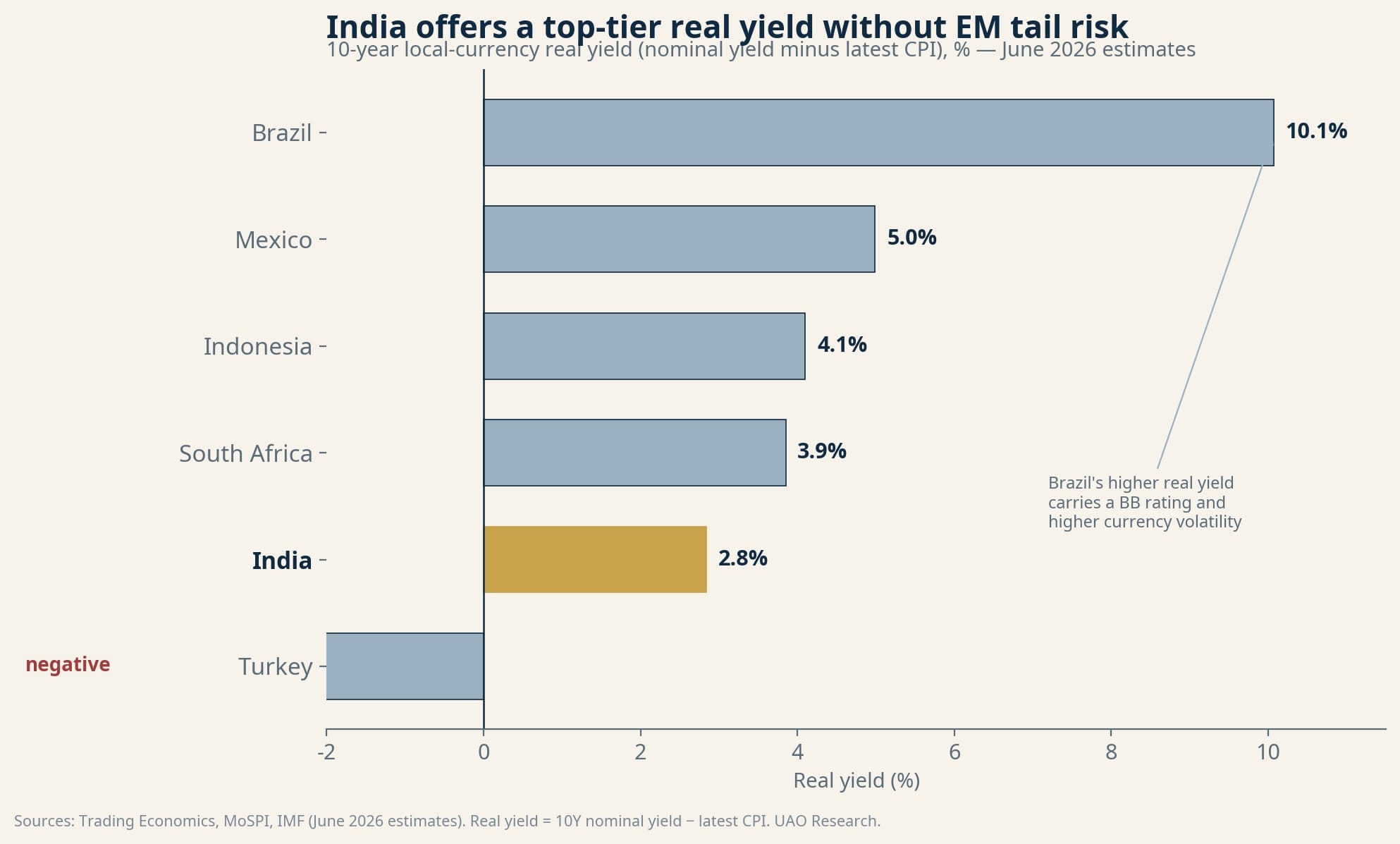
But the stronger case for universal owners is not yield alone. It is the combination of scale, diversification and policy direction. India gives long-horizon investors exposure to a sovereign curve tied to a large, domestically financed economy rather than a small open economy dependent on external capital. It offers a different inflation cycle, a different demographic base and a different policy mix from the US, Europe, China and Japan. For institutions whose liabilities stretch across decades, that matters. It also lets allocators express a more precise view on India than equities alone: Indian equities have long priced the growth story, while local-currency sovereign bonds price something different — inflation credibility, fiscal discipline, monetary-policy credibility, currency confidence and the state's ability to finance its development path at scale.
The mistake would be treating this as "free yield"
The opportunity is real, but the risk is not trivial. First, the rupee remains the central variable. The tax reforms improve post-tax returns, but they do not eliminate currency risk; the rupee hit a record low near 96.96 per dollar in May before recovering part of the move [8]. For a dollar-, euro- or sterling-based investor, the unhedged yield can disappear quickly in a currency drawdown. Second, hedging costs can consume much of the headline advantage. If US Treasury yields remain elevated — currently narrowing the spread to India's 10-year to roughly 240 bps — or if dollar-funding stress returns, the post-tax improvement may not translate into a compelling fully hedged return [10] [18]. Third, India remains exposed to imported energy shocks; it relies on foreign sources for nearly 88% of its crude consumption [17], so a renewed rise in oil prices would pressure the current account, the currency, inflation expectations and the bond market at the same time — exactly the kind of correlation universal owners must model before assuming India is a clean diversifier.
Fourth, the cap story needs precision. The overall General Route investment limits remain unchanged at 6% of outstanding central government securities and 2% of state government securities. FAR-eligible securities are different: they are specified securities open to non-resident investment without those restrictions [2]. That distinction is decisive for portfolio construction, implementation and compliance — and it is where many summaries get India wrong. Finally, index inclusion cuts both ways. It increases the probability of durable passive demand, but it can also pull returns forward. If Global Aggregate inclusion eventually arrives, the long end could richen before slower-moving owners complete their work, leaving late buyers with lower yields, more benchmark crowding and the same currency risk.
So what for owners: Treat Indian debt as a capacity-aware, currency-sensitive allocation, not free yield. The honest edge is a top-tier real yield without EM tail risk — Turkey's real yield is negative and Brazil's double-digit print carries a BB rating — paired with a closing market-access premium.
The universal-owner question
For a sovereign fund, pension plan or insurer, the relevant question is not "Should we buy Indian bonds this month?" It is larger: what role should Indian local-currency sovereign debt play in a portfolio built to survive the next decade? There are three possible answers.
The first is tactical: use India as a high-quality EM local-duration trade while the tax and index premium remain mispriced. The second is strategic: create a permanent India sovereign-debt sleeve, sized modestly at first, with clear rules around currency hedging, duration and liquidity. The third is benchmark-aware: do the work now, before global index inclusion forces a decision under less attractive entry conditions.
The third answer may be the most important. Universal owners are often punished not for being wrong on the direction of a market, but for being late to the governance work. India's bond opening is exactly the type of development that requires policy, operations, risk and investment teams to move before the benchmark does.
What to watch next
The watch list is clear. First, whether Bloomberg advances India toward Global Aggregate inclusion after its mid-2026 review. Second, whether June's FPI surge becomes a durable multi-month pattern or a one-time response to tax arbitrage. Third, whether long-end liquidity deepens as new 15-, 30- and 40-year securities enter the FAR universe. Fourth, whether hedged returns remain competitive against US Treasuries, Gulf sovereign debt and other investment-grade EM local markets. Fifth, whether the rupee stabilizes without requiring persistent central-bank intervention.
If those tests are passed, India's bond market is no longer just a local-currency EM opportunity. It becomes one of the more important sovereign-allocation questions of the next decade. That is the real story. The early capital is already moving. The slower question is whether universal owners will treat this as a trade — or as the beginning of a new allocation category.
Sources: Reserve Bank of India (RBI); Ministry of Finance; J.P. Morgan, Bloomberg Index Services and FTSE Russell index announcements; MoSPI; IMF World Economic Outlook; Trading Economics.
Editorial note: This analysis is for institutional research and editorial scenario framing. It is not investment advice. AI-assisted, editorially reviewed.