
Five stories today share one structure: a confident headline sitting on top of something the evidence does not establish. Washington says it struck launchers carrying sea mines. Ontario's pension plans report a record funding ratio. The world's largest pension reports a restructured sustainability programme. In each case the number is real, and the thing it is taken to prove is not.
Core reporting window: 30 Aug 01:32 ET → 31 Aug 01:32 ET. Live check through 31 Aug 03:40 ET / 07:40 UTC. Post-cutoff developments are labelled.
The Lead
The strike is confirmed. The mine preparations are not.
US forces struck Iran's Larak Island on Sunday — the first publicly acknowledged American attack on Iran since late July. Iranian reporting and a Revolutionary Guard acknowledgment of deaths and injuries corroborate that a strike occurred. They do not corroborate the target.
An unnamed US official said the two launchers held rockets carrying sea mines. CENTCOM separately cited an imminent threat from minelaying forces. Neither released imagery, target details, or a battle-damage assessment. By the live check, no independent source had verified the alleged mine payload or any new deployment.
The distinction matters more than it looks. Navy Captain Tim Hawkins, a CENTCOM spokesman, has confirmed that "last week, CENTCOM completed clearing sea mines from the strait's international shipping routes." Preparations to fire new mine-carrying rockets and the survival of old mines are different propositions. The public record supports the first as an allegation and establishes neither as fact. Copy that treats the strike as proof the strait was still mined is running ahead of the evidence — and this publication ran that framing in an earlier draft before correcting it.
Live update. Iran said it retaliated against two military facilities in Jordan used by US forces. Jordan reported intercepting eight missiles in its airspace, without identifying their origin or targets. Iranian state television, citing the Guards, claimed an unidentified supertanker caught fire and stopped after striking two naval mines. No vessel, maritime authority or shipowner had corroborated that claim by the live check.
Separately, UKMTO received a time-late military-authority report that an unidentified inbound tanker was struck by an unknown projectile north of Khasab, Oman, at 20:53 UTC Saturday — no casualties, no environmental impact, no attribution. It does not corroborate the later mine claim.
Live update. The UAE said it intercepted an Iranian drone over its waters with no reported damage, and denied Iran's claim of a strike on Al Minhad air base. There was no evidence Kharg oil hub was under attack: Reuters assessed the video accompanying President Trump's post as most likely synthetic, and Iran's state oil-company chief said operations had not stopped.
The operating picture is dangerous and opaque — not "open" or "closed"
A JMIC advisory current to 15:00 UTC Sunday rated the threat severe. Its independent tracking showed single-digit movements in each direction; a separate series counted 65 US-facilitated transits from 27–29 August. Reuters reported about five visible commodity-vessel transits a day over the weekend. Goldman Sachs estimated total Gulf crude-and-product exports, including alternative routes, at 15–16 million barrels a day — still 7–8 million below prewar.
These measures are not comparable. Different vessel classes, different geographies, different methodologies — and AIS-off vessels may be absent from visible counts entirely. Setting them beside one another as a single collapsing series is the error, not the reporting.
Live update. Amid Bab el-Mandeb risk and disruption at Saudi Arabia's Jazan refinery, Asia is set to ship 1.8–2.0 million tonnes of diesel to Africa in August, at least a four-and-a-half-year high, while Middle Eastern volumes fell to 600,000–800,000 tonnes, their lowest in almost nine years. Substitution lengthens voyages and raises working-capital requirements. At 04:36 UTC, Brent was $90.31, up 2.51%; WTI $85.23, up 2.19%.
What it does to three different balance sheets
Property and casualty insurers. Upward pressure on war-risk breach premiums and hull and cargo surcharges. Insurability, not price, is the constraint that actually stops cargo moving.
Sovereign wealth funds of energy exporters. Higher spot offset by restricted volume. Where domestic spending is fixed, the gap is met from liquid buffers — a chokepoint becomes a drawdown on a sovereign's most flexible assets rather than a windfall.
Defined-benefit pensions. Energy inflation sustains long-end yields, compressing fixed-income valuations while holding discount-rate floors up. Note the direction: asset-reducing and liability-reducing at once. The net depends entirely on duration matching.
Dispatches
From our correspondents on four continents — original reporting, filed overnight, every claim sourced.
What our correspondents filed this morning, in their own time zones. The desk runs these; it does not write them.
 |
Dan Agbo
Nigeria Research & Editorial Desk · Abuja
UAO Correspondent · filed 31 August, 03:28 ET
|
- FTSE Russell confirmed Nigeria returns to its Frontier Market index from 21 September, after resolving its June concern that the new T+1 settlement cycle could force foreign investors to prefund trades. The NGX All-Share rose 0.81% on the week to 241,298, ending an 11-session losing streak. TheCable
- The naira strengthened to about ₦1,337–1,341 to the dollar as external reserves reached $53.34bn. Legit
- Dangote Refinery raised ex-depot petrol prices for the third time in eight days, to ₦1,265 a litre — an 8.6% cumulative rise since 21 August — even as crude fell. Legit
- President Tinubu departed Sunday for a three-week working vacation in Europe as campaigning builds toward the January 2027 elections. Nairametrics
 |
Antoine Tigneres
Latin America Strategic Desk
UAO Correspondent · Weekly Dispatch, 21–28 August
|
- Chile and Argentina activated a dormant 1997 bilateral mining treaty at a Santiago summit, approving operating protocols reported to unlock over US$20.7bn of cross-border copper investment across the Vicuña, NexoAndino and Filo Sur projects. Rio Times
- A Pan American Energy–YPF–Pampa consortium closed Argentina's first international project financing for LNG export — US$900m for the 472-km San Matías Pipeline carrying Vaca Muerta gas to floating liquefaction, exports targeted late 2027. Buenos Aires Times
- Brazil committed roughly US$444m of public funding to sovereign AI supercomputing, split between a Rio facility built with Huawei and iFlytek and a Rio Grande do Norte machine expected to be supplied by Nvidia. EdgeUno
- Guyana's state utility is executing a GY$66bn electricity expansion — peak capacity from 318 MW in 2026 toward 1,671 MW by 2030, funded from offshore oil revenue.
Ownership & Fiduciary Affairs
GPIF published proof that its own alignment tools did not align
The Government Pension Investment Fund published its FY2025 Sustainability Investment Report this morning, 31 August — inside the window, from the primary. It is not a progress report. It is a restructuring, and GPIF says so itself.
The chapters were rebuilt around the Sustainability Investment Policy adopted in March 2025. The fund states it has moved away from a structure organised around ESG index investment as the main strategy, toward one pursuing two objectives together: reducing sustainability risk and improving market sustainability, while securing market-average returns. Chapter two is titled, without euphemism, the restructuring of ESG investment.
Two operational changes sit underneath. Climate value-at-risk and temperature-rise-potential analysis have been brought in-house, having been contracted out. And the ESG-index sleeves have been returned to ordinary policy-portfolio rebalancing, having sat outside it.
The number moved the wrong way. Reported implied temperature rise increased on both equity books — 2.6°C domestic and 2.9°C foreign, up 0.1 and 0.3 on the year. The sleeve got smaller. The portfolio got hotter.
GPIF's own site supports the direction: ESG-index passive assets stood near ¥17.8trn at end-FY2023 and near ¥12.4trn in the new report. A fall of roughly ¥5.4trn over two years is consistent in scale with Daiwa Institute of Research's July estimate that some ¥5trn left domestic ESG-index passive mandates during the FY2025 rebalance.
And one thing was removed. GPIF had previously said this report would carry an analysis built on the Taskforce on Nature-related Financial Disclosures framework. It does not. An appended note says the TNFD analysis previously scheduled for inclusion is now being considered as a separate exercise. Nature disclosure slipping out of the flagship report at the world's largest pension is a statement about the maturity of nature data.
Countercase: GPIF flags year-on-year methodology breaks itself, and implied temperature rise is model-dependent — some of the increase may be index reconstitution rather than portfolio drift. A sleeve reduced for relative-risk reasons is defensible on its own terms. None of that touches the disclosure, which is that the alignment tools did not deliver alignment.
Balance Sheet & Portfolio Health
Ontario's record 127% funding ratio came entirely from markets
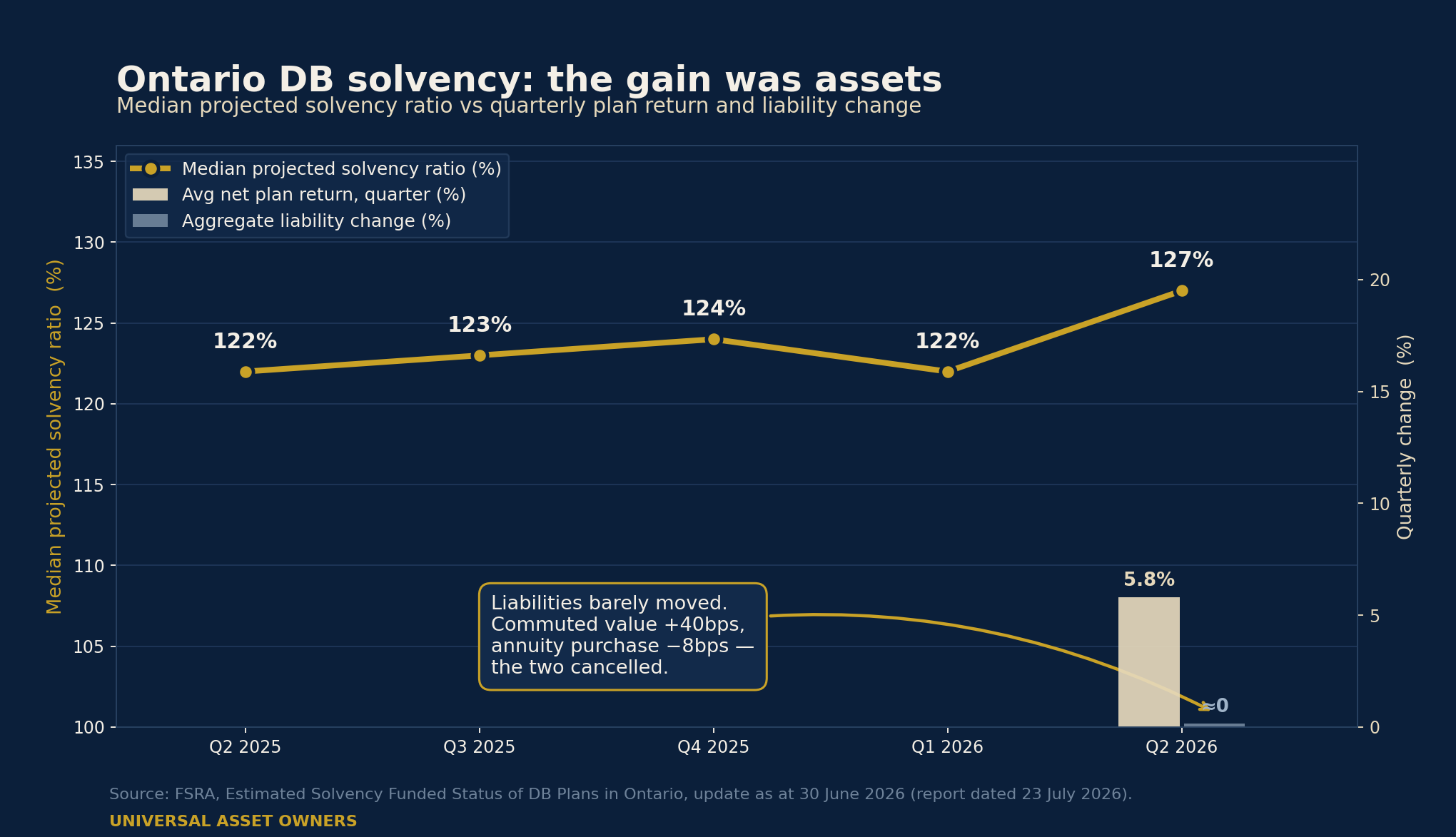
The Financial Services Regulatory Authority of Ontario reports the median projected solvency ratio of Ontario defined-benefit plans at 127% as at 30 June 2026 — up five points from 122% at 31 March, above the previous record of 124% in Q4 2025. 93% of plans are projected fully funded, up from 90%. Only 2% sit below 85%, unchanged.
The composition is the story and it is not in the coverage. Solvency discount rates moved in opposite directions and cancelled: the non-indexed commuted-value rate rose 40 basis points in the select period while the annuity purchase rate fell 8, leaving aggregate liabilities — in the regulator's own words — largely unchanged.
The entire five-point gain was assets. Plan portfolios returned an average 5.8% net in the quarter against an MSCI World total net return of 15.6% and an S&P/TSX Composite return of 7.0%. Not funding policy. Not de-risking. Not liability management. Beta.
FSRA makes the point itself, warning that strong funding levels should not diminish the importance of ongoing vigilance in an environment characterised by geopolitical tensions, evolving trade dynamics, inflationary pressures and market volatility. A record delivered wholly by markets is a record markets can withdraw.
On direction, because it is reported backwards elsewhere: a lower yield raises liabilities. Here the commuted-value rate rose, which reduces them, and the annuity rate fell, which raises them. They roughly cancelled — not because nothing happened, but because two things happened in opposite directions.
The FSRA report is dated 23 July. It runs today because its composition finding is what connects this edition. It is analysis of published data, not a new release.
Allocator Lens
What this means for the portfolio
Can we decompose this year's funding improvement into asset return, liability movement and contribution policy? If it was overwhelmingly the first, what is our pre-committed trigger for converting surplus into de-risking before the next drawdown removes it?
The window in which a surplus is large enough to fund de-risking is also the window in which it is most tempting to treat the surplus as durable.
Capital Signal
Soitec asks customers to pay for their forecasts
Soitec is negotiating multi-year capacity-reservation agreements with more than ten undisclosed photonics customers as demand rises for wafers used in AI data-centre optics. Chief executive Laurent Remont expects about 80% signed within one or two weeks. Proposed terms fix prices, require volume-linked deposits, and oblige customers to share inventory data. Buyers taking the agreed volume recover the deposit; those falling short forfeit it. Orders above the commitment reopen the price.
A disclosure conflict the company has not reconciled. The latest interview said the deposits described had not been paid. A 22 July company update said Soitec was continuing to sign reservation agreements with associated down payments. The two statements should not be combined until Soitec explains whether they concern different cohorts.
Nor do negotiations prove an acute shortage. Soitec says existing facilities and additional tools cover this year and next; a Singapore building could add capacity in six to twelve months; a new fab should not be needed before roughly 2029. The contracts may improve demand visibility while deferring expansion.
Physical Assets
Nepal's hydropower emergency exposes a rescue-access gap
Nepali authorities said 903 people had died and 4,247 remained missing after last week's Himalayan flood. The missing include 933 people associated with hydropower projects — not a count of confirmed tunnel occupants. Officials believed hundreds were inside roughly half a dozen blocked project tunnels, where mud and rock obstructed access; bad weather and renewed-flood risk repeatedly interrupted rescue work.
The investor question is whether emergency plans work when access, communications and monitoring fail together. Lenders and insurers need project-level worker, rescue, damage and coverage data. Preliminary assessments indicate an ice-rock or lower-glacier collapse may have initiated the debris flood; its cause and warming's event-specific role remain under investigation.
Industrial Transition
GM's Ontario agreements are ratified
More than 4,600 General Motors workers in Ontario have ratified three-year labour agreements. GM plans to invest about C$1.4bn in Oshawa and St Catharines over three years — but the staging matters: C$359m newly announced for a next-generation heavy-duty GMC Sierra and a transmission programme, plus C$1.034bn previously announced. The full C$1.4bn is not new capital.
CAMI's idled Ingersoll plant is protected from immediate sale or closure and has a priority allocation opportunity for Canadian military work if GM wins a contract. It has not secured a replacement vehicle. This is labour certainty plus a Canadian-capacity option under a current 25% US vehicle tariff — not a guaranteed project or a defence order.
Future Signals · The UAO Signal Ledger
Evidence strength describes the sourcing. Analytical conviction describes the implication. They are never combined.
| Signal | Status | Evidence | Conviction | What confirms or kills it |
|---|---|---|---|---|
| The alleged Hormuz mine payload | Early observable | Weak — one unnamed official; no imagery, no BDA | Low on the payload; high that the strait is dangerous | Imagery, battle-damage assessment, or a verified new mine incident |
| Most of the US data-centre power queue is phantom | Confirmed | Strong — 1,066 GW requested, ~28% served, 768 GW phantom | High | Energised MW tracking announced GW on a 12-month lag |
| AMOC tips on the rate of warming, not a threshold | Developing | Strong — Nature Climate Change; critical rate ~0.3°C/decade | Medium | A decade of flat RAPID readings at 26.5°N |
| Korea's statutory CIO pool is too thin for three seats | Developing | Moderate — KIC reopened; eligibility requires 10 years at an institution ≥₩2trn | Medium-high | Whether the applicant list is May's minus two, or genuinely new |
| Soitec's deposits | Early observable | Weak — company statements conflict, unreconciled | Medium | Signed agreements and paid cash |
Research
Coral loss is global; financial exposure is local
A new assessment estimates average hard-coral cover at 27.3% in 2020–24, down from 30.2% in its 1980–2009 reference period — a 2.9-percentage-point decline, or 9.5% on the model's underlying estimates. Cover fell to 25.8% in 2024. The report analyses 21.1 million observations from 36,886 sites across more than 120 countries and territories.
Four regions declined, four showed no net change and two increased. Hard-coral cover alone does not capture reef condition. Map tourism, fisheries, coastal protection and insurance exposures to local data — do not convert a global mean into portfolio losses.
Scenario · The Beta Surplus
Base case and escalation triggers. Built 31 August 2026, horizon 6–12 months.
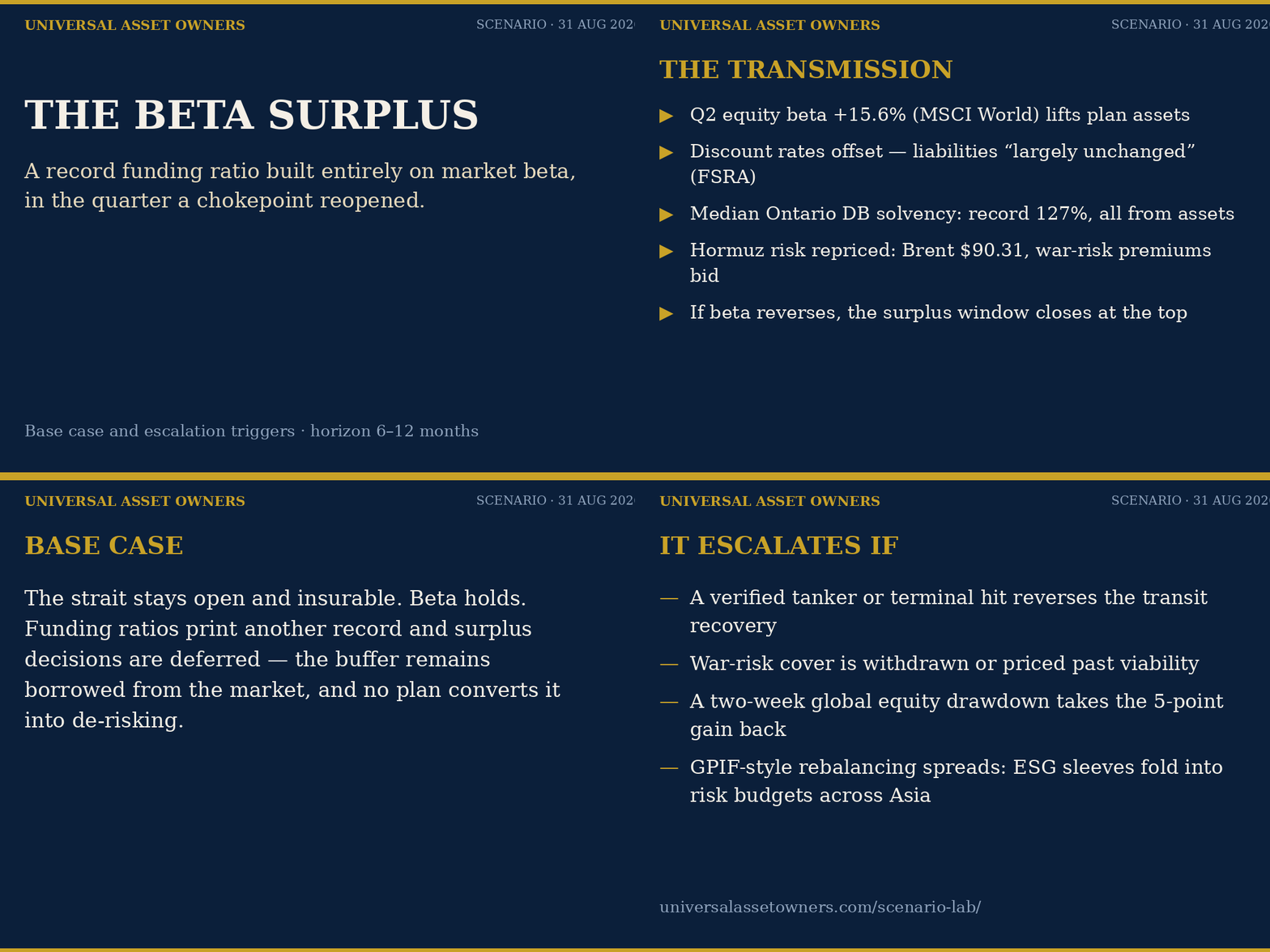
Base case: the strait stays open and insurable, beta holds, funding ratios print another record — and the surplus stays borrowed from the market, unconverted into de-risking.
It escalates if a verified tanker or terminal hit reverses the transit recovery; war-risk cover is withdrawn or priced past viability; a two-week equity drawdown takes the five-point gain back; or GPIF-style rebalancing spreads across Asian sleeves.
Explore the live Scenario Lab →
Careers, Opportunities & Must-Attend Events
Moves. John Barker leaves the Kresge Foundation — nineteen years, the last four as CIO — to become CIO of The Heinz Endowments. Kresge runs ~$4.2bn; Heinz ~$2.2bn. A Pittsburgh homecoming, not a step up in assets. Jon Gentry becomes Kresge's CIO and Emily Bertsche deputy CIO, effective 1 September subject to board approval. Maggie Millhiser is confirmed CIO of the Virginia Tech Foundation, succeeding David Greenberg.
The capability signal. NBIM is recruiting contract lawyers in two cities simultaneously. Not housekeeping — it is how a fund still building unlisted exposure actually staffs.
And the pay dispersion beneath it. Heinz advertised its CIO role at $475,000–$530,000 for a $2.2bn endowment. The City of Philadelphia Board of Pensions advertises a deputy CIO at $150,000–$170,000 for a plan exceeding $10bn — where the sitting CIO earns $229,086. A Colorado PERA deputy ($335,000–$415,000, incentive to 180%) out-earns a Philadelphia chief by roughly 46% before incentive. Mid-size US public plans are not competing for the same people, and that — not a preference for continuity — is why internal promotion keeps winning at that tier.
Deadlines inside 30 days. 31 Aug – 4 Sep Sovereign Wealth Fund Summit, Dallas (opens today) · 1 Sep Ralph Berg begins as head of Europe at Temasek; Kresge changes effective · 2 Sep NBIM closes two Senior Legal Counsel (Contracts) roles, London and Oslo · 7 Sep 18:00 KST KIC CIO applications close · 7 Sep NBIM Associate Portfolio Manager closes · 11 Sep NBIM Investment Manager, Real Estate, New York closes · 1 Oct GIC deputy group CIO promotions effective.
Watchlist
Defence, Security and Resilience Bank. Officials reported roughly €5bn of preliminary commitments toward €20bn paid-in and €80bn callable capital. The next stage is ratified constituent articles, a subscription schedule, a rating review or first financing — not the €100bn headline.
Iran sanctions. Treasury Secretary Scott Bessent said new secondary sanctions were likely weekly, beginning with banks. Track the legal instrument, target, effective date, restrictions, licences and wind-down terms — not the stated cadence.
Aon–USI — CONFIRMED, 10:31 UTC today. Aon announced the signing of a definitive agreement to acquire USI from KKR and other shareholders for a total purchase price of $17.0bn — moving this item from reported to confirmed inside the publication window, on precisely the trigger this section named: a company announcement establishing signing. USI brings roughly $3bn of annual revenue and more than 10,500 people; the firms operate independently until closing. What remains undisclosed: CDPQ is not named in the release, so any pension-seller proceeds are still unestablished — the earlier caution on seller identity stands.
Bottom Line
Every story here has a confident number attached to a weaker proposition. A strike is confirmed and its stated cause is an allegation. A funding ratio hit a record and the liabilities never moved. A sustainability programme was rebuilt and the portfolio got hotter. Capacity agreements are being negotiated and no cash has changed hands. C$1.4bn was announced and C$359m of it is new.
Long-horizon owners should price the stage of the evidence, not the confidence of the speaker.
The Back Page
The Allocator: “Largely Unchanged”
The Job Board · Open Seats
Korea Investment Corporation (~$232bn) · Closes 7 Sep, 18:00 KST |
Senior Legal Counsel — Contracts (×2) Norges Bank Investment Management — London & Oslo · Closes 2 Sep |
Norges Bank Investment Management · Closes 7 Sep |
Investment Manager — Real Estate NBIM — New York · Closes 11 Sep |
Deputy Chief Investment Officer City of Philadelphia Board of Pensions ($10bn+) · $150–170k — see the pay-dispersion note |
All open seats on the UAO job board →

Universal Asset Owners separates confirmed events, official claims, reported negotiations and analysis. Sources are linked beside material facts. Market prices are time-stamped and may have moved.