
Volume 1, Issue 20. Friday, May 29, 2026. Sent 7:00 am ET / 14:00 GST.
Meta's shareholders met on Wednesday and handed universal owners an uncomfortable result: every AI-governance proposal lost, and the world's largest fund couldn't change it. Today's Risk Radar reads three signals off that vote — the ceiling on AI stewardship, the proxy-season pattern behind it, and the way the AI build-out owners can't out-vote is now concentrating inside their bond portfolios too — with a note on why even Norway's ethics machinery sits paused.
1. Meta's shareholders showed the limit of stewardship: every AI-governance proposal lost, and the world's biggest fund couldn't move it.
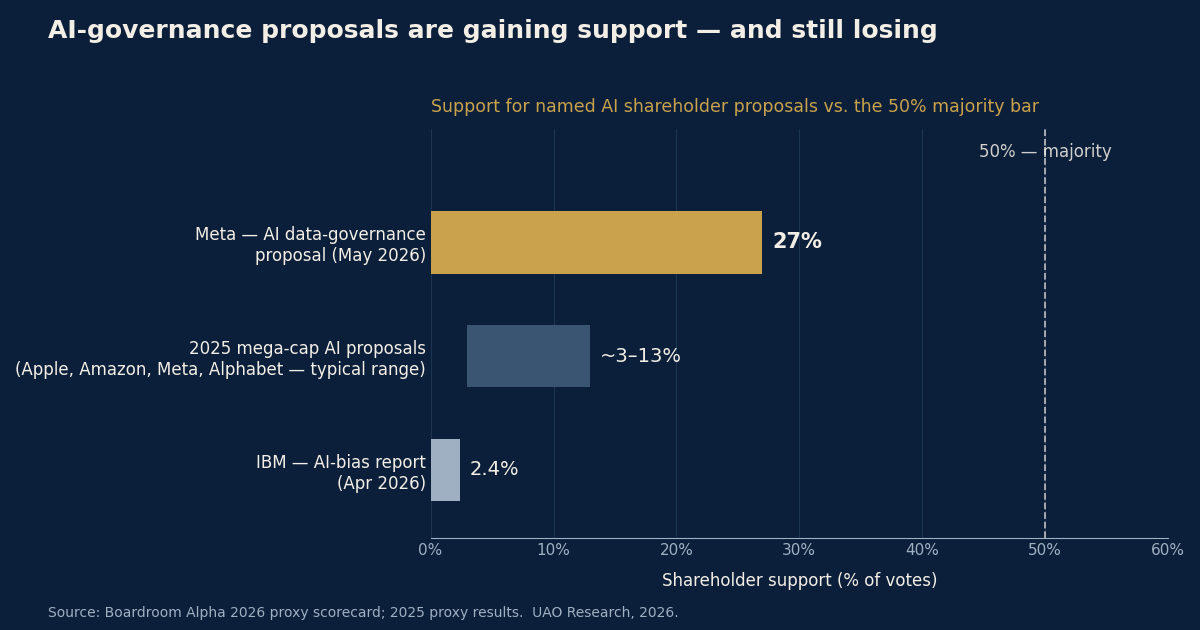
At Meta's annual general meeting on May 27, shareholders rejected all ten shareholder proposals and re-elected all twelve directors with 82%+ support. The proposal that drew the most backing — a call for a board-level data-protection impact assessment on how Meta collects user interactions with its generative-AI chatbots for advertising — topped out at roughly 27% in favour, the highest any named AI-governance proposal has ever drawn at the company, and still a clear defeat. Norges Bank Investment Management, which runs about $2.3trn, backed five of the ten proposals, including the AI-data-governance one, and withheld its vote on the re-election of director John Elkann, citing his board-meeting attendance — a rare public break with management from an owner that usually sides with boards.
The result was never in doubt. Mark Zuckerberg controls roughly 61% of Meta's votes through ten-vote Class B shares, so a diversified outside owner — even a $2.3trn one — cannot carry a proposal he opposes. That is the universal owner's bind in one vote: Meta raised its 2026 capital-expenditure guidance to $125–145bn at its Q1 results on April 29, much of it AI infrastructure that feeds the concentration and systemic risks a diversified fund cannot diversify away from, and the one governance lever shareholders have does not reach a founder-controlled board.
The open question is what stewardship means when the ballot is blocked by design. Watch whether large owners shift from voting toward escalation tools that do not require a majority — public rationales, director-attendance objections, coalition statements — and whether they say so out loud.
Source: 36Kr, May 28, 2026. · Source: The Next Web, May 2026. | Coverage: The Universal Owner Risk Radar, this week.
2. AI is now the biggest theme on mega-cap ballots — and the most reliably defeated.
Meta's vote is not an outlier; it is the high-water mark of a pattern. Boardroom Alpha's 2026 proxy scorecard counts eight AI-focused shareholder proposals across four US issuers this season. IBM's AI-bias reporting proposal failed at 2.4% support at its April 28 meeting; every named AI proposal voted in 2025 — at Apple, Amazon, Meta, Alphabet and Lyft — failed in the single digits to low teens. Meta's ~27% is the strongest showing yet, and it still lost by nearly three to one.
For a universal owner the signal is about trajectory, not any single ballot. Support for AI-governance proposals is climbing as the build-out's scale becomes legible, but it is climbing from a base so low that a majority is years away — and at the founder-controlled platforms that dominate AI capex, voting math caps it regardless. The escalation question from Item 1 is the same question here, asked across a whole season: if the ballot can't move these companies, what can.
Source: Boardroom Alpha 2026 Proxy Season Scorecard, 2026.
3. The AI capex owners can't vote down is now reshaping their bond portfolios too.
The stewardship ceiling matters more because the exposure is growing on both sides of the balance sheet. J.P. Morgan estimates that AI-linked companies will account for about 14% of its US investment-grade bond index in 2026 — overtaking banks as the single largest sector — on the back of more than $300bn of projected AI and data-centre debt issuance this year, led by the five hyperscalers. Mercer's 2026 guidance for UK defined-benefit schemes flags the implication directly: AI exposure has moved from an equity-concentration question into fixed income, and trustees now have to size it at the total-portfolio level, not just in their equity sleeve.
What this looks like from the allocator's seat is a single, undiversifiable bet wearing two costumes. The same names a fund holds in its equity index — and cannot govern through the ballot — are becoming its largest corporate-credit exposures as they borrow to build. Concentration that used to be an equity-desk problem is now a whole-portfolio governance problem. (Standing 2026 analysis from J.P. Morgan and Mercer; included as context, not as new this week.)
Source: J.P. Morgan Asset Management, 2026. · Source: Mercer, 2026.
4. Background — even the most principled owner has had its ethics machinery paused.
For context on how constrained stewardship has become: Norway's parliament suspended the $2.3trn fund's ethical-divestment process in late 2025, after US pressure over the fund's exclusion of Caterpillar. Since then, Council on Ethics recommendations have been routed to NBIM with no divestments made, and a framework review is due by October 15, 2026. The finance minister said on May 12 that the fund faces a genuine dilemma over how transparent future exclusions should be. The same fund that broke with Meta's board this week has, at home, had its sharpest stewardship tool put on hold. (Dated background, not a development this week.)
Source: Reuters via KFGO, May 12, 2026.
— Chart of the day —
Support for named AI-governance proposals is climbing — but it has never come close to a majority.
Source: Boardroom Alpha 2026 proxy scorecard; 2025 proxy results. UAO Research, 2026.
— Take of the day —
"Meta's AGM is the cleanest statement yet of the universal owner's paradox: you are big enough to own the AI build-out and its systemic risks, and too small — at a founder-controlled company — to govern them through the ballot. The 27% is not a failure of conviction; it is a structural ceiling. The next move for serious owners is not a louder vote, it is a different lever."
— UAO Research.
— Three links worth your time —
- Columbia Law Review / NBER — Index Funds and the Future of Corporate Governance (Bebchuk & Hirst). The agency-cost case for why even very large diversified owners systematically under-invest in stewardship — the academic backbone of today's deep-dive.
- Boardroom Alpha — 2026 Proxy Season Scorecard. The running tally of AI, say-on-pay and anti-ESG votes — the cleanest single view of where this season is landing.
- Reuters via KFGO — Norway's dilemma on divestment transparency. How geopolitics is quietly reshaping the world's most-watched responsible-investment framework.
*The UAO Daily Brief is produced by Universal Asset Owners. AI-assisted monitoring and drafting; reviewed and edited by the UAO editorial desk befor
Continue the briefing. Read the daily brief · watch the daily video briefing · listen to The Universal Owner · view the chart of the day.
Produced and edited by the UAO editorial desk. Not investment advice.