
Volume 1, Issue 19. Thursday, May 28, 2026. Sent 7:00 am ET / 14:00 GST.
The world's third-largest pension fund is voting today on whether to formally pull more capital home. The decision in Seoul sits inside a wider pattern: Jakarta's sovereign fund has quietly steered nearly a third of its committed capital into digital infrastructure; and New York City has just stretched out the timetable for paying off its public pensions, at a $5bn long-run cost. Three threads, one question for a universal owner: where is the patient capital actually pointing right now.
1. Korea's $1.2trn pension fund is about to vote on pulling more capital home.
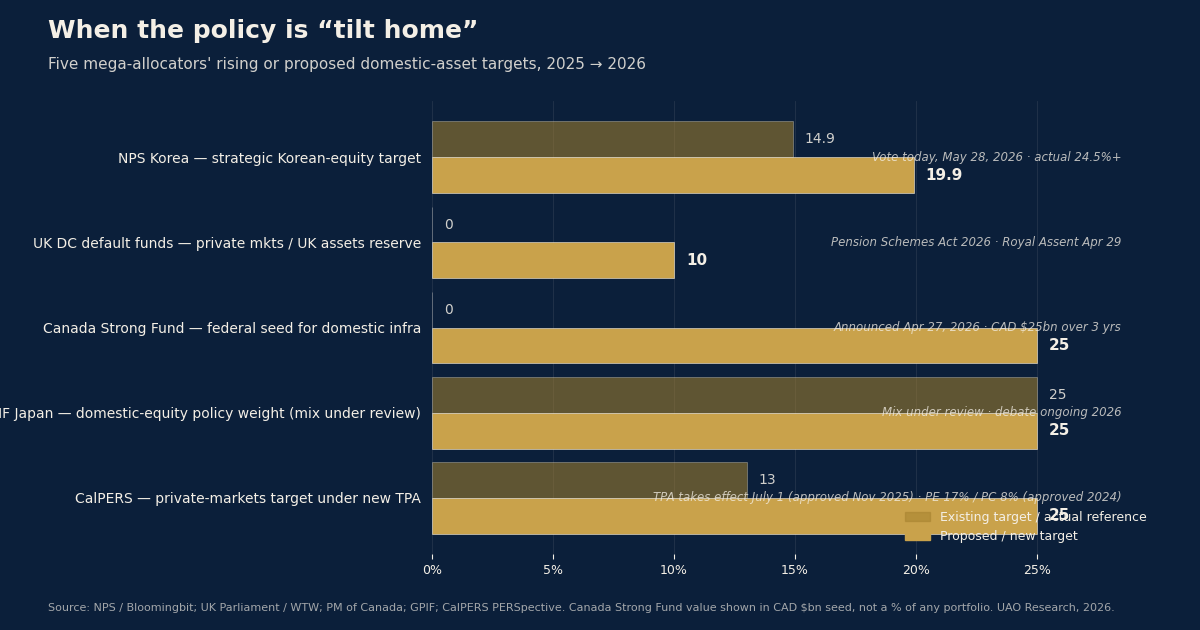
South Korea's National Pension Service Fund Management Committee meets this afternoon Seoul time to deliberate and approve the 2027–2031 medium-term asset allocation plan. The committee has formed a broad consensus to raise the strategic target for domestic equities after this year's KOSPI rally drove the actual share above 24.5% at end-February — well past the 14.9% 2026 strategic target and the 19.9% prior upper bound. NPS managed roughly KRW 1,360trn (about $1.0–1.2trn), ranking it behind only Japan's GPIF and Norway's Government Pension Fund Global among public pensions.
For a universal owner, the size of the swing matters more than the direction. Even a one-percentage-point lift in the strategic Korean-equity target redeploys roughly $10–12bn of long-horizon capital — into a market whose free float and liquidity are a fraction of US large caps. The committee's own debate, reported through the week, has split between members who want to ratify the post-rally weighting and members who worry the move locks in a top in domestic equities. Either way, today's vote crystallises a pattern visible across mega-allocators: when policy targets are reset, they are being reset toward home.
The read-across to peers is the part that matters for capital flows. GPIF Japan is publicly debating its next five-year mix amid a JGB repricing; the UK's Pension Schemes Act 2026 hardwires a 10%-private-markets, 5%-UK-assets reserve target for DC default funds; Canada has launched a $25bn sovereign vehicle explicitly to attract co-investment into domestic projects. Korea voting "more domestic" today would be the fourth simultaneous home-tilt at the policy level inside one calendar year.
Source: Bloomingbit, May 27, 2026. · UPI, May 24, 2026. · KED Global, May 18, 2026. | Coverage: Capital Flow Watch, this week.
2. Indonesia's young sovereign wealth fund has quietly committed nearly a third of its capital to digital infrastructure.
Bloomberg disclosed on May 26 that the Indonesia Investment Authority (INA) and its co-investors have deployed roughly IDR 74.5trn (about $4.2bn) to date, with around 30% — close to $1.3bn — directed at digital infrastructure. INA, which manages assets above $8bn, has taken a stake in DayOne Data Centres (the GDS Holdings spinoff) and committed alongside Singapore-based Granite Asia to a $1.2bn+ programme backing an AI/tech ecosystem and a hyperscale campus in Batam.
What this looks like from the allocator's seat is the new shape of EM sovereign capital. INA is five years old and runs less than a percent of what ADIA holds, but its template — a sovereign wealth fund that uses co-investment to put public capital alongside private and foreign capital in domestic AI infrastructure — is the same one Riyadh, Abu Dhabi and now Ottawa are running, at different scales. The capital flow it implies is direct: a meaningful share of the AI build-out's equity is going to be funded by patient sovereign pools that did not exist a decade ago.
Source: Bloomberg via The Edge Malaysia, May 26, 2026. · Primary: INA, 2026.
3. New York City just told its pension funds to slow down — and shifted $5bn of cost onto the next generation.
Mayor Zohran Mamdani's plan, with its long-run cost confirmed via a city-actuary analysis on May 27, would stretch out the timetable for paying off the unfunded liabilities of New York City's five pension systems, freeing cash in the near term to close a budget gap. The trade-off, per Bloomberg's reporting on the same day, is a roughly $5bn long-run cost increase to taxpayers. The city's pensions manage close to $300bn between them, so the change is small as a share of assets but precedent-setting at the policy layer.
The signal a universal owner reads off this is governance. A funding schedule is the financial promise behind a defined-benefit plan; lengthening it is a quiet repricing of intergenerational risk in exchange for short-term fiscal flexibility. Watch whether other large US cities — several of which run on similar amortisation tables — follow.
Source: Bloomberg, May 27, 2026.
4. Background — CPP Investments has put a number on the alternative-credit pivot.
Reported in CPP Investments' fiscal 2026 results released May 20, 2026, Canada's $793.3bn pension committed over C$3bn into alternative credit during the year to end-March, including a C$1.5bn separately managed account with Blackstone designed to invest globally across private corporate credit, asset-based and real-estate credit, structured products and liquid credit. The fund returned 7.8% for the fiscal year. Dated as background, not framed as new — included because it sizes the same private-credit demand the Financial Stability Board flagged on May 6.
Source: CPP Investments, May 20, 2026.
— Chart of the day —
When the policy is "tilt home" — five mega-allocators' rising or proposed domestic-asset targets, 2025 → 2026.
Source: NPS / Bloomingbit; UK Parliament / WTW; PM of Canada; GPIF; CalPERS PERSpective. UAO Research, 2026.
— Take of the day —
"The simultaneous policy-level tilt-home by Korea, the UK, Canada and Japan does not mean the world's biggest pools are de-globalising — they still hold most of their assets abroad. It means the marginal long-horizon dollar is being re-priced for political legibility, not for return. For a true universal owner, that is a coordinated narrowing of patient cross-border capital exactly when the global build-out — AI, grid, transition — needs more of it, not less."
— UAO Research.
— Three links worth your time —
- Bloomberg — Indonesia Sovereign Wealth Fund Joins Data Center Boom. Bloomberg's May 26 read on how a $8bn sovereign fund is buying its way into the AI build-out.
- Thinking Ahead Institute (WTW) — Total Portfolio Approach hub. The primary-research backdrop for why mega-allocators are dissolving asset-class silos at the same time they reset domestic targets.
- IIF — Capital Flows to Emerging Market Economies. The macro counter-current: official flows lift EMs to a projected $935bn in 2026 even as private allocations stay light.
UAO Daily Brief is a publication of UniversalAssetOwners.com. Editorial: UAO Editorial. Research: UAO Research. To stop receiving the Brief, manage preferences at universalassetowners.com.
Continue the briefing. Read the daily brief · watch the daily video briefing · listen to The Universal Owner · view the chart of the day.
Produced and edited by the UAO editorial desk. Not investment advice.