Chart of the Day
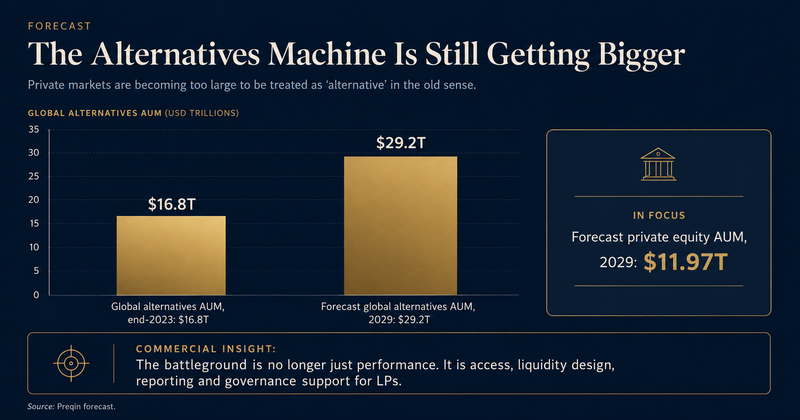
The Alternatives Machine Is Still Getting Bigger
Private markets are becoming too large to be treated as "alternative" in the old sense.
Private markets are becoming too large to be treated as "alternative" in the old sense.

A six-to-eight minute extended brief. Norway's $2.1T fund admits its real-estate strategy underperformed and pivots toward sectors AI is reshaping; PIF anchors a State Street Saudi equity ETF; Ontario Teachers halves its US-dollar exposure; FSB flags private-credit transparency; and 2026 h
An afternoon follow-on to the morning brief — Bank of America's ~$20B private-credit disclosure, the Fed Vice Chair's May 8 speech on corporate-lending migration, and the European / semi-liquid rotation.
The FSB's private-credit warning, Bank of America's $20B disclosure, and the European / semi-liquid rotation — through the eyes of universal asset owners. A daily, fully-AI-hosted institutional briefing for sovereign wealth funds, pensions, endowments and large family offices.

Private credit hits its first real liquidity test as redemption gates close at Blue Owl and Blackstone funds — yet CalPERS, APG and Nest keep buying. CalPERS retires strategic asset allocation for a total portfolio approach on July 1, and Mubadala buys into the world’s largest offshore win

Foreign governments were net sellers of US securities in March while private investors bought $162bn — the clearest sign yet that the marginal buyer of Treasuries is no longer official money. Plus: China’s holdings hit a 17-year low, and central banks bought 244 tonnes of gold.

Reserve diversification, friend-shoring and a more fragmented order. The new map a universal owner has to allocate across.

If you own the whole market, you cannot sell your way out of a bad system. Can universal owners actually shape what they own?

Inflation-linked, long-duration, and increasingly data-driven. Why asset owners are reclassifying infrastructure as a core holding.

Aging populations are a slow, certain force the universal owner cannot diversify away. What it does to liabilities, duration and returns.

The transition is a multi-trillion-dollar capital-formation problem. For universal owners it is an allocation question, not a slogan.

Record dry powder, a backed-up distribution cycle, and the denominator effect. Private markets meet the liquidity question.